
The usual advice about backup specialties is dangerously vague. “Apply broadly” is not a strategy. It is a way to burn money and still go unmatched.
If you want a real safety net, you need a calculator. You need to translate your risk tolerance, competitiveness, and specialty choice into a specific number: how many programs to apply to in your backup specialty.
Below I will walk through a numbers-based framework that mirrors how I actually build application plans for residents and MS4s: probabilities, breakpoints, and diminishing returns. Not vibes.
1. The Core Equation: What You Are Really Solving For
Strip away the emotions and it boils down to one question:
“How many total interviews (primary + backup) do I need to reach a 95–99% chance of matching somewhere I can live with?”
The NRMP data is brutally consistent:
- For U.S. MD seniors:
- ~8 contiguous ranks in a specialty ≈ ~95%+ chance of matching in that specialty
- ~12+ ranks ≈ flattens; gains above this are smaller, but still meaningful in very competitive fields
- For U.S. DO seniors:
- Often need ~1–2 more contiguous ranks than MDs for the same odds in competitive specialties
- For IMGs:
- The curve shifts right: 12–15+ ranked programs to approach similar match probabilities, depending on specialty
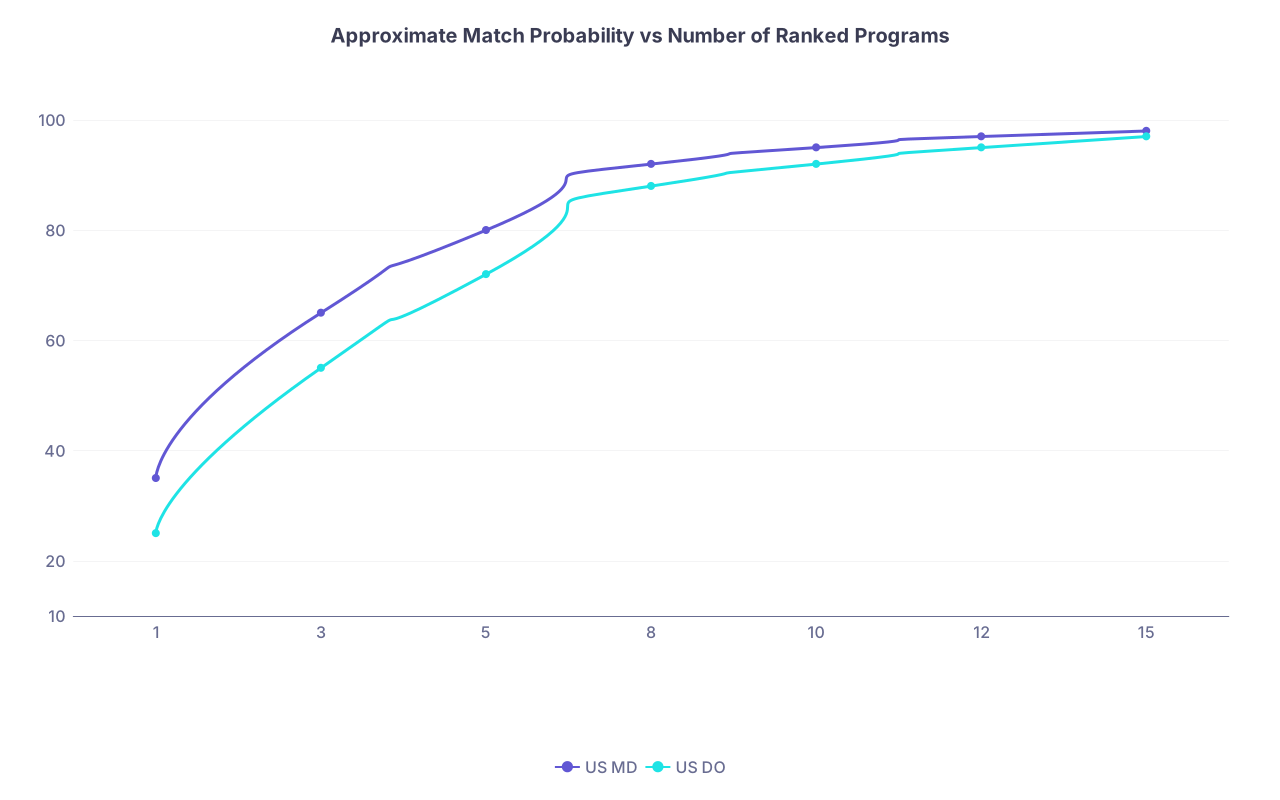
| Category | US MD | US DO |
|---|---|---|
| 1 | 35 | 25 |
| 3 | 65 | 55 |
| 5 | 80 | 72 |
| 8 | 92 | 88 |
| 10 | 95 | 92 |
| 12 | 97 | 95 |
| 15 | 98 | 97 |
The data shows this consistently across cycles.
So your real problem is:
- How many interviews do you expect in your primary specialty?
- How far does that get you on the probability curve?
- How many backup interviews do you need to push your total match probability into your target zone (typically 95–99%)?
Once you see it that way, “How many programs per backup specialty?” becomes a quantifiable optimization problem, not a guessing game.
2. Stepwise Calculator Logic (Without Needing a Spreadsheet)
You will eventually want this in a spreadsheet (and you should put it there). But you can get most of the way there with a structured mental model.
Step 1: Classify yourself and your primary specialty
You need three labels:
Applicant type:
- US MD senior
- US DO senior
- US citizen IMG
- Non-US IMG
Primary specialty competitiveness (roughly):
- Low: family medicine, psych (in many regions), peds in some markets, community IM
- Moderate: categorical IM in competitive regions, neurology, EM (variable by year), OB/GYN
- High: anesthesia, radiology, ortho, derm, ENT, plastics, gas in tight markets, etc.
Your competitiveness within that specialty:
- Above average
- Average
- Below average / red flags (low score, fail, leaves, professionalism issues)
Already, the NRMP Charting Outcomes curves should be in your head: high-competitiveness + below-average applicant = plan for serious backup volume.
Step 2: Estimate expected interview count in primary specialty
You do not guess here. You anchor in historical data and people like you:
- Ask recent grads from your school with similar stats in that specialty:
- Step/COMLEX ranges
- Research output
- Class rank
- Red flags
You want a realistic number like: “I am probably looking at 4–6 interviews in primary if I apply aggressively,” not “I hope for 12.”
For a quick-and-dirty estimate:
- Competitive specialty + “average” applicant + 60–80 programs → maybe 6–10 interviews
- Very competitive + “below average” applicant + 80–100 programs → maybe 2–5 interviews
- Less competitive + solid applicant + 30–40 programs → 10–15+ interviews
You then lock in an expected primary interview range, Example:
“Primary: radiology, US MD, average stats, applying to 70 programs → I should plan on 5–7 interviews.”
We will use the low end of that range for safety.
Step 3: Decide your target total interview / rank count
Based on NRMP curves, I use these rough targets:
For US MD:
- Low-competition primary:
- 8–10 interviews total → usually enough for 95–99%+ match odds
- Moderate competition:
- 10–12 total interviews
- High competition primary:
- 12–15 total interviews
For DO/IMG, add 2–5 interviews to these targets, depending on specialty competitiveness.
This is not perfect, but the data shows these thresholds correlate strongly with high match probabilities.
So suppose you are:
- US MD senior
- Primary: anesthesia (moderately competitive)
- You want ≥ 97–99% chance of matching somewhere (primary or backup)
I would set your target at 12–14 total interviews between primary + backup.
Step 4: Compute your “interview deficit”
This is simple subtraction.
- Target total interviews (T)
- Expected primary interviews, low end (P_low)
Interview deficit D = T – P_low
Example:
- Target T = 12
- Expected primary P_low = 5
- D = 7 additional interviews needed
These 7 interviews have to come from your backup specialty (or mix of backups).
Step 5: Convert “needed interviews” into “programs to apply to”
This is the messy part. Because interview yield per application varies wildly by:
- Specialty competitiveness
- How well-aligned your application is to the backup
- Geographic filters
- DO/IMG status
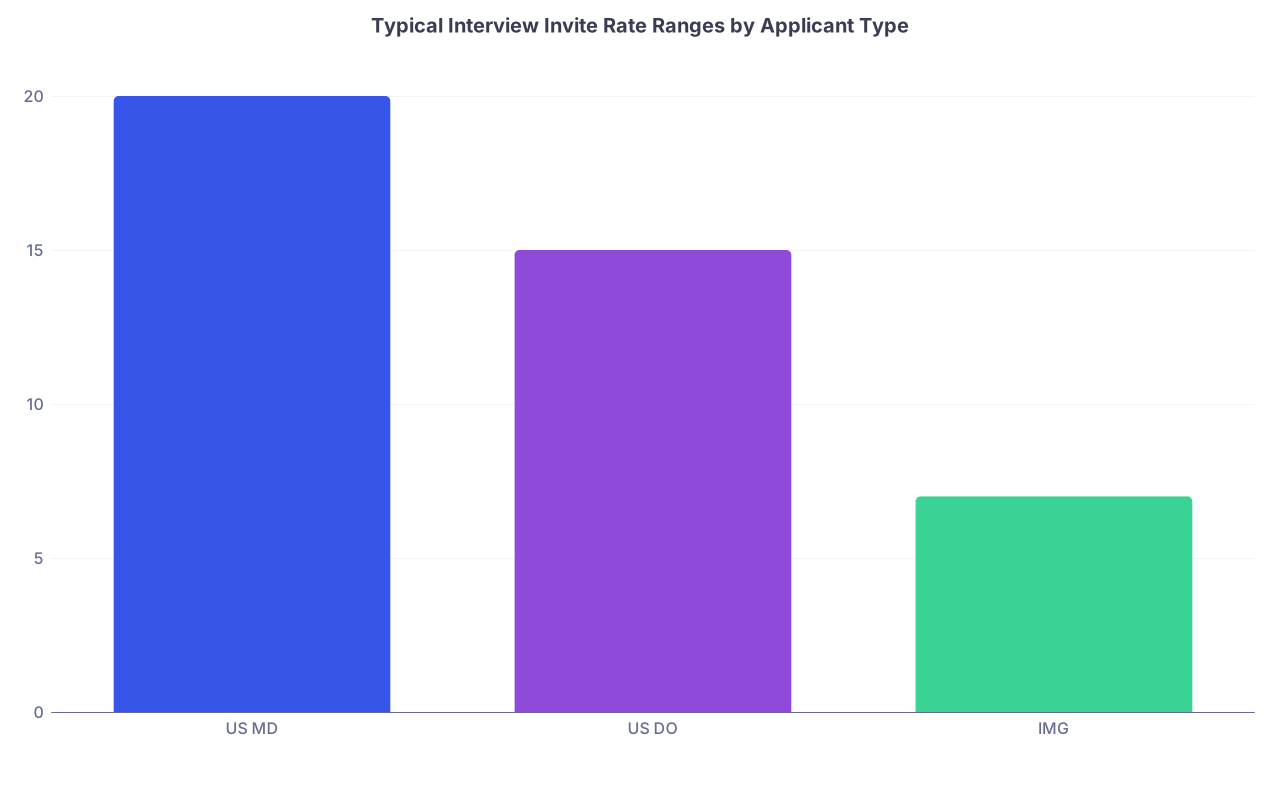
But we can use typical yield ranges:
For a reasonably aligned backup specialty (e.g., IM as backup for cards-gunner, or FM as backup for EM):
- US MD:
- 10–15% invite rate in crowded markets
- 20–30% invite rate in more forgiving fields/regions
- US DO:
- Often 5–15% in competitive regions, 15–25% in others
- IMG:
- Frequently 2–8% unless very targeted
| Category | Value |
|---|---|
| US MD | 20 |
| US DO | 15 |
| IMG | 7 |
Those values are midpoints (20%, 15%, 7%). Realistic enough for planning.
Now translate D (needed interviews) into number of backup programs N:
N ≈ D / (expected invite rate)
Example, US MD, backing up anesthesia with internal medicine:
- Need D = 7 interviews
- Expect ~20% invite rate in IM if you apply reasonably widely
- N ≈ 7 / 0.20 = 35 programs
But you do not trust one number. You bracket:
- If invite rate 15% → 7 / 0.15 ≈ 47
- If invite rate 25% → 7 / 0.25 = 28
So your “safe range” for IM backup might be 30–50 programs, with a realistic target around 40.
3. Typical Backup Volumes by Scenario (Concrete Examples)
Now let me make this real with some archetypes.
Scenario A: Competitive primary, US MD, no red flags
- Applicant: US MD, 240s Step 2, good evaluations
- Primary: Radiology
- Backup: Internal Medicine (categorical)
- Expected radiology interviews: 6–8 (using 7 as mid, 6 as low)
You want 97–99%+ chance of matching. Target T = 12–14 total interviews. Use T_low = 12.
- P_low = 6
- D = 12 – 6 = 6 additional interviews needed
IM invite rate for this applicant: likely 25–35% if they apply widely, maybe higher at mid-tier programs. Use 25% as conservative.
- N ≈ 6 / 0.25 = 24 programs
- At 20% → 6 / 0.20 = 30
- At 30% → 6 / 0.30 = 20
Realistic recommendation: Apply to 25–35 IM programs as backup.
This is much lower than the “apply to 80 IM programs just in case” nonsense that some advisors throw around. Data does not support that volume for this profile.
Scenario B: Borderline for primary, US MD, high-competition specialty
- Applicant: US MD, Step 2 = 228, no fails but below average, weak research
- Primary: Anesthesia
- Backup: Internal Medicine
- Primary interview expectation: 2–4 (use 2 as low)
You want high overall safety: T = 12–14 total interviews. Use 13 as your planning target.
- P_low = 2
- D = 13 – 2 = 11 needed backup interviews
Your IM invite rate is probably not stellar—maybe 15–20%. Use 15% to be safe.
- N ≈ 11 / 0.15 ≈ 73
- At 12% → 11 / 0.12 ≈ 92
- At 20% → 11 / 0.20 = 55
So I would tell this person: 60–80 IM programs is a rational backup volume. Not overkill. Grounded in needing 11 interviews to bring your total match probability into the high-90% range.
You can see how the primary weakness directly explodes your needed backup volume.
Scenario C: DO applicant, moderate competition primary, FM backup
- Applicant: US DO, solid clinicals, COMLEX only, no fails
- Primary: Emergency Medicine (variable competitiveness)
- Backup: Family Medicine
- Expected EM interviews: 4–6 (use 4 as low)
Target: DO applicant, wants robust safety → I would use T = 13–15 total interviews.
Use T_low = 13.
- P_low = 4
- D = 13 – 4 = 9 backup interviews needed
FM invite rates for a reasonably solid DO can be high: 30–40% or even higher if targeted. Use 30% to be conservative.
- N ≈ 9 / 0.30 = 30 programs
- At 25% → 9 / 0.25 = 36
- At 40% → 9 / 0.40 = 23
Rational range: 25–35 FM programs.
FM is often used as the “just apply to 80 programs” dumping ground. Data does not support this for a solid DO in most markets. You hit diminishing returns fast after 30–40 applications.
Scenario D: IMG with IM primary, FM backup
- Applicant: Non-US IMG, Step 2 = 235, 1 attempt on Step 1, good US letters
- Primary: Internal Medicine categorical
- Backup: Family Medicine
Expected IM interviews if applying very widely (150–200 programs): 4–6. Use 4 as low.
Target T: For IMGs, I push for 15–18 total interviews if they can afford it. Use 16.
- P_low = 4
- D = 16 – 4 = 12 backup interviews needed
FM invite rate for this IMG: maybe 7–12%. Use 8% to be safe.
- N ≈ 12 / 0.08 = 150 programs
- At 6% → 12 / 0.06 = 200
- At 10% → 12 / 0.10 = 120
Here the data tells a different story: 120–180 FM programs is not crazy. For this profile, very large backup volumes are mathematically rational.
This is why “how many programs per backup specialty” cannot be answered generically. For an IMG, the orders of magnitude are just different.
4. Multi-Backup Strategy: Splitting Across 2 Specialties
Sometimes you are not choosing “one backup specialty,” but “two partial backups.”
Example: Ortho primary, with both general surgery and preliminary surgery as backups. Or EM primary with IM and FM as dual backups.
You still use the same core equation:
- Decide total target interviews T
- Estimate primary interviews P_low
- Compute deficit D = T – P_low
- Split D across Backup 1 and Backup 2 based on:
- Your interest
- Your chances in each (invite rate)
- Geographic tolerance
A simple proportional split approach works:
Let:
- D1 = number of interviews you want from Backup 1
- D2 = number from Backup 2
- D1 + D2 = D
- E1 = expected invite rate Backup 1
- E2 = expected invite rate Backup 2
Then:
- N1 ≈ D1 / E1
- N2 ≈ D2 / E2
If you like both backups equally, weighted by yield is efficient: push more volume where your invite rate is higher.
5. Cost vs Benefit: Where Diminishing Returns Kick In
Application costs are not trivial. You must know when more programs barely move your match probability.
Think about adding 10 more backup applications.
If your invite rate is 20%, that is expected 2 additional interviews if not already saturated. But match probability increases are not linear forever.
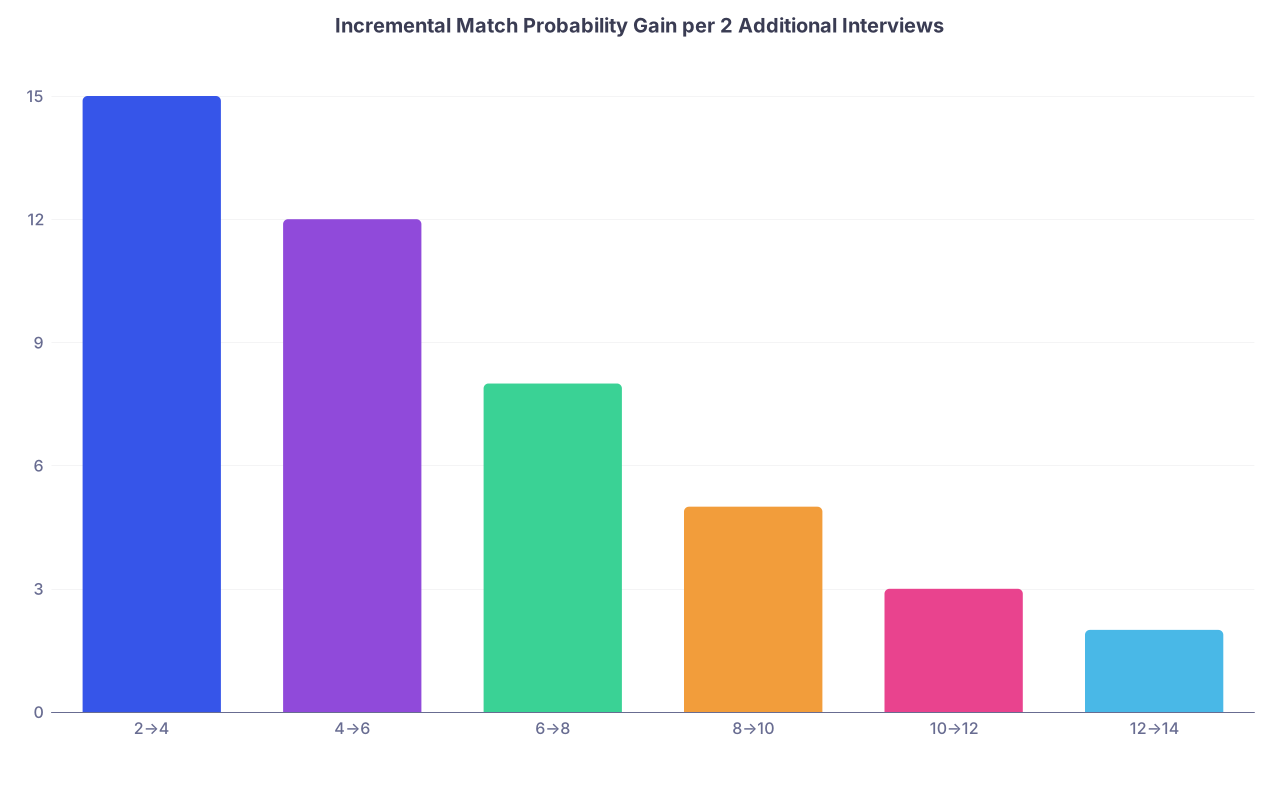
The NRMP probability curve flattens after a certain number of ranks:
- Going from 2 → 6 interviews usually adds a huge jump in match odds
- Going from 10 → 12 interviews? Smaller benefit
- Going from 15 → 17? Often marginal—maybe +1–2% absolute
| Category | Value |
|---|---|
| 2→4 | 15 |
| 4→6 | 12 |
| 6→8 | 8 |
| 8→10 | 5 |
| 10→12 | 3 |
| 12→14 | 2 |
If you are past ~12–14 total interviews and your backup specialty is reasonably matchable, applying to another 40 programs for the chance of 1 extra interview is often not a rational use of money.
Key rule:
- If your expected total interviews (primary + backup) is:
- < 6 → you are in the danger zone; more backup volume is high-yield
- 6–10 → moderate risk; more backup may make sense
- 10–14 → usually adequate; additional apps are often low-yield insurance
14 → strongly diminishing returns for most US MD/DO applicants
6. Example “Quick-Reference” Ranges
These are not one-size-fits-all, but they approximate data-based ranges if you:
- Target ≥ 95–99% overall match probability
- Have reasonably aligned backup specialties
| Scenario | Backup Programs |
|---|---|
| US MD, strong, competitive primary | 20–35 |
| US MD, average, competitive primary | 35–60 |
| US MD, below avg, competitive primary | 60–80 |
| US DO, moderate primary, FM backup | 25–40 |
| US DO, competitive primary, IM backup | 40–70 |
| IMG, IM primary, FM backup | 120–180 |
Use these as sanity checks against your own calculator outputs.
7. Operationalizing This: A Simple Planning Flow
You want a process, not a one-off guess.

| Step | Description |
|---|---|
| Step 1 | Classify applicant and specialties |
| Step 2 | Estimate primary interviews |
| Step 3 | Set target total interviews |
| Step 4 | Compute interview deficit |
| Step 5 | Estimate invite rate in backup |
| Step 6 | Calculate programs needed |
| Step 7 | Check cost and adjust ranges |
Do this once on paper or a spreadsheet, then refine when you get early interview feedback.
8. Key Nuances People Ignore (And Regret Later)
A few reality checks from watching this play out:
Early interview signal matters.
If you have 0–1 invites by late October in a competitive primary, you should immediately inflate backup volume if deadlines permit. Your assumed invite rate was too optimistic.Your backup must be rankable for you.
A “backup” specialty that you would never actually rank above SOAP or a second scramble is not a backup. It is self-deception.Geography can quietly destroy your yield.
If you restrict your backup to “only big coastal cities,” your invite rate might be half of what the calculator assumes. Adjust E (invite rate) down and increase N (programs) or widen geography.Dual applications inside related fields need care.
IM + prelim + transitional year combos have different match dynamics than full categorical backups. Do not count a bunch of prelim interviews as equivalent to categorical backup interviews in your probability calculus.
9. Visual: How Primary and Backup Add Together
Here is the mental picture you should hold.

You are not trying to “rescue” a failed primary. You are assembling a combined stack of opportunities that reaches the probability threshold you are comfortable with.
10. Putting Numbers Before Fear
You can always choose to buy more peace of mind with more applications. But do it knowingly.
If your calculator says:
- “Base case: 35 IM programs as backup gives me expected 8–10 total interviews, ~95%+ chance”
- and you choose to send 60 apps instead because the anxiety is killing you,
fine. That is a conscious decision to buy extra insurance. The problem is when you are sending 90 extra applications and only picking up a 1–2% absolute increase in match odds because you are already in the high-interview zone.

Let the data show you where the real risks are, and where the fear is lying to you.
FAQ (Exactly 4 Questions)
1. Is there a simple “X programs per backup specialty” rule I can follow?
No, and anyone who gives you one is guessing. The required number depends on your expected primary interviews, your target total interviews, and your realistic invite rate in the backup field. For a strong US MD with a moderate-risk primary, 25–35 backup programs may be plenty. For an IMG with low invite rates, 120+ backup programs can be rational. You need to compute your own numbers.
2. How do I estimate my invite rate in a backup specialty?
Use historical comparisons. Ask recent grads with similar stats what proportion of programs invited them in that specialty. Look at your Step/COMLEX scores, school type, research, and any red flags. Then assume a slightly worse rate than their experience to be conservative. For US MDs with aligned backups, 15–30% is common. For IMGs, 3–10% is often more realistic.
3. When should I increase my backup applications during the season?
If by late October you have far fewer primary interviews than your “low-end” assumption (e.g., you planned for 6 and have 1–2), revise the calculator. Your true invite rate is lower. Recompute the interview deficit and expand backup applications if deadlines are still open. The worst mistake is to cling to optimistic early estimates when real data (your actual invites) is telling you otherwise.
4. Do prelim and transitional year interviews count the same as categorical backup interviews?
Not really. Prelim/TY spots can keep you in the system, but they do not guarantee a future categorical spot, and they often require a second round of applications. When calculating your total interviews for match probability, treat prelim/TY as separate from categorical backup interviews. You can assign them some partial “safety value,” but they should not fully substitute for interviews in a true rankable backup specialty.
Two things matter here: your target total interview count and your realistic invite rate in each specialty. Once you quantify those, the “how many programs per backup specialty?” question stops being a guess and becomes simple division.