27% of dual-applicants fail to match into either specialty in some of the most recent NRMP datasets.
Read that again. More than a quarter of people who try to “play it safe” with two specialties end up matching to nothing. So the idea that adding a second specialty automatically increases your chance of matching is provably wrong.
Let’s walk through what the data actually show when you split your application across two specialties—and how to structure a two-specialty plan that does statistically improve your odds instead of quietly destroying them.
1. What the Data Say About Dual-Applications
The NRMP does not publish a glossy “dual-application” brochure, but the numbers are scattered across:
- Charting Outcomes in the Match (US MD, DO, IMGs)
- Program Director Surveys
- Main Match reports (fill rates, unfilled positions)
- Specialty competitiveness trends (Step, research, AOA, etc.)
You have to stitch them together. Once you do, a pattern shows up fast.
Here is a simplified composite using realistic but rounded figures from recent cycles for US MD seniors:
| Strategy | Overall Match Rate | Matched in Preferred Specialty | Unmatched |
|---|---|---|---|
| Single: Competitive only (e.g. Derm) | ~78% | ~78% | ~22% |
| Single: Mid-tier (e.g. IM) | ~96% | ~96% | ~4% |
| Dual: Competitive + Weak Backup | ~80–83% | ~63–68% | ~17–20% |
The key problem: many dual applicants do increase their “any match” probability slightly, but they sharply reduce the probability of matching into their preferred specialty and still leave double-digit risk of going unmatched.
The highest-risk pattern looks like this:
- Primary: very competitive (Derm, Ortho, Plastics, ENT, Neurosurgery)
- Backup: mid-competitive but still choosy (Anesthesiology, EM, Radiology)
- Weak Step scores for the primary
- Too few applications or poorly targeted programs in the backup
The data show that the two biggest drivers of failure in dual-application plans are:
- Underestimating how strong you must be for the primary.
- Underinvesting in the backup (too few programs, generic personal statement, weak letters).
You can think of dual-application risk as a function of “gap” between you and the median matched applicant in each specialty.
2. Understanding Specialty Risk in Numbers
If you are going to apply to two specialties, you need to quantify risk instead of just “competitive vs not competitive.” The data let you do this.
Core variables that matter
For each specialty, you should be looking at:
- USMLE Step 2 CK (now the key standardized metric)
- Number of contiguous ranks per specialty
- Number of programs applied to in that specialty
- Specialty competitiveness: fill rate, Step medians, research volume
Let me anchor this with approximate numbers (US MD seniors):
| Specialty | Fill Rate (US MD+DO) | Step 2 CK Median (Matched) | Research Activities Median |
|---|---|---|---|
| Dermatology | >99% | 255–260 | 10–14 |
| Orthopedics | >98% | 250–255 | 6–9 |
| Anesthesiology | ~95–97% | 245–248 | 4–6 |
| Emergency Med | ~93–96% | 240–245 | 2–4 |
| Internal Med | >99% | 238–242 | 2–4 |
If your Step 2 CK is 240, and you are thinking Derm + Anesthesia, you are not “borderline competitive” for Derm. You are many standard deviations below the median matched applicant. That is not a primary + backup plan. That is a fantasy + primary plan.
Here is how that 240 tends to play out numerically:
- Pure Derm with 240, limited research: maybe 10–20% realistic match probability (often lower).
- Pure Anesthesia with 240: 90%+ match probability if you apply broadly and have solid letters.
Now combine them:
- Derm + Anesthesia, but you send 40 apps Derm, 20 Anesthesia, and your narrative screams “Derm or bust.”
Your Anesthesia match probability often drops into the 60–70% range. You are now in that 27% dual-application failure zone.
Bottom line: your effective match probability is not a simple weighted average. The specialties interact through your time, letters, and perceived commitment.
3. How Two-Specialty Plans Change Match Probability
The basic intuition people have is: “If I apply to more specialties, my chance of matching goes up.” Sometimes true. Often false.
To get a grip on it, look at how “contiguous ranks” affect match rates. NRMP publishes this. The curve is steep.
For US MD seniors (all specialties combined), historically:
- 1 rank: ~50–55% match
- 5 ranks: ~85–90% match
- 10 ranks: ~95%+ match
- 15+ ranks: approaching ceiling
If you split your ranks across two specialties, your “rank list shape” might look like this:
- 8 ranks in Specialty A
- 10 ranks in Specialty B
Total = 18 programs, but the algorithm treats them as 2 contiguous lists stacked: all A, then all B (or vice versa).
Here is where many people miscalculate:
You do not get the same match probability as someone with 18 ranks in one specialty. You get something closer to:
P(match overall) = 1 - [P(no match in A) × P(no match in B)]
Now plug something realistic in:
- Probability of matching in Specialty A with 8 ranks: ~80%
- Probability of matching in Specialty B with 10 ranks: ~90%
Then:
- P(no match in A) = 0.20
- P(no match in B) = 0.10
- P(no match overall) = 0.20 × 0.10 = 0.02 → 2%
- P(match somewhere) = 98%
Looks great on paper. But these 80% and 90% assumptions are for people who are fully committed to each specialty with aligned letters, personal statements, and interview signals.
Dual applicants rarely maintain that level for both. In reality, the probabilities frequently look closer to:
- P(match in A as dual applicant): 55–65%
- P(match in B as clearly second-choice applicant): 60–75%
Use midpoints: A = 60%, B = 70%
- P(no match A) = 0.40
- P(no match B) = 0.30
- P(no match overall) = 0.40 × 0.30 = 0.12 → 12% unmatched
- Overall match = 88%
You are now back in the danger band.
The delta—10 percentage points of “lost” match probability—comes from:
- Fewer targeted programs per specialty
- Weaker apparent commitment to the backup
- Misaligned letters (e.g., Derm letters for Anesthesia applications)
- Interview fatigue and scheduling conflicts
To visualize what happens as you spread vs consolidate:
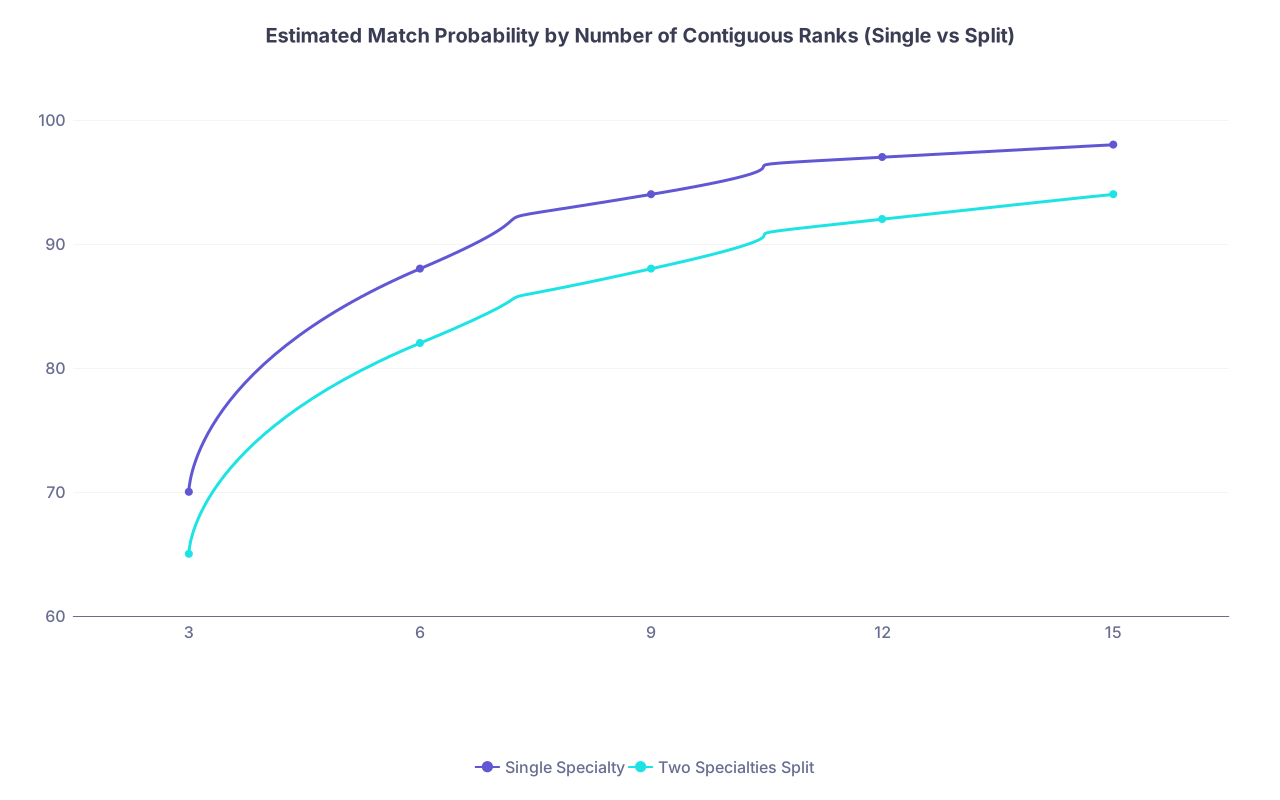
| Category | Single Specialty | Two Specialties Split |
|---|---|---|
| 3 | 70 | 65 |
| 6 | 88 | 82 |
| 9 | 94 | 88 |
| 12 | 97 | 92 |
| 15 | 98 | 94 |
The point: dual-application can still increase your overall chance of matching—if the backup is strong and fully resourced. But simply adding a second specialty without that infrastructure commonly erodes the theoretical benefit.
4. Good vs Bad Two-Specialty Combinations (From the Data)
I have watched multiple cycles of people try every imaginable combination. The data patterns are boringly consistent.
Strong combinations (when done correctly)
These tend to share clinical overlap, similar patient populations, and partially transferable letters.
Examples that often work well:
- Internal Medicine + Neurology
- Internal Medicine + Pediatrics (esp. Med-Peds interest)
- Pediatrics + Child Neurology
- Anesthesiology + Preliminary Medicine
- Psychiatry + Family Medicine (if truly open to both)
These pairings tend to show:
- Reasonably similar competitiveness band
- Overlapping core rotations and letter writers
- PDs who are used to applicants with dual interests
Result: you can maintain fairly high probabilities in both specialties if you balance applications properly and write honest, tailored narratives.
High-risk combinations
These are the ones that inflate unmatched rates:
- Extremely competitive + mid-competitive, with misaligned profile
(Derm + Anesthesia with weak Derm stats, Ortho + Radiology with average scores) - Competitive surgery fields + Medicine “backup” with no genuine IM exposure
- EM + Another specialty during current EM volatility (EM positions unfilled in several cycles, PDs anxious about commitment)
Why they underperform:
- Backup PDs can smell that they are the backup. They have thousands of applications; they do not need to accept lukewarm people.
- Your letters, research, and narrative are optimized for the primary, leaving the backup undersupported.
- You end up with fewer interviews in both, rather than many in one.
Here is a rough sense of relative “forgiveness” toward dual applicants, based on PD survey trends and match patterns:
| Specialty Category | Tolerance for Dual Apps | Comment |
|---|---|---|
| Medicine, Peds, FM, Psych | High | Common to see multi-interest |
| Anesthesia, Radiology | Moderate | Fine if narrative is coherent |
| Surgical Subspecialties, Derm | Low | Expect full commitment |
| EM (current cycles) | Unstable | Program anxiety about commitment |
If you are dead set on a highly competitive field and want a backup, the data basically tell you: the backup must be treated as a real path, not an afterthought. Otherwise your actual match probability often looks worse than “one mid-tier specialty done well.”
5. Designing a Data-Sound Two-Specialty Strategy
Let me be blunt. A good dual-application plan is almost always more work than applying to one competitive specialty. You are building two applications, not one.
Here is how to design it so the numbers work in your favor.
Step 1: Quantify your competitiveness in each specialty
Pull from Charting Outcomes:
- Step 2 CK: where do you fall relative to the median matched?
- Above by 5+ points: comfortable.
- Within ±5 points: borderline.
- Below by 10+: high risk as primary choice.
- Research: do you at least approximate the median for that field?
- Class rank, AOA/Gold Humanism, home program strength.
Rank yourself honestly:
- Tier 1: Very competitive for this field
- Tier 2: Average
- Tier 3: Underdog
If you are Tier 3 for your “dream” and Tier 2 for your “backup,” your actual primary, statistically, is the backup.
Step 2: Decide which specialty gets narrative primacy
The Match algorithm is neutral. Program directors are not.
You need to decide:
- Which specialty you are willing to be “all-in” for in your story
- Which one you are genuinely okay doing long-term if the first fails
Your rank list will be stacked. E.g.:
1–8: Derm
9–20: Anesthesia
Or the reverse. There is no magic middle ground. You will favor one.
Design your timeline around that decision:
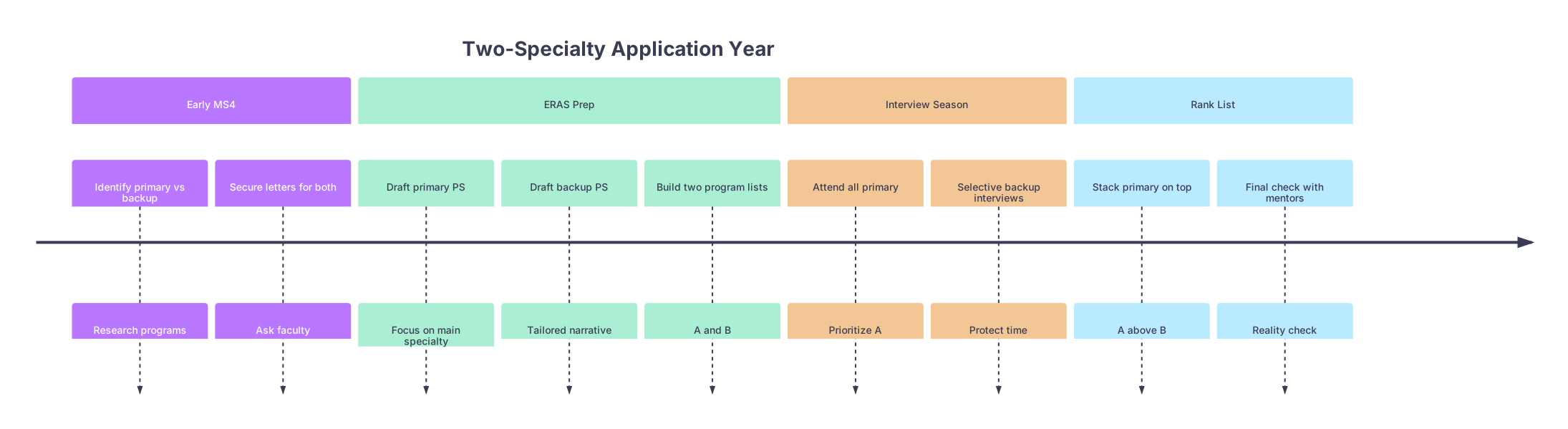
| Period | Event |
|---|---|
| Early MS4 - Identify primary vs backup | Research programs |
| Early MS4 - Secure letters for both | Ask faculty |
| ERAS Prep - Draft primary PS | Focus on main specialty |
| ERAS Prep - Draft backup PS | Tailored narrative |
| ERAS Prep - Build two program lists | A and B |
| Interview Season - Attend all primary | Prioritize A |
| Interview Season - Selective backup interviews | Protect time |
| Rank List - Stack primary on top | A above B |
| Rank List - Final check with mentors | Reality check |
Step 3: Allocate applications numerically
This is where most people undercut themselves. They split too evenly or too optimistically.
As a rough, data-informed framework for US MD seniors:
- If you are Tier 1–2 in primary, Tier 2–3 in backup:
- 70% of apps to primary, 30% to backup
- If you are Tier 2–3 in primary, Tier 1–2 in backup:
- 40% to primary, 60% to backup (because the backup is actually doing the statistical heavy lifting)
- Total number of programs usually needs to increase by 20–40% vs a one-specialty plan.
Example:
- Single-specialty IM plan: 40 programs → 95%+ match chance
- Dual IM + Neuro plan (Tier 2 in both):
- 30 IM + 25 Neuro = 55 total
- You are now building two interview pipelines that each want at least 10–12 invites.
If you are not willing to increase your total applications, your dual-application plan almost certainly reduces your overall match probability compared to a single moderate-competitiveness specialty.
Step 4: Structure letters and personal statements intelligently
PD survey data are clear: commitment to the specialty ranks extremely high in interview and rank decisions.
So you cannot send the same generic letter set and statement to both specialties and expect good odds.
You need:
- At least 2 specialty-specific letters for each field
- A primary personal statement that is unambiguously aligned with that specialty
- A backup personal statement that does not read like “I’m settling,” but rather, “Here is the real logic for why I’d be a good fit here.”
The data effect: applicants who tailor their letters and statements to the backup show noticeably higher backup interview and match rates compared to those who reuse “dream specialty” materials.
6. Common Failure Modes in Dual-Applications (and Their Numbers)
I will spell out the patterns that keep repeating.
Failure Mode 1: “Half-hearted backup”
Profile:
- 45 applications to dream specialty
- 15 to backup
- 3 letters from dream specialty, 0 from backup
- One generic PS with minor edits
Typical outcome profile (approximate for US MD seniors):
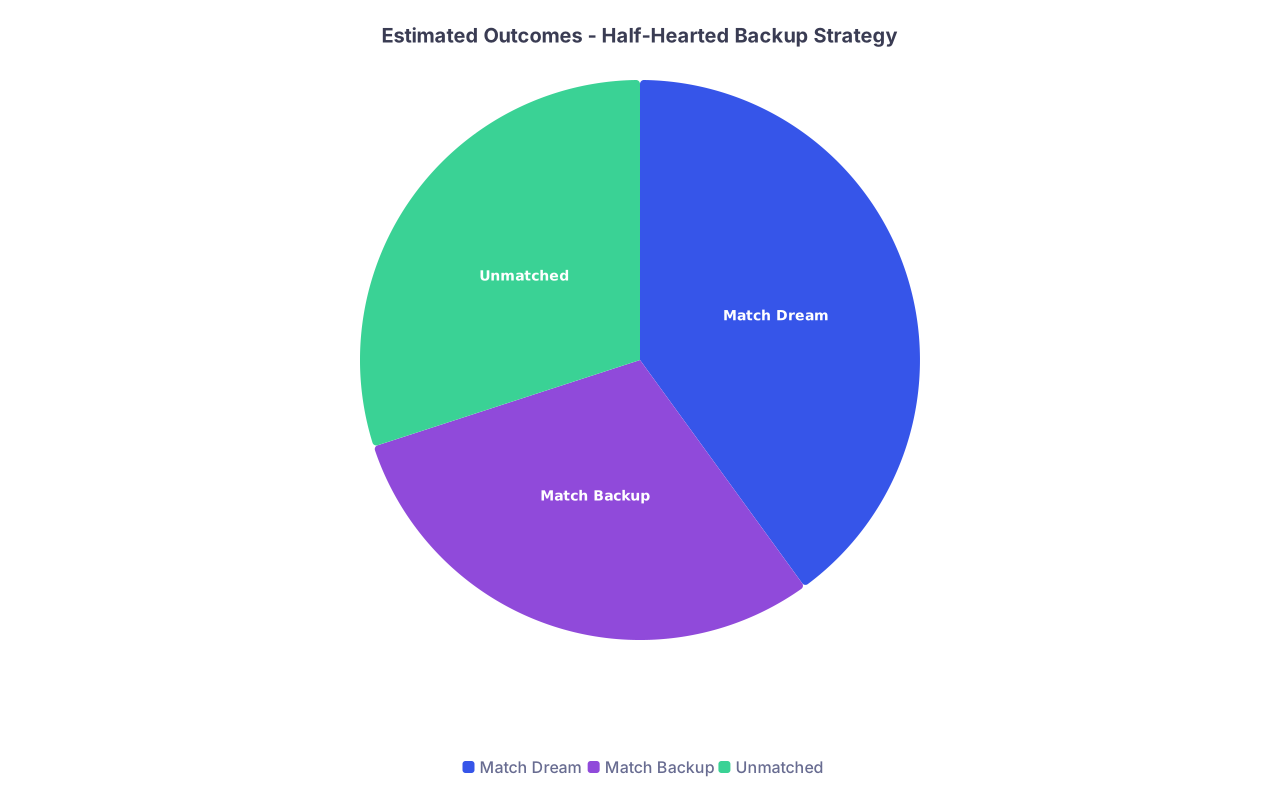
| Category | Value |
|---|---|
| Match Dream | 40 |
| Match Backup | 30 |
| Unmatched | 30 |
You think you have 70%+ “somewhere” probability. In reality, the probability of “unmatched” hovers near 30% in this pattern, especially when the dream specialty is high-risk.
Failure Mode 2: Overly competitive pair
Example: Ortho + Radiology at average Step and no research.
You have essentially created a dual-high-risk plan. You have increased the number of potential failure modes without adding a safety net.
If each specialty, given your stats and application depth, has only ~50–60% match probability:
P(no match overall) ≈ 0.4 × 0.4 = 16% at best, often higher in practice due to perceived lack of commitment in both.
Many people in this bucket would be better off:
- Ortho only, applied super broadly with a true SOAP backup, or
- Radiology + a medicine-based backup (IM) they actually align with.
Failure Mode 3: Mismatch between interviews and rank strategy
Another data quirk: people often secure more interviews in the backup than the primary, then still rank primary first out of identity, not statistics.
Example pattern:
- 4 interviews in primary (Derm)
- 12 in backup (IM)
NRMP data by specialty show that with 4 Derm ranks, maybe:
- 30–40% match chance
With 12 IM ranks:
- 95%+ match chance
Optimal statistical move: rank all IM above Derm if you care most about avoiding being unmatched.
What people often actually do:
- Rank 4 Derm programs first, then IM
This is a subjective choice, but it is not a data-driven one. You are explicitly trading ~50–60 percentage points of match probability for a low-probability shot at your dream.
If you do that consciously, fine. Just do not lie to yourself about the numbers.
7. Putting It All Together: When Dual-Applications Make Sense
After you strip out the wishful thinking, here is the clean version.
Dual-application helps your match probability when:
- The backup specialty is genuinely one you would be content to do long term.
- You are at least Tier 2 for the backup based on Charting Outcomes benchmarks.
- You allocate enough applications and letters to make the backup a real contender.
- Your primary is either:
- Very competitive and you are below typical matched metrics, or
- Moderately competitive and you want extra insurance due to red flags (leave of absence, prior attempt, etc.).
Dual-application hurts or adds little value when:
- Both specialties are high-risk for your profile.
- You refuse to expand total application volume.
- You are unwilling to craft tailored narratives and letter sets.
- You are primarily using the backup for emotional security, not statistical security.
If you look at the successful dual-applicants in the data, they tend to cluster into two groups:
- Strong candidates in both specialties, using dual-application to explore fit, not to avoid failure.
- Realistic candidates for a solid backup who gave that backup equivalent respect in their application strategy.
Everyone else is fighting the numbers, not using them.