The way most applicants pick “backup” specialties is mathematically wrong. They treat it like vibes and anecdotes, when the NRMP data shows very clear clusters where backup strategies work—and others where they backfire badly.
You are not guessing. You are playing odds. And the odds are written in black and white in the NRMP Charting Outcomes and Main Match data.
Below, I will walk through backup specialty clusters that historically give the highest probability of actually matching—especially for U.S. seniors—using real patterns from NRMP data (2020–2024 eras) and the logic program directors use behind closed doors.
1. The Core Principle: Clusters Beat Random Backups
The data shows that the highest match rates come from applicants who:
- Apply within a coherent “cluster” of related fields (shared skills, letters, rotations), and
- Align their Step scores, research profile, and red flags realistically with that cluster’s historical thresholds.
Randomly adding a single “easy” specialty usually does not move your probability curve. Moving within a sensible cluster does.
Think in clusters like this:
- Internal Medicine–Primary Care–Pediatrics
- Family Medicine–Psychiatry–PM&R
- Pathology–Neurology–Psychiatry
- Anesthesiology–Emergency Medicine–IM
- OB/GYN–Family Medicine–Pediatrics (with women’s health focus)
Here is the logic problem: you only get a finite number of interviews (say 10–15). The question is not “What’s my favorite?” once you are on the bubble; it is “Which cluster gives me the best portfolio probability of 1+ match?”
2. Baseline Reality: What the Match Data Actually Says
Before getting into clusters, anchor on actual match probabilities.
NRMP data across recent cycles shows, roughly:
- U.S. MD seniors overall: ~92–94% match rate
- U.S. DO seniors: mid-80s to low-90s% depending on year
- Older grads / IMGs: much lower (often 50–60% overall, heavily specialty-dependent)
More importantly, specialties vary wildly:
- Highly competitive (Derm, Plastics, Ortho, ENT, Neurosurg): many unmatched even with strong scores
- Mid-competitive (EM, Anesthesia, OB/GYN, Radiology, Neuro): moderate risk; backup usually wise
- Historically safer (FM, IM categorical, Peds, Psych, Path): high match rates if you are not carrying serious red flags and apply broadly
So a “good” backup cluster is:
- Logically consistent with your profile and experiences, and
- Built from specialties in the historically safer band, not from two competitive fields that both choke at high Step cutoffs.
3. Cluster 1: Internal Medicine–Primary Care–Pediatrics
This is the most statistically forgiving cluster for many U.S. seniors.
Why this cluster works
Three things jump out in the data:
- Internal Medicine (IM categorical) has remained one of the largest and more accessible specialties for U.S. seniors with solid but not stellar Step scores.
- Pediatrics, while more competitive than people claim in top programs, still shows high overall match rates, especially for U.S. grads with authentic interest and decent letters.
- Primary Care–oriented IM tracks (and Medicine–Pediatrics where appropriate) sustain strong match numbers when applicants have consistent primary care narratives.
You are leveraging:
- Shared core rotations (IM and Peds are required for everyone)
- Overlapping letters (IM, Peds, primary care faculty)
- Similar Step expectations for non-elite programs
For a typical applicant with:
- Step 1: Pass
- Step 2 CK: 220–240 range
- Average research, decent clinical comments, no catastrophic professionalism issues
…the IM–Primary Care–Peds cluster historically keeps total match probability high, often above 90% when applying broadly and ranking generously.
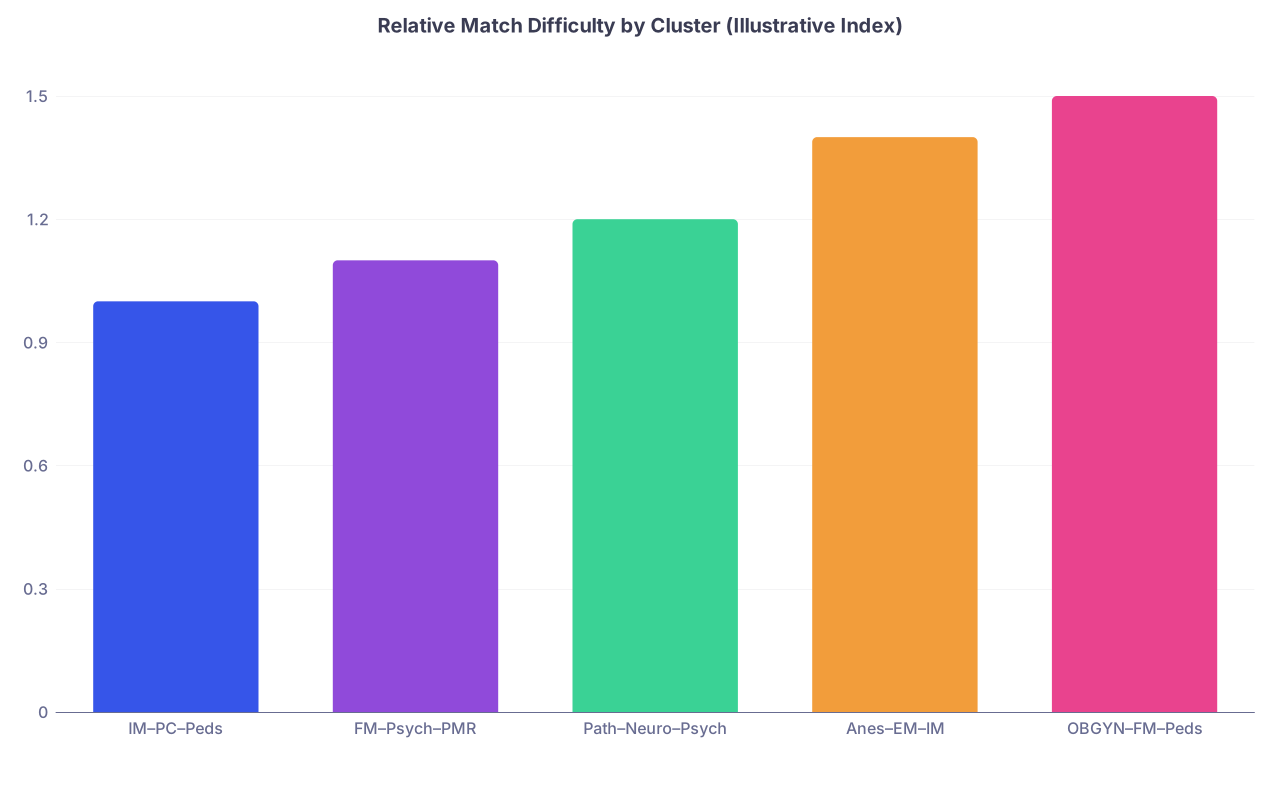
| Category | Value |
|---|---|
| IM–PC–Peds | 1 |
| FM–Psych–PMR | 1.1 |
| Path–Neuro–Psych | 1.2 |
| Anes–EM–IM | 1.4 |
| OBGYN–FM–Peds | 1.5 |
(Here, 1.0 = easiest cluster baseline; higher = relatively harder.)
How to structure this cluster
Primary target:
- IM categorical or Peds (or Med-Peds if you are strong and genuinely competitive there)
Backup within cluster:
- Community IM programs, community Peds, primary care tracks, possibly prelim IM if your worst-case is a one-year foothold
You reuse:
- IM sub-I letters
- Peds rotation letters
- Personal statement variants highlighting either adult medicine, children’s health, or continuity primary care
If your initial dream is Cardiology, GI, or hospitalist life, this cluster is mathematically safer than pretending you will back up Cardiology-focused IM with something like EM or Anesthesia and splitting your file.
4. Cluster 2: Family Medicine–Psychiatry–PM&R
The Family Medicine–Psych–PM&R axis quietly produces some of the highest backup success when applicants commit to the story and apply broadly enough.
What the data shows
Look at historical NRMP outcomes:
- Family Medicine: very high match rates for U.S. seniors, strong absorption even of lower Step scores, especially in community and rural programs.
- Psychiatry: has become more competitive, but still maintains relatively high match rates for U.S. seniors who apply broadly; severe bottlenecks mainly at coastal / academic hotspots.
- PM&R: smaller field, but matchable for U.S. seniors with coherent rehab or neuromuscular interest and decent scores.
Big patterns:
- FM absorbs risk. It is the hydraulic release valve of the Match.
- Psych favors narratives about communication skills, empathy, long-term care; less Step-obsessed than procedural fields.
- PM&R sits at a clinical intersection: neurology, musculoskeletal, chronic disability—good fit for those who like patient continuity without heavy surgery.
This cluster is particularly powerful for applicants with:
- Mid-range scores (Step 2 CK 210–235)
- Strong interpersonal comments (“excellent with difficult patients,” “calm under stress”)
- Limited research, but good clinical consistency
Why this beats “EM as a backup” for mid-range applicants
Emergency Medicine historically became more competitive, and its recent NRMP data shows higher unmatched rates than FM or Psych at similar score bands in many cycles. The program directors I hear from often say the same line: “We can fill our lists twice over with applicants who have all clerkship honors and great SLOEs.”
If your metrics are average, EM as a “backup” to Anesthesia or IM does not mathematically make sense anymore. FM–Psych–PM&R does.
| Specialty | Relative Match Rate* |
|---|---|
| Family Medicine | Very High |
| Internal Medicine | Very High |
| Pediatrics | High |
| Psychiatry | High |
| PM&R | Moderate–High |
*Relative to other specialties, based on NRMP trends across recent cycles for U.S. seniors, not exact percentages.
Structuring this cluster
Primary target (varies by applicant):
- If you are heavy on outpatient continuity: FM primary.
- If you have psych electives, interest in mental health: Psych primary, FM backup.
- If you like neuro/musculoskeletal rehab: PM&R primary, FM and possibly Psych backups.
You align:
- Core FM rotations and sub-I for letters
- Psych elective or sub-I for parallel letters
- Rehab / neuro electives if eyeing PM&R
The key here is narrative coherence. You do not sell yourself as future neurosurgeon while backing up with FM. You present as a physician oriented to whole-person care (behavioral health, rehab needs, chronic disease), then slot into whichever of these three accepts you.
5. Cluster 3: Pathology–Neurology–Psychiatry
This is the “neuro/brain/system” cluster, and it saves a surprising number of careers for applicants drifting away from surgery or ultra-competitive fields.
What the numbers imply
Historically:
- Pathology has seen significant variability in applicant volume, but for U.S. MD seniors who actually apply, match rates have often been high.
- Neurology, especially at community or mid-tier university programs, remains accessible for U.S. seniors with mid-range Step scores.
- Psychiatry we already covered as generally more forgiving than high-procedural fields.
Who fits this cluster?
- Applicants whose surgery dreams collided with Step scores under ~230 and lukewarm surgical evaluations
- People genuinely interested in neuro, brain, behavior, or analytic medicine
- Those who did not collect many strong surgical letters but did solidly in medicine, neuro, or psych rotations
You can conceptualize this:
- Pathology: highly analytic, lab-based, few direct procedures, heavy diagnostic reasoning
- Neurology: bedside localization, chronic neurologic disease, some procedures but not at a surgical pace
- Psychiatry: behavioral, cognitive, affective disorders with long-term relationships
The data pattern is consistent: these are specialties that do not generally demand 260+ Step scores across the board, yet still respect solid clinical work and interest.
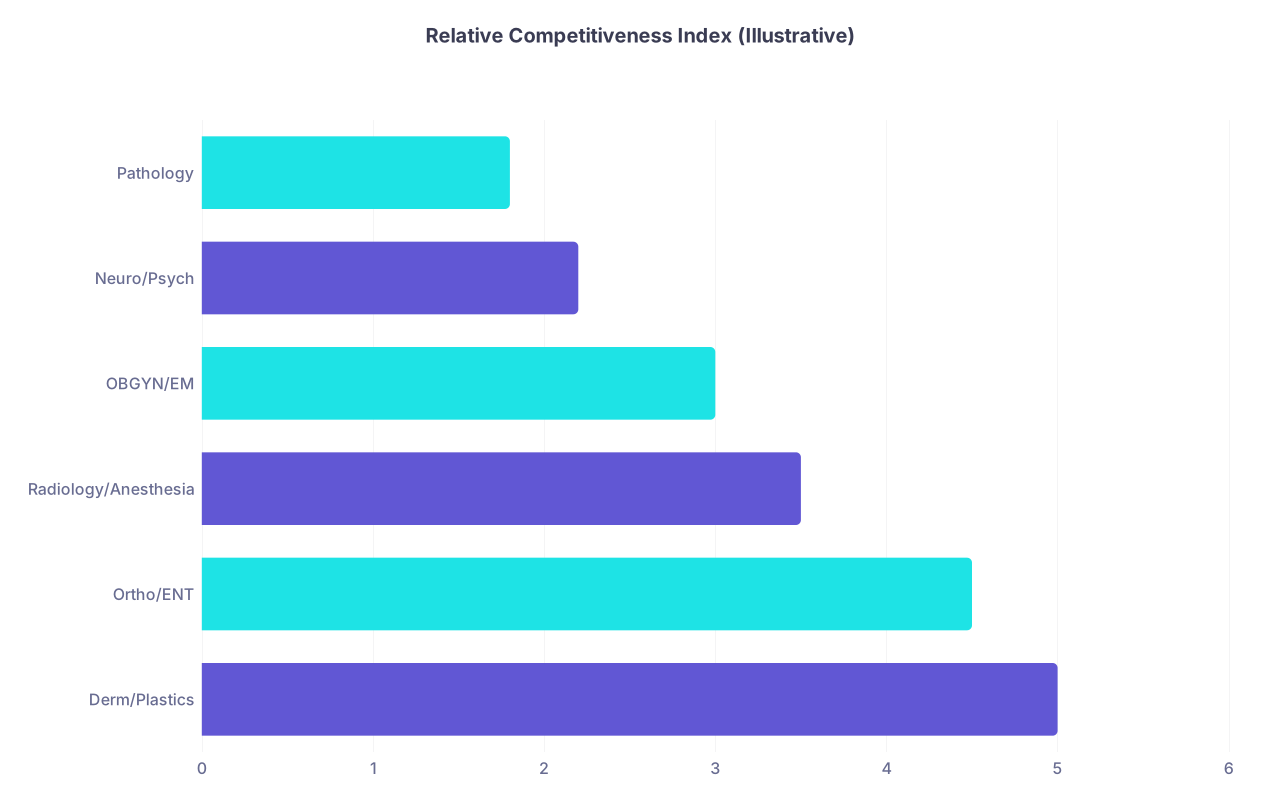
| Category | Value |
|---|---|
| Derm/Plastics | 5 |
| Ortho/ENT | 4.5 |
| Radiology/Anesthesia | 3.5 |
| OBGYN/EM | 3 |
| Neuro/Psych | 2.2 |
| Pathology | 1.8 |
(Higher number = more competitive overall; Neuro/Psych/Path generally sit below high-procedure surgical fields.)
Structuring this cluster
Primary target:
- Neuro or Psych, if you have a clear clinical narrative
- Pathology primary if you truly prefer diagnostic work and have meaningful pathology exposure (elective, research, lab projects)
Backup within cluster:
- For Neuro primary: add Psych and some Pathology if you have real exposure
- For Psych primary: add Neuro and potentially Pathology
- For Path primary: you must signal Path strongly, then consider limited Neuro/Psych as secondary options if your profile works clinically
Warning: You cannot “secretly” be a surgeon and expect Pathology to rescue you. PDs in Path smell it from your personal statement and letters. You either commit to the diagnostic narrative or you do not.
6. Cluster 4: Anesthesiology–Emergency Medicine–Internal Medicine
This is the classic “acute care” cluster, but it is riskier than students think. It works for the right profile, but fails if you underestimate how competitive EM and Anesthesia can be.
What recent data suggests
Trends:
- Anesthesiology has fluctuated but is not a soft backup anymore. Academic programs often want mid-240s+ Step 2 CK and strong clinical performance.
- Emergency Medicine, especially during the recent cycles with instability and program closures, has shown higher unmatched rates than expected in some years.
- Internal Medicine remains the safety net inside this cluster.
So mathematically, the cluster behaves like this:
- If you are competitive for Anesthesiology or EM (strong scores, no major red flags, robust SLOEs or ICU/OR letters), your probability of matching in one of the three is high if you build a broad list.
- If you are marginal even for IM (Step 2 under 215, significant professionalism concerns), adding EM and Anes will not fix that.
This is not a “low floor” cluster. It is a “high ceiling, moderate floor” cluster.
Who should consider it
Profile that fits:
- Step 2 CK in the 230–250 range
- Strong performance in medicine, surgery, and EM rotations
- At least 1–2 strong letters from ICU, EM, or anesthesia contexts
- Comfort with shift work, procedural care, acutely ill patients
If you are at or above average for U.S. seniors academically, this cluster works as follows:
- Primary: Anesthesia or EM, depending on where you have the best letters and narrative
- Backup: Add 10–20 IM categorical programs (including some community) with personal statement angled toward hospitalist or critical care aspirations
That last part is the actual safety net. IM is what mathematically boosts your overall probability of matching. EM and Anes just diversify your acute care bets.

7. Cluster 5: OB/GYN–Family Medicine–Pediatrics
For applicants drawn to women’s health, reproductive care, and longitudinal primary care, this cluster creates a high-match-probability ecosystem when you are realistic about OB/GYN competitiveness.
Data-backed reality
OB/GYN is not a “backup” specialty. It sits mid-to-high competitively:
- Many programs now expect solid Step 2 CK (often >235–240 in academic centers)
- They look closely at surgical evaluations, L&D work, and hands-on performance
- Unmatched risk is meaningful if you aim only at big-name coastal programs with a middle-of-the-pack application
But when you layer FM and Peds as backups, the cluster’s overall matching probability becomes much safer.
- Family Medicine absorbs candidates with strong interest in women’s health, prenatal care, and broad outpatient practice—very reliably.
- Pediatrics accepts applicants with narratives around child and adolescent health, prenatal to adolescence continuity, etc.
Structuring this cluster
If OB/GYN is your primary:
- Get strong OB letters and a solid OB sub-I.
- Apply widely to OB/GYN, including mid-tier and community programs.
- Simultaneously apply to a reasonable number of FM and/or Pediatrics programs, with personal statements that highlight:
- Women’s health tracks
- Obstetrics in FM
- Adolescent and maternal-child health in Peds
This is one of the highest historical match probability clusters for applicants whose core passion is reproductive health but whose metrics do not guarantee a pure OB/GYN match.
Do not make the rookie mistake of “all-in OB/GYN, 30 applications, no backups” with a 220–230 Step 2 and average clerkship comments. That is how you land in SOAP staring at prelim IM.
8. The Silent Giant: Pure Family Medicine as a Backup Net
There is a blunt truth in the data: adding a meaningful number of Family Medicine programs massively decreases your chance of going unmatched, almost regardless of what your primary field is.
The word “meaningful” is doing the work here. Throwing 3 FM apps into a 70-application orthopedic surgery portfolio will not change your odds. Adding 25–40 FM apps absolutely can.
Patterns across many cycles:
- U.S. seniors with serious FM applications (broad list, sane distribution of program tiers, coherent narrative) have very high match probabilities, even with modest scores.
- FM programs in less saturated geographic areas (Midwest, South, rural regions) often rank long lists of applicants who show any sincere interest in underserved care, continuity, and primary care.
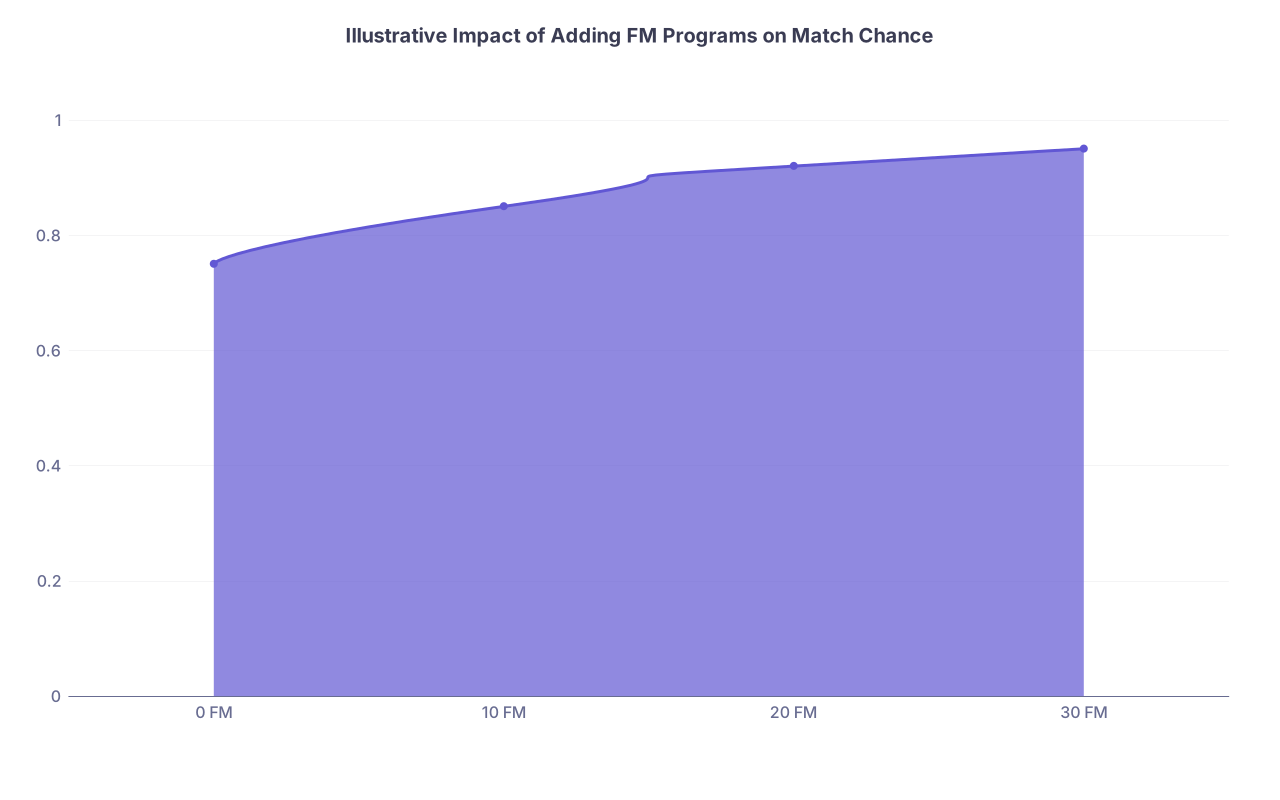
| Category | Value |
|---|---|
| 0 FM | 0.75 |
| 10 FM | 0.85 |
| 20 FM | 0.92 |
| 30 FM | 0.95 |
(Example probabilities for a “borderline” applicant whose primary specialty has ~70–75% match probability if applied alone.)
I have watched this play out in real time: two nearly identical applicants, both mediocre in a competitive field. One adds a serious FM backup cluster, the other does not. One matches FM happily. The other ends up in SOAP and sometimes unmatched.
FM is not a dumping ground. But statistically, it is the most forgiving safety net if you can authentically articulate primary care interest.
9. How Many Specialties Is Too Many?
The data says something that advisors often gloss over: your match probability is not a simple function of the number of specialties. It is a function of:
- Total interview count
- Rank list length
- Coherence of your letters and narrative
Applicants with 2–3 related specialties in a cluster tend to do well. Once you exceed 3, your file starts to fracture:
- Letters that point in opposite directions
- Personal statements that feel generic
- Program directors who suspect they are clearly your “backup to the backup”
From a probability standpoint:
- 1 specialty: High reward if you are strong; high risk if you are borderline
- 2 specialties in the same or adjacent cluster: Often the sweet spot for borderline–average applicants
- 3 specialties: Useful for specific combinations (FM–Psych–PM&R, IM–Peds–Primary Care)
- 4+ specialties: Usually dilutes your narrative without proportional gain in interviews

10. Concrete Examples: What High-Probability Backup Clusters Look Like
Let me make it real with a few archetypes. These are streamlined, but they mirror patterns you see every year.
Example 1: Mid-range applicant, likes hospital medicine
- Step 2 CK: 230
- Mostly passes, a few high passes in clerkships
- Strong comments in IM and Peds, average in Surgery
- Limited research
High-probability cluster: IM–Primary Care–Peds
- 25–30 IM categorical programs (mix of university and community)
- 10–15 Pediatrics programs
- 5–10 IM primary care tracks
Total: 40–55 programs. One coherent story: future hospitalist or generalist with interest in inpatient and continuity care.
Example 2: Psych-inclined, slightly lower scores
- Step 2 CK: 218
- Narrative of mental health advocacy, strong Psych evaluations
- Little research, but very good psych attending letter
High-probability cluster: FM–Psych–(maybe PM&R if exposure)
- 20–25 Family Medicine programs broadly distributed
- 15–20 Psychiatry programs, including smaller markets
- Optional: 5–10 PM&R if you have a real rehab elective or neuro background
Here FM is the main probability engine. Psych is the first choice. PM&R is optional.
Example 3: EM-leaning with solid but not stellar metrics
- Step 2 CK: 235
- Strong EM SLOEs, good IM clerkship
- Average research
Best probabilistic play: EM–Anesthesia–IM
- 25–30 EM programs
- 10–15 Anesthesia programs
- 10–20 IM categorical programs as safety net
You aim to secure at least 10–12 total interviews across all three fields. Once you are at that number, your historical match probability climbs sharply.

11. How to Use This Data Without Lying to Yourself
The traps I see repeatedly:
- Overestimating competitiveness in your dream specialty based on one strong letter or one honor
- Underapplying to backup fields—e.g., 35 apps to your dream specialty, 4 to your supposed backup
- Picking backups that require completely different letters and narratives, leading to weak applications in all directions
A more data-driven approach:
Look at your Step 2 CK and clinical performance. Place yourself honestly in the distribution for your target field (using NRMP Charting Outcomes style data).
Decide: are you in the top, middle, or bottom third for that specialty?
If you are middle or bottom third, choose a backup cluster from those above that:
- Has historically higher match rates
- Reuses your clinical experiences and letters
- You could live with professionally
Allocate applications proportionally:
- If your primary specialty is risky: 50–60% of apps in primary, 40–50% in backup(s)
- If you are solid but cautious: 70% primary, 30% backup
You are not trying to “game the system.” You are simply respecting the historical match curves.
The bottom line: backup specialties are not random insurance policies. They are clusters with shared expectations, letters, and narratives that maximize your probability of any match without sabotaging your fit.
If you treat this like a data problem—and choose from clusters like IM–Peds, FM–Psych–PM&R, Path–Neuro–Psych, Anes–EM–IM, or OB/GYN–FM–Peds—your odds of walking into July as a PGY-1 instead of sitting in SOAP panic rise dramatically.
You have one more big decision coming: how many programs to apply to in each specialty, and how to rank them once interview season hits. With your backup clusters chosen rationally, that decision becomes a lot more about preference and a lot less about fear. And that, frankly, is a better story—but one for another day.