
Going all‑in on one specialty with no backup is almost always a bad strategy.
There are rare exceptions. You are probably not one of them.
Let me be direct: the people who pull off a successful “no backup” match either have unusually strong applications in a not-insanely-competitive field, or they accept a level of risk that would make most sane people sweat through their white coats. Your job is to decide which group you’re in—and whether the upside is actually worth the downside.
This isn’t about courage. It’s about math, risk tolerance, and having a plan if things go sideways.
1. When Is It (Actually) Reasonable to Have No Backup?
Going all‑in is sometimes defendable. But the bar is high.
Here are the few scenarios where I’ve seen a “no backup specialty” plan make sense:
You’re applying to a moderately competitive specialty, not a bloodbath.
Think: internal medicine, pediatrics, psychiatry, family medicine, pathology, PM&R at average competitiveness. Not derm, plastics, ortho, ENT, neurosurgery, integrated vascular, or urology.Your application is clearly above average for that specialty:
- Strong Step 2 score relative to that field
- Solid letters from recognizable faculty in that specialty
- At least one away rotation (if expected) that went well
- No major red flags (fails, professionalism issues, big gaps)
You’d rather not be a doctor in that cycle than match into another field.
This is more common than people admit. Some applicants would honestly rather:- Take a research year
- Reapply
- Or change career direction
…than wake up as an intern in a specialty they dislike.
You have a specific, realistic Plan B if you don’t match.
Examples:- Pre-arranged research position in that specialty with a strong mentor
- A home department genuinely committed to supporting a reapplication
- Visa or life constraints that make a backup logistically meaningless
If you do not check most of these boxes, then “no backup” is not a bold strategy. It’s just reckless.
2. When Going All‑In Is Flat-Out Dumb
Here’s where I stop being diplomatic. If any of these apply, having no backup is a bad move.
You’re applying to a hyper‑competitive specialty and you’re not a monster applicant:
- Dermatology
- Plastic surgery (integrated)
- Orthopedic surgery
- ENT
- Neurosurgery
- Ophthalmology
- Integrated vascular, IR, etc.
Your application has obvious weaknesses:
- Below-average Step 2 for your specialty
- No home program and no strong away rotation
- Limited or no research in that field when the field expects it (derm, plastics, rad onc, etc.)
- You’re applying as an international medical graduate (IMG) or from a lower‑ranked school to a top-competitive field
You don’t actually have a realistic alternative plan if you fail to match.
“I’ll figure it out if it happens” is not a plan. That’s magical thinking.
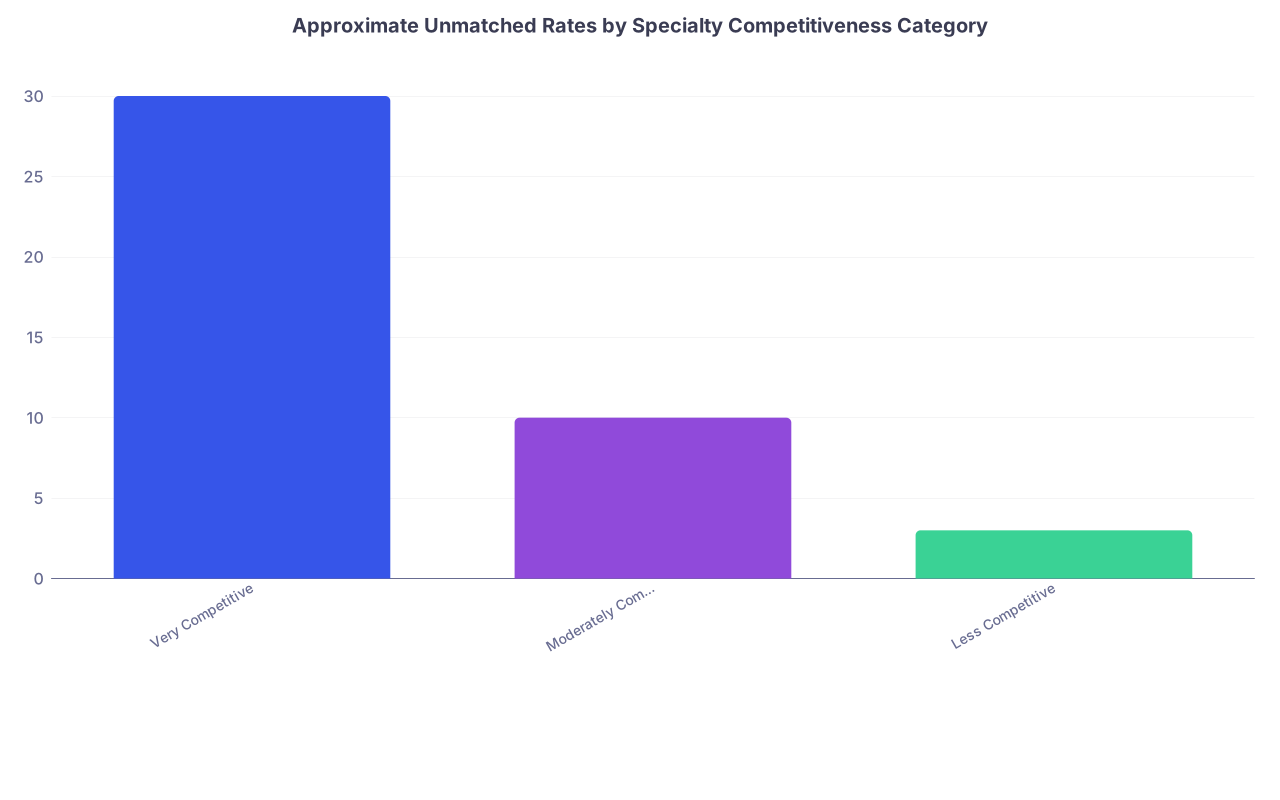
To give you a sense of where risk explodes, here’s a rough comparison:
| Category | Value |
|---|---|
| Very Competitive | 30 |
| Moderately Competitive | 10 |
| Less Competitive | 3 |
These numbers move year to year and depend heavily on applicant quality, but you get the idea: in very competitive fields, a sizeable chunk of applicants walk away unmatched. Many of them were perfectly good candidates.
Banking your entire career on being better than that entire crowd with no safety net? That’s not “confidence.” That’s denial.
3. The Real Question: What’s Worse for You—Not Matching or Matching Into a Backup?
This is the decision framework that actually matters, and most people skip it.
You’re choosing between two main risk profiles:
| Strategy | Upside | Main Risk |
|---|---|---|
| All-In, No Backup | Higher chance of your dream field | Higher chance of not matching |
| Primary + Backup | Higher chance of matching somewhere | Higher chance of “wrong” specialty |
| Primary + Research Plan | Stronger reapplication positioning | 1+ year delay in training |
Ask yourself three concrete questions:
If I match into my backup, would I be miserable—or just mildly disappointed?
- Mildly disappointed but could see yourself doing it? Backup may be smart.
- Honestly miserable, to the point of burnout risk? You may reasonably choose no backup.
If I go unmatched, can I emotionally and financially handle 1–2 extra years?
- Loans, visas, family needs, partner career, geography.
- Some people simply cannot afford a gap. For them, backing up is almost mandatory.
Am I willing to be that person explaining to future PDs why I switched fields or had a gap?
- Not fatal. PDs see it all the time.
- But you’ll be answering to it for years. Be sure you’re ok with that.
If “I never, ever want backup X” is a genuine, thought‑through position, then not listing a backup may be smart—if you pair it with a real reapplication plan. But if you’re just scared of FOMO or prestige drop, that’s not a good enough reason.
4. Smart Ways to Use a Backup (Without Torching Your Primary)
If you do decide to have a backup specialty, do it intelligently. A sloppy backup can hurt both fields.
You need three things:
- A logical connection between your primary and backup
- A credible story that makes sense to PDs in both fields
- A strategic application split (how many programs per specialty)
Step 1: Pick a backup that fits your profile and story
Good primary–backup pairings usually share at least one of these:
- Similar patient population (e.g., peds neuro → peds)
- Overlapping skills (e.g., anesthesia → EM or IM; gen surg → prelim surg or IM)
- Shared clinical narrative (e.g., psych → neurology, IM → radiology)
Examples that often work:
- Ortho → general surgery prelim (for reapplication)
- Derm → internal medicine (with derm-heavy narrative and derm research)
- ENT → general surgery prelim or categorical general surgery (depending on goals)
- Anesthesia → internal medicine or emergency medicine
- Radiology → internal medicine
Bad backups are ones you picked just because they’re “easier” but have no connection to your CV, your letters, or your stated interests. PDs can smell that mismatch.
Step 2: Decide your application split based on how risky you can afford to be
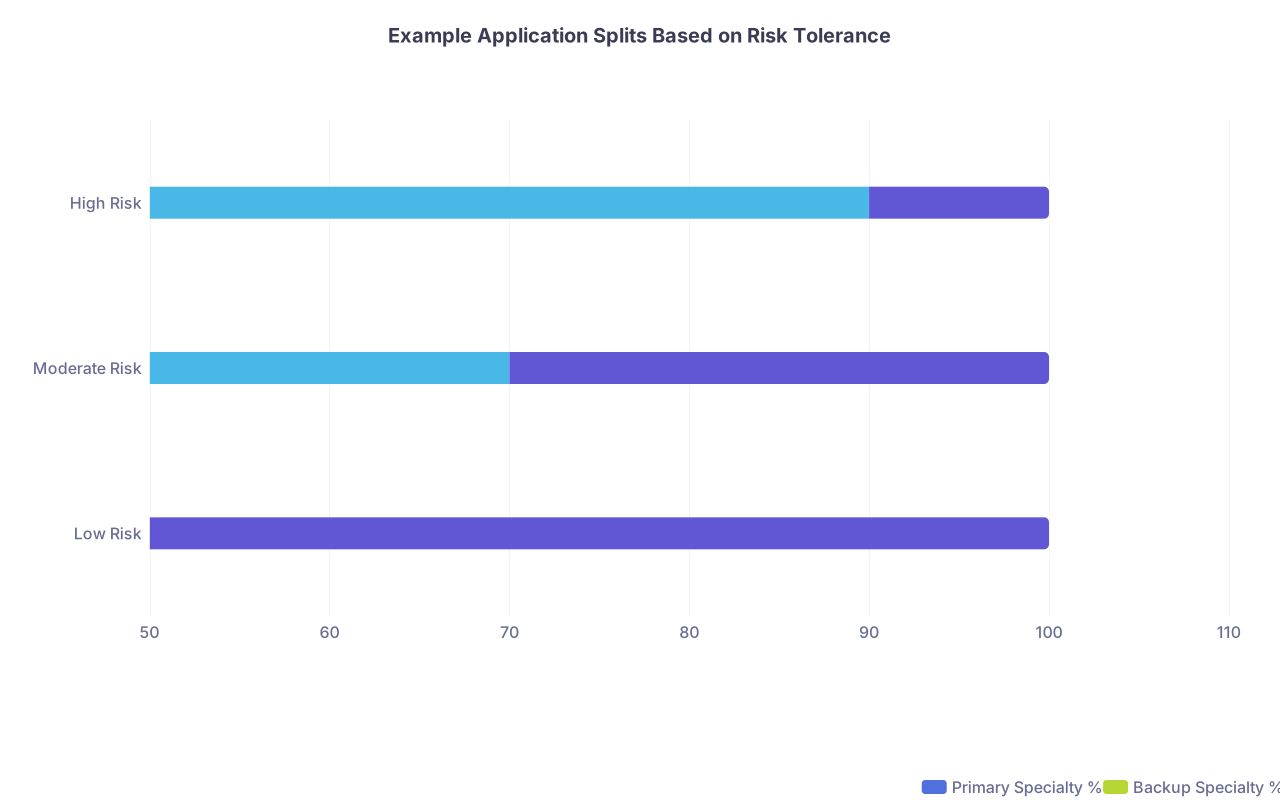
Here’s a simple way to think about it:
| Category | Primary Specialty % | Backup Specialty % |
|---|---|---|
| Low Risk | 50 | 50 |
| Moderate Risk | 70 | 30 |
| High Risk | 90 | 10 |
Rough translation:
- Low risk: 50/50 primary vs backup
- Moderate risk: 70/30 primary vs backup
- High risk (still safer than no backup): 90/10 primary vs backup
If any of these sound like what you emotionally want:
- “I want every possible chance in my dream field; I don’t care if backup is thin” → High risk split or all‑in with a structured reapplication plan.
- “I must match this year; I can live with either specialty” → Low or moderate risk split.
Step 3: Manage your narrative between two specialties
This part people constantly screw up.
You don’t need completely different lives for each field. You do need:
- Letters that are field-appropriate (majority from your primary field, at least one strong letter suitable for backup if possible).
- A personal statement that’s specific—not vague nonsense like, “I like people and procedures and continuity and variety.”
- A version of your story for each interview that genuinely explains your interest.
You can absolutely:
- Have one primary personal statement for your main specialty
- A second, tailored statement for backup
- Overlapping experiences in both, framed differently
What you should not do:
Tell your backup programs that your dream has always been their field, while simultaneously telling your primary specialty the same thing in a way that’s clearly copy‑paste. They talk. Faculty cross specialties all the time.
5. A Clear Decision Framework: Should You Go All‑In?
Let’s actually walk through a simple decision path.

| Step | Description |
|---|---|
| Step 1 | Choose Primary Specialty |
| Step 2 | Use backup or reapply plan |
| Step 3 | Use backup specialty |
| Step 4 | Consider all in + structured gap plan |
| Step 5 | Hyper competitive field |
| Step 6 | Top tier applicant |
| Step 7 | Above average in this field |
| Step 8 | Can accept not matching |
| Step 9 | Backup would make me miserable |
Use it honestly. Not how you wish your application looked, but how it looks to a PD who has 800 ERAS files and 20 interview slots.
6. How to Do “All‑In” Without Being Totally Naive
Let’s say you’ve gone through all this and still decide: I’m going all‑in on one specialty.
Here’s how to do it like an adult, not like a gambler.
Apply broadly. More broadly than you emotionally want to.
That means:- Geographic flexibility (you are not too good for middle‑of‑nowhere if you’re all‑in)
- Community programs, mid‑tier, lesser known places
- Not just big academic names or your dream cities
Have a pre‑planned unmatched pathway.
Before rank lists are due, you should already know:- Whom you’ll email for research or prelim spots if you don’t match
- What kind of 1‑year gap you’d actually accept (research, chief year, non‑ACGME fellowship, etc.)
- How you’ll manage loans, housing, and personal life during that year
Be honest with mentors about your plan.
Good mentors hate surprises. If you intend all‑in, say it:- “I understand the risk. If I don’t match, I plan to do a research year and reapply. Here’s what I’ve lined up so far—can you advise or support that?”
Have a SOAP mindset even if you “won’t need it.”
No one thinks they’ll end up in SOAP. People do.
Know:- Whether you’d consider SOAPing into a backup field if unmatched
- Or whether you would only SOAP into prelim spots related to your specialty
- Or whether you’d skip SOAP entirely and plan a gap year
You don’t have to like these options. You just have to decide which ones you’d actually live with.
7. Common Myths That Push People Into Bad Decisions
Let me kill a few unhelpful beliefs.
Myth 1: “Backup means you didn’t really love your primary specialty.”
Nonsense. PDs know the game. They’d rather you match into something than be unemployed and bitter. Having a thoughtful backup is not a character flaw.
Myth 2: “If you have a backup, you’ll match it instead by bad luck.”
You still rank your list. You’re in control. You will not “accidentally” match backup unless you rank it higher than something else or have zero offers from your primary.
Myth 3: “You can always switch later if you hate your backup.”
Switching is possible but not guaranteed.
It’s logistically messy, politically complicated, and sometimes just dead on arrival. Never choose a backup on the assumption you can easily jump ship later.
Myth 4: “Everyone successful went all‑in.”
Nope. Many matched physicians quietly had backups or had reapplication years. They just don’t advertise it on their faculty bios.
FAQ: Backup Specialties and Going All‑In
1. If I have a mediocre application to a competitive specialty, should I ever go all‑in?
No. If your metrics are clearly below the average matched applicant for that field and you have no exceptional compensating factors (major research, insane letters, home program pulling for you), going all‑in is just asking to be unmatched. You’re better off either:
- Committing to a backup where you’d be happy enough, or
- Taking time before you apply to strengthen your application (research year, extra rotations, Step 2 improvement) rather than gambling in-season.
2. Can I apply to a competitive specialty and say internal medicine as a backup without looking unfocused?
Yes, if you do it thoughtfully. Many people pair a competitive field (like derm, rad onc, rads) with IM as a backup. The key is: your story for each field must be coherent, your letters should primarily support your main specialty, and you should not visibly copy-paste vague personal statements. PDs understand that some applicants are hedging, as long as it’s done professionally.
3. Is it better to SOAP into a backup specialty or take a year and reapply to my dream field?
It depends on your risk tolerance and how strongly you feel about the primary specialty. If you’d be content—truly content—long-term in the SOAP specialty, there’s a strong argument for taking the guaranteed spot. If you know you’ll resent that choice every day, and you have a realistic, supported plan to reapply stronger next year, then skipping SOAP can be a rational decision. But that second option requires real support and some financial cushion.
4. Does having a backup hurt my chances in my primary specialty?
Not if your application is built with your primary specialty as the clear focus. Programs mostly care: Do you genuinely want our field? Do you have the skills and track record for it? They are not scouring ERAS to see whether you also sent applications in another specialty. It becomes a problem only when your materials are so generic or conflicted that it looks like you do not know what you want.
5. How many programs should I apply to if I’m all‑in with no backup?
More than you think. For competitive specialties, that often means 60–80+ programs if you’re not an absolutely top-tier candidate. For moderately competitive ones, it still frequently means 30–50. You’re trading the safety of a backup specialty for volume within your primary, so your geographic and “prestige” snobbery needs to drop. If you’re going all‑in, you go all‑in on breadth too.
Bottom line:
- Going all‑in with no backup is only smart when your risk is truly calculated, your application fits your field, and you have a concrete plan if you don’t match.
- Most applicants are safer—and often happier long‑term—with a well‑chosen backup or a deliberately planned reapplication year.
- Be honest about your numbers, your tolerance for uncertainty, and what kind of “bad outcome” you’d rather live with: the wrong specialty now, or the right specialty later.