
The usual advice about backup specialties is dangerously vague. “Have a backup plan” is useless if you do not know how close or how far that backup should be from your primary choice.
Here’s the answer you’re actually looking for:
Your backup specialty should be as close as possible clinically and lifestyle-wise to your primary choice while still being meaningfully less competitive and logistically feasible in the same cycle. Anything else is fantasy planning.
Let’s break that down.
Step 1: Figure Out If You Even Need a Backup
Not everyone needs a backup specialty.
You probably do need a backup if:
- You’re aiming for a highly competitive specialty (Derm, Plastics, Ortho, ENT, Neurosurgery, IR/DR, Rad Onc, Urology, Ophtho, sometimes EM in certain regions).
- You are an average or below-average applicant for that field:
- No home program
- Limited research or weak letters in that field
- Failed a board exam or just-barely-passing scores
- Significant red flags (LOA, professionalism concerns, significant academic struggles)
- You’re couples matching into two non-primary-care specialties.
- You’re applying in a highly saturated region only (NYC, SoCal, etc.) and refusing to move.
You probably do not need an actual second specialty if:
- You’re going for IM, FM, Peds, Psych, or Path with solid passing scores, no red flags, and reasonable geographic flexibility.
- Your advisors in the specialty you want are telling you, bluntly, “You’re fine. Just apply broadly.”
If you do not clearly fall in the “safe” group, plan a backup sooner rather than in a panic in November.
Step 2: Define “Closely Related” the Right Way
“Related” is not just about organ system. It’s about three things:
- Clinical overlap – similar patient populations, disease processes, or procedures.
- Lifestyle and identity overlap – similar day-to-day flow, call, and long-term work life.
- Training pathway/logistics – can you actually apply to both in the same ERAS season without creating a mess?
If you only look at one dimension (e.g., “Surgery is surgery” or “Medicine is medicine”), you’ll pick a backup that looks reasonable on paper and feels awful in real life.
Step 3: Common Primary/Backup Pairings That Actually Make Sense
Here’s where people get stuck, so I’ll be blunt. These are pairings I’ve seen work in real life.
| Primary Specialty | Reasonable Backup | Overlap Level |
|---|---|---|
| Dermatology | Internal Med, IM prelim → Derm later | Medium |
| Orthopedic Surg | General Surg, PM&R | Medium-High |
| ENT | General Surg, Internal Med | Medium |
| Neurosurgery | Neurology, General Surg prelim | Medium |
| Plastic Surg | General Surg, ENT | Medium |
| Radiology (DR/IR) | Internal Med, Anesthesia | Medium |
| EM (competitive regions) | IM, FM | High |
This is not a perfect map. But it’s a reality check.
Now, a more precise way to see “how close” they are is by looking at clinical and lifestyle similarity.
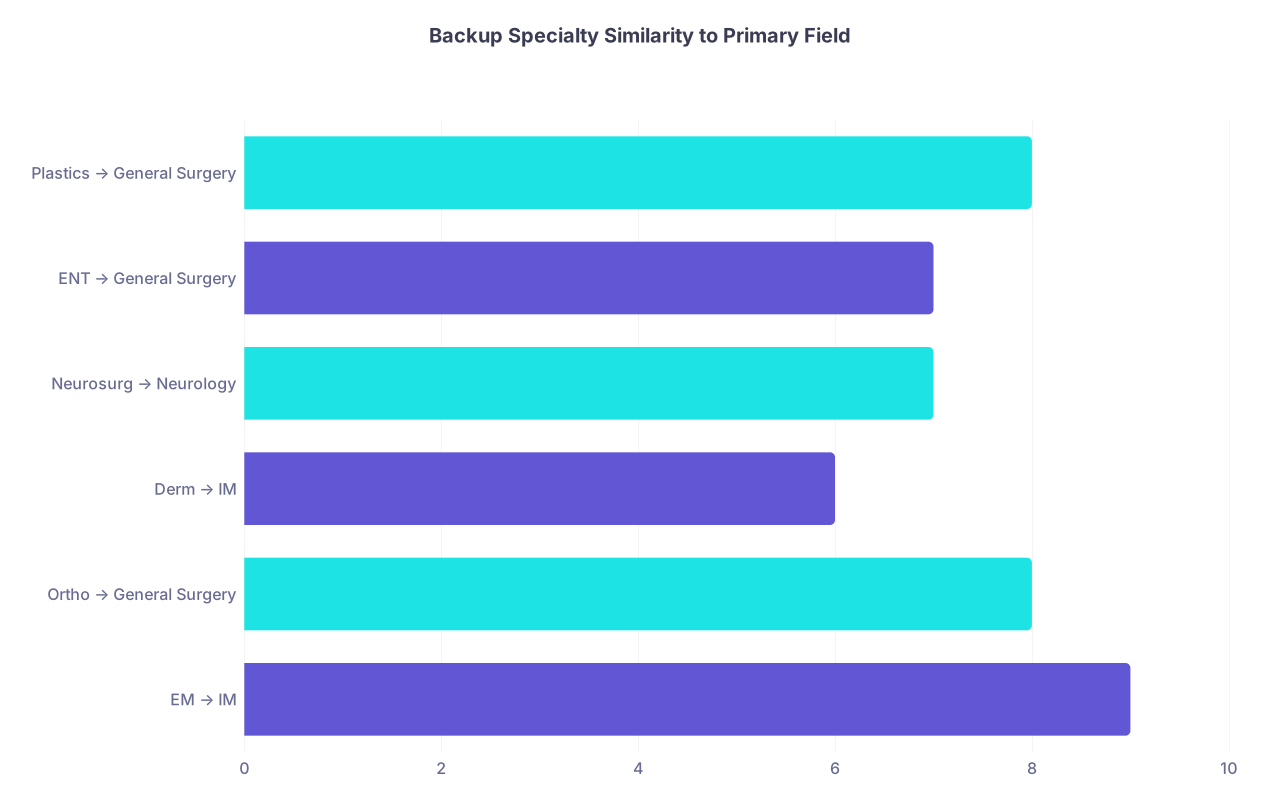
| Category | Value |
|---|---|
| EM → IM | 9 |
| Ortho → General Surgery | 8 |
| Derm → IM | 6 |
| Neurosurg → Neurology | 7 |
| ENT → General Surgery | 7 |
| Plastics → General Surgery | 8 |
(Scale: 10 = very similar day-to-day; 1 = almost totally different.)
Good examples of closely related backups
EM → IM or FM
- Shared ED rotations, acute care, same patient population.
- Similar shift-based lifestyle (esp. hospitalist for IM).
- Application materials and letters often overlap nicely.
Ortho → General Surgery
- Both in the OR, both procedural, similar schedules.
- Many programs see “I loved surgery, open to broader cases” as a believable pivot.
Neurosurgery → Neurology or General Surgery
- Neuro → more cognitive, still focused on the nervous system.
- Gen Surg prelim → you stay in the OR world and can re-apply later.
Derm → Internal Medicine
- Not “identical,” but IM is the closest realistic backup that keeps medicine focus and outpatient options.
- You can still aim for rheum, allergy, or other subspecialties with overlap in chronic disease and outpatient work.
Risky or poor “backup” choices
- Derm → Anesthesia (barely clinical/lifestyle overlap; smells like desperation on paper.)
- Ortho → Radiology if you have zero radiology exposure (letters will be weak, story incoherent).
- ENT → Psych (different everything: patients, culture, day, and training. Very hard to explain.)
Can they work? Sometimes. But they require much more explanation and stronger dual-commitment evidence.
Step 4: Decide How Close Your Backup Really Needs To Be
Here’s the decision framework, in plain language.

| Step | Description |
|---|---|
| Step 1 | Primary is very competitive |
| Step 2 | Backup optional or same field prelim |
| Step 3 | Choose moderately related backup |
| Step 4 | Choose closely related backup only |
| Step 5 | Apply broadly in primary |
| Step 6 | Get real mentorship in both |
| Step 7 | Am I an above average applicant for it |
| Step 8 | Am I ok with different lifestyle or patient type |
Let me translate that into actual moves.
Case 1: You are average or below for a very competitive field
Example: You love Ortho, but:
- No home Ortho program
- Only one ortho letter
- Average Step 2, no research
You cannot safely go “Ortho or bust.”
You need:
- A close backup (General Surgery, maybe PM&R if you can explain MSK exposure well).
- Enough work in that backup to look serious (rotation, letter, personal statement).
Case 2: You honestly like two related fields
Example: You actually enjoy both EM and IM. You’re not completely heartbroken if you end up in your backup.
Good. Then your backup can be:
- Very close (EM ↔ IM, EM ↔ FM, IM ↔ Neurology, Gen Surg ↔ Ortho/ENT/Plastics).
- Or moderately close but defensible (EM ↔ Anesthesia, Ortho ↔ PM&R).
This situation is the easiest to explain in interviews: “I love acute care, I see myself either in the ED managing the front door, or as a hospitalist managing the inpatient side.”
Case 3: You only love one field and hate everything else
Example: “I only want Derm. If I cannot be a dermatologist, I’d rather not practice.”
You have three honest options:
- Apply Derm-only, be ready to SOAP or take a research year if you do not match.
- Use IM as a career-salvage backup with the full understanding that it is not a half-step to Derm; it’s a different life.
- Fix your application first (research year, better letters, more focused story) and apply one specialty only the following year.
The worst option is a fake backup you will be miserable in.
Step 5: Logistical Reality – Can You Actually Apply To Both?
This is where people blow up their applications. They try to apply to two specialties but only build one full application.
You need to be able to do all of the following for your backup:
- At least one strong letter from faculty in that specialty.
- A personal statement that does not sound recycled or generic.
- Enough experiences, ERAS content, and interview talking points to sound believable.
Here’s a quick structure to compare options:
| Item | Primary Specialty | Backup Option A | Backup Option B |
|---|---|---|---|
| Home program in field? | Yes/No | Yes/No | Yes/No |
| At least 1 strong letter? | Yes/No | Yes/No | Yes/No |
| Completed rotation in field? | Yes/No | Yes/No | Yes/No |
| Can write distinct PS? | Yes/No | Yes/No | Yes/No |
| Less competitive than primary? | N/A | Yes/No | Yes/No |
If your backup column is “No” across the board, it is not a real backup. It is a wish.
Step 6: How to Talk About Two Related Specialties Without Sounding Fake
Programs are not stupid. If you apply to two specialties, people will notice. What matters is whether your story holds up.
Rules:
- Never say, “X is my real passion; Y is just my backup” to anyone in Y.
- Anchor your reasoning in overlapping values or interests, not “I could see myself liking this too.”
Example good explanation (EM + IM):
“I really love acute care and complex medical decision-making. In EM I get the front-end resuscitation and rapid diagnostics. In IM I get to live with the complexity and longitudinally manage those same patients. I did rotations in both and genuinely liked both environments, which is why I chose to apply to both specialties this cycle.”
Example good explanation (Ortho + General Surgery):
“I discovered I really like the OR and procedural work. I initially loved the MSK side and did a lot of Ortho exposure. But I also enjoyed my general surgery rotation and liked the broader case mix and team dynamics, so I applied to both and would be happy in either OR-focused career.”
If your story is, “I didn’t match last year and panicked,” own it, but then show what changed.
Step 7: When It’s OK for Your Backup to Be Less Closely Related
Sometimes it is smarter to pick a backup that is not a “little sibling” of your primary specialty, but a solid, separate home.
Examples:
- You’re a borderline Ortho applicant, and while Gen Surg is closest, you absolutely hate bowel surgery and abdominal cases. You’d actually be happier in PM&R despite it being less procedurally intense.
- You’re going for EM, but the idea of pure clinic life in FM appeals more than wards in IM.
- You’re going for Interventional Radiology but would be completely fine in Diagnostic Radiology or Anesthesiology, even if they’re somewhat different.
In those cases, you choose:
- Less overlap, more genuine fit.
- And you build a real application for that different field, not a half-hearted one.
Match happiness > superficial relatedness.
Step 8: How Many Spots Should Be Primary vs Backup?
There’s no perfect number, but here’s a rough rule I’ve seen work:
- If you are reasonable but not stellar for a competitive field:
- 60–70% of applications in the primary specialty
- 30–40% in the backup specialty
- If you are very borderline for the competitive field:
- 40–50% primary
- 50–60% backup
Do not apply to 100 programs in your primary and 5 in your backup. That is not hedging; that’s denial.
FAQ: Backup Specialty Relatedness – 5 Common Questions
1. Can I apply to two completely unrelated specialties (e.g., Ortho and Psych) in the same cycle?
You can. But it will be hard to explain and hard to support with strong letters and experiences in both. If you go this route, you must commit to actually building two distinct, serious applications. Programs will assume you are less committed if everything in your file points in one direction and you just tack on a second specialty at the end.
2. Is using a prelim or transitional year a valid “backup” instead of a second specialty?
Sometimes, yes. For example, surgery-prelim or TY can be a backup if your plan is “I only want X specialty and I’m willing to reapply.” But that’s not a backup career, it’s a backup tactic. You should only do this if:
- You’re highly committed to reapplying.
- You’re okay with uncertainty and the risk of still not matching later.
If you absolutely need a guaranteed long-term path, a categorical backup specialty is safer.
3. I’m applying Derm. Should my backup be IM, Pediatrics, or something else?
Usually IM is the most logical backup:
- Adult medicine, lots of outpatient options, similar pace to clinic life.
- More pathways to subspecialties like rheum, allergy/immunology, heme/onc, etc.
Pediatrics could work if your experiences and letters skew heavily peds. But randomly pairing Derm with something you have no background in (like Anesthesia or Radiology) just because it sounds competitive/“chill” is a weak strategy.
4. Will programs reject me if they find out I applied to another specialty?
Most will not care as long as your application to them looks serious and coherent. Many PDs expect people to hedge in competitive fields. What bothers them is:
- A personal statement obviously written for another field.
- Letters that only speak to another specialty.
- Answers in interviews that sound half-hearted or conflicted.
If you show up prepared and genuinely interested in their field, you’re fine.
5. What if I realize too late that I need a backup and I only have letters in my primary field?
You still have options, but they’re not ideal:
- Hustle to get at least 1–2 backup-appropriate letters (sub-internship, away rotation, or even a strong medicine or surgery letter that comments on your general clinical skills).
- Be honest with advisors and see if a late but focused pivot is realistic in this cycle or if you’d be better off strengthening your file and reapplying more strategically next year.
The worst move is slapping together a fake backup in November with no letters, no rotations, and a recycled personal statement. Programs see through that instantly.
Open your current specialty list right now and write down your realistic backup option next to it. Then ask yourself: “Do I have at least one real letter, a believable story, and enough genuine interest to spend a career in this backup field?” If the answer is no, your job this week is to fix that.