
The blunt answer: You almost never gain anything by telling a program you’re applying to another backup specialty. And you can easily hurt yourself if you do it badly.
Let’s walk through when to keep your mouth shut, when to be honest, and how to do this without tanking your chances in either specialty.
The Core Rule: Default to Not Volunteering It
If you take nothing else from this: do not volunteer that you’re applying to another specialty.
Programs want one thing from you on interview day: believable commitment to their field and their program. Anything that contradicts that makes them nervous.
So the default:
- Don’t put your second specialty in your ERAS application materials for that specialty.
- Don’t mention it in your personal statement for that specialty.
- Don’t raise it in interviews unless they explicitly ask.
That’s not lying. That’s called “answering the question you were asked” and “tailoring your application,” which everyone else is already doing.
Where people get burned is when they:
- Ramble. “I love derm, but I’m also applying IM and peds and neurology…”
- Over-explain. “I really wanted ortho but my Step score was low so I had to apply FM too…”
- Put their indecision in writing. Dual-specialty personal statements, or worse, a generic “I just want to be a great doctor in any field” essay.
You do not need to advertise that you hedged. Almost everyone is hedging in some way.
The Real Question: What If They Directly Ask?
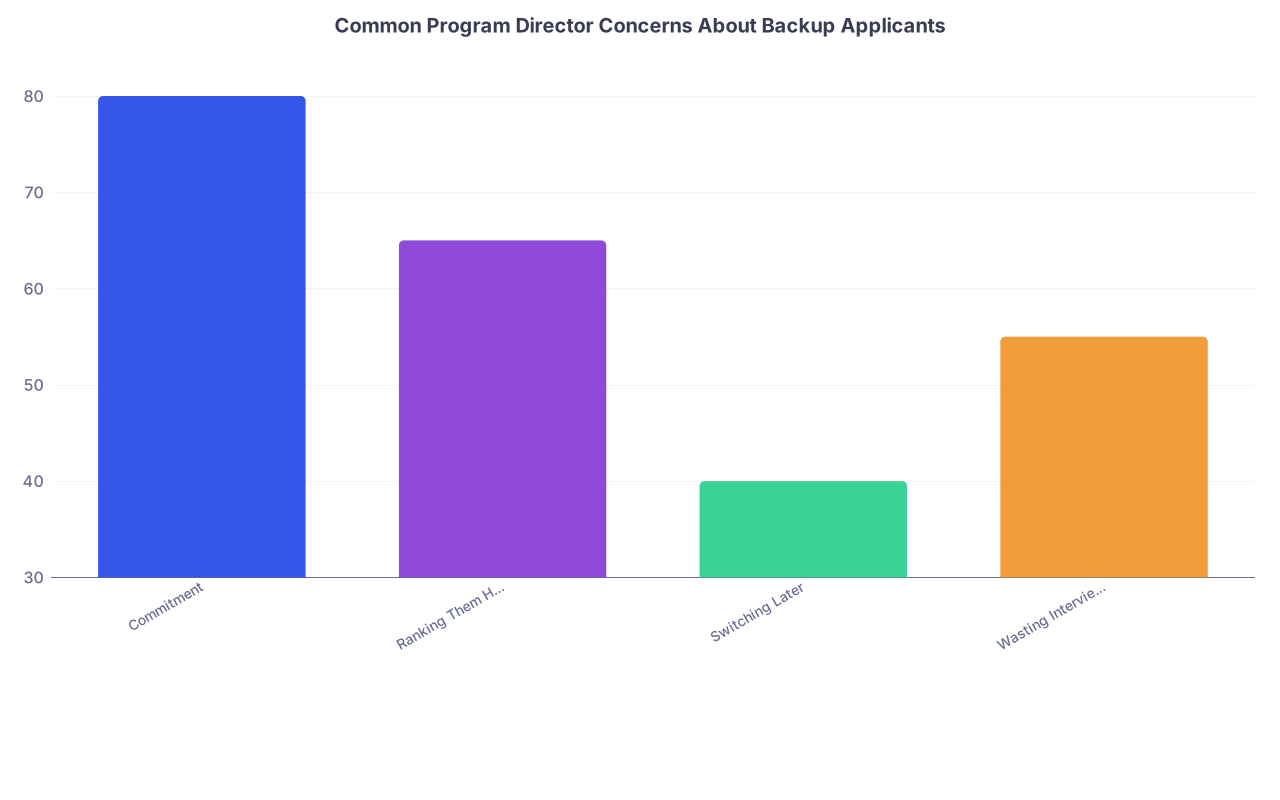
| Category | Value |
|---|---|
| Commitment | 80 |
| Ranking Them Highly | 65 |
| Switching Later | 40 |
| Wasting Interview Spot | 55 |
Programs in competitive fields know applicants are applying to backups. They’re not clueless. Some will ask directly:
- “Are you applying to any other specialties?”
- “If you do not match here, what’s your plan?”
- “Is [Specialty X] your first choice?”
Here’s the principle: be honest, but answer strategically.
You have three levers you control:
- What you admit
- How much detail you give
- How clearly you show commitment to the specialty in front of you
If you’re asked: “Are you applying to other specialties?”
Best structure:
- Brief acknowledgment
- Clear hierarchy
- Concrete reason you’re committed here
Example if interviewing for EM, with IM as backup:
“I am, yes. Emergency medicine is my first choice and the field I’m most excited about. Given how competitive it is, I also submitted a smaller number of internal medicine applications as a safety net. That said, EM is where I see myself long-term, and that’s why I’m here today.”
That hits all three:
- You answered the question.
- You defined EM as your first choice.
- You framed IM as a contingency, not a side passion.
If you’re interviewing for the backup specialty (IM in this example):
“Yes, I also applied to some emergency medicine programs. I’m very interested in acute care, and both IM and EM have paths there. I’ve thought seriously about both routes, and what I like about internal medicine is the longitudinal relationships and the flexibility in fellowship options. If I match in IM, I’d be fully committed to completing the residency and building my career from there.”
Notice the shift: here you’re not calling IM a backup. You’re explaining why it’s a legitimate path you’d follow through.
You don’t need to say “backup.” You don’t need exact numbers. Answer the spirit of the question: are you serious about us?
Situations Where You Should Say Something
There are a few cases where staying totally silent is more risky than being transparent.
1. You’re Applying to an Integrated vs Traditional Path
Think ENT vs categorical surgery + ENT research year. Or integrated IR vs DR with early specialization.
Here, dual pathways are common and programs understand the strategy.
You can say something like:
“I applied to both integrated IR and DR with an ESIR focus. I’m very committed to interventional work; I see both as viable routes. What attracts me to this DR program is the strong ESIR track and the procedural volume.”
Here, your “backup” is still essentially the same field. That’s different from “I applied ortho and also FM just in case.”
2. You Need to Explain a Major Application Pattern
Example: You have a very strong research-heavy neurology application, but you’re sitting in an IM interview with only a few IM-related experiences. They’re going to wonder.
You can preempt briefly:
“Earlier in training I was focused heavily on neurology and did a lot of research in that space, which you can see in my CV. Over the past year on my IM rotations, I realized I enjoyed managing complex, multi-system disease more broadly, so I shifted my focus to internal medicine. I did submit a small number of neurology applications, but I see IM as the better long-term fit.”
Here, you’re:
- Explaining the discrepancy they can obviously see.
- Signaling a relatively recent, thoughtful shift.
- Still giving them a version of “I would actually do this.”
3. You’re Asked a Very Direct, Binary Question
Some PDs don’t dance around it. They’ll ask:
“If you had to choose between [Specialty A] and [Specialty B], which would you pick?”
Dodging that looks worse than answering. You can answer clearly but still keep them:
“If I had offers in both on the same day, I’d choose emergency medicine. That said, I’m not treating internal medicine as a placeholder; if I match here, my plan is to complete residency and likely pursue a critical care fellowship. I’m not interested in hopping specialties later.”
Honesty, plus a plan.
What You Should Never Do
Here’s where people shoot themselves in the foot.
1. Do not write a “dual-specialty” personal statement
“I’m applying to both psychiatry and internal medicine because I love the whole patient…”
No. That usually reads as: “I don’t know what I want and I’m hoping someone else decides for me.”
Write separate personal statements:
- For each specialty
- With specialty-specific reasoning, experiences, and goals
- No cross-talk about your other applications
Programs can sniff a recycled statement in about 20 seconds.
2. Do not send the wrong letter set
If your EM application has:
- 1 EM SLOE
- 2 internal medicine letters
- 1 research letter from radiology
…then you might need to explain the mix if they ask about it. But don’t proactively apologize for it in your PS or interview opener.
At minimum, keep your letters appropriate to each specialty. Do not have:
- A PD letter explicitly saying, “He decided against surgery and is now trying for anesthesia,” in your anesthesia application.
- An attending gushing about how you’ll be a “great psychiatrist” in your FM set.
If you must reuse a letter, choose ones that are clinically focused and not tied to one field.
3. Do not posture or lie
Saying, “I’m only applying to this specialty” when you’re clearly a dual-applicant (e.g., multiple away rotations in the other field, tons of research there) is risky if your story does not line up.
You can emphasize priority without lying:
- Good: “This is my top choice specialty.”
- Bad: “No, I’m definitely not applying anywhere else at all,” when you obviously are.
If you get caught, they’ll just drop you on the rank list. Quietly.
How Backup Specialties Interact With Match Risk

| Step | Description |
|---|---|
| Step 1 | Program asks about other specialties |
| Step 2 | Do not volunteer info |
| Step 3 | Explain dual path and long term goal |
| Step 4 | Admit small backup plan, reaffirm priority |
| Step 5 | Explain thoughtful consideration and commitment |
| Step 6 | Direct question? |
| Step 7 | Same field pathway or related? |
| Step 8 | Interview for primary or backup? |
Backup specialties are about risk management. Program directors know that.
Where you get into trouble is when they think:
- You’ll rank them so low they’ll “waste” a rank spot.
- You’ll match there and then try to switch out.
- You’re so undecided that you’ll be a disengaged resident.
So your job is to communicate three things, in this order:
- “If I match here, I will be all-in.”
- “I have a coherent story for why this field makes sense for me.”
- “Yes, I had to think about risk, but I’m not treating you as disposable.”
If you can’t honestly say #1 and #2 about a backup, you picked the wrong backup.
Specialty-Specific Nuances

Highly Competitive Primary (Derm, Ortho, ENT, PRS, etc.)
Programs assume nearly everyone has a backup. Many will not even ask.
Your strategy:
Primary specialty:
- You can admit a backup briefly if asked.
- Emphasize “I’d reapply to this field” or “I’m looking for pathways that still keep me close to this work.”
Backup specialty:
- Do not undersell them: calling it a pure consolation prize is a fast way to get tanked.
- Focus on authentic aspects you like about the backup field: patient population, practice style, procedures, lifestyle, etc.
Primary IM / Peds / FM With Backup Psychiatry or Neurology (or vice versa)
Here there’s more content overlap. Your explanation is easier:
- Talk about what kind of patients or problems you enjoy most.
- Then show why that leans you one direction or the other.
- Talk about your long-term practice style: continuity vs consultative vs procedure-heavy vs acute.
Again: never call one “real” and the other “backup” in front of any program.
How This Plays With Match Strategy
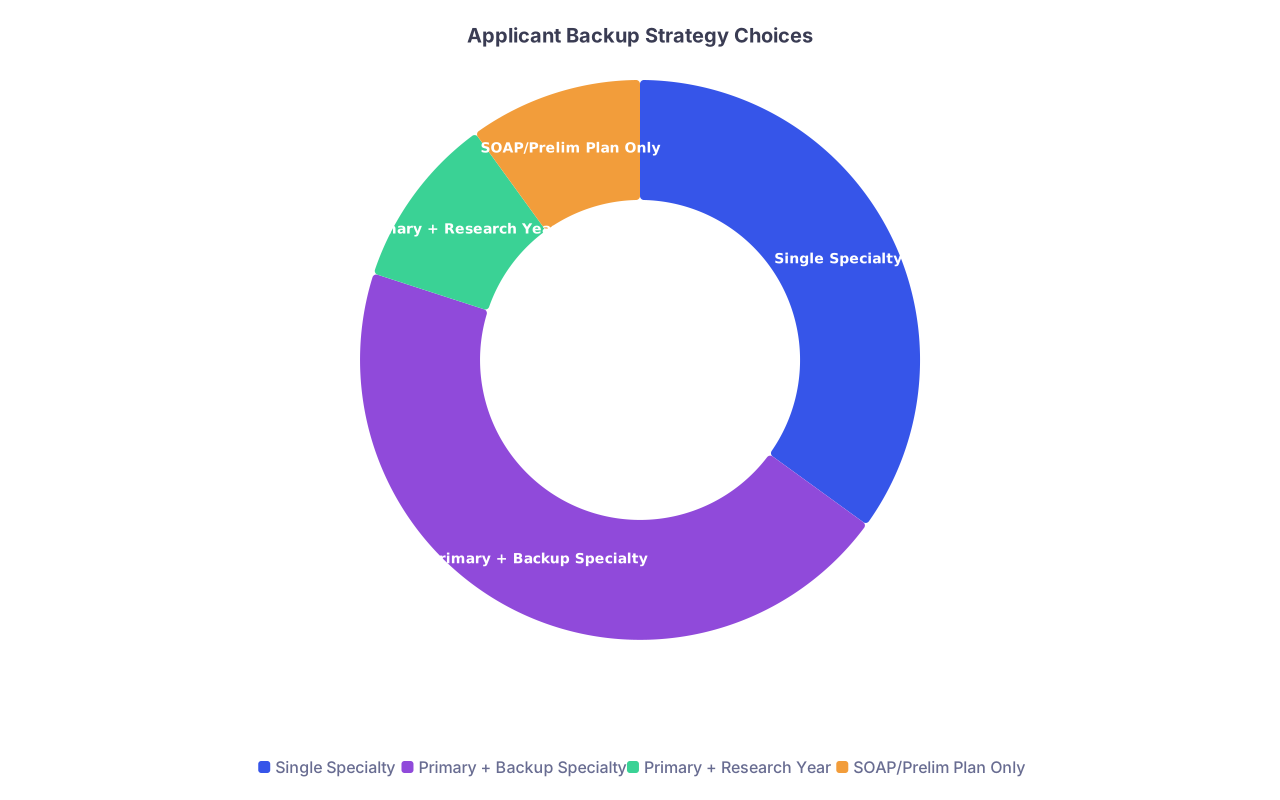
| Category | Value |
|---|---|
| Single Specialty | 35 |
| Primary + Backup Specialty | 45 |
| Primary + Research Year | 10 |
| SOAP/Prelim Plan Only | 10 |
Your back-up strategy has to be coherent:
- If you tell derm programs: “If I don’t match, I’ll do a research year and reapply,”
and you tell IM programs: “If I match IM I’m all in forever,”
you better accept that you’re holding two mutually exclusive stories.
The fix is to choose a real backup lane:
- True backup specialty you’d be okay staying in
- Prelim / TY + reapply route
- Research year then reapply
Then stay consistent in what you tell each type of program.
Don’t try to sell everyone a different future. You’ll confuse yourself and sometimes them.
What To Put In Writing (and What Not To)

Clear lines:
OK in writing:
- Specialty-specific motivations
- Concrete experiences in that field
- Future fellowship interests within that specialty
- Geographic or patient-population preferences
Not okay in writing for that specialty:
- Detailed explanations of other specialties you’re applying to
- “I also applied to…” paragraphs in your personal statement
- Ranking strategy hints (“I will rank all [Specialty X] first, then [Specialty Y]”)
Save any nuanced discussion for live conversations where you can read the room.
Quick Decision Framework
If you’re wondering, “Should I tell them I’m applying to another specialty?” run it through this:
| Scenario | Recommended Approach |
|---|---|
| Not asked about other specialties | Say nothing |
| Vague question about plans if unmatched | Mention broad plan, not specialty list |
| Direct question about other specialties | Admit briefly, define priority, show commitment |
| Application obviously geared to other field | Prepare a 2–3 sentence explanation |
| Dual-pathway (IR/DR, etc.) | Be open and tie both routes to same goal |
| Backup specialty interview | Emphasize genuine reasons you’d stay |
If in doubt, lean toward shorter, honest, specialty-affirming answers.
FAQs

1. Will programs see that I applied to another specialty?
No. Programs do not see which other specialties you applied to through ERAS. They only see what you send them: your specialty-specific application, letters, and personal statement. They figure out dual applicants mostly from your experiences, letters, and what you say.
2. Should I list experiences from both specialties on all my applications?
Yes, but with emphasis. Your ERAS experience section is shared, so you can’t hide prior work. What you can do is:
- Put specialty-relevant experiences higher in the list.
- Use your descriptions to highlight skills and insights that fit that specialty.
You don’t need to scrub your derm research for your IM app; just describe it in a way that makes sense for IM.
3. Is it bad if my letters are mostly from my primary, more competitive specialty?
Not automatically, but it can look odd. If you’re applying to a backup field, they want to see at least one strong letter from someone in that specialty who has actually seen you do the work. Aim for:
- 1–2 letters from the backup specialty
- 1–2 strong, clinically oriented letters from anywhere else
If all your letters talk about how perfect you are for another field, that’s a problem.
4. What if I panic and say the wrong thing in an interview?
Happens all the time. Do not send a three-page clarification email. If you truly mis-spoke (“I told them psych was my first choice when it’s actually IM”), you can send a short, calm note to the coordinator:
“During my interview I realized I may have misstated my future plans. I want to clarify that [short clarification]. I remain very interested in your program.”
Then stop. Over-explaining usually makes it worse.
5. Can I tell my primary specialty programs that I’ll reapply rather than go to my backup?
You can, but you need to mean it. Saying “I’ll only ever do ortho” while you have 30 FM apps out there is a bad look. If your real plan is “ortho or FM, both fine,” then don’t claim some heroic, purist reapply route you don’t intend to follow.
6. How does this change for couples match?
Couples match makes backup specialties more common and more complicated. In interviews you can say:
“I’m in the couples match, so we had to think carefully about geography and options. We structured our lists so that we still end up in programs and specialties we’re genuinely excited about.”
You don’t need to map out your whole couples strategy; just show that the specialty you’re interviewing for is a serious option, not collateral damage from your partner’s apps.
7. What should I do today to clean this up?
Open your personal statements and interview prep notes. For each specialty, remove any explicit mention of other specialties or ranking strategy. Then write out one clear, honest, 2–3 sentence answer to: “Are you applying to other specialties?” for your primary and for your backup. If you can say those out loud comfortably, you’re in good shape.