
It’s early February. Your rank list window just opened. You’re staring at “Dermatology – Dream Program” on line 1 and “Internal Medicine – Very Safe” a few spots down… and your brain won’t shut up.
“If I put derm first and don’t match… did I just throw away IM?
If I move IM up, am I giving up on my dream?
What if I end up scrambling into something I hate?”
Here’s the answer you’re looking for: you’re not actually deciding “dream vs safety” on your rank list. You’re deciding how much risk you’re willing to take with the only shot you get this year.
Let’s turn this from vague anxiety into a clear framework.
First: How the Algorithm Really Treats Your Risk
Before you play with risk, you need to understand the game.
The NRMP algorithm is applicant-proposing. Translation: it tries to make your dreams happen first, and only settles down to the safer stuff if it has to.
Here’s what that means in practice:
- Ranking a competitive specialty first does not hurt your chances of matching your backup.
- Programs do not see your full list or where you ranked them.
- You can’t “scare off” a safe program by putting a reach program above it.
The algorithm goes down your list in order:
- Tries your #1.
- If that doesn’t work (program didn’t rank you high enough), it tries #2.
- Then #3. And so on.
You only “lose” if you run out of programs you both:
- Ranked
and - Ranked you high enough to fill an open spot.
So ranking your dream field above safer backups never directly reduces your odds of matching anything below it. The risk you’re actually playing with is:
“Am I OK if this year ends with no match in order to give myself a shot at the dream?”
Everything in this article is just different ways of answering that one question.
Step 1: Be Brutally Honest About Your Competitiveness
You cannot build a sane risk strategy if your self-assessment is fantasy.
You need a clear-eyed view on how you stack up within your dream field, not against your class in general.
For your dream specialty (derm, ortho, plastics, ENT, optho, anesthesia, whatever), ask:
- Board scores / COMLEX:
- Did you pass on the first attempt?
- If Step 2 numeric: are you at, above, or below your specialty’s average?
- Class performance:
- Honors in core rotations, especially those related to your field?
- Any professionalism flags, remediation, leaves?
- Letters:
- At least 2 strong specialty-specific letters from people who actually know you?
- Research:
- Any pubs/posters in the field, or at least something scholarly to show commitment?
- Home / away rotations:
- Rotated in the specialty?
- Got strong feedback? Anyone advocating for you?
If you’re not sure where you land, this is where I get blunt: ask people who will tell you the truth. Not the “you’re great, you’ll be fine” crowd. You want:
- The PD or APD in your field at your home program
- A specialty mentor who’s on a selection committee
- A dean who looks at your whole file and has seen 10+ cycles
Ask them explicitly:
“If I apply only to [dream field], based on applicants you’ve seen, do you think I’m:
A) likely to match
B) 50/50
C) unlikely without a backup plan?”
Push for an answer. If they refuse to commit, that’s often a soft “B/C.”
Now, translate that into your categories:
| Category | Description |
|---|---|
| Strong | Above average for the field |
| Borderline | Around average / slightly below |
| High Risk | Clearly below average / major flags |
You probably already know which you are, even before the table.
Step 2: Decide Your “Failure” You’re Willing to Tolerate
Here’s where you stop thinking about “rank order” and start thinking about worst-case scenarios.
There are really only three:
Worst Case A: No Match, No Backup
- You rank only dream specialty.
- You don’t match.
- You enter SOAP, reapply, or take a gap year.
Worst Case B: Match Backup, Not Dream
- You rank dream + backup.
- You don’t match dream.
- You match backup and start residency in something that isn’t your #1.
Worst Case C: Delay But Preserve Dream
- You go all-in on dream.
- If you don’t match, you’re willing to spend 1–2 years doing research, prelim, or something else, then reapply.
Most people pretend they’re OK with A or C, then panic in March. Don’t do that to yourself.
Be explicit:
- Am I actually OK being unmatched next year if that’s what it takes to swing for this?
- Am I willing to live with matching a backup I’m lukewarm about, for good job security and no gap?
- Or do I absolutely, non-negotiably need to work in my dream specialty, even if it costs me time and money?
Write your honest answer down. Literally. On paper.
Step 3: Use a Simple Risk Framework
Now let’s put this together into an actual decision tree.
Framework 1: The “Go All-In” vs “Two-Path” Decision
This is the core fork in the road:

| Step | Description |
|---|---|
| Step 1 | Assess Competitiveness |
| Step 2 | Rank only dream field |
| Step 3 | Rank dream plus real backup |
| Step 4 | Apply and rank both fields |
| Step 5 | Consider research or improving CV before applying |
| Step 6 | Strong for dream field |
| Step 7 | Unmatched acceptable |
| Step 8 | Borderline or high risk |
| Step 9 | Would you be happy in backup |
Let me spell it out more concretely.
If you are Strong for your dream field AND:
You can tolerate the (small) chance of going unmatched →
Strategy: Rank your dream field programs first, then your backups.
This is the ideal scenario. You give the algorithm full freedom to get you dream, but you have a safety net.You absolutely cannot tolerate going unmatched →
Same strategy (rank dream first, then backup),
but you must:- Apply widely in both fields
- Make sure your backup specialty list, by itself, is strong enough to match you somewhere
If you are Borderline / High Risk for your dream field:
You now have three realistic options:
Two-Field Application Now (Dream + Backup)
- You apply to both fields this year.
- You rank dream programs first, then backup programs.
- You accept there’s a high chance you’ll end up in the backup.
All-In Dream + Plan to Reapply
- You apply only to dream field now.
- If you don’t match, you do research / prelim and reapply stronger.
- This makes sense if your dream field is the only thing you can see yourself doing long-term.
Delay Application, Build CV, Then Apply Dream
- You take a research year (or other structured gap) now before even applying.
- This is the most painful in the short term but sometimes the smartest long-term play for ultra-competitive specialties.
What you don’t do (because it’s the worst combo of all worlds):
Apply half-heartedly to a dream field you’re weak for, barely apply to backup, then act surprised when you don’t match at all.
Step 4: Concrete Ranking Strategies for Common Situations
Let’s turn this into actual rank list behavior. Here are the big scenarios I see over and over.
Scenario 1: Strong in Dream Field, Good Backup Options
Example: Step 2 252, multiple ortho publications, strong letters, but also liked EM and applied to a few EM programs as backup.
Rank list approach:
- Put every ortho program you interviewed at above any EM backup
- Then rank your EM programs underneath, in your true preference order
Risk profile: You’re prioritizing dream strongly but giving the algorithm plenty of chances to catch you in EM if ortho doesn’t work. You’d have to completely whiff on ortho and EM to go unmatched. Low risk.
Scenario 2: Borderline Dream, Very Happy With Backup
Example: Average derm applicant with a couple red flags, but genuinely likes IM and could see a satisfying career in heme/onc or rheum later.
Rank list approach:
- Rank all derm programs first, ordered by how much you like them
- Then rank all IM programs under that, also by true preference
- Don’t play games like “I should move that mid-tier IM above that top derm because it’s safer.” That’s not how the algorithm works.
Risk profile: You give yourself a shot at derm, but if the field collectively says no, you are very likely to land in IM. You’ve basically chosen Worst Case B (match backup, not dream) over A (no match).
Scenario 3: Borderline Dream, Hate Backup Option
Example: You love ENT. You’d deeply dislike gen surg as a career. No other field appeals. You’re mid/low tier ENT on paper.
You have two honest choices:
- All in ENT now:
- Apply to every reasonable ENT program, couples match if relevant, etc.
- Accept the real possibility of being unmatched and doing research/prelim.
- Step back this year:
- Do a formal research year, build publications, improve letters, reapply as a much stronger ENT applicant.
What you don’t do:
Apply to ENT and then rank a gen surg backup high “just in case” when you already know you’d be miserable in gen surg. That’s how people end up in specialties they resent, burning out early.
If you rank a field, you must be willing to do that job for real. Not “only if I never think about ENT again.” For real.
Step 5: Quantify Your Risk Tolerance in Plain English
You don’t need a PhD in statistics. You need a sentence.
Pick the one that feels most accurate for you:
- “I’d rather risk going unmatched than settle for a field I don’t want.”
- “I’d rather end up in my backup than risk going unmatched.”
- “I’m OK with spending an extra year or two to get into my dream field.”
Those three sentences map to three clean strategies:
| Your Sentence | Strategy |
|---|---|
| Prefer risk of unmatched | All-in or heavy emphasis on dream |
| Prefer backup over unmatched | Rank dream first, robust backup list |
| OK with extra years to chase dream | Research/gap + stronger reapplication |
Once you pick the sentence, ranking actually gets easier. You’re just ordering programs inside your chosen bucket.
Step 6: Avoid These Three Common Mistakes
I’ve watched a lot of people blow up an otherwise reasonable plan with dumb rank list decisions. Don’t be that person.
Mistake 1: “Protecting” a Backup by Ranking It Higher
Example: Putting “Safe IM #1” above “Dream Derm #1” because you’re scared.
This does nothing to increase your chance of matching IM. Zero. All it does is:
- Guarantee that your best shot at your dream is now permanently below that IM program, even though the algorithm would happily have tried derm first and then IM.
Always rank in true preference order. The algorithm already protects your backups.
Mistake 2: Ranking a Field You Don’t Actually Want
If you will be miserable doing it, don’t rank it. Full stop.
You are not “just trying it for a year.” Residency is years of your life, in a field that naturally tends to funnel you into that career path. Switching later is possible, but painful and not guaranteed.
Mistake 3: Ignoring SOAP Risk
If you go all-in on a hyper-competitive field with a marginal application, your realistic backup might not be “match backup IM.” It might be “SOAP into prelim surgery or transitional, then scramble for something later.”
Look at historical SOAP data. Look at how many categorical spots go unfilled in realistic backup specialties. Don’t assume SOAP will hand you a cushy categorical IM job in your hometown.
Step 7: Use Data To Sanity-Check Your Plan
Before you lock anything:
- Look up the NRMP Charting Outcomes for your dream field:
- Match rates by Step 2, AOA, research, etc.
- Compare yourself honestly to the median matched applicant.
- Look at how many programs you interviewed at in each field.
Then, ask:
- If I only had my backup specialty list, is it strong enough on its own that I’d expect to match somewhere?
- If I only had my dream specialty list, what’s my realistic match probability?
You can even do a rough mental “portfolio” breakdown. For example:
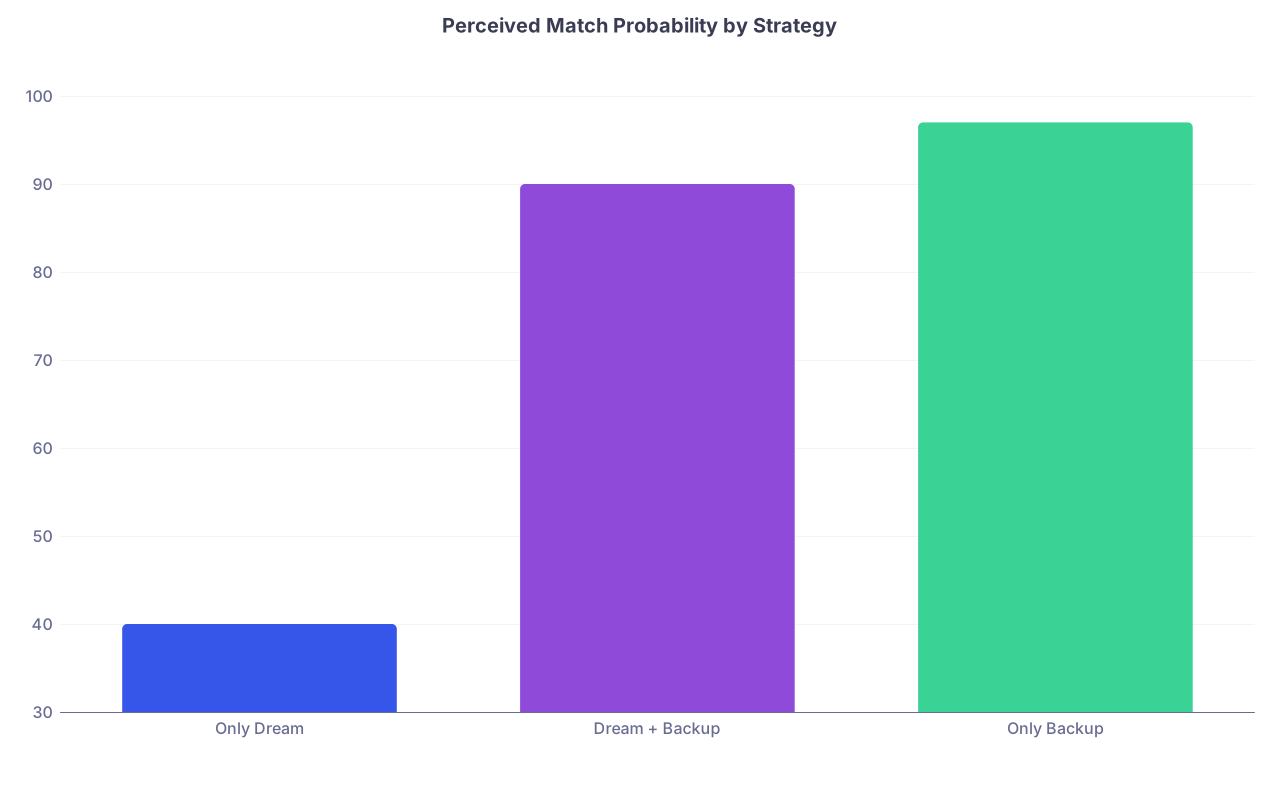
| Category | Value |
|---|---|
| Only Dream | 40 |
| Dream + Backup | 90 |
| Only Backup | 97 |
Fake numbers, but you get the point. One plan gets you 40% chance at anything. Another gives you 90% at something you can live with.
If your numbers look like “10% vs 95% vs 99%,” the smart answer usually jumps off the page.
Step 8: How to Actually Build Your List Tonight
Here’s the concrete workflow I’d use if you handed me your interview spreadsheet.
Split your programs into columns:
- Dream specialty
- Backup specialty 1
- Backup specialty 2 (if you have it)
Within each specialty, drag programs into order of where you’d want to live and train, totally ignoring risk.
Decide your overall strategy sentence:
- “I’d rather risk unmatched than backup” → heavy dream emphasis.
- “I’d rather backup than unmatched” → robust backup list.
Start your rank list:
- Put all dream specialty programs first (in the order you made).
- Then all backup 1 programs.
- Then backup 2 if applicable.
Sanity check:
- If you deleted all dream field programs from the list, would you still have enough backup ranks to feel safe?
- If yes → You’re likely fine.
- If no → You either need more backup interviews or to accept higher unmatched risk.
If you’re couples matching, multiply the complexity by 10. But the principle is the same: your rank list should still reflect true combined preferences, just across both of you.
The One Thing You Should Do Today
Pull up your current draft rank list.
Now do this:
Delete all the program names. Replace them with only the specialty names in order.
It should look something like:
- Derm
- Derm
- Derm
- IM
- IM
- IM
Stare at that distribution. Forget which derm or which IM.
Ask yourself: “If this is how the Match algorithm tried me—three derm attempts, then three IM—am I truly OK with the risk that implies?”
If the answer is no, adjust the mix (either more dream or more backup) until your gut yes is honest.
Once you like the specialty pattern, you can put the program names back.