
You’re in August. ERAS is opening soon. Your main specialty is set… sort of. But now you’re staring at your CV, your Step scores, maybe a lukewarm advisor comment, and thinking: “Do I need a backup? And if I pick two or three backups, do I just look completely scattered?”
Let me give you the bottom line first, then we’ll unpack it.
Most applicants should have 0–1 backup specialties.
2 backups is the upper limit before you start looking unfocused.
3+ backups is almost always a red flag.
Now let’s walk through how to decide where you fall on that spectrum and how to do backups without torpedoing your application.
The Core Answer: How Many Backup Specialties Is “Reasonable”?
Here’s the clean, honest answer:
Competitive specialty, borderline app (Derm, Ortho, ENT, Plastics, Urology, NSG, Rad Onc, sometimes EM):
Reasonable: 1 clearly related backup
Risky / scattered: 2+ backupsModerately competitive specialty (Anesth, OB/GYN, Radiology, General Surgery at solid programs):
Reasonable: 0–1 backup
Risky: 2+ backupsLess competitive specialty (FM, Psych, Peds, IM at community / mid-tier):
Reasonable: 0 backups for most; consider 1 only if you have major red flags
Risky: 2+ backups (this tends to look confused, not cautious)
If you want a single rule to hang onto:
More than 2 specialties total (primary + 1 backup) puts you on thin ice.
3 different specialties on your ERAS is where people start saying, “What is this person actually trying to do?”
Step 1: Do You Even Need a Backup Specialty?
Before counting backups, decide if you actually need one. A lot of people overdo this because of anxiety, not reality.
You should seriously consider a backup if:
- You’re applying to a very competitive field and:
- Your Step 2 is on the low side for that field, or
- You’re late with applications, or
- You have limited research / letters in that field.
- You have red flags:
- Failed Step/COMLEX attempt
- Repeated a year, leaves of absence
- Very limited geographic flexibility
- You’re at a med school with weak track record in your chosen field:
- Almost no recent matches in that specialty
- Few or no home rotations / faculty
You probably don’t need a backup if:
- You’re applying to:
- IM, Peds, FM, Psych, Path, PM&R
- With decent scores, no red flags, reasonable geographic flexibility
- You have:
- Strong letters in your main field
- Solid audition rotations
- A realistic program list
A lot of strong IM or Psych applicants waste time backing themselves up into FM or another field they don’t want and never rank. That’s just dilution. If your primary target specialty is realistically within reach, commit.
Step 2: How Many Backup Specialties Can You Have Before It Looks Scattered?
Here’s the sanity framework: Programs don’t see how many specialties you applied to, but they do see what your story looks like. That story comes from:
- Your personal statement
- Your letters (who wrote them and what specialty they’re in)
- Your experiences (electives, sub‑Is, research)
- Your interview answers (“Why this specialty?”)
So the question isn’t just “How many backups?” It’s actually “How many different stories can I tell convincingly?”
For almost everyone, the answer is: one story + maybe one very closely related backup story.
Safe territory: 1 primary + 0–1 backup
This looks focused, mature, and realistic. For example:
- Derm + Med‑Derm/IM
- Ortho + General Surgery
- ENT + General Surgery
- Rad Onc + IM
- Neurosurgery + General Surgery
- Anesthesia + IM
- EM + IM or FM (depending on your narrative)
In these pairs, you can craft a believable through-line: procedure vs non‑procedure, critical care focus, continuity vs acute, etc. Programs see that as thoughtful, not scattered.
Caution territory: 1 primary + 2 backups
Can this work? Sometimes. But you’re now doing triage:
- Your time is split across 3 different application strategies
- Your letters are probably misaligned
- At least one specialty will feel “thin” or generic
Example that might work but is risky:
- EM + IM + FM
Or - Ortho + Gen Surg + Anesthesia
You’ll spend a ton of energy maintaining 3 separate explanations. One of those explanations will crack on interview day.
Red-flag territory: 3+ true backups (so 4+ specialties total)
This almost always screams:
- “I don’t know what I want”
- “I’m chasing a job, not a career”
- “I panicked and applied everywhere”
Even if programs don’t literally see the list of other specialties, your application will betray it: mismatched letters, generic personal statements, experiences all over the map.
Step 3: How To Pick a Backup That Doesn’t Make You Look Scattered
If you decide on a backup, pick it strategically, not emotionally.
Rule 1: Choose a logically related backup
You want something where the narrative is believable. Examples:
Surgical primary → General Surgery or Anesthesia
Ortho, ENT, NSG, Plastics → Gen Surg or Anesthesia makes sense: shared OR environment, procedural mindset.Medicine‑adjacent primary → IM or Med‑Peds
Cards, GI, Heme/Onc interests from the start? IM backup is natural.Acute care primary (EM) → IM or FM
You can spin continuity of care, hospitalist interest, or community impact.Radiology‑adjacent primary → Radiology or IM
If you like physiology, diagnostics, patterns → those are bridges you can articulate.
What doesn’t look good:
Derm + Ortho + Psych, with one random letter in each. That’s not being open-minded, that’s being lost.
Rule 2: Don’t pick a backup you’d be miserable doing
I’ve seen this too many times:
Student applies Ortho → backs up with FM “just in case” → matches FM → spends intern year watching Ortho residents scrub from the other side of the hallway and hating life.
Ask yourself bluntly:
“If I never do my primary specialty and I end up in this backup, can I see myself doing this for 30 years without constant resentment?”
If the answer is no, that’s not a backup. That’s a disaster.
Rule 3: Be realistic about competitiveness
Don’t “backup” Derm with Radiology if your Step 2 is 210 and you failed Step 1. That’s not a backup, that’s a parallel fantasy.
Your backup should be:
- Clearly less competitive than your primary
- Realistically matchable for you on paper
Step 4: How To Align Rotations, Letters, and Statements Across 1–2 Specialties
This is where people either look focused… or scattered.
Rotations
Rough model:
If you have 1 primary only:
2–3 rotations in that field (home + away(s)) is fine.If you have primary + 1 backup:
- 1–2 sub‑Is / audition rotations in your primary
- 1 sub‑I or elective in your backup
That tells both sets of programs: “I took you seriously enough to actually show up in your field.”
If you claim 3 specialties:
Odds are you did 0–1 meaningful rotations in at least one of them → that’s how you look scattered.
Letters
Letters matter more than students like to admit.
Aim for:
- Primary specialty: 2–3 letters in that specialty
- Backup specialty: at least 1 strong letter in that specialty
Do NOT:
- Apply to Gen Surg with 3 Derm letters and no surgeon letter
- Apply to IM with only Ortho and EM letters
Programs will rightly question if you’re just “using” them.
Personal statements
If you have two specialties, you need two statements.
Full stop. One generic “I love patient care and teaching” statement reused everywhere is a fast way to look unfocused.
Each statement should:
- Clearly articulate a coherent “why this specialty”
- Use experiences that fit that field’s vibe
- Avoid references that betray another specialty (“When I’m in the OR…” in your Psych statement, for example)
You do not need to explain your other specialty in each statement. You just need to sound fully committed to the one you’re applying to in that application.
Step 5: The Hidden Cost of Too Many Backups
Even if programs never know you applied to four fields, you will feel it. And it shows.
Here’s what happens when people apply to 3–4 specialties:
- They dilute their effort: weak personal statements across the board
- They’re constantly context-switching in interview prep
- They give mushy answers to “Why this specialty?” because they’ve rehearsed three different answers and they bleed together
- They end the season with multiple rank lists they don’t actually understand
And the worst part: they often match into the “backup of the backup” they never wanted, because that’s the program that loved them most.
I’ve heard this line more than once from interns:
“I didn’t think I’d actually match here. I just threw in an application as a backup.”
That’s not a good feeling.
So yes, on paper you can apply to a bunch of fields. But the cognitive and emotional cost is huge. One primary plus one well-chosen backup keeps you sane and focused.
Quick Scenarios: Does This Look Scattered?
Here’s a rapid-fire check.
| Combo | Verdict |
|---|---|
| Derm + IM | Reasonable |
| Ortho + Gen Surg | Reasonable |
| Ortho + Gen Surg + Anesthesia | Risky |
| EM + IM | Reasonable |
| EM + IM + FM | Risky |
| Neurosurgery + Gen Surg | Reasonable |
| Neurosurgery + Gen Surg + IM | Risky |
| Derm + Ortho + Psych | Scattered |
If you’re staring at your list and thinking “these specialties don’t sound like the same person at all,” you’ve got a scattered problem.
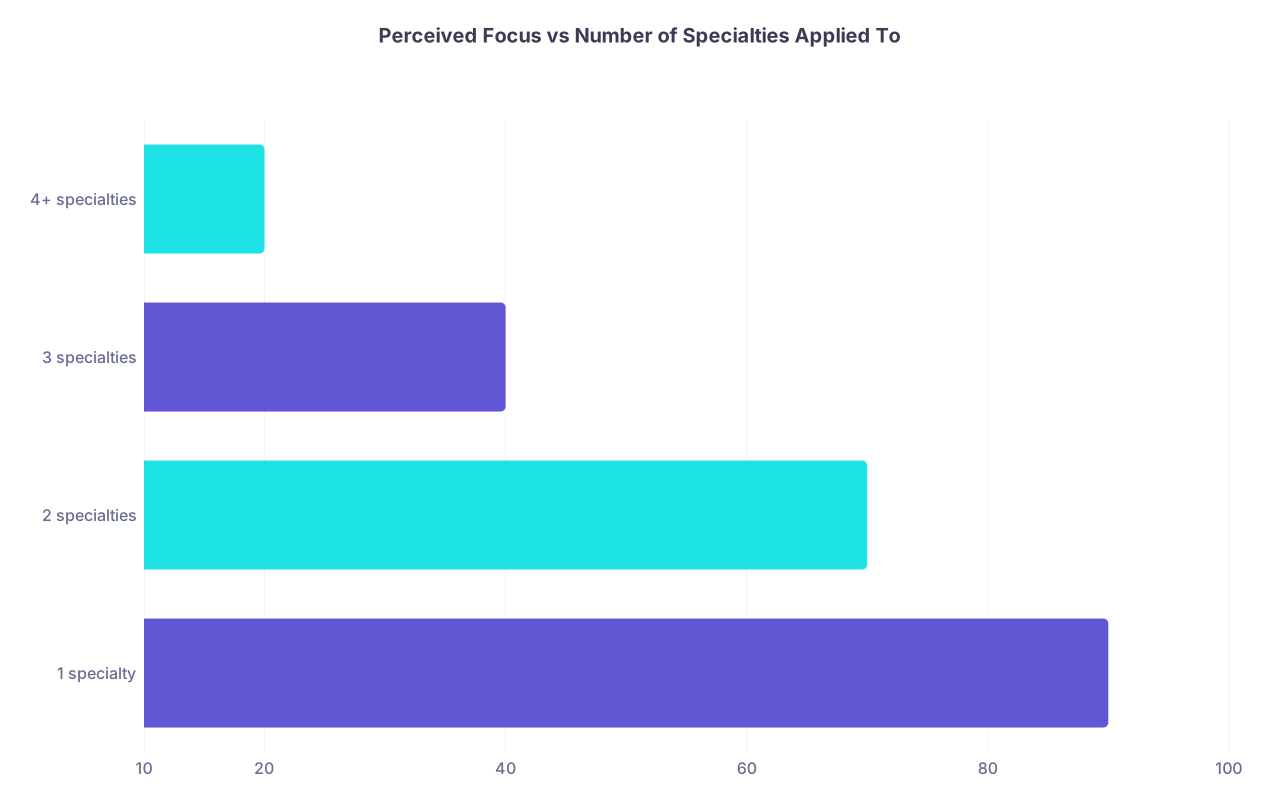
| Category | Value |
|---|---|
| 1 specialty | 90 |
| 2 specialties | 70 |
| 3 specialties | 40 |
| 4+ specialties | 20 |
(Approximate perceived “focus score” out of 100 by program directors I’ve talked to. Not a real study, but pretty on‑brand with their attitudes.)
How to Decide Your Number in 10 Minutes
If you want a quick decision framework, here it is:

| Step | Description |
|---|---|
| Step 1 | Choose primary specialty |
| Step 2 | 0 backups or 1 related backup |
| Step 3 | 1 clear backup |
| Step 4 | 0 backups |
| Step 5 | 1 clear backup |
| Step 6 | Stop. Too scattered for most |
| Step 7 | You are done |
| Step 8 | Is it highly competitive? |
| Step 9 | Are your stats strong for that field? |
| Step 10 | Do you have major red flags? |
| Step 11 | Thinking about 2nd backup? |
If you’re still trying to force a second or third backup after this, ask yourself honestly: is that planning, or pure anxiety?
FAQs: Backup Specialties and Looking Scattered
1. Can programs see that I applied to other specialties?
They can’t see a literal list in ERAS, but they can often infer it from:
- Your letters (mix of unrelated specialties)
- Your experiences and research being all over the place
- Inconsistent interview answers
So no, there isn’t a “multi-specialty” flag. But yes, they can smell a scattered application.
2. Is it okay to talk about my primary specialty when interviewing for my backup?
You can reference your journey briefly, but don’t make it the star of the show.
Acceptable: “I explored Ortho early on and realized what I actually loved was the longitudinal care and complex medical management, which is why I committed more fully to IM.”
Not acceptable: spending 5 minutes talking about how much you still love Ortho and how sad you are to leave it behind. Programs want people who want them, not people actively grieving another field.
3. What if my advisor says I should apply to 3–4 specialties “to be safe”?
I’ve seen this. Some advisors are risk-averse to a fault. Push back a little:
- Ask them which one backup they’d pick if it had to be just one.
- Ask what that would mean for your rotations and letters.
Most will admit that 1 carefully chosen backup with a strong application is better than 3 shallow ones.
4. Can I use the same personal statement for my primary and backup specialties?
No. If you’re applying to two different specialties, write two statements.
Recycling a generic “I love medicine and teaching” essay is how you end up sounding like you committed to nothing. Your backup deserves a targeted, honest “why this field” just as much as your primary.
5. How many programs should I apply to in my backup specialty?
Depends on your risk profile, but as a rough rule:
- Competitive primary + 1 less-competitive backup:
25–40 programs in your main field, 15–25 in your backup is common.
The point is not to match the numbers; it’s to have a realistic shot in each field without turning your entire life into interview chaos.
6. What’s one clear sign my plan looks scattered?
If you can’t answer this question cleanly for each specialty in 2–3 sentences:
“Why this specialty, and how has your path clearly pointed you here?”
…then you’re scattered. If you’re inventing a completely different persona for each application, you’ve gone too far.
Do one thing today:
Open a blank page and write down the specialties you’re currently planning to apply to. Circle your true primary. Now force yourself to pick at most one backup that you would genuinely be okay doing long-term. Cross out everything else. That’s your new, focused plan.