
You’re three tabs deep in ERAS. You’ve got a primary specialty you actually want, two backup specialties “just in case,” and a half-written email to your letter writers sitting in your drafts. You suddenly realize:
“I’m applying to EM, IM, and maybe prelim medicine. Do I need totally different letters for each? Or can I reuse?”
Here’s the straight answer:
You do not need a completely new set of letters for every backup specialty.
But you do need at least some specialty-appropriate letters for each field you’re seriously applying to.
Let’s break it down properly so you stop guessing.
The Core Rule: Match Letters to the Specialty You’re Actually Applying To
Programs care about two things from your letters:
- Are you a safe, reliable resident?
- Are you a good fit for this specialty?
If you apply to a specialty with only letters from a different field, you’re telling them:
- Nobody in this specialty was willing to vouch for you
- Or you didn’t care enough to get one
Both look bad.
So as a baseline:
- For each distinct specialty you apply to (IM, FM, EM, Psych, etc.) you should ideally have:
- At least one letter written by someone in that specialty
- Better: two if the specialty strongly prefers them (IM, EM, surgery especially)
But you can reuse some general letters across specialties if they’re written wisely.
How ERAS Actually Handles Letters (So You Don’t Overcomplicate This)
Programs don’t see “your letters.” They see the specific letters you assign to their program.
You can:
- Upload a letter once
- Assign it to some specialties and not others
- Mix and match different letters for each program
Most programs accept 3–4 letters. Common patterns I’ve seen work:
- 2 specialty-specific letters
- 1–2 general “this person will be a great resident” letters
So you don’t need 12 different letters. You need a core pool you can recombine.
| Specialty Type | Recommended Letters | Max Letters Used |
|---|---|---|
| Medicine (IM/FM) | 2 IM/FM + 1–2 general | 3–4 |
| Surgery | 2–3 surgery + 0–1 general | 3–4 |
| EM | 1–2 SLOEs + 1 general | 3–4 |
| Psych/Neuro | 1–2 specialty + 1–2 general | 3–4 |
| Prelim-only (IM/Surg) | 1 specialty + 1–2 general | 3–4 |
Concrete Scenarios: Do You Need Separate Letters?
Let me walk through the exact scenarios students ask me about every year.
1. Primary IM, Backup FM
Internal Medicine and Family Medicine are cousins. They overlap heavily.
What you actually need:
- You do not need two completely separate letter sets.
- If you have:
- 2 strong IM letters
- 1 outpatient or primary care–oriented letter (clinic, FM, IM outpatient, geriatrics, etc.)
You can usually reuse most letters for both IM and FM.
Best setup:
- Use IM-heavy combos for academic IM programs
- For FM programs, include:
- Any FM letter you have, or
- A letter that clearly comments on outpatient, continuity, whole-patient care
If you can get one FM letter, do it. It strengthens FM apps a lot with minimal extra work.
2. Primary EM, Backup IM
This one trips people up.
Reality:
- EM wants SLOEs (Standardized Letters of Evaluation) from EM rotations.
- IM wants IM letters. Preferably from inpatient ward attendings.
Can you apply to IM with only EM SLOEs?
You can. I’ve seen it. But it’s not ideal.
What I recommend:
- For EM:
- 1–2 SLOEs (mandatory for any realistic EM shot)
- For IM:
- 1–2 IM ward attendings
- 1 SLOE or general letter can be reused if it emphasizes teamwork, reliability, and internal medicine–type thinking
Bottom line: Yes, you need separate IM letters if you’re seriously using IM as a backup. EM letters alone make IM programs nervous that you’re not actually interested.
3. Primary Categorical IM, Backup Prelim-Only IM
You do not need special “prelim-only” letters.
Use the same IM letters for:
- Categorical IM
- Prelim IM
- Transitional Year (TY), if you apply to those too
What changes is:
- Your personal statement (you may want a separate prelim/TY one)
- The way you talk about your plans on interviews
Letters can be identical across IM categorical and prelim programs. No problem.
4. Primary Surgery, Backup IM
These read as different identities to programs. They’ll sniff out confusion immediately.
You should have:
- For Surgery:
- 2–3 letters from surgeons (ideally including someone from your sub-I)
- For IM:
- 1–2 letters from IM ward attendings
Can you reuse a medicine letter that’s also “fine for surgery”?
Yes—but surgery programs really want surgeons saying, “This person belongs in the OR.”
For IM backups, at least one solid IM letter is non-negotiable if you want anyone to take that backup seriously.
5. Primary Psych, Backup IM or FM
For each of these, you want at least one specialty insider:
- Psych: 1–2 psychiatry faculty letters
- IM/FM: 1–2 letters from IM/FM attendings
A good bridging letter:
A medicine attending who can comment on your psych interest, empathy, communication, and ability to manage medically complex patients with psychiatric comorbidity. That letter can be used for both psych and IM/FM if written thoughtfully.
But do not apply to psych with only medicine letters. Or to IM with only psych letters. That looks like you just sprayed applications around.
How Many Total Letters Do You Actually Need?
Not all that many. People overbuild their letter lists and then confuse themselves.
For most students applying primary + 1–2 backups, a core pool of 4–6 letters is enough.
Example setup (primary IM, backup FM and prelim):
- 2 Internal Medicine ward letters
- 1 primary care / outpatient letter (IM or FM)
- 1 research or general strong mentor letter
From that pool you can build:
- IM: IM1 + IM2 + general
- FM: primary care + IM1 + general
- Prelim IM: IM1 + IM2 + general or primary care
You’re not rewriting the whole letter ecosystem per specialty. You’re curating.
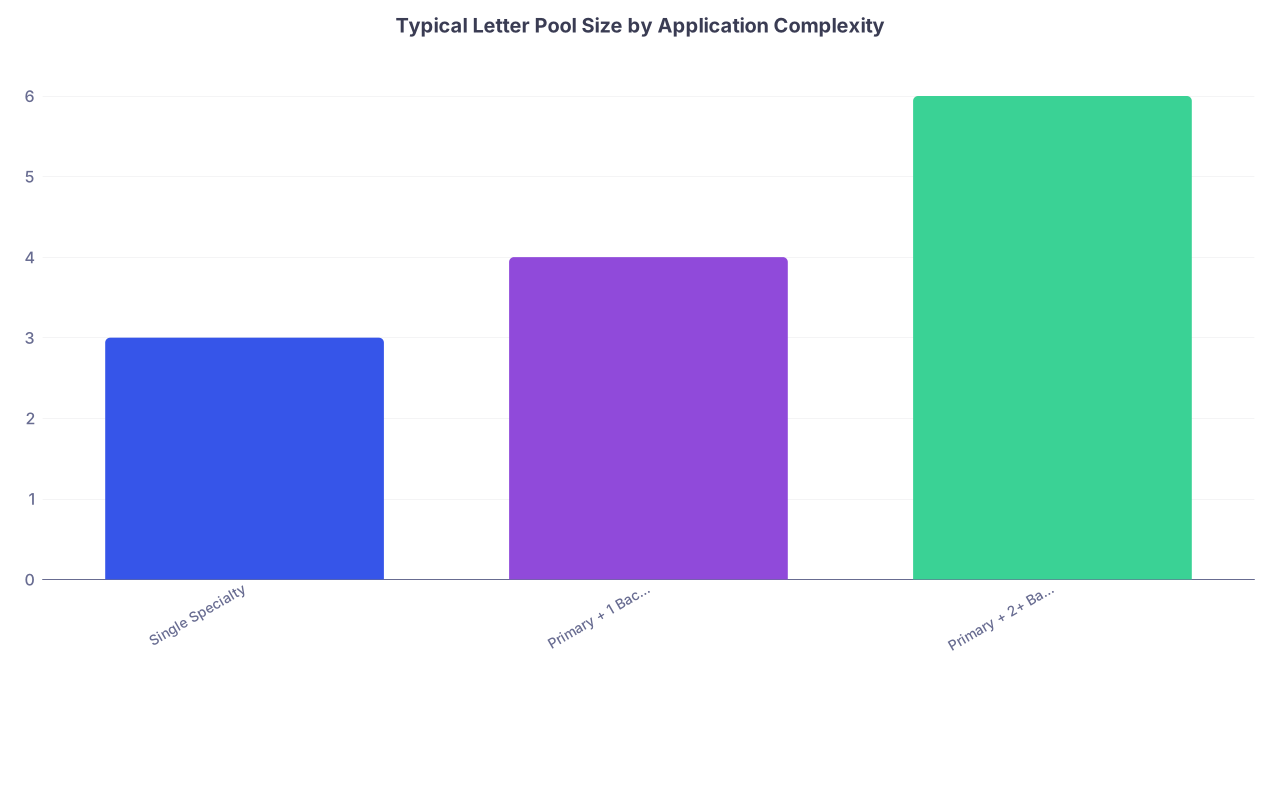
| Category | Value |
|---|---|
| Single Specialty | 3 |
| Primary + 1 Backup | 4 |
| Primary + 2+ Backups | 6 |
What to Tell Letter Writers When You Have Backups
The smartest move: ask for flexible letters.
You do not need to tell every writer every backup specialty you’re considering. But you should:
For your primary specialty letters
Ask clearly for “a strong letter in support of my application to [Primary Specialty].”For general or flexible letters
Say something like:
“I’m applying primarily to Internal Medicine, with possible related fields like Family Medicine. Would you be comfortable writing a letter that focuses on my clinical strengths and potential as a resident in those areas?”
This lets you:
- Use that letter freely for IM, FM, prelim IM, TY
- Avoid specialty-locked lines like “She will be an excellent emergency physician” that you then awkwardly send to an IM program
Worst case scenario: your letters are too specific. You can still selectively assign them only to programs where they fit.
Red Flags: When Reusing Letters Is a Bad Idea
There are times when reusing letters actually hurts you. I’ve watched this tank applications.
Don’t reuse a letter for another specialty if:
- The writer says you’re “perfect for [specialty]” that isn’t the one you’re sending it to
- The letter talks about procedures, OR performance, or ED shifts that don’t translate at all
- The letter is obviously out of date and doesn’t match your more recent rotations
- The clinical scenarios are too niche (e.g., heavy EM trauma content for a psych program)
Example bad reuse:
Sending a surgery-heavy letter about your laparoscopic skills to a psych program that cares 0% about that and 100% about your interview with agitated patients.
You want letters that match the vibe of the field:
- IM/FM: depth, reasoning, reliability, continuity, teamwork
- EM: speed, team leadership, crisis management
- Surgery: grit, manual skill, OR work ethic
- Psych: empathy, listening, rapport, patient-centered care
If the letter doesn’t speak that language, don’t force it.
Backup Specialties: How “Serious” Do Your Letters Need to Look?
Here’s the part most people won’t say out loud:
Programs can tell when they’re your backup. And they don’t love it.
Your letters are one of the main ways you signal seriousness.
- If you send zero specialty letters to a field, you’re telling them:
“No one in your field knows me or supports this choice.” - If you send one solid specialty letter plus some general ones, you’re telling them:
“I’ve actually done the work to get to know this specialty and people in it.”
For a true backup specialty where you just want something if primary fails, I’d still do:
- Minimum: 1 specialty-specific letter
- Plus: 1–2 general letters that any program could appreciate
That’s the difference between “obvious backup” and “plausible match.”
Practical Steps: How To Plan Your Letters Across Backups
Here’s the simple workflow I push students to use:

| Step | Description |
|---|---|
| Step 1 | List all specialties |
| Step 2 | Identify primary specialty |
| Step 3 | Mark true backups |
| Step 4 | For each specialty need 1 insider letter |
| Step 5 | Identify 2-3 flexible general letter writers |
| Step 6 | Ask specialty attendings for specific letters |
| Step 7 | Ask mentors for general letters |
| Step 8 | Upload and label letters in ERAS |
| Step 9 | Assign different combos to each program |
If you walk through that once, you’ll stop wondering “Do I need separate letters?” because you’ll have a clear map of:
- Which letters are locked to a specialty
- Which are reusable
- How many total you actually need
FAQs
1. Do programs know if I’m using the same letter for different specialties?
No. Programs only see the letters you assign to their program. They don’t see where else that letter went. What they do see is whether the letter matches their specialty or feels off-topic.
2. Can I use a letter from a surgeon for an IM application (or vice versa)?
You can, but it should not be your only or main letter. A single out-of-specialty letter is fine as a supplement, especially if it highlights your work ethic or character. But each specialty should have at least one letter from someone in that field.
3. Is it okay if my letter says “she’ll be an excellent internist” and I send it to FM?
For IM → FM, usually yes. Those two are close enough that the intent is clear. For completely different specialties (IM letter sent to EM, surgery, psych) with that kind of line, I’d avoid it. If you know a letter is that specific, use it only where it truly fits.
4. How many total letters should I request if I have two backup specialties?
Most people do well with 4–6 letters total:
- 2 from your primary specialty
- 1 from each backup specialty (so 1–2 more)
- 1–2 flexible general letters (research mentor, sub-I where you were outstanding, etc.)
You’ll never assign all 6 to one program; you’ll pick 3–4 per program.
5. Do prelim and TY programs need different letters than my categorical applications?
Usually not. Prelim IM and TY programs are perfectly happy with your IM letters and strong general letters. You don’t need dedicated “prelim-only” letters. What matters more for prelim/TY is your transcript, Step scores, and reputation for being reliable on wards.
6. What if I decided on a backup specialty late and don’t have time for a rotation in it?
Then you lean heavily on:
- General letters emphasizing your core clinical strengths
- Any partial exposure you’ve had (consult services, clinics, electives)
- Personal statement and interview answers that show you’ve actually thought about the field
Still try to get one letter from someone at least adjacent to that specialty (e.g., for psych backup, an IM or neuro attending who saw you manage patients with complex psych issues).
Key points:
- You don’t need completely separate letter sets for every backup specialty, but you do need at least one specialty-appropriate letter for each field you’re serious about.
- Build a core pool of 4–6 letters: a few specialty-specific, a few flexible general, and recombine them for different programs.
- Use letters strategically to show each specialty you’re a real candidate, not a random backup dump.