
The way most applicants talk about backup specialties in residency interviews is terrible.
They either:
- Pretend they don’t have one (no one believes that), or
- Blur out something vague and panicked that makes them look unfocused or disloyal.
You can do much better than that.
Here’s the playbook for how to explain your backup specialty choice in a way that sounds thoughtful, grounded, and mature—without tanking your chances in your top field.
Step 1: Understand Why Interviewers Ask About Backup Specialties
They’re not asking to catch you lying. They’re screening for three things:
Are you realistic?
Programs know the match is competitive and imperfect. If you tell a surgery PD, “It’s surgery or I’ll rematch next year,” they hear: poor insight, possible problem resident, risky rank.Are you genuinely committed to this specialty?
They want to see that this isn’t just one of five interchangeable choices. If your answer sounds like, “I’m applying to IM, EM, FM, and anesthesia and would be happy with any,” that’s a red flag for everyone.Will you be happy in your career even if Plan A doesn’t happen?
They want residents who won’t be bitter, burned out, or miserable if they end up in a backup instead of their dream.
That’s the frame. Your answer needs to show: clear preference, realistic backup, and emotional stability.
Step 2: Decide If You Should Even Bring It Up
Here’s the rule:
You don’t volunteer your backup specialty in the main flow of the interview.
You only answer this if:
- They directly ask: “Are you applying to another specialty?” or
- They ask a version of: “What’s your plan if you don’t match?”
And when they do, you answer clearly. No squirming, no three-paragraph monologue.
If you’re dual applying (for example, Radiology + Transitional Year; EM + IM; Ortho + Preliminary Surgery), you should already have a clean, 30–45 second explanation rehearsed.
Step 3: Use This Simple Structure For Your Answer
Think of your answer in three moves:
- Reaffirm primary commitment
- Explain why this backup makes sense
- Show you’ll be happy and professional either way
Template you can adapt:
- “My clear first choice is [Primary Specialty] because [1–2 concrete reasons tied to experiences].”
- “I’m also applying in [Backup Specialty], which I see as a good fit for me because [specific overlap in skills/values].”
- “I’d be thrilled to match in [Primary], but I know I’d also have a very satisfying career in [Backup], working with [type of patients/setting] and using [skills you truly enjoy].”
That’s it. Calm. Simple. Adult.
Step 4: Concrete Example Answers (By Situation)
Let’s walk through some real scenarios and answers that actually land well.
Example 1: Primary – Emergency Medicine; Backup – Internal Medicine
Question: “Are you applying in any other specialties?”
Answer:
“My primary goal is to match in Emergency Medicine. I like the shift-based team environment, high-acuity cases, and being the first point of contact when patients enter the system.
I’m also applying in Internal Medicine. On rotations I really enjoyed longitudinal problem-solving, complex medical patients, and teaching on the wards. If I match into IM, I’d likely pursue a hospitalist or critical care path. So while EM is where I see myself first, IM still aligns strongly with how I like to think and work.”
What this does right:
- Clear preference
- Backup is logically related
- Shows specific future vision if backup happens
Example 2: Primary – Ortho; Backup – Preliminary Surgery / Transitional Year
Question: “What’s your backup plan if you don’t match into orthopedics?”
Answer:
“Orthopedics is my clear first choice—I’ve put most of my energy into research, sub-Is, and mentorship in this field, and I really enjoy the combination of biomechanics, procedures, and seeing rapid functional improvement in patients.
That said, I know ortho is very competitive. I’m also applying to preliminary surgery and transitional year programs with the goal of being in a strong surgical environment where I can grow clinically, be a reliable intern, and then either reapply to ortho or pursue another surgical field if needed. Wherever I am, my focus will be to be a high-performing intern and a good teammate.”
That signals: realistic, not entitled, and not going to sulk all year.
Example 3: Primary – Dermatology; Backup – Internal Medicine
Question: “If you don’t match into dermatology, what then?”
Answer:
“Dermatology is my primary goal—my research, electives, and mentorship have all been in this space, and I’m drawn to the mix of complex medical disease and outpatient continuity.
I’m also applying to categorical Internal Medicine. I’ve really enjoyed complex diagnostic workups and longitudinal care in IM, and I know there are strong pathways into hospital medicine, rheumatology, and even some skin-focused niches through IM. I’d be disappointed not to match into derm, but I’m confident I’d still have a very fulfilling career in IM focusing on complex medical patients.”
This is honest without sounding fragile.
Example 4: When You Panicked and Dual Applied Late
Maybe you started in one specialty, freaked out about competitiveness, and threw in another specialty in October. Programs can often smell that.
Question: “Why did you decide to apply to both [Primary] and [Backup]?”
Answer:
“I spent most of my third year focused on [Primary Specialty] and that’s still what I’m most excited about—especially [specific aspects]. Late in the summer I had a really positive experience on my [Backup Specialty] rotation and realized I also genuinely enjoyed [specific clinical features].
Talking with mentors, I decided to apply to both, but I was careful to only apply to programs where I’d truly be happy training. I’d be excited to build a career in either field.”
You don’t have to confess the panic. You just frame it as added clarity.
Step 5: Align Your Story With Your Application Reality
Your answer can’t fight your ERAS/NRMP data. Interviewers will cross-check what you say with what they see.
Here are the biggest pitfalls:
- Saying: “IM is my clear first choice” while your application is stacked with EM away rotations, EM SLOEs, and EM research.
- Claiming: “I’d be happy in either field” when you only applied to three programs in your so-called “backup.”
- Telling an IM PD you’re “equally excited about IM and anesthesia” while listing 40 anesthesia programs and 10 IM programs.
You don’t need perfect symmetry, but your story has to be believable.
If your record leans heavily toward one field, anchor your answer to that and explain the backup as realistic, not equal.
For example:
“I’ve clearly done more focused work in EM—that’s been my main interest for the last two years. As I was finalizing my applications, I realized that the aspects I enjoy most—resuscitation, acute care, team-based medicine—also exist in critical care-oriented IM paths. So I added selected IM programs where I think I’d be a strong fit and could still practice that type of medicine.”
That’s honest and coherent.
Step 6: Choose a Backup That Actually Makes Sense
Not all backup choices sound thoughtful. Some look random, or worse, like you don’t know what you want.
Good backup choices usually share at least two of these with your primary:
- Similar patient population
- Overlapping skill set (procedures, outpatient care, acute care, etc.)
- Similar practice environment (hospital-based, clinic-based, shift-based)
- Similar values (continuity, complexity, teamwork, procedures)
Here’s a quick comparison:
| Primary | Common Backup |
|---|---|
| Emergency Med | Internal Med, FM |
| Ortho | General Surgery, TY |
| Dermatology | Internal Med |
| Radiology | Internal Med, TY |
| Anesthesiology | Internal Med, EM |
If your pairing does look weird (say, EM + Pathology), your explanation needs to be especially clear, or you’ll sound flaky.
Step 7: How Honest Should You Be About Your “Dream Specialty”?
Here’s the line:
Be honest about preference. Don’t be dramatic about disappointment.
What to say:
- “X is my clear first choice.”
- “I’d be excited to train in either field.”
- “I’d be disappointed at first, but I know I’d adapt and commit fully.”
What not to say:
- “If I don’t match X, I’ll just reapply rather than do Y.” (While interviewing in Y.)
- “Honestly, Y is just a backup; my heart is in X.”
- “I don’t really like Y, but I know I need something.”
Programs are not going to rank someone who basically tells them, “I’ll resent you if I end up here.”
Step 8: Practice Saying This Out Loud Without Sounding Robotic
This sounds small. It isn’t.
You need to practice answering this question with:
- A normal speaking pace
- No nervous laughter after “backup”
- No overly rehearsed, monologue vibe
Try this:
- Write your 3-sentence answer using the structure above.
- Say it to your phone camera 3–4 times.
- Watch it once. You’ll see exactly where you ramble or sound fake.
- Edit, simplify, and do it again.
You want “comfortable and consistent,” not “memorized script.”
Step 9: Special Case – Explaining a Switch in Primary/Backup
If you initially chased one specialty, then switched, and now use the first as “backup,” that’s trickier. Example: You spent two years on surgery, then realized you prefer anesthesia, but still applied to some surgery programs.
If asked:
“I spent a lot of time early in medical school thinking I’d go into general surgery, which is why I did research and sub-Is there. On my anesthesia rotation I realized I was more drawn to physiology, acute perioperative medicine, and the mix of procedures without managing a full clinic. That’s why anesthesia is now my primary focus.
I still applied to a limited number of surgery programs where I know I’d get strong training, because I did enjoy the OR environment and could see myself satisfied in a surgical career as well. But anesthesia is my first choice.”
You’re allowed to evolve. Just own the timeline and the logic.
Visual: How Programs Think About Dual Applicants

| Step | Description |
|---|---|
| Step 1 | Applicant |
| Step 2 | Top of Rank List |
| Step 3 | Consider as Dual Applicant |
| Step 4 | Lower Priority |
| Step 5 | Rank Appropriately |
| Step 6 | Rank Lower or Not Rank |
| Step 7 | Primary Specialty Fit Strong? |
| Step 8 | Backup Specialty Also Applied? |
| Step 9 | Career Satisfaction Likely? |
Step 10: What If You’re Not Dual Applying at All?
Sometimes you’re all-in on one specialty. That’s acceptable, but you still need a grown-up answer to “What if you don’t match?”
For example, EM-only applicant:
“If I unfortunately didn’t match, my plan would be to seek a research or clinical gap year in Emergency Medicine, work closely with mentors to strengthen my application, and reapply. I’ve put a lot of thought into this and feel confident EM is the right long-term fit for me, so I’d rather improve my application than switch into a field that doesn’t align as well.”
That’s fine, as long as your application is actually competitive enough that this doesn’t sound delusional.
Quick Reality Check: How Programs Might Interpret Your Answer
Use this mental chart when you craft your explanation:
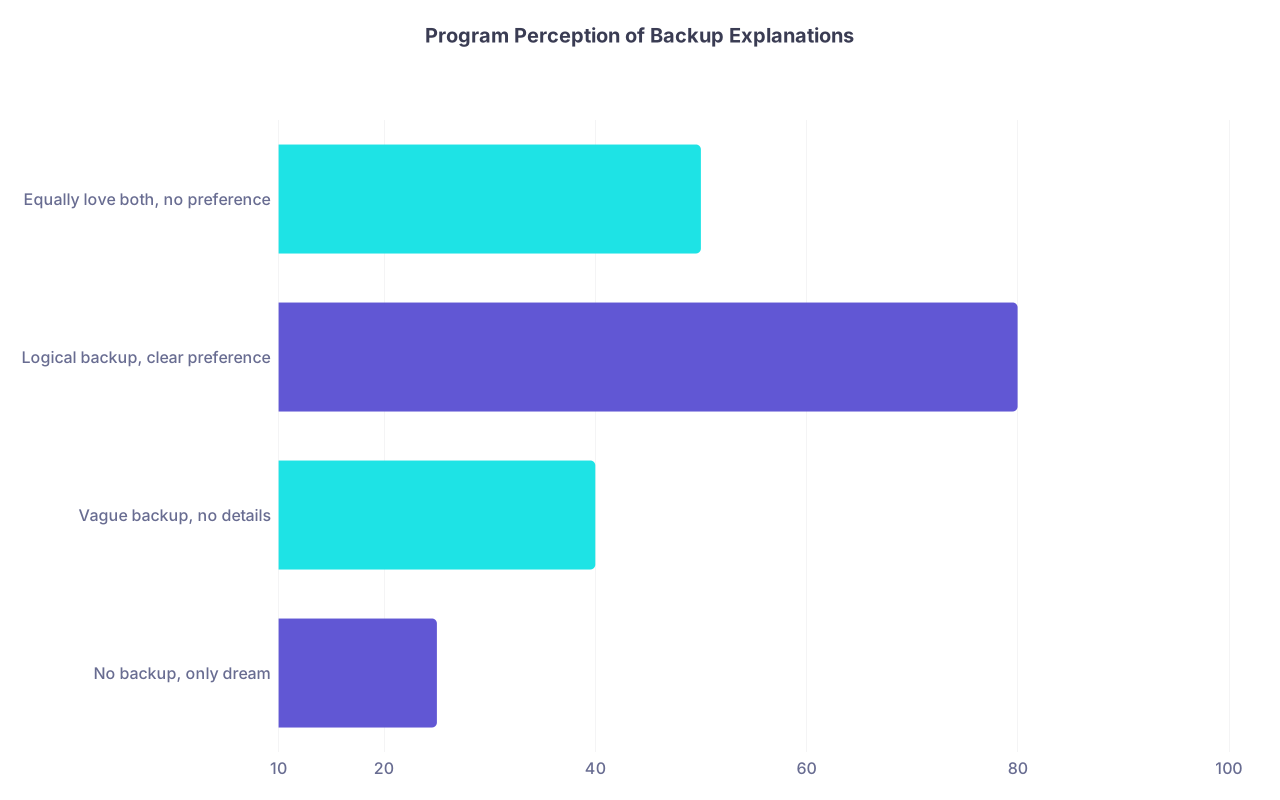
| Category | Value |
|---|---|
| No backup, only dream | 25 |
| Vague backup, no details | 40 |
| Logical backup, clear preference | 80 |
| Equally love both, no preference | 50 |
Higher number = more confidence they’ll rank you well.
The “logical backup + clear preference” answer wins almost every time.
FAQ: Backup Specialty Questions (Exactly 7)
1. Should I ever lie and say I’m not applying to a backup when I actually am?
No. Programs talk. PDs compare notes. And your ERAS application usually makes it obvious which letters and rotations match which specialty. Lying here is a character red flag. Be honest, but focused: “Yes, I’m also applying in X, but Y is my clear first choice.”
2. How many backup programs do I need for it to look “real?”
There’s no magic number, but if you apply to 40 of your primary and 3 of your backup, nobody believes you’re truly open to the backup. If you’re serious about dual applying, your list should reflect that—often something like 60–80% primary, 20–40% backup, depending on competitiveness and your stats.
3. Will programs rank me lower if I admit I’m dual applying?
Some will, some won’t. The ones that penalize you for being realistic about the match are not the ones you want as your training environment anyway. The key is how you explain it: clear preference, coherent reasoning, and assurance that you’d commit fully if you matched there.
4. What if my mentor told me never to mention a backup specialty?
That advice is outdated and usually bad. You shouldn’t volunteer it unprompted, but if you’re asked directly and dodge the question, experienced faculty will see right through it. Answer succinctly, then pivot back to why you’re excited about their field and their program.
5. Is it okay if my backup specialty is actually something I like just as much?
Yes, but don’t say “I love them equally” in an interview. That makes you look unfocused. You can feel that internally, but externally you should present a clear preference based on where you’ve invested most of your time and energy. Programs want to feel chosen, not like 1 of 5 equal options.
6. How do I handle it if they ask me this in a group or social setting with residents?
Keep it even lighter. “Yeah, I’m also applying to X. I love [overlapping aspect], so it made sense as a backup, but [their specialty] is definitely my first choice.” Then move the conversation back to their program: “How did you decide on this field?” Residents mostly want to see you’re normal and not spiraling.
7. What if I genuinely have no backup and no plan B?
Then you need to quietly fix that for yourself, even if you don’t talk about it on interview day. At minimum, have a real, thought-out answer: research year, post-doc, chief year, prelim/TY and reapply, etc. Saying, “I haven’t thought about that” makes you sound naive and unprepared.
Key Takeaways
- Don’t deny having a backup if asked; explain it with a clear structure: primary commitment, logical backup, and confidence you’d be happy in either.
- Make your story match your application—rotations, letters, and program list should support your explanation, not contradict it.
- You’re judged less on whether you have a backup and more on whether you sound focused, realistic, and like someone who’ll be a solid, committed resident wherever you match.