
You can apply to two backup specialties without looking unfocused—but only if you do it with ruthless clarity and separate, coherent stories for each one.
If you try to “kind of” apply to three things with the same vague personal statement and a mushy narrative—yes, you’ll absolutely look unfocused. Programs are not dumb. They read hundreds of applications a year and can smell a “I just want a job” strategy instantly.
Let’s walk through how to do this right.
The Real Answer: Yes, But You Need Strict Rules
Here’s the short version you actually care about:
You can safely:
- Apply to your primary specialty
- Apply to one strong backup
- Sometimes add a second, clearly distinct backup path (often a prelim or a truly compatible alternative)
Without:
- Destroying your credibility
- Looking scattered
- Tanking your chances in all of them
If:
- Each specialty gets its own clear, believable narrative
- Your letters, experiences, and personal statements match that narrative
- You don’t accidentally cross-contaminate (IM letter talking about Derm passion, for example)
If you want a simple decision rule:
- One primary + one backup = almost always fine
- One primary + two backups = possible, but only if the structure is tight and you’re disciplined about documentation
What you can’t do is apply to, say, Derm, Ortho, EM, and Psych with one generic story about “loving patient care and teamwork.” That’s how you wind up unmatched.
When Two Backup Specialties Actually Makes Sense
There are a few situations where applying to two backups is not only okay—it’s smart.
1. You’re Aiming High in a Very Competitive Field
Example:
Primary: Dermatology
Backup 1: Internal Medicine categorical
Backup 2: Transitional Year or Preliminary Medicine
Here, the “second backup” isn’t truly a different ultimate specialty—it’s a different route to still chase Derm or pivot later. Programs see this all the time. It doesn’t look flaky if:
- Derm apps: Derm-specific story, Derm-focused letters, Derm research
- IM apps: Genuine IM story (not “I failed Derm so I guess IM is fine”), strong IM letter or sub-I
- TY/prelim: Framed as “strong clinical year while demonstrating readiness for advanced training”
This is one of the cleanest ways to have two backup paths without signaling confusion.
2. Your Primary Specialty Logically Bridges Two Fields
Example:
Primary: Med-Peds
Backup 1: Internal Medicine
Backup 2: Pediatrics
Or:
Primary: EM
Backup 1: Internal Medicine
Backup 2: Anesthesiology
If your CV and rotations naturally span those areas, two backups can actually look coherent, not chaotic. Programs often know they’re in overlapping pools.
The key: each backup must be plausible as a first choice for you. Your application to IM can’t read like “I’m sad I didn’t get EM, but you’re fine I guess.”
3. You Have Clear Geographic or Visa Risk
If you:
- Need a visa, or
- Are absolutely locked into one region, or
- Have a below-average Step/COMLEX profile for your primary field
Then adding a second backup—as long as it fits your story—may be a rational hedge.
Example:
Primary: General Surgery
Backup 1: Preliminary Surgery
Backup 2: Categorical Internal Medicine
Again: this is acceptable only if your IM application is real, not obviously a consolation prize.
How Programs Actually Perceive Multiple Specialties
Let me be blunt: programs don’t care that you applied elsewhere; they care if you look unserious about them.
They don’t see:
- The list of specialties you applied to
They do see: - Your personal statement
- Your letters
- Your ERAS experiences
- Whether it feels like they’re the “backup” from how you write and talk
Red flags that make you look unfocused:
- Generic personal statement that could apply to literally any specialty
- LORs that clearly talk about a different field (“She will be an outstanding radiologist” in your IM app)
- Interview answers that sound like you’re hedging (“I like a bit of everything, I’m still figuring it out”)
- Very shallow specialty-specific engagement (no electives, no relevant experiences)
Programs are comfortable with the fact that applicants hedge. They’re not comfortable with being Plan D and having to guess why they’re on your list.
How to Structure Two Backup Specialties Without Mess
You need structure, or this falls apart. Here’s a clean model that works.

| Step | Description |
|---|---|
| Step 1 | Choose Primary Specialty |
| Step 2 | Add one realistic backup |
| Step 3 | Consider if backup is needed |
| Step 4 | Primary + Backup + Prelim/TY |
| Step 5 | Primary + One Backup |
| Step 6 | Is it highly competitive |
| Step 7 | Do you also need a prelim or TY |
| Step 8 | Personal risk high |
Now the nuts and bolts.
1. Decide Your Primary and the “Tier” of Each Backup
Be honest with yourself:
- Primary = what you truly want
- Backup 1 = specialty you can see yourself in long-term
- Backup 2 = either
- a different route (prelim/TY), or
- a genuinely acceptable alternate specialty you understand
If you can’t look someone in the eye and say “I’d be okay doing this specialty,” it’s not a backup. It’s a fantasy safety net.
2. Build Separate Personal Statements
Minimum:
- One for primary
- One for each distinct categorical backup specialty
Do NOT reuse the same essay with just a few words swapped out.
Bad:
“I love procedures, continuity, and working with teams across the hospital.”
(Could be anything. Also says nothing.)
Better for IM:
“In my ICU month, I found myself drawn to the challenge of managing complex, multi-morbid adults over days and weeks, watching small physiological changes translate into clinical improvement.”
Better for EM:
“In my overnight shifts, I loved being the first point of contact, making rapid decisions in uncertainty, and working in high-acuity, time-sensitive situations.”
Different stories. Different values emphasized. Same person, but specific.
3. Make Your Letters Align Logically
Ideal pattern if you have primary + 2 backups:
- Strongest letters (2–3) in your primary specialty
- At least one solid letter in each categorical backup field
- Any “generic” letter (e.g., from medicine sub-I that isn’t deeply specialty-specific) can be used across multiple specialties if it reads as broadly clinical
Problem pattern that makes you look confused:
- 3 letters from EM attendings
- Applying to EM, Anesthesia, and Psych
- No psych or anesthesia letter
That screams “I want EM, and I don’t really care about the rest.”
| Letter Type | Primary (Derm) | Backup 1 (IM) | Backup 2 (Prelim Med) |
|---|---|---|---|
| Derm faculty letter | Yes | No | No |
| Derm research mentor | Yes | No | No |
| IM sub-I attending | No | Yes | Yes |
| Chair/department letter | Yes | Yes | Yes |
4. Clean Up Your ERAS Experiences
You don’t need different ERAS entries for different specialties. You do need to:
- Put the most relevant experiences to each specialty near the top
- Frame descriptions in ways that aren’t obviously exclusive to one field
Example: if you’re applying to EM and IM, your ERAS experience blurb for an ICU project can be framed to emphasize:
- Decision-making under uncertainty → EM
- Longitudinal, complex care → IM
You don’t lie; you just choose which emphasis goes where in interviews and personal statements.
Tactical Considerations: How Many Programs Per Specialty?
You can’t half-apply and expect full results. If you’re going to do primary + 2 backups, you need to think in numbers.
Very rough, non-personalized idea of how people split (you’ll need to adjust for competitiveness, scores, school, etc.):
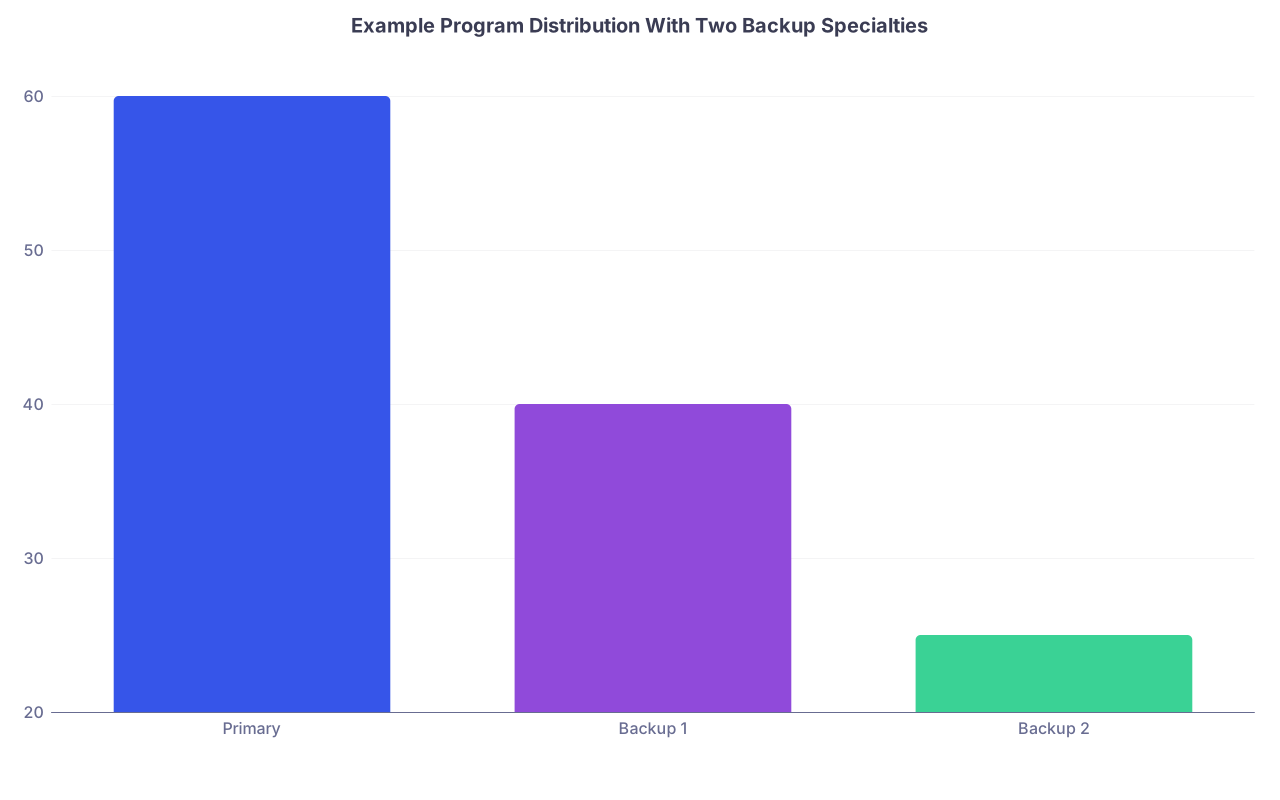
| Category | Value |
|---|---|
| Primary | 60 |
| Backup 1 | 40 |
| Backup 2 | 25 |
This might look like:
- 60 programs in your primary field
- 40 in your main backup categorical
- 25 prelim/TY / additional categorical backup
If your app is weak for your primary, that ratio shifts. What’s dumb is applying to:
- 25 primary
- 10 backup 1
- 5 backup 2
Then acting surprised when you don’t match. Multiple specialties don’t fix undershooting your numbers.
Interview Season: How Not to Out Yourself as “Unfocused”
You’re going to get asked variations of:
- “Why this specialty?”
- “Did you consider anything else?”
- “What made you decide on us over [other specialty]?”
You don’t need to lie. You do need a crisp, mature narrative.
Use this structure:
Anchor your choice:
“I explored several fields, but I kept coming back to [specialty] because…”Acknowledge exploration without sounding lost:
“I did rotations in both IM and EM. EM gave me energy, but in IM I found I enjoyed following complex patients over time and working through diagnostic uncertainty in depth.”Respect the backup specialty as legitimate:
Never frame them as “if I don’t get what I actually want.” That’s suicide.
If they ask directly, “Are you applying to other specialties?”
A mature response might be:
“My primary focus is Internal Medicine, and that’s where the bulk of my applications and letters are. I did also apply to a small number of [backup] programs that align with my skills and interests, but IM is the field that best fits how I want to practice long-term.”
Short, honest, and doesn’t sound like you’re trying to game them.
When Two Backup Specialties Is a Bad Idea
Here are the situations where I’d tell you flat-out: don’t.
- You’re already struggling to put together even one strong, coherent application
- You don’t have any specialty-specific letters for one of the backups
- Your Step/COMLEX scores are borderline, and splitting attention will water down all apps
- Your school advisors/program director strongly warn against it for your specific case
Also bad: backing up into completely unrelated fields with no overlap or story.
Example of “this looks chaotic”:
Primary: Radiology
Backup 1: Psychiatry
Backup 2: OB/GYN
Can it be done? Sure. Will most people be able to make that look coherent? No. That’s three completely different lives you’re claiming to want.
Simple Framework to Decide If You Should Do Two Backups
Ask yourself these five questions:
- Could I give a genuine 2–3 minute answer about why I want each field as if it were my only choice?
- Do I have at least one legit letter for each categorical specialty?
- Are my scores/clinical performance strong enough that I’m not in total panic “apply to everything” mode?
- Can I handle writing separate, specific, non-generic personal statements and actually meet deadlines?
- Would my advisor say “this makes sense” rather than “this looks desperate”?
If you can answer yes to all five, you’re probably okay.
If you can’t, you’re better off with:
- One primary
- One backup (often a broadly compatible field like IM, FM, prelim, TY)
And putting real effort into making those two apps excellent.
FAQ: Two Backup Specialties and Looking Unfocused
1. Will programs know I applied to multiple specialties?
They don’t see a list of your other specialties in ERAS. But they infer it from your letters, personal statements, and what you say. If you’re sloppy (Derm letter in IM app, generic essay, confusing story), they’ll correctly assume you’re hedging hard.
2. Is it better to have one strong backup or two weaker ones?
One strong backup beats two weak, half-baked backups every time. If adding a second backup means worse personal statements, rushed letters, and fewer total programs per field, it’s usually a net negative.
3. Can I reuse the same personal statement for more than one specialty?
You can reuse for closely related routes (e.g., IM categorical and IM prelim or TY with a medicine flavor). You should not reuse the same statement for clearly different specialties (EM vs Psych vs Anesthesia). That looks lazy and unfocused.
4. What if my school advisor says not to apply to multiple specialties?
Listen carefully. They’re seeing your whole file and how programs view graduates from your institution. Sometimes they’re overly conservative, but often they’re protecting you from scattering your chances. If you disagree, at least be able to explain a clear rationale for your plan.
5. How many programs should I apply to in each backup specialty?
Enough that you’d realistically expect interviews from that specialty alone if your primary flops. For many IM backups, that’s 30–60+ programs. For prelim/TY, similar. Don’t treat backup apps like token “just in case” submissions.
6. Bottom line: can I apply to two backup specialties without looking unfocused?
Yes—if you:
- Keep a clear hierarchy (one true primary, one real backup, maybe one route-based second backup)
- Build distinct narratives and letter sets for each field
- Apply to enough programs in each to make them real options
If adding a second backup doesn’t pass that test, it’s not a strategy. It’s just anxiety in ERAS form.
Key takeaways:
Keep one primary passion, don’t pretend you “equally love” three unrelated fields, and only add a second backup if you can make each application look like it belongs to a serious future colleague in that specialty. Coherence beats volume. Every time.