
The idea that you have to completely rebuild your entire ERAS application for a backup specialty is wrong. Most of your application can and should be reused—if you’re smart about it.
Here’s exactly what you can safely recycle, what you must rewrite, and how to do it without torpedoing your chances in either specialty.
The Big Picture: What You Can Reuse vs. What You Must Rewrite
Let me start bluntly:
- You can reuse: most experiences, CV content, exams, demographic data, transcripts, MSPE, many letters.
- You must change: your personal statement, program signaling strategy, some letters, how you frame experiences.
- You must check carefully: anything that mentions a specialty by name.
If you’re applying to, say, Dermatology as your primary and Internal Medicine as your backup, your “core data” on ERAS doesn’t change. What changes is the story those data tell.
Here’s the quick mental model:
- Static documents = generated by your school or exam boards → usually reusable as-is.
- Narrative documents = written by you or your letter writers → need tailoring by specialty.
Let’s break it down piece by piece.
Documents You Can Almost Always Reuse As-Is
1. ERAS Common Application (Core Profile)
Your biographical and core data don’t change just because you’re applying to a different specialty. You can reuse:
- Demographics
- Contact information
- Medical school and prior education
- USMLE/COMLEX scores and attempts
- Publications, abstracts, presentations
- Honors/awards
- Work experiences (jobs, teaching, leadership)
You don’t create a second ERAS account for a backup specialty. You build one core application, then customize specialty-specific pieces (like personal statements and LoR assignments) for each program.
So yes, the backbone of your app is reusable.
But there’s a catch with experiences, which we’ll get to.
2. USMLE / COMLEX Score Reports
Completely reusable. You don’t get to choose which programs see which scores. Every program sees the same testing history.
If your specialty switch is because of a lower-than-hoped score, you don’t “hide” that in the backup specialty. You just rely on the fact that some specialties care less about top-percentile scores than others.
3. Medical School Transcript and MSPE (Dean’s Letter)
These are one-and-done documents sent by your school. You don’t rewrite or tailor them.
Can they hurt you if they’re written very specialty-heavy? Occasionally. For example, if your MSPE says “Jane is totally committed to a career in neurosurgery” and now you’re applying Psych, that’s awkward.
But you still reuse them. You don’t get a “neurosurgery version” and a “psychiatry version.” You fix the mismatch with your personal statement and letters, not by trying to edit institutional documents.
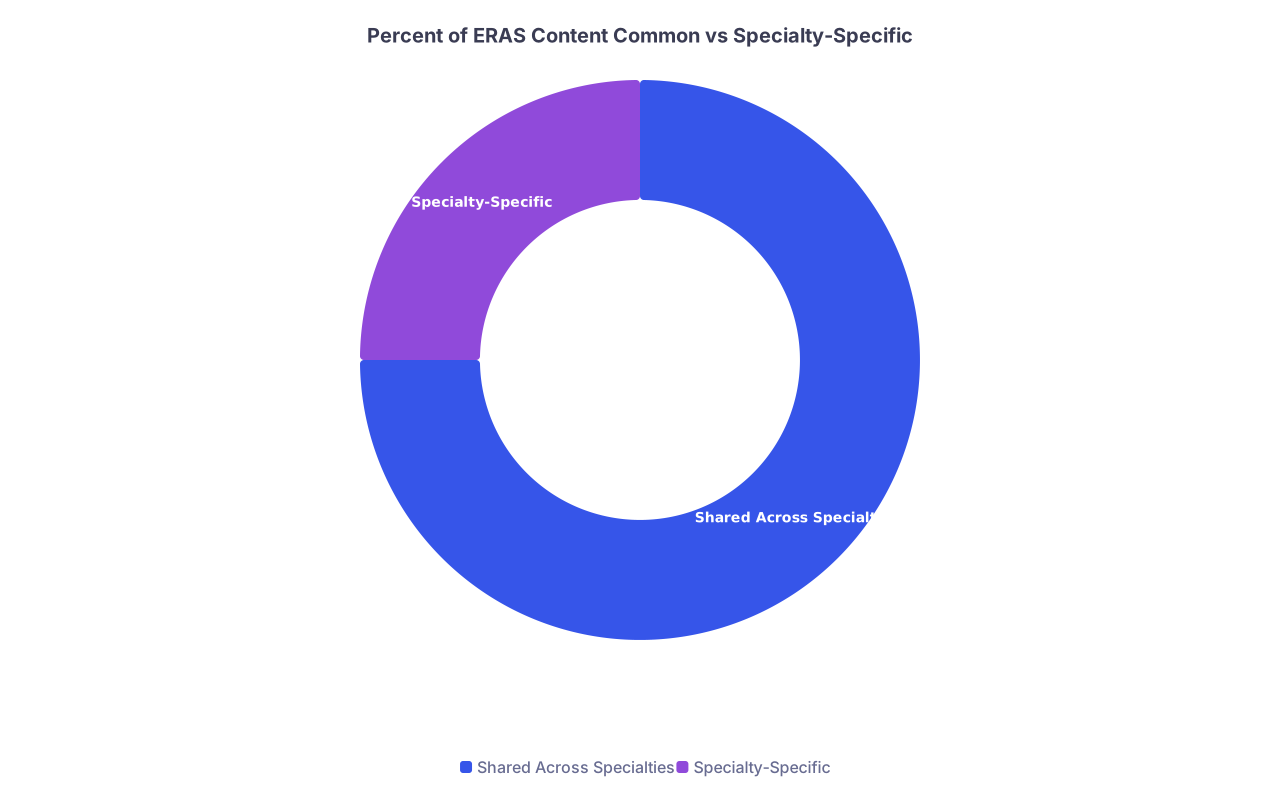
| Category | Value |
|---|---|
| Shared Across Specialties | 75 |
| Specialty-Specific | 25 |
4. Most Letters of Recommendation (With Strategy)
This one surprises people.
You can reuse some letters between your primary and backup specialty, but only under certain conditions:
- Letters from core medicine fields (IM, FM, Peds, Surgery, etc.)
- Letters that emphasize work ethic, clinical reasoning, communication, professionalism
- Letters that are not intensely specialty-anchored (e.g., not “She will be an outstanding plastic surgeon”)
You can assign different letters to different programs. That’s the key.
Example:
- Applying to Ortho (primary) + IM (backup)
- Ortho programs: 2 ortho letters + 1 IM letter
- IM programs: 2 IM letters + 1 ortho letter that focuses on your work ethic, team behavior, and OR performance in a generalizable way
What you don’t do: send a letter that reads, “He has been absolutely committed to a career in vascular surgery since day one” to a Pediatrics program. That screams “backup.”
When in doubt: re-read every letter you plan to reuse and ask: Would this make sense if the reader never knew my original specialty plan?
If yes → reusable.
If no → keep it only for your primary specialty.
Documents You Can Reuse With Careful Editing
This is where people either do a great job or blow up their backup plan entirely.
5. Experience Entries (ERAS Experiences Section)
You almost never need to delete experiences. But you might need to reframe how you describe them.
Your titles, dates, and locations stay the same.
Your descriptions and “most meaningful” tags may change by specialty.
Things to watch for:
- Specialty-specific language
- Over-the-top devotion to your primary specialty
- Missed chances to highlight skills valued by the backup specialty
Example 1: Research Experience
Original (for ENT primary):
- “Completed chart review on postoperative outcomes for head and neck cancer patients. This solidified my desire to pursue Otolaryngology by exposing me to complex airway surgery.”
Better (for EM backup):
- “Completed chart review on postoperative outcomes for head and neck cancer patients, coordinating with multidisciplinary teams (ENT, anesthesia, ICU). Gained experience with complex airway management, peri-operative care, and high-acuity patients.”
Same experience. Different emphasis.
Example 2: Leadership/Teaching
If you’re switching from Derm to IM, that Derm interest group leadership can be reframed:
- Derm version: “Organized dermatology subspecialty panels to learn about different derm career paths.”
- IM version: “Organized interdisciplinary talks on autoimmune and systemic diseases with skin manifestations, collaborating with rheumatology and internal medicine faculty.”
You don’t need two separate ERAS submissions. You adjust the language before you finalize and submit for that cycle, knowing it applies to all specialties you’re sending to that year.
If you’re applying to both specialties in the same cycle:
Pick descriptions that make sense and are neutral enough for both.
6. CV / Resume (If Programs Request Uploads)
Most residencies won’t ask for a separate CV beyond ERAS. A few prelim/transitional year or non-ERAS positions sometimes do.
You can reuse:
- Formatting and structure
- Education, exams, experiences, research, leadership
You should tweak:
- Objective/summary line (if you include one)
- Section ordering (e.g., research-heavy for Neuro vs. teaching-heavy for Psych)
Don’t send a CV with “Objective: To match into Orthopaedic Surgery” to a PM&R program. That’s the sloppy, avoidable mistake I’ve actually seen sink people.

Documents You Should Never Directly Reuse
Here’s where people get themselves in trouble.
7. Personal Statement
You do not reuse your primary specialty personal statement for your backup. Ever.
You write:
- One personal statement per specialty.
- You name them clearly in ERAS (e.g., “Internal Medicine PS,” “Radiology PS”).
What you can reuse inside the backup PS:
- Your core story (big life experiences, family background)
- Specific example patient encounters
- Themes like teamwork, communication, resilience
What you must change:
- The articulation of why that specialty
- What you enjoy about the day-to-day work
- The skills you bring that align with that field
- Any explicit naming of your primary specialty (don’t: “My love for surgery began…” in a Psych personal statement)
If you’re pivoting late (e.g., didn’t get enough interview invites in your primary and now adding a backup), you can absolutely cannibalize paragraphs from your original PS, but you still have to rewrite the framing.
No program wants to feel like your consolation prize.
8. Specialty-Specific Letters of Recommendation That Are Too Anchored
If a letter reads like this:
“John has long expressed his singular passion and commitment to a career in orthopedic surgery. I have no doubt he will become an excellent orthopedic surgeon, and I recommend him without reservation to your orthopedic program.”
Do not send that to an Internal Medicine program.
Reusing that kind of letter in a different specialty:
- Makes you look disingenuous
- Confirms to the backup that they’re Plan B
- Undercuts your personal statement claims
If you’re asking new backup-specialty letters late:
- Be honest with the writer about the switch
- Ask them to keep the praise competency-centered, not destiny-centered
- Ask for “strong letter for IM residency” etc., not “lifelong passion X”
9. Program Signaling / Preference Signaling
This is not a “document,” but it’s application content you absolutely cannot reuse.
You get a small number of signals per specialty (in fields that use signaling). You don’t:
- Copy-paste your primary list to your backup specialty
- Use signals on programs you don’t genuinely consider for that specialty
Each specialty = its own signaling strategy.
How to Strategically Reuse Without Looking Disingenuous
Here’s the decision framework I use when I help students salvage a cycle.

| Step | Description |
|---|---|
| Step 1 | Look at a document |
| Step 2 | Reuse as is |
| Step 3 | Read for specialty bias |
| Step 4 | Rewrite or reframe |
| Step 5 | Reuse with minor edits |
| Step 6 | Rewrite description |
| Step 7 | Use only for primary |
| Step 8 | Reuse if content general |
| Step 9 | Written by you? |
| Step 10 | Institutional or exam? |
| Step 11 | Mentions specialty by name? |
| Step 12 | Skills align with both specialties? |
| Step 13 | Heavily specialty anchored? |
Ask these questions for each piece:
Does this clearly scream one specific specialty?
If yes, either keep it for that specialty only or edit the language.Does this contradict my backup narrative?
“Always dreamed of being a surgeon” in a Radiology PS? That’s a contradiction. Rewrite.Can I spin this as a skill that’s valuable in both fields?
Procedures, communication, uncertainty tolerance, complex decision-making. Most clinical strengths cross specialties.If a PD only saw my backup specialty materials, would I look like a legit applicant?
That’s your test. You want them to think, “This person actually wants my field,” not “They missed out somewhere else.”
Concrete Examples: What Reuse Looks Like Across Specialties
| Primary → Backup | Reusable As-Is | Reuse With Edits | Must Rewrite |
|---|---|---|---|
| Gen Surg → IM | Transcript, MSPE, scores | Experience descriptions, some letters | Personal statement |
| Derm → FM | Research, honors, core apps | Experience framing, neutral letters | PS, derm-only letters |
| Ortho → PM&R | Scores, transcript, MSPE | Ortho letters that stress function, rehab; experiences | PS, hyper-ortho destiny letters |
| EM → IM | Scores, transcript, MSPE | ED experiences reframed toward continuity, systems | PS |
| Psych → Neurology | Scores, transcript, MSPE | Experiences emphasizing cognition, behavior | PS, psych-only destiny letters |
Notice the pattern: it’s the narrative elements that change, not your underlying record.
Practical Step-by-Step: If You’re 2–4 Weeks From ERAS Submission
Here’s how to not lose your mind.
List your target specialties
Primary + realistic backup(s). Don’t list five. Pick 1–2 max.Lock in your core ERAS
Fill everything out with neutral-but-true descriptions. Avoid writing “I chose this because of my love for X specialty” in the experiences section.Create separate personal statements
- Start from your existing PS for the primary
- Duplicate the doc for the backup
- Strip every explicit specialty mention
- Rebuild the “why this field” and “future career” paragraphs
Audit your letters
- Make a table of each letter, who wrote it, and what field it mentions
- Assign 3–4 letters per specialty (as allowed), avoiding obviously mismatched content for the backup
Final read-through “as if I only applied to backup”
Pretend you’re a PD in the backup specialty seeing only those materials. Does this file feel coherent and intentional? If not, fix the weak link.
FAQs: Backup Specialty Document Reuse (7 Questions)
1. Can I send the exact same personal statement to both my primary and backup specialties?
No. That’s lazy and programs can tell. You should have at least one distinct personal statement per specialty. You can reuse core life stories, but your explanation of why you’re drawn to the field and what you want long-term has to match that specialty.
2. Is it okay if my MSPE or transcript mentions my original specialty interest, but I’m now applying to a different field?
Yes, it’s okay, and you can’t change it anyway. Programs know interests evolve. You just need your personal statement and letters for the new specialty to make a compelling, coherent case that you’re genuinely interested in them now, not just defaulting.
3. Can I reuse a strong letter from my primary specialty for my backup specialty programs?
Sometimes. If the letter focuses on your clinical performance, teamwork, judgment, and doesn’t read like “lifelong calling to [Primary Specialty],” it’s usually fine. If it’s heavily branded with “She will be a fantastic [Primary Specialty] physician,” keep it only for that field.
4. Do I need to change my ERAS experiences for each specialty in the same cycle?
You can’t send different experience descriptions to different programs in the same cycle; there’s only one ERAS experiences section. So you should write descriptions that are accurate and neutral enough to work for both specialties. Avoid overly specialty-specific language there and let your personal statements and letters do the specialty targeting.
5. If I apply to a backup specialty late (after interview season starts), do I have to redo my entire ERAS?
No. You keep the same account, same core application. You add: a new personal statement for the backup, new program list, and ideally at least one or two letters from that field. You then assign the right PS and letters to those new programs. It’s an add-on, not a full rebuild.
6. Can I reuse the same CV I sent to an away elective or research mentor when applying to a backup specialty?
You can reuse the structure and content, but you should always skim and tweak the header/objective and any specialty-specific language. If a CV says “Objective: Match into Neurosurgery” and you’re now applying Radiology, that’s a bad look. Two minutes of editing can fix that.
7. Will programs in my backup specialty know they’re my backup from my documents?
Only if you let them. If your personal statement is half-hearted, your letters all scream another field, and your experiences are framed entirely around a different specialty, they’ll assume they’re Plan B. If instead your documents for that specialty are coherent, specific, and respectful of the field, many PDs genuinely won’t care that you once considered something else.
Key takeaways:
- You reuse 70–80% of your application across specialties; you rewrite the narrative parts (personal statement, some letters, framing).
- Anything that screams one specialty by name either gets edited, separated by specialty, or replaced.
- Your backup specialty deserves its own clear, honest story—even if most of the underlying data stays exactly the same.