
You're in a residency interview. You tell a perfectly decent behavioral story. Then the interviewer leans in and asks, "What happened between that rotation and the QI project?" Or: "When exactly did you take over?" Or the dangerous one: "What was your specific role there?"
That's the moment people start rambling. Bad move.
If your story has missing months, fuzzy transitions, or a sequence that only makes sense in your own head, the interviewer won't just hear a harmless memory lapse. They may hear weak ownership, unclear impact, or inflated involvement. I've seen this happen with otherwise strong applicants. The story was good. The timeline was a mess. And once the interviewer starts probing, they're not really asking for dates. They're checking for competence signals: Did you actually do the work? Did you make decisions under uncertainty? Do you understand what changed because of your actions? Can you reflect without spinning?
The fix is simple and brutally effective: build a timeline spine.
Your timeline spine has four parts:
- What you did, the action
- When it happened, the timing
- What changed, the outcome
- What you learned, the reflection
That's it. Not a memoir. Not a courtroom speech. Just a clean structure that lets you survive follow-up probes without sounding evasive.
Most follow-up probes land in four predictable places:
- Timeline clarity: "When did this occur?"
- Role clarity: "What exactly were you responsible for?"
- Decision-making: "Why did you choose that approach then?"
- Results: "What came out of it?"
At this point you should identify what kind of gap you're dealing with before you try to fix it. There are only three broad types:
- Missing timeframe, the dates or sequence are vague
- Missing details, the action or transition is thin
- Inconsistent sequence, parts of the story don't line up
And then you choose the safest clarification strategy. Safe means accurate, brief, and anchored. Not confident nonsense. Interviewers forgive imperfect recall. They do not forgive polished fabrication.
Week 1: Identify the Gap Type and Prepare 3 "Probe Responses" Before You Interview
Your first week is diagnostic. Don't rehearse yet like you've already solved the problem. You probably haven't.
Day-by-day plan
Day 1: Re-list your story in 6-10 bullet steps
- Start at the first meaningful event.
- End with the outcome or lesson.
- Keep each bullet concrete.
Example:
- Joined resident-led QI team
- Noticed discharge delays
- Reviewed chart patterns
- Proposed standardized checklist
- Piloted process on one unit
- Collected feedback
- Refined and expanded
Day 2: Label each step with an approximate month Not exact if you don't know. Approximate is fine.
- Early July
- Mid-August
- Late September
- During my sub-I
- Just before ERAS submission
Day 3: Mark where detail is missing Circle the weak spots:
- "Worked on project for a few months"
- "Helped coordinate"
- "Later we expanded it"
That language is a red flag. "Helped" is the national anthem of vague applicants.
Day 4: Classify each gap Use these categories:
- Time missing
- Action missing
- Result missing
- Role ambiguity
- Transition confusion
Day 5: Draft a one-sentence gap bridge This is your patch between two points on the timeline.
Examples:
- "Over the next six weeks, I shifted from data collection to leading the checklist pilot."
- "Between the initial case review and the intervention, my main role became coordinating stakeholder feedback."
Day 6: Write 2 alternative timelines that resolve confusion Why two? Because your first version is usually clunky. Your second version tends to be cleaner and more honest.
Day 7: Rehearse out loud Out loud. Always. Silent rehearsal is fake confidence.

Your 3 probe-response templates
Once you've classified the gap, you need three response types ready.
1. Anchor + Action
Use this when they ask when or what happened next.
Formula:
- Anchor the time
- State your action
Example:
- "Around late August, after we'd reviewed the first batch of charts, I took responsibility for drafting the discharge checklist and presenting it to the senior resident team."
2. Decision Under Uncertainty
Use this when they ask why you chose that move then.
Formula:
- State what you knew
- State the constraint
- State your decision
Example:
- "At that point we didn't yet have enough data for a broad rollout, so I chose a small pilot first because it let us test workflow changes without disrupting the whole service."
3. Impact + Learning
Use this when they ask what changed or what you learned.
Formula:
- Concrete outcome
- Reflection
- What you'd do next time
Example:
- "The pilot improved consistency in discharge documentation, and more importantly it showed me that early buy-in from nursing mattered more than I initially realized. Next time I'd involve them even earlier."
Use word economy or you'll sink yourself
A follow-up probe is not an invitation to retell the whole story. Answer the category directly, then return to the main point.
Good:
- "This was in early September. My role was to organize the pilot and collect feedback. That mattered because it let us refine the checklist before scaling."
Bad:
- "So, just to give some background, the hospital at that time was going through a lot of changes..."
No. Don't do scene-setting unless they asked for it.
Build your uncertainty-safe phrases
At this point you should have a short set of phrases that protect accuracy without making you sound slippery:
- "Around that time..."
- "If I recall correctly..."
- "The sequence was..."
- "My role shifted at that point to..."
- "What I'm sure of is..."
- "The key transition happened when..."
These are good. Pretending to remember exact dates you don't remember is dumb.
Week 2: Choose the Right Follow-Up Probe and Respond With Chronological Closure
Now you move from diagnosis to delivery.
The goal this week: match the interviewer's probe to the right response structure and close the gap cleanly.
Probe-to-response map
Timeline probes
Examples:
- "When exactly was this?"
- "How long did that phase last?"
- "What happened between those two events?"
Your job:
- Give a relative or exact anchor
- Clarify sequence
- Move forward
Template:
- "This was during the second month of the project. First I reviewed the charts, then I summarized the pattern for the team, and after that I proposed the pilot."
Role probes
Examples:
- "What was your specific responsibility?"
- "Were you leading that, or assisting?"
- "What part was yours?"
Your job:
- Separate your role from the team's work
- Name your deliverable
- Avoid collective fog
Template:
- "The team designed the overall project, but my specific responsibility was building the checklist draft and gathering feedback from residents using it on the unit."
Reasoning probes
Examples:
- "Why did you choose that approach then?"
- "Why didn't you escalate earlier?"
- "What were you considering?"
Your job:
- Explain your decision logic
- Show judgment, not hindsight theater
Template:
- "At that stage, we had a signal but not enough certainty for a broader change, so I chose a small test first. That let us get cleaner feedback before involving more services."
Month-by-month adaptation
If the gap spans months, summarize the broader arc:
- "From June to August, my role evolved from observing workflow problems to collecting baseline data and then helping pilot a checklist."
If the gap is within days or weeks, go micro:
- "First we identified the delay pattern, then I reviewed ten recent discharges, then I met with the senior resident, and after that we tested the checklist on one team."
Broad arc for long gaps. Micro-sequence for short ones. That's the rule.
Day-by-day micro-scripting for Week 2
Day 8, Write one sentence that anchors the start Day 9, Write one sentence that closes the gap Day 10, Write one measurable result sentence Day 11, Write one reflection sentence Day 12, Add one contingency detail:
- what you checked
- who you asked
- what evidence you used
Day 13, Practice with a timer Day 14, Revise for clarity and brevity
At this point you should be able to answer a follow-up in 20-35 seconds without drifting.
Use the chronological closure loop every time:
- Answer the timing
- Restate your action
- Quantify the impact
- Reflect
- End forward
That ending matters. It signals maturity.
Example:
- "This happened over about six weeks in early fall. My role was to move the project from chart review into a small pilot. We saw more consistent discharge communication on the test team, and I learned to involve frontline staff earlier. That's a lesson I've carried into later team projects."
Clean. Closed. Credible.
Week 3-4: How to Handle "I Don't Recall" Without Losing Trust (and How to Repair Inconsistencies)
This is where people panic and start digging.
Don't.
If you don't recall the exact date, say so well. Precision is great. False precision is poison.
Four recovery strategies that work
1. Ask permission to clarify
Use:
- "Can I take a moment to be precise?"
- "Let me make sure I give you the sequence accurately."
That buys you a beat and makes you sound careful, not evasive.
2. Use relative timing
Examples:
- "This was shortly after I joined the team."
- "It was before the pilot phase but after our initial chart review."
- "It happened near the end of that rotation."
Relative timing is completely acceptable if it preserves accuracy.
3. Cite a record you could reference
This is useful if the interviewer presses hard.
Examples:
- "I don't recall the exact week, but I'd placed it in late September based on my rotation schedule."
- "I'd need my project notes to give the exact date, but the sequence I remember clearly is..."
You are not required to have a photographic memory. You are required to be honest.
4. Describe the decision logic even if dates are fuzzy
Sometimes the exact day doesn't matter. The reasoning does.
Example:
- "I may be off on the precise week, but what drove the decision was that we had enough early feedback to test the checklist and not enough evidence yet for a full rollout."
How to repair an inconsistency on the spot
If you realize mid-answer that your sequence may be wrong, correct it directly.
Say:
- "Let me correct that sequence."
- "I may have reversed those two steps."
- "The order was actually..."
Then stabilize what remains true:
- your role
- your action
- the outcome
Example:
- "Let me correct that sequence. We reviewed the charts before I presented the checklist draft, not after. What remains the same is that my role was drafting the tool, getting frontline feedback, and helping move the pilot forward."
That's how adults handle mistakes. Calmly. No drama.
The gap repair checklist
When fixing a fuzzy or inconsistent story, run this checklist fast:
- What changed?
- What stayed the same?
- Who was involved?
- What exactly was your contribution?
- What result followed?
If you can answer those five questions, you can usually recover the story.
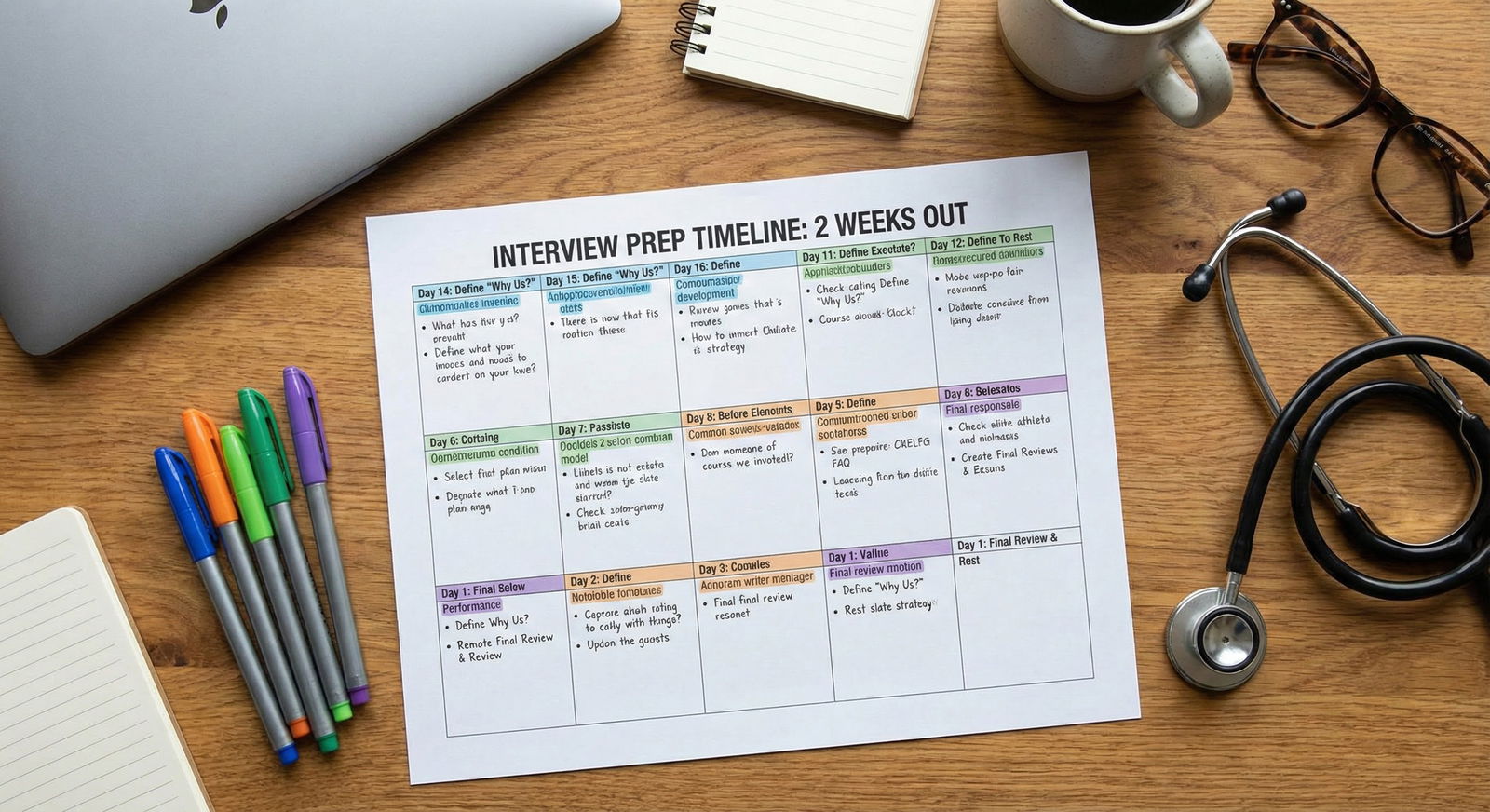
Week 3 rehearsal plan: Days 15-21
At this point you should stop passively reviewing and start pressure-testing.
Each day:
- Pick one behavioral story
- Generate 5 likely probes
- Answer each in under 30 seconds
- Record yourself once
- Cut one unnecessary sentence from every answer
Likely probes include:
- "What happened between A and B?"
- "What was your exact role?"
- "How did you decide that?"
- "What was the measurable change?"
- "What would you do differently?"
Week 4 rehearsal plan: Days 22-28
Now do full mocks focused only on weak points.
Each day:
- Run one 10-15 minute mock
- Tell the interviewer to interrupt you whenever the timeline gets fuzzy
- Practice correcting yourself without apologizing excessively
- End each answer with a crisp lesson
Day 29: Build your one-page timeline handout
For yourself. Not for the interviewer.
Include:
- 5-7 core stories
- Approximate dates
- Role label
- Main action
- Outcome
- One lesson
- One likely probe
This becomes your pre-interview reset sheet.
Day 30: Final review
Strip out:
- extra background
- team-credit fog
- vague verbs
- fake precision
Keep:
- chronology
- ownership
- impact
- reflection
That's the formula.
Summary
Behavioral interview gaps are not fatal. Unmanaged gaps are.
The strongest applicants don't try to sound flawless. They sound organized, accurate, and self-aware. That's what interviewers trust. If your story has missing time, thin detail, or a sequence problem, don't improvise your way out of it. Build a timeline spine. Classify the gap. Match the probe to the response. Then use the closure loop:
- Anchor
- Action
- Impact
- Learning
At this point you should be able to do two things well: first, identify whether the problem is time, action, result, or role; second, answer the exact probe category directly without wandering. And if you don't recall an exact date, good. Say that honestly, use relative timing, explain the decision logic, and correct inconsistencies by naming what changed versus what remains true.
That's not just safer. It's better interviewing.