
What do you actually say when the interviewer asks about “working on a team” and you’ve basically done everything alone?
Let’s be blunt: behavioral questions about teamwork are not optional in residency interviews. You will get them. And if your real background is heavy on solo studying, observerships, shadowing, or research you mostly did alone, you’re probably dreading this.
You should not walk into interviews hoping they just “do not ask that.” They will. So let’s build answers that are honest, specific, and do not make you sound like you’ve never interacted with another human being.
We’ll walk through what to do if:
- You truly lack formal team-based experiences (no sports, no committee work, minimal group projects).
- Your “teams” were weak or dysfunctional and you’re scared to bring them up.
- You have experiences, but they’re not clinical or not recent.
- You blank on the spot and cannot remember anything except “I study alone.”
You’re not trying to fake being a team player. You’re trying to correctly frame the real experiences you do have so they show how you’ll function on a residency team at 3 a.m. on ICU call.
Step 1: Redefine “team” before you walk into the room
Most applicants mess up right away by having a narrow mental definition of “team.”
You think “sports team,” “quality improvement committee,” “leadership board,” “code team.” Those count. But residency interviewers know a lot of med students haven’t had extensive formal leadership roles. They will absolutely accept less formal teams—if you present them well.
Think broadly, but honestly. Teams you can legitimately use:
- Clinical: clerkship groups sharing a patient list, sign-out with co-students, working with nurses, PT, social work on discharge planning, pre-rounds with a co-student and intern.
- Academic: lab groups, multi-author projects, class group projects, peer-tutoring setups where you coordinated schedules and materials.
- Work: restaurant shifts, retail, tutoring centers, EMT crews, scribe teams.
- Non-clinical: volunteer orgs, religious groups, family small business, musical ensembles, theater groups.
The key is: multiple people, shared goal, interdependence. That’s a team.
If you walk into interviews thinking “I have no teams,” you’ll freeze and give vague nonsense. If you walk in with a mental list of 4–5 real “team situations,” you’ll handle almost any behavioral angle.
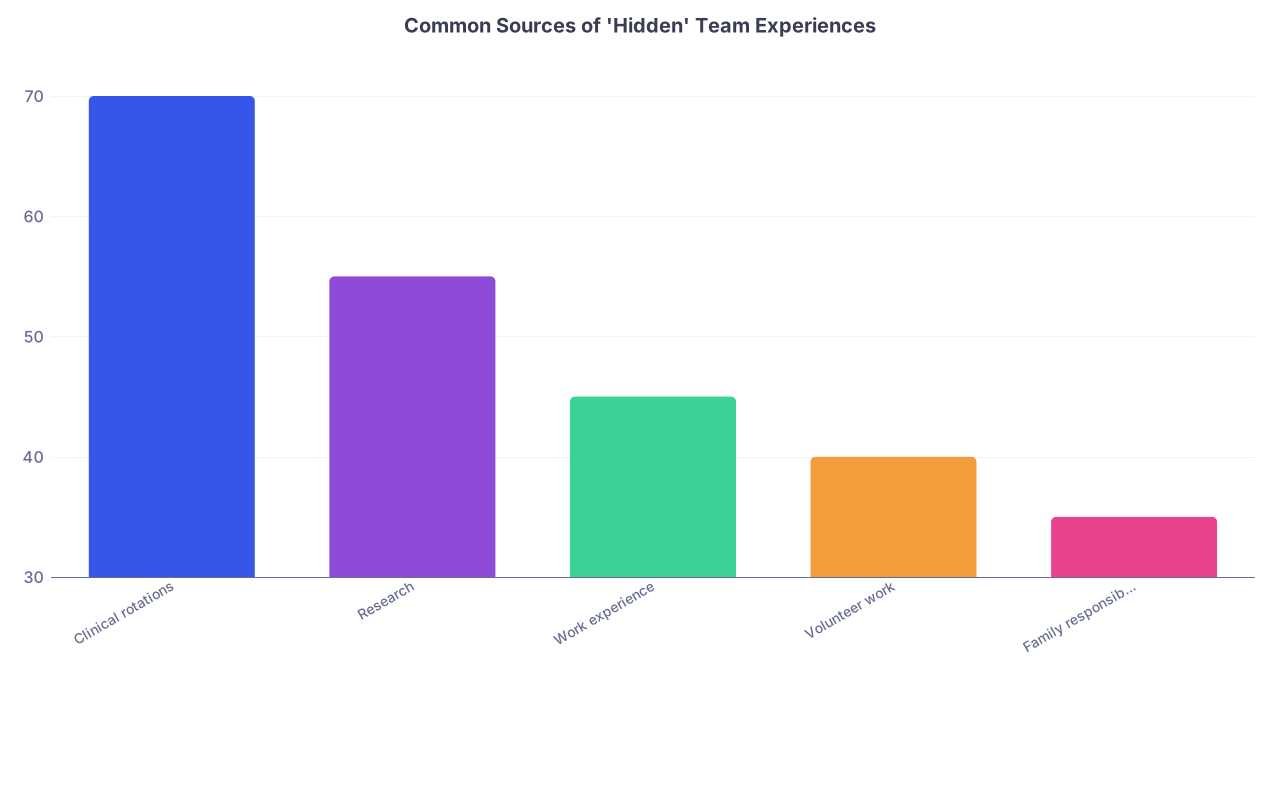
| Category | Value |
|---|---|
| Clinical rotations | 70 |
| Research | 55 |
| Work experience | 45 |
| Volunteer work | 40 |
| Family responsibilities | 35 |
These numbers aren’t from a paper; they’re roughly what I see when I actually talk to applicants who initially say “I have no team experience.” They’re almost always wrong. They just didn’t recognize it as team-based.
Step 2: Know the behavioral question types you’re going to get
You do not need to predict the exact wording. But you should be ready for the common behavioral “team” questions that show up over and over:
- “Tell me about a time you worked on a team.”
- “Tell me about a time there was a conflict on a team.”
- “Tell me about a time you worked with someone difficult.”
- “Tell me about a time you had to assume a leadership role on a team.”
- “Tell me about a time you had to follow instead of lead.”
- “Describe a time your team failed or fell short.”
If you’re thinking, “I don’t have six team stories,” let me save you: you do not need six separate stories. You need 2–3 good team stories that you can twist slightly depending on the prompt.
One case could become:
- “working on a team”
- “difficult teammate”
- “conflict”
- “taking initiative”
- “learning from failure”
This is efficient prep. You’re not writing a novel; you’re building a small toolkit.
Step 3: When your experiences really are thin – here’s how to build usable stories
Let’s say you’re that classic student:
- Strong board scores.
- Mostly did solo research analysis, not heavy lab teamwork.
- Clinical rotations with minimal responsibility.
- No sports, no big leadership roles.
- International grad, a lot of time spent just surviving and studying.
You still have material. Here’s how to extract it.
1. Mine your rotations aggressively
Do not just think “I rounded on a team.” Get specific.
Examples you can shape into behavioral answers:
- You and another student shared pre-rounding and split patients, then coordinated sign-outs to the intern.
- You worked with a nurse and social worker to solve a discharge barrier for a complex patient.
- You shadowed an attending who actively asked for student input on management and you had to coordinate with the intern and resident to communicate changes.
Pick one case where there were moving parts: more than two people, a shared problem, time pressure, and you contributing something concrete.
2. Mine your research for actual interaction
Most people talk about “my research” like they did it on Mars. Terrible move.
Ask yourself:
- Was there a weekly lab or Zoom meeting?
- Did you coordinate with a statistician?
- Did you divide tasks with a co-author (data extraction, writing, references)?
- Did you have disagreements on methodology or authorship order that got resolved?
That’s teamwork. Use it.
3. Use work or non-clinical experiences unapologetically
Programs do not care that your “best team story” came from working in a restaurant. If anything, they like it, because service jobs are where you actually learn to function under pressure with other humans.
You can absolutely say:
“In college I worked at a busy restaurant, and that’s actually one of the clearest examples I have of learning real-time teamwork…”
Then tell a sharp, specific story. Don’t apologize for it.
Step 4: Use a clean structure so you don’t ramble (STAR, but actually done right)
You’ve heard of STAR (Situation, Task, Action, Result). Most people butcher it and talk for 4 minutes with no point.
Here’s how I want you to structure answers when you’re light on team experiences: brutally tight.
- Situation: 1–2 sentences
- Task: 1 sentence
- Action: 3–4 sentences (this is where you show up)
- Result: 2–3 sentences, including what you learned
Example: “Tell me about a time you worked on a team.”
Weak start:
“Well, I guess one example is during my internal medicine rotation we had a team that rounded on the patients and I helped with things and we…”
Strong, even if simple:
“During my internal medicine rotation at City Hospital, our team admitted a patient with decompensated heart failure and very limited social support. I was working with another student, the intern, and the floor nurse, and we were struggling to coordinate follow-up because the patient kept declining home health services.
My specific role was to help the team understand the patient’s concerns and find a discharge plan that everyone could support. I sat down with the patient to clarify why he was declining services, learned that he’d had a bad experience with a prior agency, and brought that back to the nurse and social worker. Together, we identified an alternate agency, and I helped organize a brief family meeting where we reviewed the plan. The intern appreciated that I kept everyone updated in real time, including confirming the follow-up appointment before discharge.
The result was a safe discharge with home health, and the patient showed up to his one-week follow-up. For me, it reinforced that on a team my strength is closing communication loops—understanding different perspectives and making sure everyone is on the same page, especially the patient.”
Is this the most dramatic story in the world? No. Does it show you on a real healthcare team, doing something concrete, with a result and a takeaway? Yes. That’s what they want.
Step 5: Handling the dreaded conflict / difficult teammate questions
This is where people with limited team background panic. “I’ve never really had big conflicts.”
You almost certainly have. You just called them “annoyances” instead of “conflicts.”
Sources of mild but usable conflict:
- A co-author not answering emails for a deadline.
- A classmate who didn’t do their part of a group project.
- A nurse who seemed frustrated with you and stopped responding to your questions.
- A lab mate who kept “forgetting” to share data or update you.
You don’t need a screaming match. You need:
- Different expectations or behavior.
- A choice you made in response.
- A new or better outcome after.
Example, from research:
“On one retrospective study, I worked with another student who was responsible for half the chart reviews. We were facing a submission deadline, and I realized a week out that she was significantly behind, which put the entire project at risk.
My first instinct was to just take over her part, but I knew that would hurt the relationship and wasn’t sustainable. Instead, I asked to meet briefly, and I approached it from a ‘shared goal’ perspective—‘I’m worried about our deadline; how can we divide this so we both succeed?’ I learned she was overwhelmed with another rotation and felt embarrassed to say so. We renegotiated the timeline with our PI, I took on some of her simpler charts, and we set up 15-minute check-ins twice that week so she did not fall further behind.
We submitted on time, and we’ve worked together on another project since. That experience pushed me to be more proactive about checking in before things reach a crisis point, which I think will matter even more on a residency team where delays affect patient care, not just a manuscript.”
Notice what I’m doing: showing how you handle conflict without needing a dramatic meltdown scene.
Step 6: When your experience truly isn’t “team-based” — how to pivot without looking evasive
Sometimes, you’ll get a very pointed question:
“Tell me about a time you worked on a clinical team.”
Or:
“Describe a time you led a medical team.”
If your clinical team experiences are thin, you don’t lie. You also don’t crumble. You acknowledge the limitation briefly, then pivot to your best related example and connect the dots.
Something like:
“To be candid, as a student I wasn’t leading formal medical teams; my role was usually as part of the group supporting the resident and attending. One example that felt closest to a leadership role was during my surgery rotation…”
Then you tell a focused story where you:
- Coordinated others.
- Anticipated needs.
- Took ownership of one slice of care (sign-out, pre-op checks, patient education).
Programs don’t expect you to have run a code team as an MS3. They expect you to show situational awareness and readiness to grow into that role.
Step 7: Use non-clinical examples strategically—not as a last resort, but as proof of pattern
If your best, cleanest team example is from non-clinical life, use it early in the answer and then explicitly tie it back to residency.
For instance, from restaurant work:
“At a busy restaurant where I worked during college, we functioned a lot like a clinical team—multiple roles, time pressure, and customers who didn’t see the behind-the-scenes chaos.
One night we were short-staffed, and tickets were backing up. I was working as a server but had cross-trained at expo. I made a quick decision to step into expo during the rush, coordinated with the line cooks, and asked another server to cover my section briefly while I organized orders. We re-prioritized tickets, communicated delays honestly to customers, and comped one meal when a delay was excessive.
That experience taught me two things that I know translate directly to residency: first, in a crunch, clear communication and role flexibility matter more than titles; second, you protect the ‘front-facing’ experience—in residency that’s the patient—by staying calm and honest even when things behind the scenes are messy.”
Now you’ve made the connection for them. They don’t have to guess.
Step 8: Avoid the three answers that quietly kill your credibility
I’ve heard versions of these on actual interview days, and they land badly.
- “Honestly, I prefer to work alone.”
You can think this. You cannot say this in a residency interview. Rephrase the truth:
“I’m very comfortable with independent work, but over the last few years I’ve become more intentional about seeking and valuing team input, especially in clinical settings.”
- “I haven’t really had conflicts. I get along with everyone.”
No you don’t. Nobody does. This sounds naive or dishonest. Find a small conflict and show maturity in how you handled it.
- “We worked as a team and we did X, Y, Z…” with zero “I.”
If I stop you mid-answer and ask, “What did you do?” and you cannot immediately answer, your story is useless. Always include your piece: “My role was…,” “I decided to…,” “I suggested…”
Step 9: Patch the gap before interview season if you truly have almost nothing
If you’re reading this months before interviews and realizing, “I actually am pretty isolated,” fix that now. Not in theory. Tangibly.
Options that give you real team material within a few months:
| Option | Time Commitment | Team Element |
|---|---|---|
| Join a clinic or free health fair | 1–2x/month | Work with staff & volunteers |
| Start/lead a small QI project | 2–4 hrs/week | Coordinate with clinicians |
| Group OSCE prep with assigned roles | Weekly | Shared goals & feedback |
| Volunteer in non-clinical org (soup kitchen, tutoring) | Weekly | Shift-based teamwork |
You’re not gaming the system. You should be functioning in teams if you’re going into residency. This just forces you to do it before July 1st of intern year.
Step 10: Put it all together with a mini “answer bank”
By the time you’re done preparing, you should have at least:
- 2 clinical team stories (even if modest)
- 1 research/academic team story
- 1 non-clinical/work team story
- 1 clear conflict/difficult teammate story
Label them for yourself like this:
- Story A – IM rotation, discharge planning, communication strength.
- Story B – Research co-author behind schedule, proactive check-in.
- Story C – Restaurant short-staffed shift, stepping into new role under pressure.
- Story D – Group project, unequal contribution, expectation-setting.
Then map them loosely to common questions:

| Step | Description |
|---|---|
| Step 1 | General Teamwork |
| Step 2 | Story A - IM team |
| Step 3 | Story C - Restaurant |
| Step 4 | Conflict on Team |
| Step 5 | Story B - Research conflict |
| Step 6 | Story D - Group project |
| Step 7 | Leadership on Team |
| Step 8 | Following on Team |
You walk into the interview with this mental map, not a blank slate. That’s the difference between rambling and sounding like an adult who’s actually thought about how they function with other people.
FAQ (exactly 4 questions)
1. Is it a red flag if my best teamwork example isn’t clinical?
No. What matters is that it’s concrete, shows how you behave with others, and you explicitly connect the lessons to residency. A sharp restaurant, tutoring, or family business story is better than a vague “I rounded with a team” story any day.
2. What if the interviewer interrupts and says, “Give me a different example”?
Do not panic. Say, “Sure,” brief pause, and go to the next story in your bank. They’re usually checking whether you’re flexible or if you only memorized one script. Keep it shorter the second time—1 minute instead of 2—focusing on your role and what you learned.
3. How long should my behavioral answers be?
Aim for 60–120 seconds. Under a minute usually means you’re being too vague. Over two minutes and you’re likely rambling. Practice out loud and time yourself. If it keeps hitting 3+ minutes, you’re giving way too much background and not enough “here’s what I actually did.”
4. Can I reuse the same story for multiple questions in one interview day?
Yes, but do it carefully. You can reuse a strong story for different angles—as long as you emphasize a different aspect each time (communication in one answer, conflict resolution in another). If you’re reusing the same story with the same emphasis, it starts to look like you only have one example. Rotate through your story bank when you can.
Key points to walk in with:
- You almost certainly have more team-based experiences than you think; mine them from clinical, academic, work, and life.
- Structure your answers tightly around a few well-prepared stories that clearly show what you did and what you learned.
- Non-clinical examples are absolutely fair game—use them confidently and tie them back to how you’ll show up on a residency team.