
Two days before her internal medicine interviews, a fourth-year I worked with sent me her CV. Starbucks barista. High school teacher. Uber driver. Zero “real” research, barely any formal leadership. Her email said: “I’m terrified they’ll ask about teamwork and conflict and all I’ll have is coffee stories.”
If that feels uncomfortably familiar, stay with me. You’re not the only one walking into residency interviews with more non‑clinical jobs than publications. The difference between looking underqualified and looking like a strong, experienced adult comes down to how you use those jobs in behavioral questions.
1. Reality check: Your non-clinical work is not the problem
Let me be blunt: programs are not allergic to non‑clinical work. What they dislike is applicants who:
- Apologize for their background
- Tell shallow “I worked hard” stories
- Fail to connect prior work to residency skills
I’ve seen residents match into anesthesia after years as a construction foreman. Psych after corporate marketing. EM after being a public school teacher for a decade. The common thread? They knew how to translate their experience.
Behavioral questions are exactly where non‑clinical work can shine. Those questions are about:
- Conflict
- Feedback
- Mistakes
- Leadership
- Working in teams
- Handling stress and uncertainty
You know who has those stories? People who’ve actually had jobs.
If your path includes:
- Retail, food service, gig work
- Corporate/tech/finance roles
- Teaching/tutoring
- Military service
- Family business, manual labor, trade work
…then you have a huge bank of behavioral stories. You just probably haven’t organized them right yet.
2. What programs actually listen for in your stories
They do not care if the story happened in an ICU or an ice cream shop. They care what the story shows about you.
For residency, they’re testing for things like:
- Reliability and work ethic
- Ability to function under pressure
- Communication (especially with difficult people)
- Owning mistakes, not blaming others
- Learning from feedback
- Initiative and follow‑through
- Emotional maturity
Translate that: they’re trying to decide if they want to be on call with you at 3 a.m. for the next three years.
So any story you use from non‑clinical work must clearly show at least one of these qualities. If it doesn’t, it’s a bad story, not a bad job.
To make this concrete, here’s how non‑clinical roles often map to residency skills:
| Non-Clinical Role | Strongest Residency Skills You Can Show |
|---|---|
| Retail / Food Service | Teamwork, conflict management, customer empathy |
| Teaching / Tutoring | Communication, patience, feedback skills |
| Corporate / Office | Organization, leadership, systems thinking |
| Manual Labor / Trades | Work ethic, safety mindset, reliability |
| Gig Work (Uber, etc.) | Adaptability, stress tolerance, professionalism |
Your job is to pick the right story from the right job for the right question.
3. The structure you should use for every behavioral answer
If you walk into interviews with only one tool, make it this: tighten your story structure.
Use a stripped‑down version of STAR, but keep it clean:
- Context – 1–2 sentences: where you were and what was going wrong
- Action – what you did; specific behaviors, not vague traits
- Result – what happened; numbers, feedback, or concrete outcome
- Residency tie‑back – 1–2 sentences that explicitly connect it to training
Skip the life story. They don’t need to know how long you worked there or your whole job description unless it’s relevant.
Bad answer structure:
“I worked at Target for three years and I was usually a closer. One time it got really busy and a customer was very upset, but I stayed calm and handled it.”
Good structure:
“During college I worked evening shifts at Target, often as the only floor employee covering three departments. One Black Friday, a customer became angry when we ran out of a doorbuster TV they’d waited in line for.
I listened without interrupting, validated their frustration, then checked inventory at nearby stores and online while they stayed at the service desk. Nothing matched the original deal, so I spoke with my manager and we agreed on a comparable model with an additional discount.
The customer left satisfied, and my manager later asked me to help train new hires on de‑escalation.
In residency, the pressure is different, but the skill’s the same: stay calm under stress, listen, and try to solve the problem within the system’s constraints while keeping the person in front of you at the center.”
Notice the last line. You must connect the dots for them. Do not assume they’ll “get” how Target -> residency.
4. Common behavioral questions and how to use non-clinical stories for each
Let’s go through the usual suspects and exactly how you’d pull in non‑clinical work.
A. “Tell me about a time you had a conflict with a coworker.”
Perfect for retail, food service, office jobs, or teaching.
Weak move: Pretend you never have conflict.
Strong move: Show you can handle conflict professionally.
Example (server at a restaurant):
“As a server at a busy restaurant, I had a colleague who routinely disappeared during peak hours, leaving others to cover her tables. One Saturday, I found myself managing her section plus mine, which led to long waits and frustrated customers.
After the shift, instead of venting to others, I asked if we could talk privately. I framed it around shared goals: tips, guest reviews, and making the night manageable. I asked if there was anything about the flow she found overwhelming. She admitted she felt lost with the new POS system and was avoiding it.
I offered to come in 20 minutes early before our next shift to run through her typical orders and show her a few shortcuts. Over the next few weeks, her efficiency improved and the tension on the team eased.
In residency, I expect similar situations when workload or new systems overwhelm people. That experience taught me to address issues directly but respectfully, and to look for what’s actually driving the behavior before jumping to judgment.”
That’s conflict resolution, coaching, empathy, and professionalism. All from a restaurant.
B. “Describe a time you made a mistake.”
This is where many applicants panic and try to hide. Don’t. Programs know you’ll make mistakes. They want to see if you crumble, blame, or learn.
You can absolutely use a non‑clinical story here if your clinical ones are either too trivial or too dangerous to discuss.
Example (office job):
“At my first office job, I was responsible for compiling a weekly sales report for our regional manager. One week, I mis‑sorted a spreadsheet column and submitted numbers that under‑reported our sales by roughly 15%. The manager used that report in a call with corporate before catching the error.
As soon as I realized the mistake, I owned it. I emailed my manager with a corrected report, highlighted the error, and explained exactly how it happened. I then created a brief checklist for my own process, including a second sort check and spot‑comparison to the prior week’s numbers before submitting.
My manager wasn’t happy, but she appreciated the transparency and the prevention plan. After that incident, I didn’t repeat that error, and I started catching subtle issues in other reports as well.
For residency, I know I’ll need that same approach: acknowledge errors early, communicate clearly, and build systems to protect patients and the team from repeat mistakes.”
The key: specificity, personal responsibility, and process improvement.
C. “Tell me about a time you led a team.”
Do not confuse “leadership” with “having a title.” Programs care more about what you actually did.
You can pull leadership from:
- Shift lead at a store
- Senior server training new hires
- Team captain in sports
- Project lead at a corporate job
- Coordinating a tutoring program
Example (teaching):
“Before medical school, I taught 8th‑grade science. We had a group of students who consistently failed labs because they were missing instructions or rushing through. Instead of writing it off as ‘unmotivated,’ I proposed restructuring labs so students worked in stable teams with clear assigned roles: materials manager, data recorder, presenter.
I trained each team on expectations and created quick 3‑minute debriefs at the end of labs focusing on what went well and what they’d change next time. Over the next quarter, lab completion rates increased from roughly 60% to over 90%, and discipline incidents during labs dropped noticeably.
That experience taught me that leadership is less about authority and more about creating structure and clarity so a group can function. On a residency team, that translates to clear task division, brief check‑ins, and making sure everyone knows the plan for the day.”
That’s a leadership story programs will respect.
5. Pre-building your “story bank” from non-clinical work
Walking into interviews trying to invent stories on the fly is how you end up rambling about “this one time at Costco…” and losing the thread.
You need a story bank. One evening of work will save you on every interview day.
Here’s a simple, practical way to build it:
- List every non‑clinical job you’ve had. Even the ones you think are “small.”
- For each job, write down 3–5 moments that involved:
- Stress or time pressure
- Interpersonal conflict
- Taking initiative
- Fixing a mistake
- Teaching or training someone
- From that pool, pick:
- 2 conflict stories
- 2 mistake/feedback stories
- 2 leadership/initiative stories
- 2 teamwork stories
- 1 resilience/burnout/long‑hours story
Now refine each into the 4‑part structure: context, action, result, residency tie‑back. Keep each story under 90 seconds when spoken.
Here’s what this might look like in practice:
| Slot | Job | Quick Label |
|---|---|---|
| Conflict #1 | Restaurant | Server covering unreliable coworker |
| Mistake #1 | Office | Wrong numbers in sales report |
| Leadership #1 | Teaching | Restructuring lab groups |
| Teamwork #1 | Retail | Black Friday line management |
| Resilience #1 | Gig work | Night shifts + school + family |
You’re not going to recite them word‑for‑word. But you want the skeletons built so your brain isn’t scrambling under pressure.
6. Fixing the two big mistakes applicants make with non-clinical stories
I see the same errors over and over.
Mistake 1: Apologizing for the job
Phrases like:
- “This isn’t medicine‑related, but…”
- “I know this is just retail, but…”
- “Sorry, this was before I got serious about medicine…”
Cut all of that. It signals insecurity and invites them to see your experience as lesser.
Instead, own it:
- “In my previous job as a server…”
- “When I worked full‑time in retail before medical school…”
- “During my three years as a teacher…”
You are an adult who has done adult work. Act like it.
Mistake 2: Never tying it back to residency
You tell a decent story, then stop. Interviewer stares. Silence. They’re waiting for you to connect it for them.
You should almost always land on a line like:
- “That experience shaped how I plan to handle…”
- “I see a direct parallel to residency in…”
- “That’s the same approach I plan to bring to…”
Make the residency connection explicit. Do not assume they’ll infer it.
7. When (and how) to choose non-clinical vs. clinical stories
You might be wondering: “Should I always use non‑clinical work? Or only if I have to?”
Here’s the rule of thumb I give students:
- Use clinical stories when:
- The question is clearly medical: patient safety, clinical error, complex care decisions
- You’ve got a strong, concrete example that won’t take 5 minutes to explain
- Use non‑clinical stories when:
- The skill is universal (conflict, leadership, teamwork, resilience)
- Your clinical example is too emotionally heavy or too vague
- Your non‑clinical story has a clearer start/end and better outcome
And yes, mixing is good. If every answer is from pre‑med retail, that’s a problem. If every answer is from a single ICU rotation, also a problem. You want to look like a whole human.
To help balance things, think roughly like this over an entire interview day:
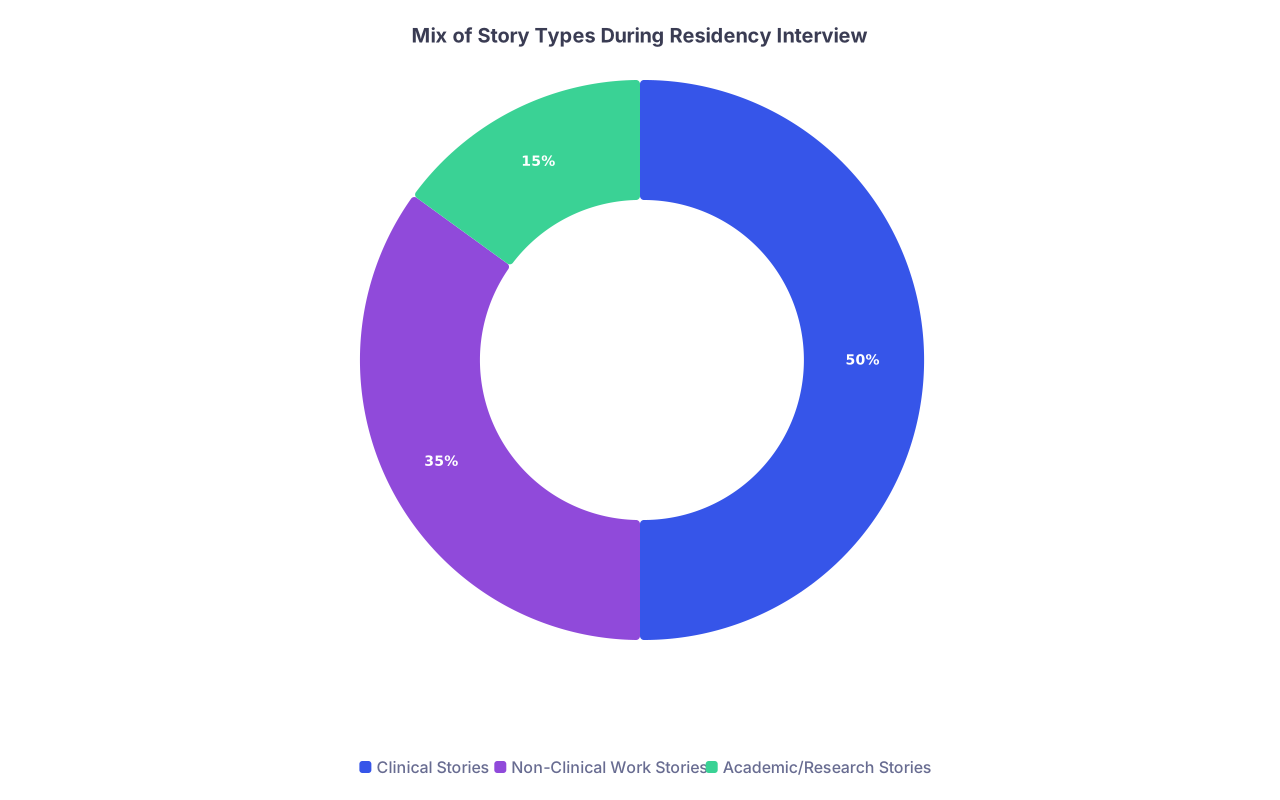
| Category | Value |
|---|---|
| Clinical Stories | 50 |
| Non-Clinical Work Stories | 35 |
| Academic/Research Stories | 15 |
That’s not a rule, just a decent target: clinical-centered, but with non‑clinical experience clearly present.
8. How to rehearse without sounding robotic
Yes, you need to practice. No, you should not memorize scripts.
Here’s the method that works:
- Bullet points only. For each story, write 4 bullets: setting, key action, result, residency link. No full sentences.
- Say them aloud, on camera. 60–90 seconds per story. Watch yourself. Notice where you ramble.
- Cut the fluff. Any background detail that doesn’t change the point of the story — gone.
- Vary your openings. Don’t start every answer with “So…” or “One time…”. Rotate: “During my time as…”, “On one particularly busy shift…”, “In my previous role…”
- Practice mixing clinical and non‑clinical. Do mock questions and force yourself to answer half with clinical examples, half with work/other life examples.
You’re aiming for: practiced structure, natural wording. Like telling a story you’ve told friends a few times, not reciting an essay.
9. Example Q&A: Putting it all together
Let’s run through one full question with a clear, strong non‑clinical answer, step by step.
Question: “Tell me about a time you had to work with a difficult supervisor.”
Example (construction job):
“Before medical school, I spent two summers working construction. Our site supervisor was highly experienced but had a very blunt, sometimes demeaning communication style. One day, after I mis‑measured a cut and wasted material, he criticized me loudly in front of the crew, saying I was slowing everyone down.
I felt embarrassed and defensive, but I also knew he controlled the workflow and my schedule. After the shift, I asked if we could talk briefly. I told him I respected his experience and wanted to get better, but that being called out in front of the group made it harder for me to focus and learn. I asked if he could give technical feedback directly and, when possible, in the moment at the task, rather than across the job site.
He didn’t change his personality, but he did start correcting me more quietly and occasionally pointing out when I’d done something right. My performance improved, I made fewer errors, and our relationship became more functional.
That experience taught me that in hierarchies — like a job site or a hospital — you won’t always get supervisors who communicate the way you’d choose. But you can still advocate for yourself respectfully, focus on learning, and not let your ego get in the way of the work. That’s the mindset I plan to bring to residency when I’m working with different attending styles.”
That’s professional, adult, zero apologies for the job itself, and directly relevant to residency dynamics.

10. Quick action plan if your interviews are soon
If your first interview is in a week or two, here’s what to do tonight:
- Write down every non‑clinical job you’ve had and your main responsibilities.
- Build a 10‑story bank: 5 clinical, 5 non‑clinical (using the categories above).
- For each story, outline the 4 parts: context, action, result, residency tie‑back.
- Record yourself answering:
- Conflict with coworker
- Time you made a mistake
- Time you led a team
- Dealing with stress/burnout
- Working with someone very different from you
- Watch once, fix only two things:
- Cut length if >90 seconds
- Make the residency connection more explicit
That alone will separate you from half the applicant pool, who will walk in with “uhh… let me think…” answers and never mention what the story means for them as an intern.
FAQs
1. Will programs judge me for having mostly non-clinical work and limited research or leadership?
Some ultra‑research-heavy programs may care, but the majority of residencies care more about whether you’re reliable, teachable, and not a nightmare to work with. If your non‑clinical work shows consistency, responsibility, and growth — and you articulate that clearly — you’re far better off than someone with a fancy title who can’t communicate or handle feedback.
2. Is it okay if my best behavioral story is from many years ago, before medical school?
Yes. If the story still reflects who you are and how you operate, use it. Just anchor it clearly in time: “During my two years teaching before medical school…” Programs care more about the maturity and self‑awareness the story shows than whether it happened 2 or 6 years ago. If it feels outdated or you’ve grown since, add a quick line about how you’d handle it even better now.
3. What if I’ve only ever done one type of non-clinical job, like just retail or just teaching?
That’s fine. Depth beats breadth. Pull multiple different kinds of situations from that single role: conflict with a coworker, handling an angry customer, training a new hire, juggling too many tasks, dealing with burnout. If you can show growth and reflection across those stories, that one job can easily carry half your behavioral questions.