
The way most applicants handle professionalism questions in residency interviews is lazy—and programs see right through it.
You cannot “wing” a professionalism concern. Not a failed rotation. Not a write-up for lateness. Not a blip on your MSPE. If you’ve got any professionalism smoke in your file, programs assume there’s fire—unless you walk them, calmly and clearly, through concrete behavior that proves you’ve changed.
This is where behavioral interview examples either save you or sink you.
Below is how to handle this like an adult professional, not a panicked applicant.
Step 1: Be Brutally Clear About What’s In Your Record
Before you can answer anything well, you need to know—exactly—what they know.
Here’s what programs usually see:
- MSPE professionalism comments or “concerns” box checked
- Clerkship evals mentioning lateness, conflict with staff, “needs to improve communication”
- Course or rotation failures/remediations
- Leaves of absence, especially unexplained ones
- Honor council or conduct issues, even if “minor”
- Step failure or big score drop paired with “professionalism” wording (missed exam, no‑show, etc.)
You should do three things before you walk into any interview:
- Read your MSPE line by line. Circle anything that even smells like professionalism.
- List every event that could be interpreted as a professionalism concern—even if you think it’s “not a big deal.”
- For each one, write:
- What happened
- Your part in it (no blaming)
- What you did afterward
- What’s permanently changed
If you can’t describe your own story cleanly in two minutes, you’re not ready for the interview.
Step 2: Understand What They’re Actually Testing
Programs are not asking themselves, “Is this applicant perfect?”
They’re asking:
- When they screw up—and everyone will—do they:
- Own it fast?
- Fix it?
- Change their behavior?
- Are they going to create extra work, risk, or drama for my team?
- Will I regret having them in my program at 3 a.m. on a bad call night?
So your behavioral answers have to show 4 things, every time:
- Insight – you actually understand what went wrong and why it mattered
- Accountability – you stop blaming circumstances and people
- Action – you took specific, visible steps
- Trajectory – the pattern is different now, with proof
If your story is just “X happened, I felt bad, now I’m more professional,” you’ve failed all four.
Step 3: Use a Grown‑Up Version of STAR (That Programs Actually Like)
You’ve heard of STAR (Situation, Task, Action, Result). It’s fine, but most applicants butcher it into a long introduction and a vague ending.
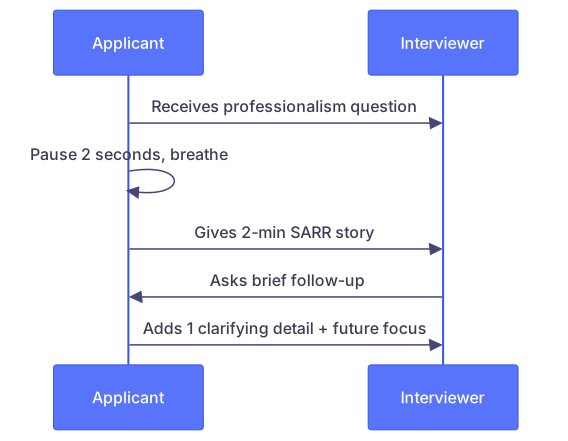
Use this instead: S-A-R-R.
- Situation – very short, just enough to set the stage
- Action – what you personally did (not what “we” did)
- Result – concrete outcome
- Reflection – what you changed and how it’s showing up now
And keep each example under 2 minutes. They don’t need a Netflix documentary.
Step 4: Core Professionalism Areas You Need Examples For
Even if you never had a formal “incident,” they will still test your professionalism with behavioral questions. If you do have an incident, assume they will dig deeper.
You should have at least one strong behavioral example for each of these domains:
- Reliability and follow‑through
- Handling conflict respectfully
- Accepting and using criticism
- Boundaries and integrity
- When you were wrong / made a mistake and fixed it
- Responding to stress without falling apart or becoming unsafe
Let’s go domain by domain with specific example scripts you can adapt.

| Step | Description |
|---|---|
| Step 1 | Identify Concerns |
| Step 2 | Group by Theme |
| Step 3 | Draft Behavioral Stories |
| Step 4 | Refine to SARR Format |
| Step 5 | Practice Out Loud |
| Step 6 | Get Feedback from Mentor |
Domain 1: Reliability – Lateness, Missed Deadlines, No‑Shows
If you’ve ever been called out for being late, missing notes, or dropping the ball, expect something like:
- “Tell me about a time you failed to meet a professional obligation.”
- “Describe a situation where your reliability was questioned.”
Bad answer: “Third year was tough, I overcommitted, but I’ve gotten better with time management.”
Too vague, no behavior, no evidence.
Better structure:
- Very specific incident
- Clear ownership
- Concrete system changes
- Objective evidence things are different
Example:
“During my internal medicine clerkship, I submitted several notes late in the first two weeks. My senior and attending both mentioned that while my clinical work was solid, documentation delays were affecting the team’s workflow.
I realized I was underestimating the time needed to finish notes while also trying to pick up extra patients. I met with my senior, asked for specific expectations, and created a checklist and strict time blocks: pre-round notes done by 9:30, discharge summaries started the night before, and I limited myself to a manageable patient load until I could prove I could keep up.
By the end of the rotation, I consistently had notes in on time, and my final evaluation specifically mentioned ‘reliable and timely documentation.’ On sub‑I, I carried a heavier census and still maintained on‑time notes, which my residents commented on. I now build in ‘note time’ as a protected task in my day instead of assuming I’ll squeeze it in.”
That answer says: yes, I had a reliability issue; no, it didn’t stay that way; here’s the evidence.
Domain 2: Conflict – Nurses, Residents, Attendings, Peers
This is where people get defensive and tank the interview.
Typical questions:
- “Tell me about a time you had a conflict with a team member.”
- “Describe a situation where you disagreed with a supervisor.”
Worst move: making yourself the hero and the other person the villain.
You want to show: respect, calm, focus on patient care, and the ability to repair relationships.
Example with nursing staff:
“On my surgery clerkship, there was a day when a scrub nurse told me I’d contaminated the field and asked me to step back. I felt embarrassed and responded in a clipped tone, saying I didn’t think I had. She reported to the resident that I’d been disrespectful.
After I had a chance to cool down, I realized two things: first, the nurse’s job is to protect the field and the patient, and second, my reaction made it harder for her to do that. I went back to her after the case, apologized for my tone, and asked if she’d be willing to give me specific feedback on my technique. She walked me through exactly what she’d seen and some best practices they expect from residents.
From then on, I made a point of checking in with the scrub nurse before each case, asking about their preferences and verbalizing that I appreciated their safety role. I noticed the OR staff became more open in teaching me. That experience changed how I respond in the moment—I still sometimes feel defensive initially, but I pause, listen, and assume the other team member is trying to help the patient.”
Here, your “Action” and “Reflection” are doing all the work.
Domain 3: Handling Criticism and Difficult Feedback
They’re trying to figure out if you’re coachable or a nightmare.
Questions:
- “Tell me about a piece of critical feedback that was hard to hear.”
- “Describe a time your performance was below expectations.”
Bad: “They told me I needed to read more. So I did.”
That’s nothing.
You want: humility + specific behavior change + proof.
Example:
“On my first rotation of third year, my attending commented that my oral presentations were disorganized and that I tended to jump between systems. It stung because I thought I was doing well.
That night, I asked a senior resident for help. She suggested I use a strict SOAP structure and write bullet points the same way I’d say them. I also started timing myself during practice to keep presentations under 3 minutes.
Within a week, my attending remarked that my presentations were ‘much clearer and more efficient.’ At the end of the rotation, my evaluation specifically mentioned my improvement in communication. I’ve kept that structure and now teach it to junior students when I’m the senior on the team.”
The “hard to hear” part is acknowledged, but you don’t stay there. You move quickly to change and outcome.

Domain 4: Boundaries, Honesty, and Ethical Judgement
This is where the scary professionalism stuff lives: charting you didn’t do, covering up a mistake, cheating, HIPAA issues.
If you have a real incident (honor council, professionalism committee, remediation) you must be ready with a clean, unapologetically honest story.
Common questions:
- “Tell me about a time you made a decision that tested your integrity.”
- “Have you ever been involved in a professionalism or conduct concern?”
Format here:
- Direct acknowledgment (no euphemisms)
- Clear description without oversharing drama
- What you learned about yourself and professional standards
- Structural changes to prevent recurrence
- Evidence of regained trust
Example – minor charting integrity issue:
“During my second year, I was documenting vitals from the EMR into my note and realized I’d copied a set without double‑checking the time. A resident reviewed my note and realized it appeared I’d documented a blood pressure that had not yet been taken. He confronted me, and while I hadn’t intended to fabricate data, I understood that from a chart perspective, that’s exactly what it looked like.
He reported the incident, and I met with the clerkship director. I was given a formal warning and required to complete a professionalism reflection and additional documentation training.
That experience made me very aware that intent and impact aren’t the same. Since then, I’ve adopted a ‘trust but verify’ rule: I only document what I personally verify or clearly attribute the source in the note. On later rotations, attendings have commented that my documentation is careful and appropriately sourced. I also share this story with students I work with as a caution about the line between efficiency and accuracy.”
If your situation was more serious (e.g., academic misconduct), you still follow the same structure but you must be even more explicit about remediation and time‑proven change.
Domain 5: Mistakes and Patient Safety
You will be asked:
- “Tell me about a clinical mistake you made.”
- “Describe a time a patient was affected by your error or oversight.”
If you say, “I can’t think of any,” you look oblivious or dishonest.
Example:
“On my family medicine rotation, I saw a patient with new‑onset headaches. I focused on stress and sleep in my history and didn’t ask about red flag symptoms thoroughly. When I presented, my preceptor specifically asked about visual changes and neurologic symptoms, which I hadn’t fully explored. On exam, the patient had subtle visual field changes, and we ended up ordering imaging that showed a mass.
I felt awful that my incomplete history could have delayed that workup if my preceptor hadn’t caught it. Afterward, I created a personal checklist of ‘must ask’ red flag questions for common complaints and started keeping it on my clipboard. Over time, it became automatic. On my sub‑I, one of my attendings commented that my histories were ‘thorough and safety‑oriented,’ which I see as a direct extension of that earlier error.”
Again: clarity about the risk, no sugar‑coating, and clear functional change.
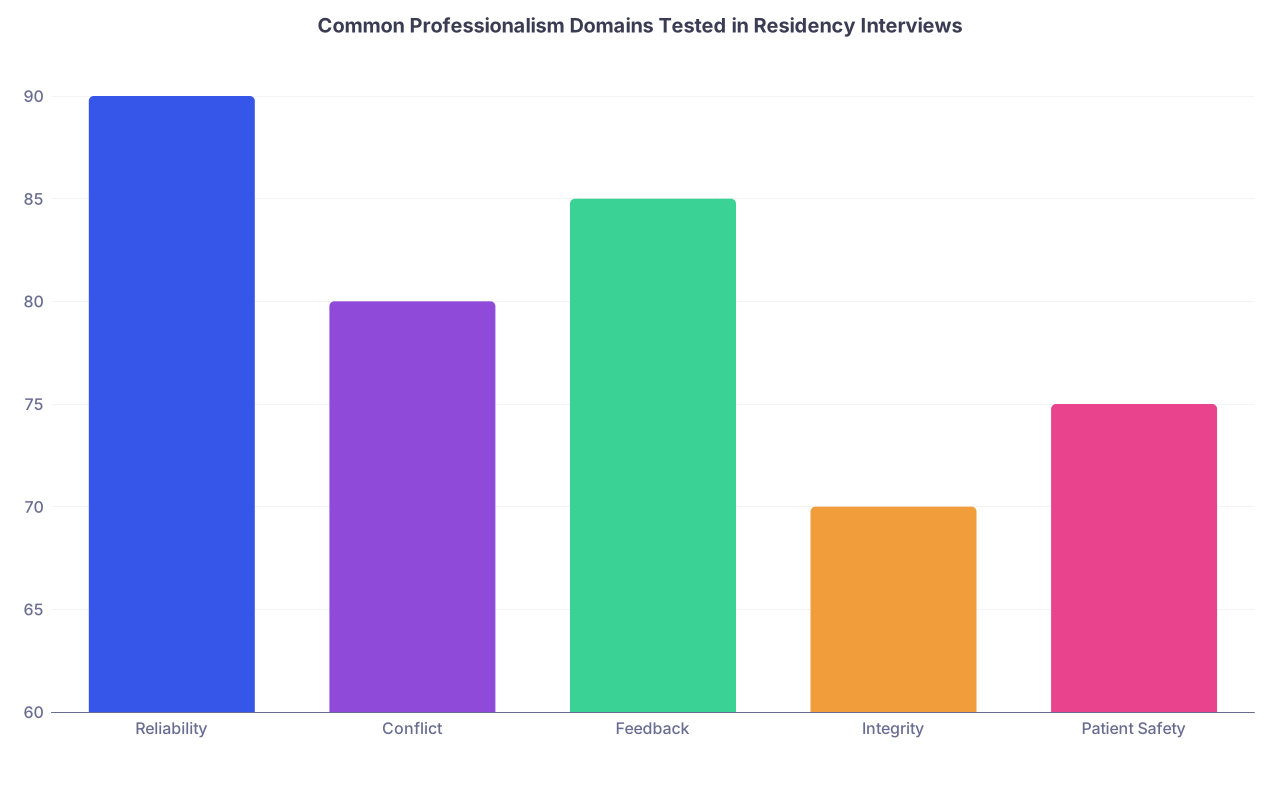
| Category | Value |
|---|---|
| Reliability | 90 |
| Conflict | 80 |
| Feedback | 85 |
| Integrity | 70 |
| Patient Safety | 75 |
If You Have a Documented Professionalism Hit in Your File
Different situation. Higher stakes. You can still match. But you do not have the luxury of vague answers.
Here’s how to structure it when they directly reference your MSPE or a flagged incident:
Program: “Your MSPE mentions a professionalism concern on your surgery clerkship. Can you tell me what happened and what you’ve done since then?”
Your answer needs 5 moves:
- Plain language admission
- No blame, no excuses (context is fine, but secondary)
- Formal consequences and how you complied
- Concrete, observable behavior changes
- Evidence from later rotations / faculty
Example:
“On my surgery clerkship, I was cited for unprofessional behavior after I raised my voice to a resident in front of the team when I felt a criticism was unfair. That was unprofessional, regardless of how I felt in the moment.
I met with the clerkship director and received a formal professionalism concern note, which is reflected in my MSPE. As part of remediation, I completed a professionalism course, met with a faculty coach to review conflict management strategies, and wrote a reflection about how public conflict affects team function and patient care.
Behaviorally, I made two specific changes: first, I committed to addressing disagreements privately and calmly; second, I started actively asking for feedback mid‑rotation instead of letting frustration build. On my medicine sub‑I and ICU rotation the following year, I had zero professionalism concerns, and my evaluations specifically describe me as ‘calm under pressure’ and ‘respectful with staff.’ I also asked those attendings to comment on my professionalism in their letters, because I wanted programs to see the trajectory, not just the low point.”
You’re not minimizing it. You’re showing this is now a data point in a larger, positive story.

How to Practice These Answers Without Sounding Scripted
Here’s the part most people skip. Then they ramble for 6 minutes in the actual interview and wonder why things feel off.
Do this:
- Write out each key professionalism story in full once. Get all the details out.
- Underline the 2–3 sentences that are absolutely essential.
- Turn those into a skeleton on a notecard:
- “Missed deadlines IM → late notes”
- “Owned + met senior”
- “New system: blocked note time, smaller panel”
- “Eval quote: ‘reliable documentation’”
- Practice out loud until you can tell the story smoothly in 90–120 seconds off the skeleton, not memorized phrases.
- Record yourself once. If you sound like you’re reading a statement to a board of inquiry, you need to relax your language.
Then get a brutally honest person—a chief resident, trusted attending, or advisor—to listen to two or three stories and give this exact feedback:
- “Does this sound honest?”
- “Anywhere I sound defensive or like I’m blaming others?”
- “Do you believe I’ve really changed, based only on what I said?”
If their answer to any of those is “not really,” fix it now, not in front of a PD.
Red Flags That Your Answer Will Backfire
If any of this shows up in your responses, cut it:
- “It was kind of blown out of proportion.”
- “Everyone was under a lot of stress.” (as the main explanation)
- “Looking back, I don’t think I did anything wrong.” (for something documented as wrong)
- Long, emotional side stories showing how unfair it all was
- Overemphasis on how much it hurt you vs how it affected patients, team, or trust
- Zero mention of specific behavior change
You can absolutely say, “It was painful,” or “I was embarrassed.” But that cannot be the main point.
Turning Professionalism Concerns Into a Strength
The paradox is this: some PDs actually like applicants who’ve been through something hard and handled it well.
If you can talk about:
- A real misstep
- Humbling feedback
- Formal consequences
- Concrete change
- Clear upward trajectory
…you’re signaling resilience, self‑awareness, and maturity. The exact traits they need at 2 a.m. when systems fail and patients crash.
Do not aim to convince them you’re flawless. Aim to convince them you’re safe, honest, and improving.