
What do you say when the interviewer leans back and asks, “So… tell me about your leave of absence”?
You feel your stomach drop. You knew it was coming. The LOA, the remediation, the “issue” in your file. You prepped everything except this one thing you do not want to relive. And now it is the only thing in the room.
If that is where you are, this is for you.
This is not about whether you should disclose. In residency interviews, if it is in your MSPE, transcript, deans letter, or there was formal remediation, you are already “disclosing.” Programs see it. Behavioral interviews are how they decide: do we trust you with residents, patients, and their brand?
You cannot dodge it. You can control how you come across when they ask.
Let me walk you through exactly what to do.
Step 1: Understand what they are really testing
Behavioral interviews after a leave of absence or remediation are not about the incident itself. They are about who you are post-incident.
Programs are silently scoring you on:
- Accountability – Do you own your part or do you blame everyone else?
- Insight – Do you understand why it happened, not just “what” happened?
- Change – Can you show specific, boring, consistent behavior changes?
- Stability – Are you likely to repeat the same problem under residency stress?
- Professionalism – Can you have a hard conversation without melting down or getting defensive?
They are thinking:
- “If I put this person on nights as a PGY-1, do I need to worry?”
- “Will this be a ‘problem resident’ meeting six months in?”
- “Is this someone who grew from adversity or someone we’ll be cleaning up after?”
You need to answer those questions without them asking.
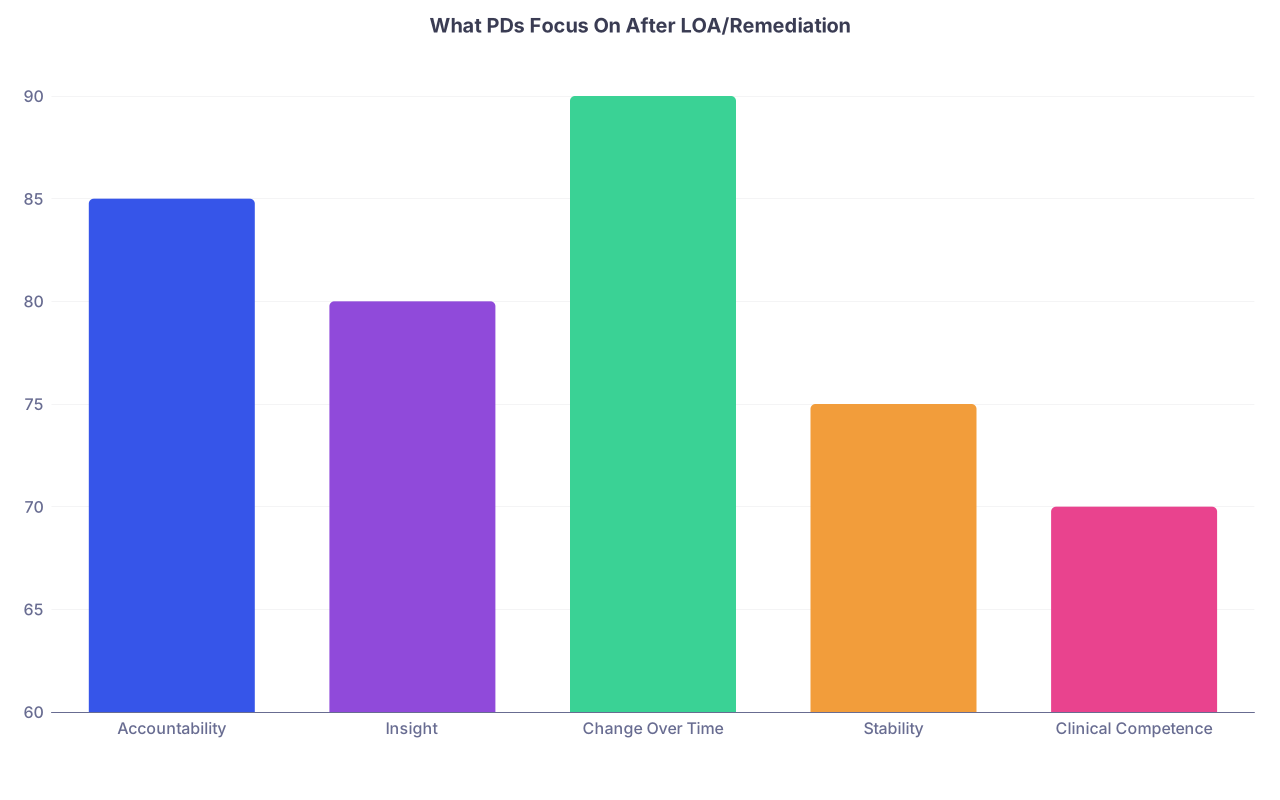
| Category | Value |
|---|---|
| Accountability | 85 |
| Insight | 80 |
| Change Over Time | 90 |
| Stability | 75 |
| Clinical Competence | 70 |
Notice what is not at the top: the exact GPA hit or the number of months you were off. They care about trajectory more than the raw event.
Step 2: Know your “story” before they ask
If you try to improvise this in the room, you will ramble, overshare, or sound evasive. All three are bad.
You need one clear story prepared for:
- Academic remediation (failed course/rotation, Step failure, professionalism concern)
- Personal/health LOA (mental health, physical health, family crisis, pregnancy, burnout)
- Conduct-related issue (boundary violation, plagiarism, unprofessional behavior)
Here is the structure that works, regardless of category:
- Brief context (1–2 sentences)
- What actually happened (1–3 sentences, factual, not graphic drama)
- What you learned (2–3 specific insights)
- Concrete changes you made (3–4 behaviors, not feelings)
- Evidence of sustained improvement (scores, evals, leadership, consistent performance)
- How it made you a better resident candidate
That is it. If you go longer than ~2 minutes, you are doing too much.
Example: Academic remediation story (clinical failure)
“Tell me about this ‘required remediation’ on your transcript.”
Bad answer: “The attending was unfair and it was a very toxic environment and honestly everyone struggled on that rotation.”
Good answer:
“In my third year I initially failed my surgery clerkship. Mid-rotation feedback flagged that my presentations were disorganized and I was not proactive in the OR. I underestimated how assertive I needed to be and did not seek enough feedback early.
I met with the clerkship director, completed a formal remediation rotation, and worked with a faculty mentor on daily pre-rounding plans and structured presentations. I also started asking for end-of-day feedback from residents.
On remediation I passed with honors, and on my subsequent rotations my evaluations consistently mention being well-prepared, reliable, and more engaged. That experience was humbling, but it pushed me to build a feedback habit and a more systematic way of preparing for patient care. Those are things I rely on now every day on sub-I.”
Short. Concrete. No victim tone. Shows growth.
Step 3: Decide how transparent you will be about why you took an LOA
If your LOA was for a health or personal issue, there is a spectrum of disclosure. You do not owe them every detail of your therapy sessions or family drama. You do need to answer three questions clearly:
- Are you stable now?
- What changed so it will not derail residency?
- What did you learn about managing yourself under stress?
You can be honest without being graphic.
Example: Mental health leave
Question: “Can you tell me about the leave of absence in your second year?”
Option that works:
“During second year I took a medical leave for a mental health issue related to burnout and depression. I was overwhelmed, did not recognize how far it had gone, and waited too long to ask for help.
I took a semester off for treatment and to build better support and coping strategies. Since returning, I have been in regular follow-up with my physician and therapist, I maintain a consistent schedule with sleep and exercise, and I’m much quicker to ask for help early.
I completed the remaining pre-clinical and all clinical years on time without further leaves, including full call schedules on my sub-Is. The experience forced me to build a sustainable way of working that I feel is actually an asset going into residency.”
Notice a few things:
- “Medical leave for a mental health issue” is clear enough. You do not need DSM codes.
- You explicitly answer the “are you stable now?” concern with examples.
- You anchor it with time (“since returning… completed X years without further leaves”).
If you do not say how long you have been stable, they will assume it was yesterday.

Step 4: Convert your remediation/LOA into behavioral “competency” answers
Behavioral interviews love questions like:
- “Tell me about a time you failed.”
- “Describe a time you received critical feedback.”
- “Tell me about a time you had to change your behavior after a mistake.”
- “Describe a time your performance did not meet expectations.”
Your LOA/remediation can be the answer. But you must control it; do not sound like you are confessing in church.
Use the STAR skeleton (yes, I know you’ve heard of it, but most people butcher it):
- Situation – One sentence. Set the stage, not your autobiography.
- Task – What you were supposed to do.
- Action – What you did to fix it or respond.
- Result – What happened, with specific outcomes.
Plus: Reflection – One line of what you carry forward from it.
Example: Using remediation as your “failure” answer
“Tell me about a time you failed.”
“In my third year, I failed my internal medicine OSCE. My communication skills in complex goals-of-care conversations were weaker than I realized, and the standardized patient feedback was clear that I came across as rushed and task-focused.
I met with the course director, watched my OSCE video, and worked with a palliative care fellow to practice structured conversation frameworks. I also started deliberately volunteering to lead family discussions on my rotations, and I asked for targeted feedback on empathy and clarity.
On repeat OSCE I passed comfortably, and on my sub-internship my attending specifically highlighted my communication with a complex ICU family as a strength. That experience shifted my approach: I now build in a mental check to slow down and explicitly address emotions and understanding before I launch into plans.”
This does three critical things:
- Normalizes that you can watch yourself fail on video and not disintegrate.
- Shows concrete practice and coaching, not just “I tried harder.”
- Ends on validating evidence from a later rotation.
Step 5: Anticipate and script the tough follow-ups
Experienced PDs and faculty do not stop at “Tell me about your LOA.” They will poke. You need to be ready for the second-level questions without getting flustered.
Common follow-ups:
- “What would you do differently now if you were in that situation again?”
- “How do you manage your stress now?”
- “If I talk to your current faculty, what would they say about how you have changed?”
- “Why should we believe this will not happen again during residency?”
- “Did you consider a different career path at any point?”
You should have 1–2 sentence answers mentally loaded.
Example: “Why won’t this happen again in residency?”
Bad: “It won’t, I promise.” (Meaningless.)
Better:
“The biggest change is that I no longer wait until I’m in crisis to ask for help. I schedule regular check-ins with mentors, I monitor my sleep and mood more actively, and I’ve learned to set earlier limits and prioritize. I’ve stress-tested that system through sub-internships, busy ED shifts, and Step 2 prep without needing further time off, so I feel confident it’s sustainable at the residency level.”
Specific behaviors. Mention “stress-testing” the new habits. That phrase lands well because it tells them this is not theoretical.
Step 6: Do not do these three things (they sink you fast)
I’ve watched applicants with completely redeemable stories blow themselves up in 60 seconds. You avoid that by avoiding these three moves.
1. Do not minimize or spin it as “no big deal”
If you had a formal LOA or remediation, someone thought it was a big deal. When you shrug it off, you sound out of touch or dishonest.
Bad: “It was just a misunderstanding, honestly.”
Better: “It was taken seriously at the time, and I understand why. Here is what I learned…”
You can believe the system is overzealous and still communicate that you understood the stakes.
2. Do not blame directly, even if others messed up
I know some of you got wrecked by one malignant attending or clownish admin process. You cannot drag them in the interview.
You can acknowledge context without pointing fingers.
Instead of: “The attending just didn’t like me.”
Try:
“There was a clear mismatch in expectations between myself and the attending. I did not clarify early enough what they valued, and I waited too long to involve the clerkship director.”
You still get your point across: this was not entirely you, but you’re choosing to talk about your controllable piece.
3. Do not overshare trauma
Your job is not to make your interviewer cry. Overly detailed stories about suicide attempts, family abuse, or diagnostic labels can backfire—people focus on the drama, not your recovery.
High-level, grounded, forward-looking. That is your lane.

Step 7: Align your story with your written application
If your MSPE says one thing and you verbally say another, they will notice. They read these all day.
Do a cross-check:
- MSPE description of LOA/remediation
- Any professionalism narratives
- Transcript notes
- Personal statement mention (if you included it)
- Dean’s letter language
Then:
- Pull out any key phrases they use: “remediated,” “received additional support,” “formal leave.”
- Borrow that tone. You do not need to repeat verbatim, but do not make it sound like a different event.
- Make sure your timeline is consistent—same semester/year, same duration.
If your dean’s letter says “two semesters” and in person you say “a few months,” that feels slippery. Say “two semesters” there too.
Step 8: Practice out loud until it is boring
Your story needs to sound like a well-rehearsed truth, not a monologue. That means you practice enough that:
- You do not tear up (unless you want to and can recover).
- Your voice does not crack on the hard parts.
- You can say it in under 2 minutes without rushing.
- You do not get defensive if they ask, “What else?”
Practical drill:
- Record yourself answering: “Tell me about your leave of absence.”
- Watch once focusing only on:
- Length
- Filler (“uh, like, you know”)
- Blame language (“they, the system, unfair”)
- Rewrite into bullet points.
- Practice again until you can hit those bullets naturally.
Do this with one brutally honest friend or mentor. Not someone who says, “That sounded great!” Someone who says, “You sound angry there” or “You’re dodging the question.”

| Step | Description |
|---|---|
| Step 1 | Identify Issue |
| Step 2 | Clarify Facts & Timeline |
| Step 3 | Define Key Lessons |
| Step 4 | Outline Behavioral Changes |
| Step 5 | Gather Evidence of Improvement |
| Step 6 | Write 2-Min Story |
| Step 7 | Practice Out Loud |
| Step 8 | Get External Feedback |
| Step 9 | Refine & Memorize Bullet Points |
Step 9: Have “evidence” ready and weave it into answers
Saying you have changed is cheap. Showing it with concrete evidence is how you close the loop.
Think in three buckets:
Academic/clinical performance
- Later clerkships with strong comments
- Sub-I performance, especially in related area
- Step 2/COMLEX 2 scores if they show an upward trend
Professional behavior
- Leadership roles after the incident
- Being asked to teach or mentor younger students
- Serving on committees (wellness, professionalism, curriculum)
Reliability over time
- No further LOAs or incidents over several years
- Strong letters from faculty who knew about your past issue
- Longitudinal involvement in something that required consistency
| Area | Weak Evidence | Strong Evidence |
|---|---|---|
| Academics | “I did fine after” | Honors on related clerkships, stronger Step 2 |
| Professionalism | “No more issues” | Leadership in student orgs, positive narratives |
| Reliability | “I’ve been trying to improve” | 2+ years with no further leaves or incidents |
| Insight | “I learned a lot” | Specific feedback quotes from later evaluations |
Use this evidence in your answers:
“Since then I’ve completed all rotations on time, with my last three medicine-focused rotations graded honors, and my sub-I attending commented specifically on my reliability with follow-up tasks.”
Now your growth is not just a story. It is documented.
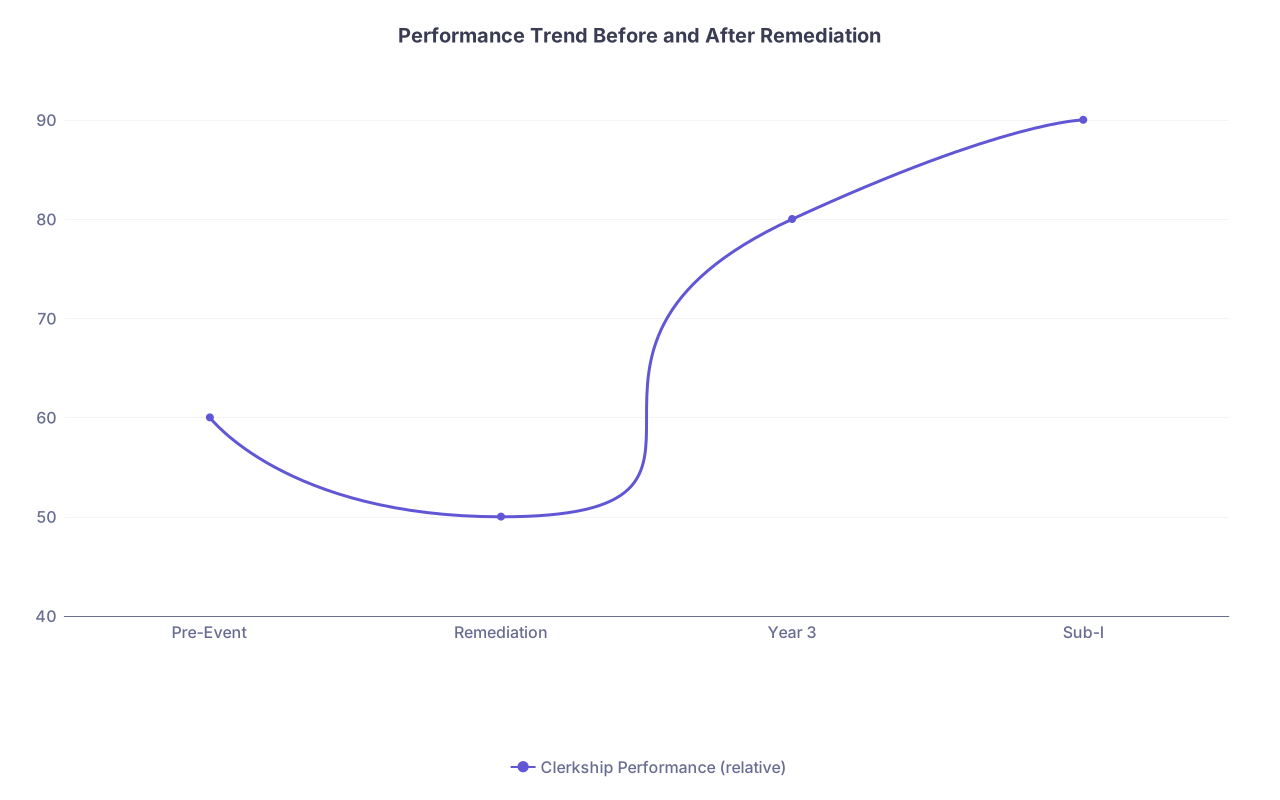
| Category | Clerkship Performance (relative) |
|---|---|
| Pre-Event | 60 |
| Remediation | 50 |
| Year 3 | 80 |
| Sub-I | 90 |
Step 10: Manage your own mindset walking into the room
You are not walking into that interview as “the LOA applicant” or “the remediation case.” You are a full application with one red flag that needs adult handling.
A few mental shifts that help:
- Stop trying to hide it. Assume they already know and are deciding how to feel about it based on your behavior.
- Do not lead with it. You are not obligated to bring it up unless asked. Answer what they ask, no more, no less.
- Treat it as one story in your broader arc. You should still have other examples ready for teamwork, leadership, conflict, etc. This should not be the answer to every behavioral question.
If every time they ask, “Tell me about a challenging situation,” you trot out the LOA story, you paint yourself as nothing but that event. Use it strategically, not obsessively.

Two sample scripts you can adapt
Script 1: Academic remediation (exam or course failure)
“During second year I failed our pharmacology final. I had been relying too heavily on last-minute cramming and question banks without deeply understanding mechanisms. The failure was a wake-up call.
I worked with our learning specialist to restructure my study approach—spaced repetition, weekly content reviews, and practice questions used to diagnose gaps rather than just for repetition. I remediated the course successfully and then applied the same system to Step 1 and my clerkships.
Since then I have passed all major exams on the first attempt, improved my exam scores, and consistently performed above the class average on shelf exams. More importantly, I learned to build sustainable habits instead of sprinting to each deadline. That shift will serve me far more in residency than the initial pass would have.”
Script 2: Personal LOA (family crisis)
“In my third year I took a one-semester leave of absence due to a major family health crisis that required me to be a primary caregiver. At the time, trying to juggle full-time clinical training and those responsibilities was not safe for me or for patients, so I stepped back temporarily with my dean’s support.
During that period I worked with a social worker to set up longer-term supports for my family member, and I learned to be more realistic about what I can manage at once. When I returned, I resumed full clinical duties, completed all remaining clerkships on schedule, and have not required further time off.
That experience gave me a deeper empathy for families navigating serious illness and forced me to build boundaries and support systems proactively. I am confident in my ability to carry a full residency workload while maintaining that balance.”
Bottom line
Two things matter most when you face behavioral interviews after a leave of absence or remediation:
- Own the story with clarity, accountability, and specific evidence of sustained change. No drama. No blame. No vague “I grew a lot” without receipts.
- Treat the incident as one chapter, not your whole book. Prepare one tight, honest narrative for it, then spend the rest of the interview showing who you are now: consistent, reliable, teachable, and ready to do the work.
If you can do that, your LOA or remediation becomes less of a scarlet letter and more of a proof point that you can get knocked down, do the hard self-work, and come back stronger. That is exactly the kind of resident most programs actually want.