
How to Navigate Behavioral Questions After a Career-Ending Injury or Illness
You’re staring at your residency interview invite email, and your stomach drops at one line in particular: “Our interviews will include behavioral questions focusing on resilience, professionalism, and handling adversity.”
You know exactly what that means.
They’re going to ask about the injury. Or the diagnosis. The thing that blew up your original plan — surgery, EM, ortho, whatever — and forced you to rebuild your career direction from the ground up.
You’re not just dealing with a “tell me about a challenge” situation. You’re sitting on a career-ending injury or chronic illness that changed everything: specialty choice, timeline, maybe even your physical capabilities. And you have to package that into coherent, composed, residency-ready behavioral answers… in front of people who control your future.
This is where people either stumble badly or come across as grounded, honest, and very resilient. Let’s put you firmly in the second group.
Step 1: Decide What You’re Willing to Share (Before They Ask)
If you walk into interviews without a clear line between “what I’ll disclose” and “what I’ll keep private,” you’ll either overshare or clam up. Both read badly.
You need two things:
- A short, non-graphic medical summary
- A clear, forward-looking narrative
First, write down a 1–2 sentence medical summary you’re comfortable repeating:
- “During third year, I had a spinal injury in a car accident that permanently limited my ability to stand for long procedures.”
- “In early M3, I was diagnosed with a chronic autoimmune condition that required multiple hospitalizations and time off.”
- “I developed a vocal cord issue that ultimately made procedural specialties with heavy OR time unrealistic.”
Keep it simple, factual, and non-dramatic. No detailed clinical course, no lab values, no teary saga.
Second, your forward-looking narrative: why this changed your path and where you’re going now. Something like:
- “That forced me to reassess where I could sustainably practice long term, and it led me to internal medicine, where I’ve found I can contribute at a high level while also taking care of my health.”
- “I had to step back for a period, which delayed some clerkships, but that time also sharpened my interest in psychiatry and chronic illness care.”
You’re not hiding the impact, but you’re not centering your identity on being “the injured applicant” either.
Step 2: Know Which Behavioral Questions Are Actually About Your Injury
Programs may never say “tell me about your injury.” Instead, they’ll come at it sideways.
Common behavioral questions that are really invitations to talk about your career-ending event:
- “Tell me about a time you faced a major setback.”
- “Describe a situation where things did not go as planned and what you did.”
- “Tell me about a time you had to adapt to new circumstances.”
- “Describe a time you had to advocate for yourself or a patient.”
- “Tell me about a time you received difficult feedback or news.”
- “What’s a challenge you’ve faced that changed how you practice or think about medicine?”
You don’t have to use your injury/illness for all of these, but you should have at least one polished story about it ready. Most people in your situation end up using it for:
- major setback
- adapting to change
- resilience
Pick 1–2 specific questions where you want to use this story and practice those out loud. Have other stories (non-medical, non-injury) ready for the rest so your entire interview isn’t about your health.
Step 3: Structure Your Story So It’s Not Trauma Dumping
You need structure. Otherwise you’ll drift into too much detail, or you’ll sound flat and robotic.
Use a slightly tweaked STAR format:
- Situation – Briefly, what happened.
- Task – What you were up against / what needed to be decided.
- Action – What you did, step by step.
- Result – Concrete outcomes.
- Reflection – What changed in how you work and think now.
Here’s a concrete example for: “Tell me about a time you faced a major setback.”
Situation (tight, not a monologue):
“Early in my third year, I was in a car accident and had a spinal injury that made it clear I couldn’t safely pursue longer surgical cases. Up until then, I’d built everything around a surgical career.”
Task:
“I had to figure out two things pretty quickly: how to physically recover and complete my rotations, and how to re-evaluate my specialty choice in a way that would be sustainable over a 30-year career.”
Action:
“I met with student affairs, my physicians, and occupational health to map out realistic physical limitations. I delayed one rotation to focus on rehab, then worked with my school to rearrange my schedule toward more medicine-based rotations I could physically tolerate. At the same time, I set up meetings with internists and PM&R physicians to understand what their day-to-day looked like with respect to standing, procedures, call, and lifestyle. I journaled after each rotation specifically about what parts of the work energized me that didn’t depend on being in an OR all day.”
Result:
“As a result, I was able to complete my clerkships with some accommodations, stay on track for graduation, and discovered that I genuinely enjoyed internal medicine — especially complex chronic care — more than I expected. I also ended up doing a small QI project around consult communication for patients with mobility limitations, which came directly out of my experience navigating the hospital as a patient.”
Reflection:
“The setback forced me to evaluate my identity separately from a single specialty. I learned to ask early: ‘Is this sustainable for me and my patients?’ Now, when I think about residency, I’m focused on programs where there’s good communication, team support, and a culture that recognizes physicians as humans with long-term needs, not just short-term productivity.”
Notice what’s missing: no long pain descriptions, no emotional spiral. You’re not minimizing that it was hard, but you’re not asking the interviewer to comfort you. You’re showing judgment and maturity.
Step 4: Decide How Much Medical Detail to Give (and When to Stop)
You do not owe anyone your full chart.
But they are allowed to assess whether you can do the job. That’s fair. You need a clean, honest, boundaries-respecting way to handle follow-ups like:
- “Is this condition stable now?”
- “Will this affect your ability to handle call?”
- “Are there any accommodations you’ll need?”
Here’s the line that usually works well:
General status
“My condition is chronic but currently well-controlled with treatment.”
Or: “The injury is permanent, but I’ve fully recovered functional capacity for the demands of this specialty.”Functional capabilities (this is what PDs care about)
“I’m able to carry a typical inpatient census, do call, and complete the physical demands of internal medicine without restrictions.”
“I can handle standard outpatient clinic volume and call responsibilities expected of psychiatry residents.”Boundaries
“I’ve worked closely with my physicians and student affairs to ensure that the specialty I’m applying to is compatible with my long-term health. I’m very comfortable that I can meet the demands of residency.”
If they push for highly specific medical details that aren’t clearly job-related, you can redirect without sounding combative:
- “I’m happy to talk about how it affected my training and how I work now. In terms of medical details, I’d prefer to keep that part private, but functionally I’m able to meet the requirements of this specialty.”
Programs that get weirdly intrusive about your diagnosis during an interview? That’s data. You probably do not want to spend three years there.
Step 5: Answer the “Why This Specialty Now?” Question Without Sounding Like You Settled
This one is brutal if you originally wanted something else. They might ask:
- “Why internal medicine and not surgery, given your background?”
- “How did your injury influence your decision to choose this field?”
- “If you hadn’t developed this condition, what would you be doing?”
Here’s the trap: sounding like you “fell into” the specialty as a consolation prize. That kills enthusiasm.
What you want is: The event forced me to reassess — but I actively chose this specialty for specific, positive reasons.
Bad version:
“I wanted ortho but couldn’t do it after my injury, so I ended up choosing PM&R because it fit my limitations.”
Better version:
“Before my injury, I was strongly considering orthopedics because I liked musculoskeletal medicine and working with active patients. After the injury, long OR days and heavy physical demands weren’t realistic, so I took a fresh look at where I could still work closely with function, rehab, and patient goals. In PM&R, I found that same focus but with a broader view of the whole person over time. I’ve had enough exposure now — both through rotations and a rehab-focused elective — that I’d choose PM&R even if the injury hadn’t happened. The fit is actually better for how I think and how I like to work with patients.”
If you’re not yet at “I’d choose this anyway,” do not say that out loud. Instead, use:
- “I discovered that this specialty aligns better with my strengths in X, Y, Z…”
- “The experience clarified for me that what I value most is A, B, C — and I see those every day in [specialty].”
You’re allowed to admit the injury influenced your direction. Just don’t let it sound like it’s the only reason you’re there.
Step 6: Practice Staying Steady When They Go Direct and Personal
Some interviewers are blunt. You might get:
- “So what exactly happened to you?”
- “Are you sure you can handle residency with your condition?”
- “If this flares again, what happens to your call schedule?”
You need pre-planned, calm answers. Not improvisation in the heat of the moment.
For “what exactly happened?”
“I had a significant spinal injury in a car accident that limited my ability to stand for prolonged periods. The acute phase is over; what’s relevant now is that I’ve adapted and chosen a specialty where I can practice safely and effectively long term.”
For “are you sure you can handle residency?”
“Yes. I’ve stress-tested that assumption by completing full-time rotations, including call, under my current treatment plan. I’ve also explicitly discussed the physical and cognitive demands of residency with my physicians, and we’re aligned that this specialty is sustainable for me.”
For “what if it flares?”
“I’ve had flares before and I have a management plan in place with my care team. It hasn’t prevented me from fulfilling my responsibilities as a student. If something acute happened, I’d communicate early with leadership the way any resident would for a short-term medical issue, and I’d work to make up any missed responsibilities. My goal is to be as reliable as any other resident, and my track record during clerkships reflects that.”
Deliver these matter-of-factly. No defensiveness. No apology.
Step 7: Turn the Experience Into Evidence of Residency-Relevant Skills
Programs are not purely evaluating your health story. They’re evaluating whether this crucible produced skills they actually want in a resident.
You should be ready to tie your experience to:
- Reliability and follow-through
- Empathy, especially with complex/chronic patients
- Communication across teams
- Self-awareness and asking for help appropriately
- System navigation and advocacy
Concretely:
- “Being a patient made me much more precise in my discharge instructions. I know exactly how confusing they can be on the receiving end.”
- “I’m more comfortable now saying, ‘I need to step away for 10 minutes and regroup’ than I was before. That makes me safer and more effective in high-stress situations.”
- “Going through the accommodations process taught me how opaque hospital systems can be. Now I routinely think about which patients on my list might be struggling with forms, transportation, or insurance because I’ve been that person.”
You are not trying to “inspire.” You’re trying to show operational changes in how you work.
Step 8: Don’t Let the Injury Consume Your Whole Interview
Easy mistake: they ask one question, you open the door, and 60% of the interview becomes your health story. That’s not what you want.
You control how much space it takes up by:
- choosing a single primary story where you discuss it in depth
- using brief references elsewhere: “As you’ve heard, I went through X — that experience reinforced my focus on Y…”
- pivoting back to your actual work: research, QI, teaching, patient care
If they keep circling back:
Them: “How did your illness shape your approach to teamwork?”
You: “It definitely made me appreciate clear communication and backup. For example, on my medicine sub-I, I…” — and then you tell a story that’s about you as a functioning team member, not as a patient.
You’re allowed to redirect gently. You’re there to be evaluated as a future colleague, not as a case report.
Step 9: Prepare for Virtual vs. In-Person Differences
If your injury/illness is visible (brace, cane, scars, tremor, etc.), you need to decide how you’ll handle that in different formats.
Virtual:
- Make sure you’ve already referenced your story in your application somewhere (personal statement, secondary). That way, if they see something on camera, it’s not a surprise.
- If they ask about it, you can say: “Yes, that’s related to the injury I mentioned in my personal statement. Functionally, I’m able to handle the demands of this specialty.”
In-person:
- Assume they notice but might not ask.
- Don’t lead with an apology. Don’t start the day by explaining yourself unprompted.
- If it comes up in small talk: keep it light, then move on. “Old injury, fully worked up. I’m doing well, thanks — really enjoying getting to see the program in person.”
If you need accommodations (e.g., seating during conferences, limited standing on tours), ask the coordinator ahead of time, not on the spot with the PD. That keeps it administrative, not evaluative.
Step 10: Train Your Emotional Tone (This Matters More Than You Think)
Content is only half the battle. The other half is how you sound.
You want:
- Candid but composed
- Serious but not bitter
- Grateful for growth, not grateful for suffering (huge difference)
- Confident without coming off as defensive
The easiest way to kill your tone is to only practice in your head. You need to:
- Record yourself answering 2–3 questions about the injury/illness.
- Watch it back once as a stranger: would you want to work with this person at 3 a.m.?
- Watch again as a PD: are they stable? Are they self-aware?
Things to watch for:
- Long pauses and visible emotional overwhelm: normal as a human, but not ideal in an interview.
- Overly flat, detached delivery: reads as shutdown or unresolved.
- Overcompensation: lots of “I’m totally fine, no issues at all!” in a strained voice.
Adjust your wording until it feels like you’re telling a difficult but integrated part of your past, not reliving an ongoing trauma.
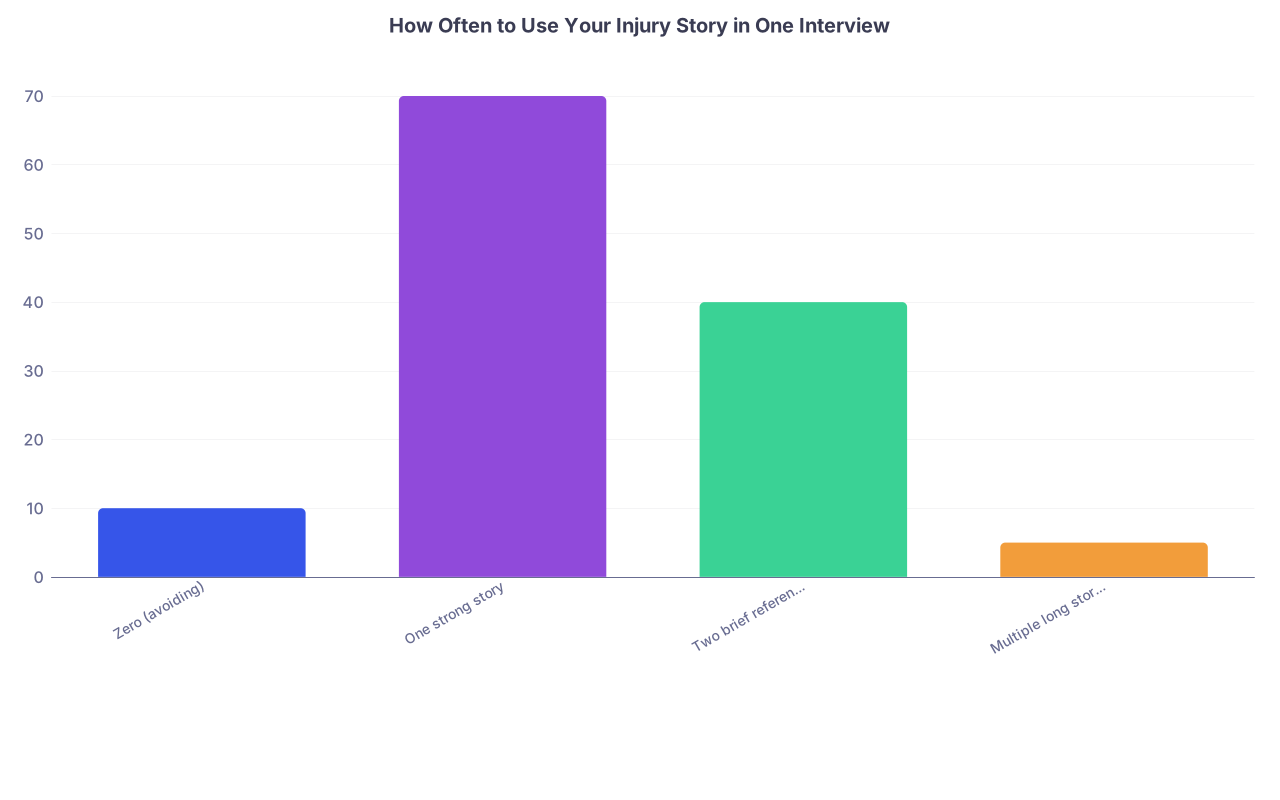
| Category | Value |
|---|---|
| Zero (avoiding) | 10 |
| One strong story | 70 |
| Two brief references | 40 |
| Multiple long stories | 5 |

| Step | Description |
|---|---|
| Step 1 | Behavioral Question Asked |
| Step 2 | Use Prepared STAR Story |
| Step 3 | Use Alternate Example |
| Step 4 | End with Reflection & Current Function |
| Step 5 | Link Back to Skills for Residency |
| Step 6 | Use Injury Story? |
| Situation | Weak Phrase | Strong Phrase |
|---|---|---|
| Describing event | "My life was basically over for a while." | "It completely disrupted my original plan and forced me to reassess." |
| Addressing ability | "I think I can handle residency." | "I’ve tested this during full-time rotations and I can meet the demands of this specialty." |
| Talking about specialty change | "So I had to settle on IM instead." | "The experience clarified that internal medicine fits my strengths and long-term sustainability best." |
| Setting boundaries | "I’d rather not talk about that." | "I’d like to keep the medical specifics private, but functionally I can perform all the duties of this role." |

Final Tight Summary
- Build one clear, structured story about your injury or illness that shows growth, judgment, and concrete changes in how you work — not just suffering.
- Be honest but bounded: emphasize current function, realistic sustainability in your chosen specialty, and redirect if questions drift into unnecessary medical detail.
- Use the experience strategically: once as a strong behavioral example, briefly elsewhere if relevant, then move the spotlight back to your skills, contributions, and fit as a resident.