
The way programs use behavioral interview questions is not about “teamwork” or “leadership” in some generic HR sense. They’re hunting for one specific thing: who is going to fall apart on night float.
And most applicants have absolutely no idea that’s what’s happening.
Let me walk you through how people on the other side of the table actually think. The faculty, the chief residents, the PD quietly watching your answers and trying to predict what you’ll do at 3:47 a.m. when your pager is screaming, the cross-cover list is long, the nurse is angry, and the patient in 7B is crashing.
They are not imagining you on a sunny continuity clinic afternoon. They are simulating you on night float. Every behavioral question is a stress test for that.
What Night Float Really Looks Like (From the Program’s Perspective)
You already know your version of night float: brutal, fragmented sleep, endless pages, feeling alone. That’s the trainee view.
From the program’s side, night float is where residents show their true baseline. No attendings hovering. No daytime structure. No hand-holding. Just judgment, resilience, and whether you make catastrophically bad decisions.
Programs care about three things at night:
- Will you be safe when no one is watching?
- Will you call for help at the right time?
- Will you poison the culture with whining, avoidance, or blame?
They’ve all seen the extremes. The intern who quietly covers 45 patients, triages appropriately, calmly calls the senior when needed. And the one who escalates every single page, wakes people unnecessarily, and melts down emotionally by night three.
Behavioral questions are their way of forcing you to show which category you lean toward, without ever asking, “So, will you crumble on nights?”
The Hidden Translation: What They’re Really Asking
Here’s the part nobody tells you: most programs have a mental “night float rubric” in the background. They’re scoring your behavioral answers against it, even if they don’t say that out loud.
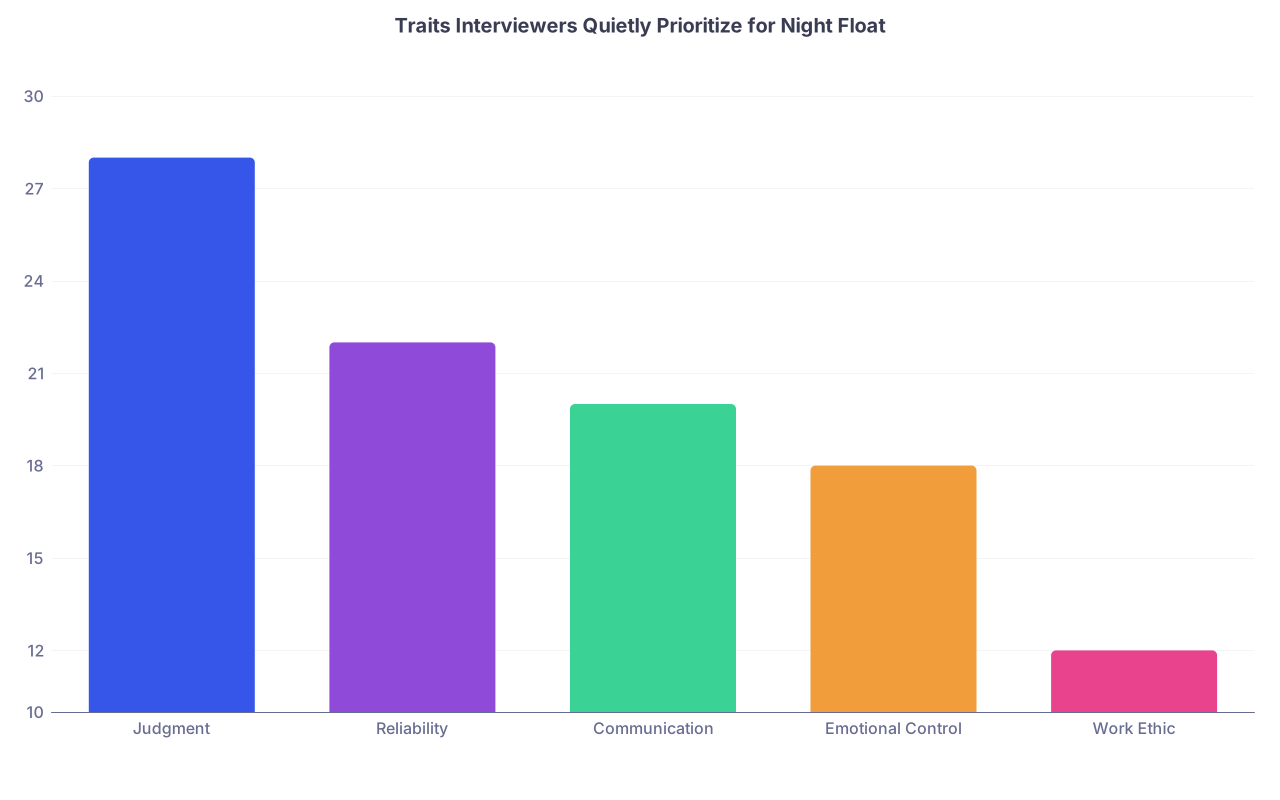
| Category | Value |
|---|---|
| Judgment | 28 |
| Reliability | 22 |
| Communication | 20 |
| Emotional Control | 18 |
| Work Ethic | 12 |
Let’s decode some common behavioral questions and how they map to night float predictions.
“Tell me about a time you made a mistake.”
Surface level: humility, insight.
Real use: Can you own an error at 3 a.m., fix it, and tell someone? Or are you going to hide it and let it blow up on rounds?
They’re listening for:
- Do you clearly say “I made a mistake,” or do you drown in passive voice? (“There was a situation where…” = red flag.)
- Did you immediately act to stabilize the situation?
- Did you loop in a supervisor without being pushed?
- Did you change your future behavior in a concrete way?
On night float, you will mis-dose, mis-triage, or miss something at least once. Programs are trying to predict: will you call the senior at 3:05 a.m. or will you silently hope it goes away?
“Describe a time you were overwhelmed and how you handled it.”
Everyone has some canned story here. Very few answer it in a way that reassures the people who have actually staffed nights.
They’re not looking for heroics. They’re looking for your algorithm under load:
- How do you triage?
- Do you write things down?
- Do you anchor on one task and forget the rest?
- Do you communicate with nursing about delays?
- Do you shut down emotionally?
If your answer sounds like: “I just powered through, stayed late, and got it done,” you’ve told them nothing. On nights, “just power through” is how you miss the septic patient while charting on a stable one.
The strongest answers sound almost boringly systematic: “I stopped, ranked tasks, informed the nurse I’d be delayed, and pulled in help appropriately.”
“Tell me about a conflict with a nurse or team member.”
This is a direct probe for your night float survival.
Because when are most conflicts with nurses? Not at 10 a.m. rounds. At night, when everyone is tired, anxious, and short-staffed.
Interviewers are scanning for:
- Do you immediately blame the nurse, or do you recognize the system pressures?
- Do you show respect for nursing judgment?
- Did you pick up the phone and de-escalate, or hide behind the EMR?
- Do you understand that a “demanding” nurse might actually be sensing a crashing patient?
Programs have long memories of residents who were dismissive of nursing. Those residents cause code blues, complaints to risk management, and 3 a.m. phone calls to the PD. Behavioral answers that even smell like that get you quietly moved down the list.
The Five Behaviors Programs Try to Predict
Let’s be more explicit. When they use behavioral questions, they’re trying to answer five non-negotiable questions about your future night float self.

1. Will you triage or will you drown?
Night float is triage. Not “finish everything perfectly.” That mentality gets you killed.
Questions that probe this:
- “Describe a time you had multiple competing priorities.”
- “Tell me about a time a deadline was at risk.”
They’re listening for whether you:
- Identify what truly matters.
- Are willing to let low-yield tasks wait.
- Keep people informed about delays, instead of disappearing.
If you flex about “always getting everything done,” you inadvertently signal that you have no idea how to triage. At 2 a.m., you’re supposed to leave nonurgent med recs alone and go see the hypotensive patient first. They want residents who understand that instinctively.
2. Will you call for help late, early, or never?
Programs have been burned both ways. The intern who dials the senior for every Tylenol order. And the one who doesn’t call for a crashing patient until the rapid response is overhead.
Behavioral proxies:
- “Tell me about a time you had to ask for help.”
- “Describe a time you were out of your depth.”
What they want to hear:
- You recognized the limit of your knowledge.
- You stabilized what you could before calling.
- You called the right person, concisely, with a clear question.
- You didn’t wait until it was a full disaster.
If your story has you waiting too long, hiding, or being “embarrassed” to ask – programs hear: “This person will kill someone at night to avoid bothering the senior.”
3. Will you own the cross-cover list or be a passive scribe?
There are residents who treat night float as “babysitting orders.” And there are those who understand they’re actually managing a population of vulnerable patients.
Interview questions:
- “Tell me about a time you took initiative without being asked.”
- “Describe a time you inherited a mess.”
These are stand-ins for: when you sign out 35 patients, do you just react to pages, or do you think ahead?
On the inside, attendings remember residents who:
- Proactively checked on the borderline patient from sign-out.
- Reconciled medication issues before they were pages.
- Clarified code statuses before trouble hit.
If your answer never shows you scanning ahead for risk, that’s a strike. You sound like a reactive, not a manager.
4. Will you keep your head or emotionally spiral?
Everyone says they’re “calm under pressure.” Interviewers do not believe you. They’ve seen too many residents fall apart by Q4.
So they poke at:
- “Tell me about your most stressful day on the wards.”
- “Describe a time you received tough feedback.”
They’re not just listening to the content; they’re watching your physiology in real time:
- Do you speed up, fidget, lose your train of thought?
- Do you get defensive when challenged gently?
- Does your story end in growth, or in self-pity?
Programs do not want the resident who cries at the workstation at 4 a.m. every other night. Or the one who becomes snappy and sarcastic with staff. Behavioral answers that center on rumination, resentment, or external blame light up their radar.
5. Will you silently resent, or will you be part of the solution?
Night float exposes character. Do you quietly handle what needs to be done despite unfairness? Or do you keep score?
Behavioral probes:
- “Describe a time you had to do more than your fair share.”
- “Tell me about a time you disagreed with a policy or decision.”
This is where you either sound like a future chief resident. Or like the person everyone avoids scheduling on nights.
Good: You acknowledge unfairness, still protect patient care, and then address the systemic issue at the right time with the right person.
Bad: You gossip, simmer, or weaponize minimal effort. Programs have already dealt with residents like that, and they remember the fallout.
How Interviewers Actually Score Your Behavioral Answers
Here’s the part you never see. After you leave, they sit in a room or fill out a form and translate your stories into ratings.
| Trait | Green Flag Example | Red Flag Example |
|---|---|---|
| Triage/Judgment | Prioritizes sickest first, defers low-yield work | Tries to “do it all,” no prioritization |
| Help-Seeking | Calls early with organized data | Hides, calls late, vague or apologetic |
| Accountability | Clearly owns error, describes fix | Blames system/others, passive voice |
| Team Communication | Proactive with nurses and seniors | Defensive, dismissive, avoids direct dialogue |
| Emotional Regulation | Describes concrete coping strategies | Focus on feelings, no tools, ongoing resentment |
They’re not charmed by your phrasing. They’re asking:
“If this exact personality type is on night float in January, do I sleep soundly or wake up anxious?”
And they calibrate against real residents they’ve known. You remind them—consciously or not—of someone. That works both ways. You can get mentally tagged as “like that rockstar PGY-3 we all loved” or “like the intern who almost got put on remediation.”
How to Answer Like Someone They Trust on Nights
You don’t need to fake being a superhero. They don’t trust superheroes anyway. They trust the resident with systems, humility, and pattern recognition.

| Step | Description |
|---|---|
| Step 1 | Prompt |
| Step 2 | Brief context |
| Step 3 | What was at risk? |
| Step 4 | Specific actions you took |
| Step 5 | How you used help |
| Step 6 | Outcome |
| Step 7 | Concrete change in behavior |
Notice that “how you used help” is built into that structure. If your stories never include anyone else, that’s a red flag by itself.
Here’s how to tune your answers the way actual faculty respond well to.
Make the risk explicit
On nights, everything is about risk. So show that you see it.
Weak: “We were very busy, and I had a lot to do.”
Stronger: “I had five new admissions and was cross-covering 30 patients; I realized if I did everything sequentially, I’d delay seeing the two hypotensive patients.”
You’re flagging that your brain automatically thinks in triage mode. That’s gold to them.
Show your algorithm, not your feelings
You can mention that it was stressful, but dwell on your thinking process.
For example:
- “I paused and wrote down all active issues.”
- “I quickly scanned vitals and prioritized who needed to be seen now vs. who could wait.”
- “I let the nurse know I’d be delayed by 10 minutes but was aware of their concern.”
That’s exactly what good night float residents do on the real wards.
Normalize calling for help
The residents programs trust on nights don’t act like calling the senior is failure. So your stories shouldn’t either.
Bad: “I didn’t want to bother my attending, so I figured it out myself.”
Good: “After stabilizing what I could, I called my senior with a concise summary and a specific question.”
You’re telegraphing: “I won’t make you guess what’s happening at 3 a.m., but I won’t call you for nonsense either.”
Own the mistake without performative guilt
One of the quickest ways to tank an impression is to sound like you think guilt is the same as accountability.
Better pattern:
- “I missed X.”
- “This led to Y.”
- “I did Z immediately to mitigate harm.”
- “Here is the concrete system I now use so I don’t miss this again.”
That’s what programs want on nights: someone who will fix, communicate, and systematize.
A Few Real-World Scenarios Interviewers Mentally Simulate
When you’re answering, they’re not picturing your preclinical standardized patient. They’re running scenarios like this in their head:

- You’re post-call on your third night, cross-covering 40 medicine patients. You get:
- A page about a blood pressure of 80/40.
- A family demanding to see “the doctor now.”
- An admission from the ED who’s stable but complicated.
- A nurse furious about delayed pain meds.
They’re asking: based on this candidate’s behavioral answers, do I believe they will:
- See the hypotensive patient first.
- Call for backup early if needed.
- Communicate with the angry nurse instead of hiding.
- Defer nonurgent work and not drown in guilt.
- You write the wrong sliding scale insulin order at 1:30 a.m. The next morning, the glucose is 450. The attending calls you.
They’re asking:
- Will this resident proactively disclose it?
- Will they be defensive and blame the system?
- Will they quietly feel bad but change nothing?
- A nurse calls you repeatedly, “this patient just doesn’t look right,” but vitals are okay. Your stories about conflict, humility, and listening tell them exactly what you’ll do next.
If you’ve framed every disagreement with a nurse as them “overreacting,” you’ve already answered their question. They just won’t say it to your face.
What Programs Don’t Tell You – But Talk About After You Leave
Here’s what the debrief really sounds like behind closed doors.
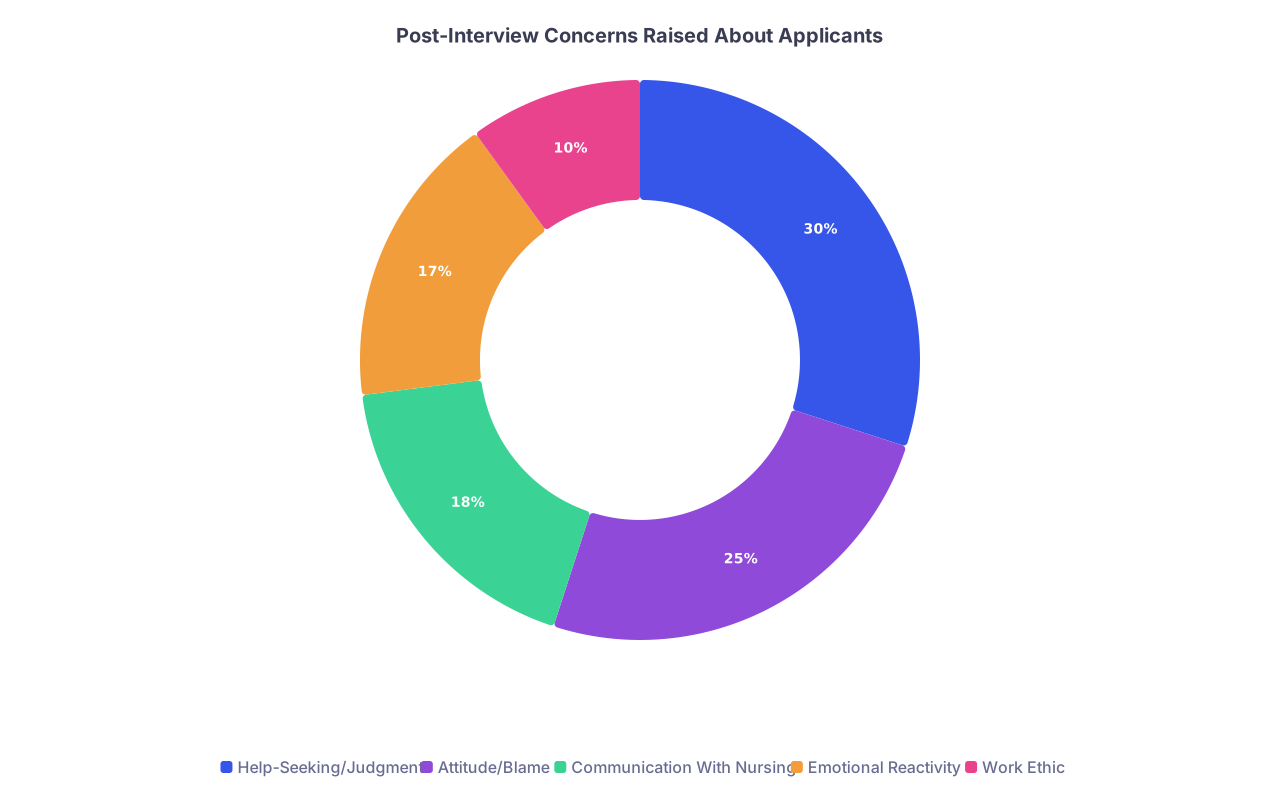
| Category | Value |
|---|---|
| Help-Seeking/Judgment | 30 |
| Attitude/Blame | 25 |
| Communication With Nursing | 18 |
| Emotional Reactivity | 17 |
| Work Ethic | 10 |
You’ll hear faculty say things like:
- “Great scores, but I’m worried they’ll hide mistakes.”
- “Sounds like someone who will argue with nurses on nights.”
- “They’ve never clearly sat with being overwhelmed – everything was a win in their stories. I don’t believe that.”
- “I don’t want my senior fielding calls from this personality at 2 a.m. all month.”
Notice how little they talk about your polished phrasing. They talk about your patterns.
The internal logic is simple: if your default tendency in your best, most curated stories is to deflect, dramatize, or self-protect, then on night 8 of a 14-night block, that tendency will be worse. Not better.
How to Practice So You Don’t Sound Like Everyone Else
Most applicants rehearse content. Lists of stories, tidy outlines. That’s amateur hour.
You should be rehearsing patterns:
- Can you describe being overwhelmed without sounding either heroic or helpless?
- Can you talk about conflict without being self-righteous or submissive?
- Can you own screw-ups without turning it into a guilt performance?
Grab a friend, resident, or mentor and have them specifically listen for:
- Do you show triage thinking?
- Do you use help appropriately in your stories?
- Do you respect nurses as clinical partners, or just service obstacles?
- Do you describe growth in concrete, behavioral terms?
If they can’t see the calm, systematic night float resident in your answers, the interviewers won’t either.