
The biggest mistake applicants make two weeks before interviews is “adding more” instead of refining. You do not need new stories. You need cleaner, tighter, sharper answers.
You are in the polishing phase now. At this point you should be cutting, not collecting.
Below is a day‑by‑day, time‑boxed plan for the final 14 days before your residency interview, focused purely on behavioral questions: conflict, failure, feedback, teamwork, leadership, ethics, and “tell me about a time” stories.
Big Picture: Your 14‑Day Behavioral Answer Blueprint
For these two weeks, your goal is not memorization. It is muscle memory. By interview day, your behavioral answers should feel:
- Predictable in structure (STAR or variation)
- Flexible in content (you can swap examples)
- Consistent in themes (what kind of resident you are)
You are aiming to have:
- 8–10 core stories
- 3–4 “go‑to” strengths themes
- 2–3 honest, contained weakness narratives
- 2–3 conflict / difficult team scenarios
- 2–3 failure / mistake scenarios
- 2–3 leadership / initiative examples
| Story Type | Minimum | Ideal |
|---|---|---|
| Teamwork | 2 | 3 |
| Conflict | 1 | 2 |
| Failure/Mistake | 2 | 3 |
| Leadership | 2 | 3 |
| Ethics/Integrity | 1 | 2 |
| Adaptability | 1 | 2 |
You probably already have these experiences. The next 14 days are about discipline: rewriting, trimming, drilling.
Days 14–12: Audit, Select, and Cut Your Stories
Day 14: Story Inventory and Brutal Triage
At this point you should stop collecting new experiences and commit to a finite story bank.
Task 1: Dump everything (60–90 minutes)
Open a blank document and list every potential behavioral story you can recall, quick‑and‑dirty:
- Team conflict on surgery, internal medicine, psych, etc.
- Times you made a clinical or communication mistake (safe, pre‑attending level)
- Situations where you led: QI project, student group, night float coordination
- Ethical gray zones: inappropriate comments, unsafe practice, professionalism issues
- Stress, burnout moments, high workload days that you managed
Aim for 20–30 bullet points, each 1–2 lines. No detail yet.
Task 2: Label each story (30 minutes)
Next to each bullet, tag what it covers:
- T = Teamwork
- C = Conflict
- F = Failure / mistake
- L = Leadership
- E = Ethics / integrity
- A = Adaptability / ambiguity
- S = Strength illustration
- W = Weakness illustration
You will see patterns. A lot of students discover they have 9 teamwork stories and 1 ethics story. That is a problem.
Task 3: Ruthless triage (45–60 minutes)
Now you narrow down.
Keep a story if:
- You can tell it without throwing anyone under the bus
- The outcome shows growth, not just drama
- It is specific to you (not “the team did,” but “I did”)
- You could tell it in 60–90 seconds if pushed
You want 10–14 “A‑tier” stories by the end of today. Hard rule.
If you are torn between two near‑identical stories, pick the one with clearer metrics or impact.
Day 13: Turn Your Stories into STAR Skeletons
At this point you should move from “story idea” to repeatable structure.
Use STAR (or a variant): Situation, Task, Action, Result, plus Reflection (STAR‑R).
Task 1: 1‑page story bank (90–120 minutes)
For each of your 10–14 selected stories, write a mini‑outline. Not a script. Just:
- Situation: 1–2 sentences
- Task: 1 sentence
- Action: 2–4 bullets
- Result: 1–2 sentences (with a metric or clear outcome if possible)
- Reflection: 1–2 sentences (what changed in your behavior)
Example (Failure story):
- S: “Third‑year IM rotation, cross‑covering, new admission with chest pain at 2 a.m.”
- T: “I needed to assess quickly and communicate clearly with my senior.”
- A:
- Took rushed, incomplete history, anchored on reflux because of age and past history
- Presented poorly organized data to senior, missed red‑flag in EKG
- Senior caught it, we re‑assessed, diagnosed NSTEMI
- R: “Patient received timely treatment, but it was clear my initial assessment had gaps.”
- Rf: “I changed my overnight approach: checklist for chest pain, slower initial assessment, and pre‑presentation ‘mental run‑through’ with vitals and ECG before calling the senior.”
Task 2: Cap every story at 2 minutes (45–60 minutes)
Read each outline out loud, timing yourself loosely.
Your target:
- 60–90 seconds for simple questions
- 90–120 seconds for complex ones (ethics, big failure)
If you are blowing past 2 minutes, your Situation and Task are bloated. Cut.
Day 12: Map Stories to Common Behavioral Questions
You do not want one story per question. You want a small story bank that can flex.
Task 1: Build a question‑to‑story map (60–90 minutes)
Create a 2‑column table in your notes:
- Column 1: Behavioral question type
- Column 2: Primary + backup story
Common buckets:
- Conflict with a colleague
- Difficult feedback you received
- Time you made a mistake with a patient
- Time you advocated for a patient
- Handling stress / workload
- Working with someone difficult
- Leading a team through change
- Ethical concern / unprofessional behavior
- Time you went above and beyond
- Time you failed or did not meet expectations
Assign 1–2 stories to each. Some stories will appear multiple times. That is good.
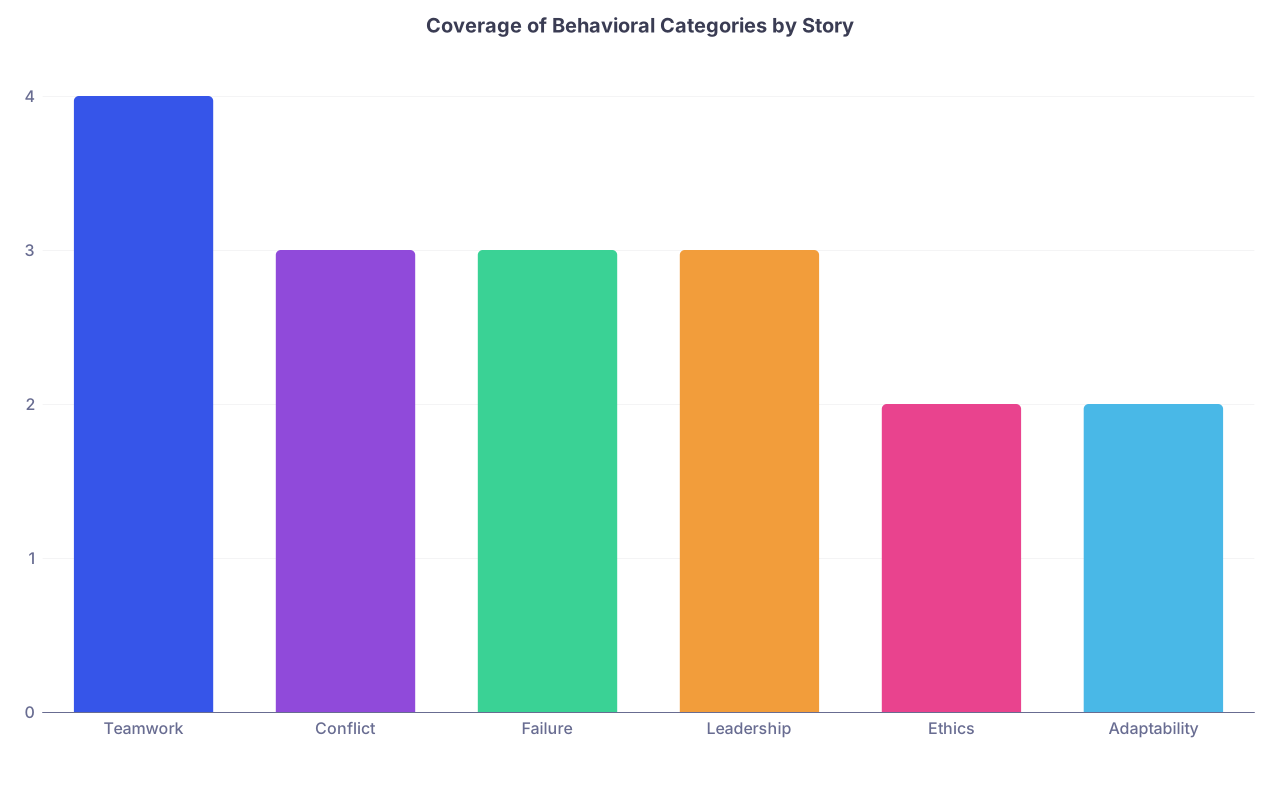
| Category | Value |
|---|---|
| Teamwork | 4 |
| Conflict | 3 |
| Failure | 3 |
| Leadership | 3 |
| Ethics | 2 |
| Adaptability | 2 |
Task 2: Patch gaps (30–45 minutes)
If a category has no good story:
- Conflict: often from team dynamics, nursing, or co‑student situations
- Ethics/professionalism: lateness, confidentiality, consent, inappropriate comments
- Leadership: even “small” leadership—coordinating sign‑out, revamping a template
Pick one reasonable story and add it to your bank, but do not spend more than an hour here. You are no longer in story‑collection season.
Days 11–8: Condense, Thematize, and Align with Your Specialty
Now you move from “I have stories” to “My stories clearly show why I fit this field.”
Day 11: Tighten Openings and Closings
At this point you should stop rambling into stories. Your first sentence must anchor the question.
Task 1: First sentence surgery (60–90 minutes)
For each story, create a one‑line opener that clearly answers the prompt:
- “One example of a conflict with a colleague was on my surgery rotation when…”
- “A meaningful failure for me happened during my ICU month when…”
- “A time I received difficult feedback was when my attending told me…”
You are allowed to be this literal. Interviewers are tired.
Task 2: Reflection polish (45–60 minutes)
Every story needs a grown‑up reflection. None of this “I learned communication is important” nonsense.
Force yourself to finish each story with:
- Exactly what you changed in your behavior or system
- How it will affect you as a resident in this specialty
Example for EM: “Since then, in the ED I deliberately slow down my initial mental differential and force myself to articulate at least three alternate diagnoses before locking in on one, especially on high‑risk complaints.”
Day 10: Align Stories with Your Chosen Specialty
Different specialties value different things. Your stories should lean into the right traits.
Quick specialty lenses (examples, not exhaustive):
- Internal Medicine: thoroughness, follow‑up, longitudinal care, team coordination
- Surgery: ownership, decisiveness, resilience, care of the surgical patient
- EM: triage, prioritization, handling chaos, clear communication under pressure
- Pediatrics: family communication, patience, advocacy
- Psychiatry: listening, boundaries, managing difficult conversations
- OB/GYN: balancing surgical and clinic demands, advocacy, emergency response
Task 1: Tag stories with traits (45 minutes)
For each story, identify 2–3 traits it shows:
- e.g., “Failure story 1: humility, teachability, attention to safety.”
- “Conflict story: respect for hierarchy, direct communication, patient‑first focus.”
Task 2: Rewrite reflections with specialty flavor (60–90 minutes)
Adjust the final 1–2 sentences of each story:
- Bad: “This made me a better team player.”
- Better (IM): “This pushed me to be the person on the team who closes loops—calling consultants back, confirming follow‑up, and making sure the plan is actually executed, which I see as core to being an effective IM resident.”
You are not changing the story. You are tightening the framing.
Day 9: Build Your Strengths and Weaknesses Narratives
At this point you should have behavioral answers that support your “headline” about yourself.
Task 1: Decide on 3–4 core strengths (45–60 minutes)
Pick them, write them, stop second‑guessing:
- Example set for IM: “Deliberate communicator, reliable workhorse, organized follow‑through, comfortable with complexity.”
For each strength, attach 1–2 of your existing stories that prove it.
Task 2: Choose 2–3 weaknesses (60 minutes)
They must be:
- Real (but not catastrophic)
- Behavioral (something you do, not something you are)
- Already in progress (you are actively working on it)
Examples:
- “I tend to over‑document and can get bogged down in notes.”
- “I hesitate to delegate when I feel responsible for outcomes.”
- “Early in rotations I sometimes under‑speak in team discussions.”
For each weakness:
- One brief real example
- One specific system/behavior you implemented to improve
- One sentence tying it to residency readiness
Days 8–5: Live Drills, Recording, and Pressure Testing
Now you move from written to spoken. This is where most people realize their “perfect” answers are actually incoherent out loud.
Day 8: First Full Behavioral Run‑Through (Solo)
At this point you should start hearing yourself.
Task 1: 30‑question solo mock (60–90 minutes)
Use any online list of residency behavioral questions. Set a timer:
- 90 seconds max per answer
- No pausing to write
- Answer out loud, standing or sitting upright
Record yourself (phone or laptop). Yes, it is awkward. Do it anyway.
Task 2: Ruthless playback review (45–60 minutes)
Listen with a notebook and track:
- Filler: “um,” “like,” “sort of”
- Wandering intros: if you do not answer the question in the first 2 sentences
- Overused stories: the same story for 9 totally different questions
- Tone: defensive on failure? blames others in conflict?
Pick 3 patterns to fix. Not 10. Three.
Day 7: Peer or Mentor Mock with Focused Feedback
Now you get external data.
Task 1: 45–60 minute mock
Ask:
- A resident you know
- A faculty mentor
- Or at minimum, a co‑student applying this cycle
Give them a short script:
- “Please push on: conflict, failure, feedback, teamwork, and ethics scenarios.”
- “Interrupt me if I go past 2 minutes.”
- “After each answer, give me 1 thing to keep and 1 thing to change.”
Task 2: Debrief and adjust (45 minutes)
Immediately after:
- Write down common comments (too vague, too long, too self‑blaming, etc.)
- Pick 2–3 stories to rewrite slightly based on their feedback
- Adjust any reflections that sound canned
Day 6: Advanced Drills – Same Story, Different Question
This is where you build true flexibility.
Task: 60–90 minute re‑mapping drill
Take 3 of your core stories and answer 3–4 different behavioral questions with each:
Story: ICU failure example
Questions:
- “Tell me about a time you made a mistake with a patient.”
- “Tell me about a time you received critical feedback.”
- “Tell me about a time you had to change your usual approach.”
- “Tell me about a time you felt you let your team down.”
Goal: Same core story, different emphasis and reflection based on question.
This prevents you from panicking when they ask a question you did not script.
Day 5: Pressure Simulation – Multi‑Station or Panel Style
At this point you should test “interview stamina.”
Task: 60–75 minute intense mock
Option A: If you have friends:
- 2–3 people, each plays an interviewer for 15–20 minutes
- They each choose their own set of behavioral questions
- You rotate without breaks
Option B: Solo with structure:
- 4 “stations” of 15 minutes each
- Station 1: Conflict / teamwork
- Station 2: Failure / feedback
- Station 3: Leadership / ethics
- Station 4: Stress / time management
Use a timer, do not pause between “stations.”
Mark any answers where you felt yourself:
- Rambling
- Getting defensive
- Saying “I don’t really have an example”
Those are targets for the next phase.
Days 4–2: Micro‑Tuning and Mental Rehearsal
Now you stop making big changes. You refine and stabilize.
Day 4: Clean Up Language and Red Flags
At this point you should be editing for risk.
Task 1: Scan for blame and overshare (45–60 minutes)
Read through your outlines and ask:
- Am I blaming a specific person by name or role repeatedly?
- Am I describing unsafe care in a way that makes me look reckless now, not historically?
- Am I talking about mental health or burnout in a way that suggests I am currently unstable or unable to function?
If yes, soften and reframe:
- Shift from “they were awful” to “we had different expectations.”
- Shift from “I was completely overwhelmed and shut down” to “I realized my coping strategies were insufficient, so I did X.”
You can be honest without self‑sabotage.
Task 2: Simplify jargon (30 minutes)
You are not presenting at grand rounds. Reduce unnecessary acronyms and specialty‑specific jargon. You do not know who is on the panel.
Day 3: Quick‑Fire and Curveball Practice
By now your core stories are solid. Now you stress test.
Task 1: 30‑minute lightning round
Set a timer for 30 minutes. Use a random question generator or list.
Rules:
- 60 seconds max per answer
- No repeating the same story twice in a row
- First sentence must directly answer the question
This trains you to be decisive under time pressure.
Task 2: “Worst case scenario” drill (30–45 minutes)
Prep for questions that rattle people:
- “Tell me about a time you saw something unsafe.”
- “Tell me about the most difficult feedback you have ever received.”
- “Tell me about a time you felt you failed a patient.”
- “Tell me about a time a patient or family was angry with you.”
For each, pick 1 story and write a very lean STAR‑R outline. Just enough to keep you from spiraling in the moment.
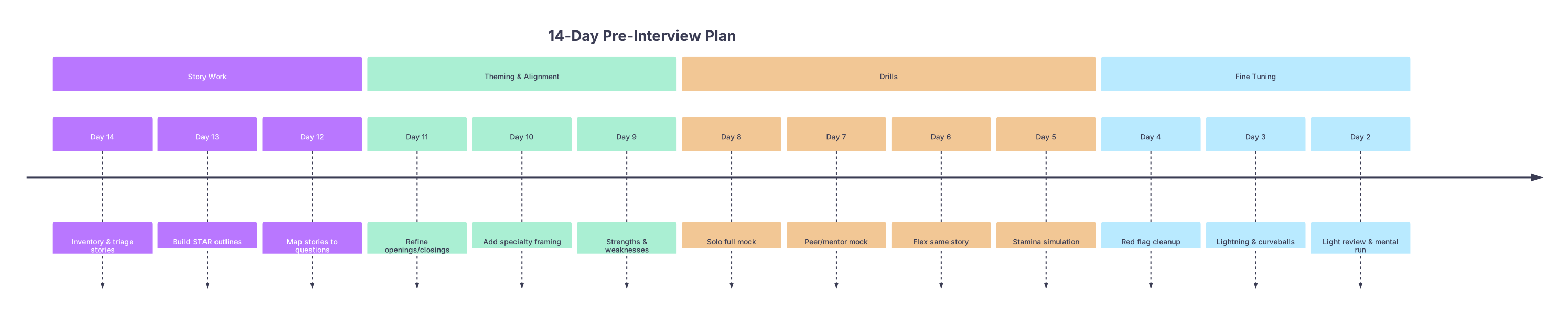
| Period | Event |
|---|---|
| Story Work - Day 14 | Inventory & triage stories |
| Story Work - Day 13 | Build STAR outlines |
| Story Work - Day 12 | Map stories to questions |
| Theming & Alignment - Day 11 | Refine openings/closings |
| Theming & Alignment - Day 10 | Add specialty framing |
| Theming & Alignment - Day 9 | Strengths & weaknesses |
| Drills - Day 8 | Solo full mock |
| Drills - Day 7 | Peer/mentor mock |
| Drills - Day 6 | Flex same story |
| Drills - Day 5 | Stamina simulation |
| Fine Tuning - Day 4 | Red flag cleanup |
| Fine Tuning - Day 3 | Lightning & curveballs |
| Fine Tuning - Day 2 | Light review & mental run |
Day 2: Consolidation, Not Reinvention
At this point you should resist the urge to “fix everything.” You are past that window.
Task 1: 30–45 minute structured review
- Re‑read your 1‑page story bank
- For each story, say out loud:
- The opener
- The key action step
- The reflection sentence
This is like reviewing flashcards, not re‑learning the content.
Task 2: Short, focused mock (30 minutes)
- 5–7 behavioral questions, timed
- Stop if you feel yourself getting fatigued or frustrated
- The goal is confidence, not perfection
Day 1 and Interview Morning: Final Touches and Mental Scripts
Day 1 (Day Before): Calm Rehearsal and Cutoff
At this point you should stop new practice by evening. Seriously.
Morning (30–45 minutes):
- One light run‑through of:
- 1 conflict story
- 1 failure story
- 1 leadership story
- 1 ethics/professionalism story
- 1 “big win” / proud moment
Afternoon:
- Pack / prep logistics
- Confirm interview times, links, dress, travel
- No more rewriting answers
Evening (15–20 minutes max):
- Review your strengths and weaknesses bullet points
- Skim your story map
- Shut it down. The benefit of more drilling now is minimal; the risk of rattling your confidence is high.
Interview Morning: Mental Priming, Not Cramming
You should not be frantically scrolling question lists in the waiting room.
15–20 minutes of quiet mental rehearsal:
- Remind yourself of:
- Your 3–4 core strengths
- Your 2–3 weaknesses with “in progress” plans
- 3 anchor stories:
- Favorite teamwork example
- Clearest failure with strong growth
- Strongest leadership/initiative story
Picture yourself answering in a calm, measured way. Not rushed. Not over‑rehearsed.

Set one simple rule for the day:
- First sentence answers the question.
- Then STAR.
- Then one sentence of reflection.
If you do only that, your behavioral answers will already be above average.
Quick 14‑Day Checklist
Use this as your sanity check. If you can tick these boxes, you are ready.
| Time Point | Key Milestone |
|---|---|
| Day 14–12 | 10–14 core stories, STAR outlines complete |
| Day 11–9 | Stories aligned with specialty + S/W narratives |
| Day 8–7 | At least 2 mocks (solo + peer/mentor) completed |
| Day 6–5 | Same‑story flex drills + stamina simulation done |
| Day 4–3 | Red flags cleaned; curveball answers outlined |
| Day 2–1 | Light review only; no new content added |
If You Remember Nothing Else
- Two weeks out is for refinement, not reinvention. Commit to 10–14 stories and stop collecting more.
- Every behavioral answer should follow a clear structure: direct opener → lean STAR → specific reflection tied to your specialty.
- Prioritize live, timed drills with feedback in the final week over endlessly re‑writing scripts. You are training performance, not prose.