
The worst time to think about your behavioral answers is during the interview. The second worst time is never. You should be fixing them in the 24 hours after every interview.
You’re not just collecting programs. You’re collecting data on yourself. How you answer. Where you freeze. What makes you ramble. If you treat each interview like a one-off performance instead of a live rehearsal for the next one, you’re leaving points on the table.
Here’s the timeline: what you should do in the first hour, first 24 hours, between interviews, and in the final weeks to systematically log and improve your behavioral responses.
0–60 Minutes After the Interview: Capture Before You Forget
At this point you should not be “relaxing.” You should be dumping everything out of your head before it fades.
Step 1: Immediate Brain Dump (First 10–20 minutes)
As soon as you leave the hospital or log off Zoom:
- Sit in your car, a coffee shop, or a quiet corner.
- Turn on your phone’s voice recorder or open a notes app.
- Talk/type fast, don’t edit.
Capture three things:
Questions you were actually asked
Especially behavioral ones like:- “Tell me about a time you had a conflict with a team member.”
- “Describe a time you made a mistake.”
- “How do you handle stress on busy days?”
Your rough answers (what you remember saying)
Not verbatim. Just:- Main story you used
- Key points or examples
- Any part you felt yourself stumble over or repeat
Real-time impressions
- What they reacted to (nodding, follow-up questions, smiles).
- Any answer where you thought mid-sentence: “This is not going well.”
Do not trust that you’ll remember later. By tomorrow, all your interviews will start to blur.
Step 2: Quick Emotional Tagging (Next 5–10 minutes)
Now, before your brain starts rewriting history to make you feel better, rate your own performance. Fast and honest.
Use a simple 1–5 scale for behavioral questions only:
- 1 = Train wreck
- 2 = Weak/rambling
- 3 = Acceptable but forgettable
- 4 = Strong, organized, clear
- 5 = Nailed it; they reacted well
You’re not doing a full post-mortem yet. You’re tagging answers for later surgery.
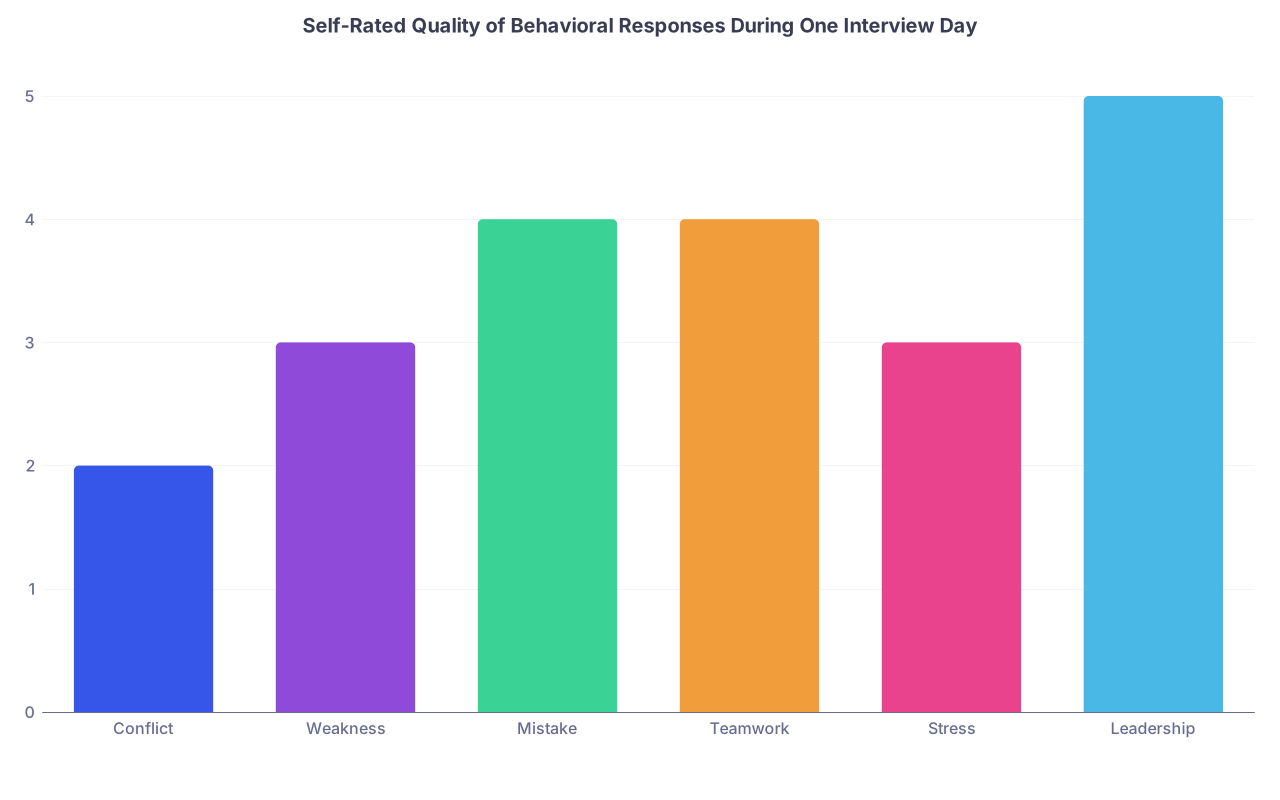
| Category | Value |
|---|---|
| Conflict | 2 |
| Weakness | 3 |
| Mistake | 4 |
| Teamwork | 4 |
| Stress | 3 |
| Leadership | 5 |
This is what one of my former students’ logs looked like leaving a single interview day. Those 2s and 3s? That’s where the work happens.
Same Day (Within 24 Hours): Build Your Behavioral Answer Log
By the end of interview day, you should have a structured record, not scattered notes.
Step 3: Create or Update Your Behavioral Question Tracker
If you do not have a tracker yet, today is the day. Use Excel, Notion, Google Sheets, anything you’ll actually open.
Set up columns like this:
| Field | Example Entry |
|---|---|
| Program | University Hospital IM |
| Interview Date | 2026-01-05 |
| Question Category | Conflict with colleague |
| Exact/Approx Question | “Tell me about a time you had a conflict with a peer.” |
| Story Used | Night float handoff disagreement with co-intern |
| Framework Used (STAR/CAMP) | STAR |
| Self-Rating (1–5) | 2 |
| Weak Points | Too long, vague outcome, blamed co-intern |
| Planned Fix | Shorten; emphasize shared responsibility & learning |
At this point you should:
- Transcribe your brain dump into this tracker.
- Group questions by category, not exact wording:
- Conflict
- Mistake/failure
- Feedback received
- Leadership
- Difficult patient/family
- Time you went above and beyond
- Handling stress/workload
- Ethical dilemma / professionalism
- Working with diverse teams / DEI
- Dealing with limited resources / systems issue
You’ll quickly see patterns: some categories you’re solid, others are embarrassing.
Step 4: Reconstruct Your Answers Using a Framework
Now, same day while it’s still fresh, you reconstruct the answer you actually gave, using a structure. I like STAR or CAMP.
- STAR = Situation, Task, Action, Result
- CAMP = Challenge, Action, Mindset, Professionalism/Personal growth
Pick one and stick with it.
For every behavioral question you remember:
- Write out:
- The story you used (brief)
- One bullet each for S/T/A/R (or C/A/M/P) as you actually said it
- Then mark:
- What you left out but wish you’d included
- Where you over-explained
Example from a real conflict answer that bombed:
- Situation: Co-intern not following sign-out protocol on nights.
- Task: Needed reliable sign-out to keep patients safe.
- Action: “I told him it was unsafe, and we had a heated discussion…”
- Result: “Eventually he adjusted somewhat.”
Problems: Blamey tone. Weak result. No insight. No professionalism.
You’re not fixing it yet. You’re documenting the damage accurately.
1–3 Days After: Turn Weak Responses into Strong Ones
At this point you should be rewriting, not just regretting. This is the “improvement” phase.
Step 5: Identify Your Top 5 “Core Stories”
You don’t need 40 stories. You need 5–8 flexible ones you can angle different ways.
From your tracker, pull out the best stories you’ve used (or could’ve used):
- A clinical conflict with a colleague or nurse
- A significant mistake or near-miss
- A time you received critical feedback and changed
- A leadership or initiative story (QI project, schedule problem, teaching initiative)
- A tough patient/family interaction
- A serious time-pressure / workload situation
- A systems problem you worked around or improved
Map each story to multiple categories. One story can handle:
- Conflict + Professionalism + Leadership
- Mistake + Resilience + Growth
- Difficult patient + Communication + Empathy
This lets you respond more smoothly when the wording of the question shifts.
Step 6: Rewrite Your Worst-Performing Answers
Focus on any answer you rated 1–3. Systematically clean them up.
For each:
Clarify the Situation in one sentence.
If it takes 60 seconds to explain the background, you’ve already lost them.State your specific role and task.
Not “the team.” You.Tighten the Action to 2–4 concrete moves.
Avoid vague mush like “I communicated more effectively.” Say what you actually did:- “I scheduled a brief one-on-one.”
- “I owned my part and apologized for my tone.”
- “We agreed on a standard sign-out format.”
End with a result that shows growth, not perfection.
- What changed in the situation?
- What changed in how you now practice?
- What would you do differently next time?
Example: rewrite of that earlier conflict answer:
- Situation: “On night float, sign-outs from one co-intern were inconsistent, and we had a near-miss with a missed critical lab.”
- Task: “I needed a safer, more reliable system without burning bridges.”
- Action:
- “I asked him to grab coffee post-call so we could debrief the night.”
- “I owned that I’d been frustrated and may have sounded accusatory at 3 a.m.”
- “We walked through the near-miss, agreed on a shared sign-out template, and ran it by our senior.”
- Result:
- “Our sign-outs improved, we didn’t have further misses, and I learned to address conflict earlier and with more curiosity instead of at peak frustration.”
That’s what a healthy behavioral answer sounds like. Honest, specific, and not self-righteous.
Between Interviews (Rest of Interview Season): Weekly Improvement Routine
At this point in the season you should be using each interview as a controlled experiment, not a solo event.
Step 7: Weekly Review (30–45 minutes)
Once a week—Sunday afternoon works well—sit down with your tracker.
Do three passes:
Question Frequency Scan
- Which behavioral categories are showing up repeatedly?
- Programs love:
- Conflict
- Mistake/failure
- Handling stress
- Weaknesses and feedback
Quality vs Frequency
- Where you’re getting asked the most AND rating yourself the lowest—that’s your highest ROI.
Story Fatigue Check
- Are you overusing one story?
- Did any story feel off-brand for a particular specialty? (That trauma bay hero story might not land the same in pediatrics as in EM.)
Then pick 2–3 high-yield questions to actively polish for the coming week.
Step 8: Short, Focused Reps (10–15 minutes at a time)
Don’t “practice interviews” for 2 hours. That’s how you burn out and start sounding rehearsed.
Instead, 10–15 minute blocks, 3–4 times a week:
Block format:
- Pick 2 behavioral questions (from your tracker).
- Hit record (voice or video).
- Answer each once, out loud, no pausing.
- Stop. Re-listen. Make 2–3 quick notes:
- Too long?
- Missing clear Result?
- Sound defensive? Arrogant? Vague?
- Re-answer once with those tweaks in mind.
That’s it. Short sprints, not marathons.
Mid-Season: Spot Trends and Fix Systemic Problems
By the midpoint of your interview season, you should have enough data to see patterns. Time to act like it.
Step 9: Analyze Your Pattern of Mistakes
Open your tracker and sort by:
- Question Category
- Self-Rating
You’ll likely see one of these patterns:
- Always weak on “time you failed” → You’re probably dodging vulnerability or minimizing impact.
- Always weak on conflict → You may be either:
- Pretending you never have conflict (which no one believes), or
- Describing conflict but not showing emotional maturity.
- Always weak on weakness questions → You’re giving fake weaknesses or no concrete plan for improvement.
Pick the single most problematic category and deep-dive:
- Write down 2–3 new story options for that category.
- Choose the one that:
- Shows genuine imperfection,
- Has a clear resolution or growth arc,
- Does not question your judgment or integrity at a core level.
Then build one fully structured answer and practice it 3–4 times across the week.
Step 10: Align Behavioral Stories with Specialty Signals
Behavioral answers aren’t generic. What impresses a surgery PD isn’t identical to what impresses a psychiatry PD.
At this point you should be bending your stories toward the specialty:
- Internal Medicine: nuance, longitudinal thinking, collaboration.
- Surgery: decisiveness, ownership, composure under pressure.
- Pediatrics: communication with families, patience, advocacy.
- EM: prioritization, team coordination, rapid decisions with incomplete data.
- Psych: listening, boundaries, managing your own reactions.
Same story, different lens. For a difficult patient:
- EM version: emphasize triage, safety, clear limits.
- Psych version: emphasize curiosity, de-escalation, therapeutic alliance.
- IM version: emphasize continuity, negotiation around adherence.
Rewrite the “Result” and “Reflection” parts of your core stories to match the specialty’s culture.
Late Season (Last 2–3 Weeks): Tighten and Standardize
Near the end of interview season, your job is no longer to invent. It’s to refine and not get sloppy.
Step 11: Build Your Personal Behavioral “Playbook”
By now you should have a one-page cheat sheet (yes, literally one page) with:
- 5–8 core stories, each labeled:
- Primary category (e.g., Conflict)
- Secondary angles (e.g., Leadership, Systems)
- One-line Situation for each.
- 3–4 bullet Action/Result highlights each.
- A short reflection line:
- “This taught me…”
- “Since then, I…”
This is not to read from. It’s to keep your own mental library organized so you don’t blank when someone phrases a question weirdly.
You want to be able to think:
“OK, that’s really a ‘mistake’ question” → pull story 3 → shift emphasis slightly → answer.
Step 12: Final Rehearsal Cycles
Last stretch. You’re tired. That’s when people start rambling.
Twice a week, run a 15-minute simulation:
- Have a friend, resident, or even yourself with a question list ask 5 behavioral questions at random.
- Answer them in one take, out loud.
- Evaluate on three things only:
- Was there a clear story?
- Did I actually answer the question asked?
- Did I show insight/growth, not just description?
If you’re solid on those three, stop tinkering. Over-rehearsal will make you robotic.
After Interview Season: Use Debriefs for Thank-You Notes and Rank List
Your behavioral log isn’t just for self-improvement. It’s a memory prosthesis.
Step 13: Use Your Notes for Specific Thank-You Emails
Within 24–48 hours of each interview, you should already have:
- Names (from your schedule/notes).
- Specific questions they asked you.
- Moments where they reacted to your stories.
Use that:
- “I appreciated our discussion about handling conflict on the night float team…”
- “You asked about a time I made a mistake, and our conversation about near-misses really stuck with me.”
You’ll sound like someone who actually pays attention. Because you did.
Step 14: Inform Your Rank List with Behavioral Fit
Look back across your tracker once the dust settles:
- Which programs asked thoughtful behavioral questions that let you show who you are?
- Where did you feel like your genuine stories landed well?
- Where did you have to contort yourself into someone you’re not?
Those impressions matter. Behavioral interviews are two-way: they’re showing you how they think about people and problems.
Common Debrief Mistakes (And When They Happen)
To make this brutally clear, here’s how people typically screw this up across the season:
| Phase | Mistake |
|---|---|
| First 24 hours | No notes; “I’ll remember later” |
| Early interviews | New story every time; no refinement |
| Mid-season | Ignoring low-rated categories |
| Late-season | Over-rehearsed, scripted-sounding answers |
| Post-season | No review; rank list based only on “vibes” |
You avoid this by anchoring to the clock: what you do right after, same day, weekly, and end of season.
Visual: Your Interview Season Debrief Timeline
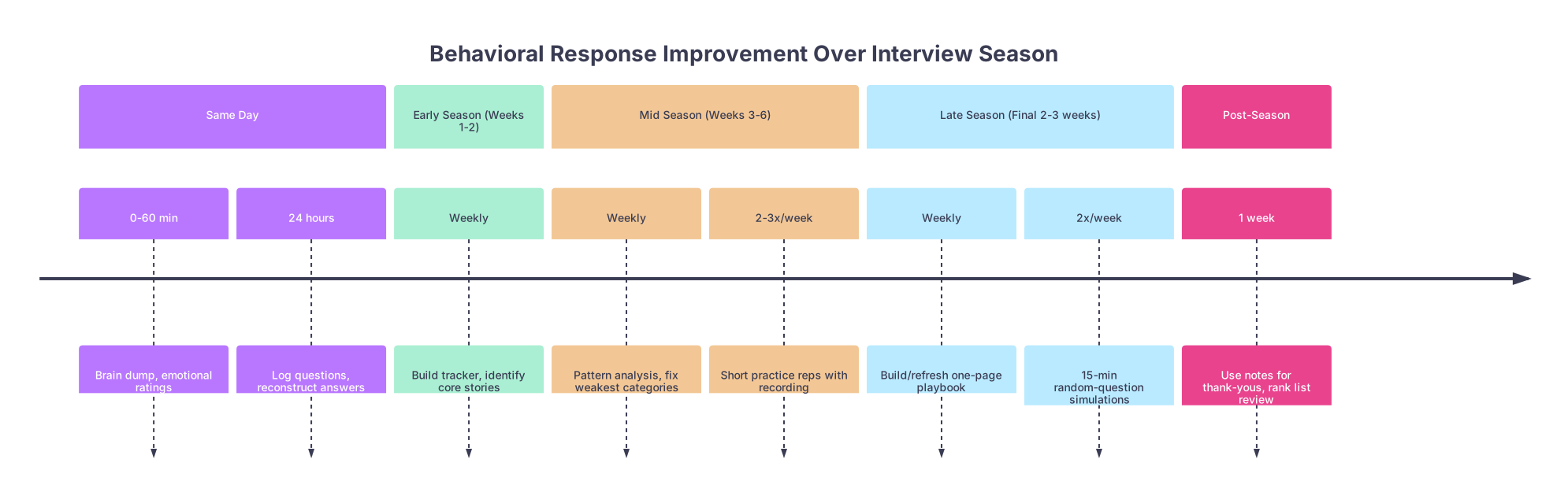
| Period | Event |
|---|---|
| Same Day - 0-60 min | Brain dump, emotional ratings |
| Same Day - 24 hours | Log questions, reconstruct answers |
| Early Season (Weeks 1-2) - Weekly | Build tracker, identify core stories |
| Mid Season (Weeks 3-6) - Weekly | Pattern analysis, fix weakest categories |
| Mid Season (Weeks 3-6) - 2-3x/week | Short practice reps with recording |
| Late Season (Final 2-3 weeks) - Weekly | Build/refresh one-page playbook |
| Late Season (Final 2-3 weeks) - 2x/week | 15-min random-question simulations |
| Post-Season - 1 week | Use notes for thank-yous, rank list review |
Today: Start Your Log in 20 Minutes
Do not wait for the “next” interview to become the “better” one.
Here’s your concrete move for today:
- Open a blank note or spreadsheet.
- Create columns for: Program, Date, Question Category, Approx Question, Story Used, Framework, Self-Rating, Weak Points, Planned Fix.
- Write down at least three behavioral questions you’ve already been asked (or you know are coming) and fill out the row as best you can from memory.
That’s your behavioral log v1.
Next interview, you’re not just showing up—you’re running an experiment.