
Most applicants practice behavioral questions completely out of order—and it shows on interview day.
If you cram everything into the week before interviews, your stories sound flat, your answers ramble, and you default to clichés. Programs notice. I’ve watched residents get quietly written off because their “Tell me about a time you failed” answer was a 7-minute word salad.
You’re in the ERAS-to-interview window now. This is where you fix that—with a timeline, not vibes.
Below is a month‑by‑month, then week‑by‑week behavioral prep plan from ERAS submission through the heart of interview season. Follow the sequence. At each point, you’ll know exactly what you should be doing and what should already be done.
Big Picture Timeline: ERAS to Interview Season
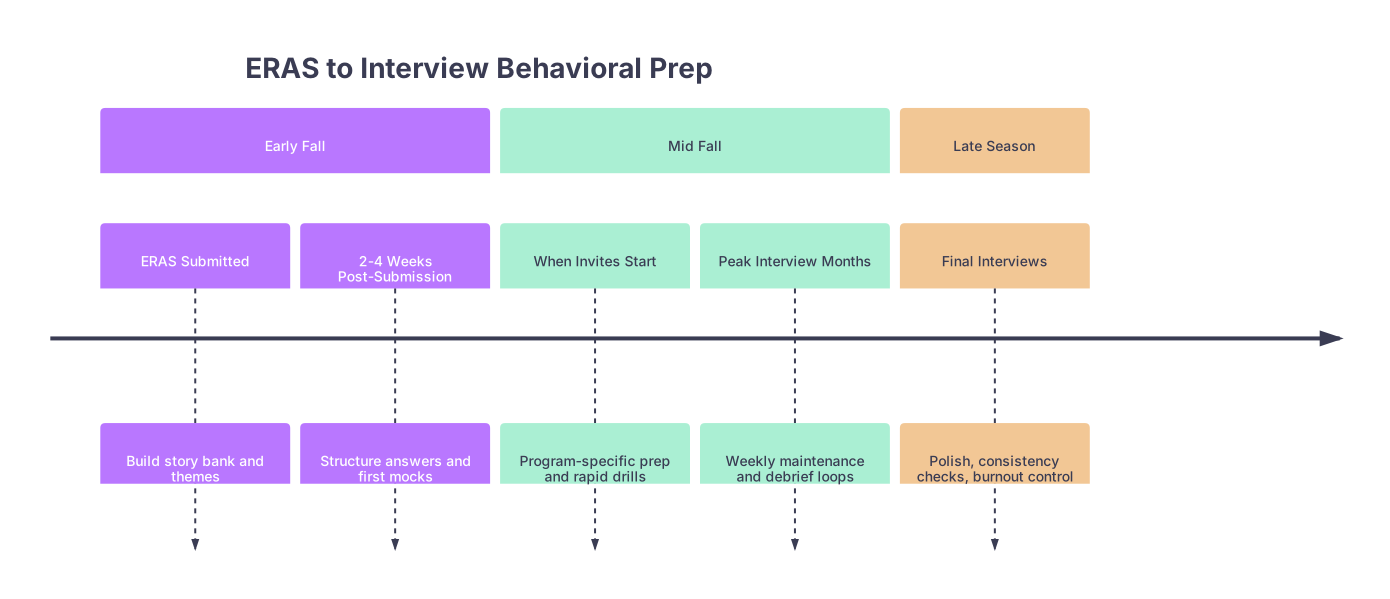
| Period | Event |
|---|---|
| Early Fall - ERAS Submitted | Build story bank and themes |
| Early Fall - 2-4 Weeks Post-Submission | Structure answers and first mocks |
| Mid Fall - When Invites Start | Program-specific prep and rapid drills |
| Mid Fall - Peak Interview Months | Weekly maintenance and debrief loops |
| Late Season - Final Interviews | Polish, consistency checks, burnout control |
At a high level, your behavioral prep moves through 5 phases:
- Story Inventory – capturing raw material (stories) before details fade
- Structure & Polish – forcing every story into tight, repeatable formats
- Program Targeting – aligning stories with each specialty/program
- Rehearsal Cycle – short, frequent, focused practice as interviews roll
- Consistency & Recovery – staying sharp in week 10 like you were in week 1
We’ll walk this chronologically from ERAS submission through the late interviews.
Month 0: ERAS Submitted – Build the Story Bank (Weeks 0–4)
The day you hit “submit” on ERAS, your behavioral prep clock starts. At this point you should not be memorizing answers. You should be hunting for raw stories.
Week 0–1: Capture Before You Forget
At this point you should:
- Block 2 x 60‑minute sessions just for story mining. Phone off. Email closed.
- Open a simple doc with 3 sections:
- Clinical stories
- Team/leadership stories
- Personal/adversity stories
Brain-dump every situation under these prompts:
- A patient who changed how you think about medicine
- A time you made a mistake or almost did
- A conflict with a nurse, resident, or attending
- A time you advocated for a patient against resistance
- A rotation that went badly at first, then improved
- A time you got tough feedback
- A personal setback (family, health, finances) that hit during school
You’re not polishing. You’re writing ugly bullet notes so later-you has material.
Aim for 15–20 total stories, even if half feel “meh” right now. Many will clean up nicely once structured.
Now quickly map your stories to the usual behavioral buckets:
| Category | Target # Stories | Your Count (fill in) |
|---|---|---|
| Teamwork | 3–4 | |
| Conflict | 2–3 | |
| Leadership | 3–4 | |
| Failure/Mistake | 2–3 | |
| Ethics/Integrity | 2–3 | |
| Resilience | 2–3 |
Any category with <2 stories is a red flag. You’ll backfill those in the next two weeks.
Week 2: Fill the Gaps and Tag the Stories
At this point you should:
- Add 1–2 stories per weak category. Ask yourself:
- “When was the last time I felt really uncomfortable on the wards?”
- “When did I disagree with a plan but was afraid to say so?”
Then tag each story with:
- Competencies: teamwork, communication, leadership, adaptability, etc.
- Specialty relevance: e.g., fits EM, Psych, Surgery, IM, etc.
- Risk level:
- Low-risk: smooth success stories
- Medium-risk: some tension or vulnerability
- High-risk: major error, personal crisis, remediation episode
You’ll want mostly low/medium‑risk stories with a few high-impact, honest ones.
Week 3–4: Introduce Structure (STAR/SAO)
Now you start light structuring, not memorization.
For each story, outline:
- S/T (Situation/Task) – 1–2 lines max
- A (Action) – what you specifically did (not “we” by default)
- R/O (Result/Outcome) – what changed + what you learned
At this point you should:
- Fully outline 8–10 core stories using STAR or SAO
- Make sure each can answer multiple questions:
- A conflict story that also shows advocacy
- A leadership story that also shows resilience
If your outlines are paragraphs, they’re too long. This is scaffolding, not a script.
Month 1: Invitations Start – Turn Stories into Answers (Weeks 5–8)
Around this time, invites start dribbling in. Your prep shifts from “inventory” to “how I say this out loud.”
Week 5: Core Questions, Core Scripts
There are about 10 behavioral questions you’ll hear in some form at nearly every interview. At this point you should have tight, 90‑second skeletons for each:
- Tell me about yourself.
- Why this specialty?
- Why our program?
- Tell me about a time you had a conflict on the team.
- Tell me about a time you made a mistake.
- Tell me about a time you went above and beyond.
- Tell me about a time you received critical feedback.
- Tell me about a time you had to adapt quickly.
- Tell me about a time you handled an ethical dilemma.
- Tell me about a time you were under significant stress.
Use your story bank to assign one or two strong stories to each. Write bullet-scripts only:
- One line: setup
- 2–3 bullets: key actions
- One line: outcome + reflection
No full paragraphs. If you write an essay, you’ll sound memorized and robotic.
Week 6: First Mock + Brutal Feedback
At this point you should schedule 1–2 full mock interviews:
- One with a faculty member or chief resident
- One with a peer who’ll actually tell you the truth
Ask for specific feedback:
- “Where did I ramble?”
- “Which stories felt generic?”
- “What did you not believe?”
Record at least one mock (video if possible). Yes, it’s painful. Do it once. You’ll catch:
- Filler words
- Overlong setups
- Monotone delivery
Your task for the week: rewrite 3–4 of your worst-performing answers. Shorter. Clearer cause‑effect. More “I” statements.

Month 2: Early Interviews – Weekly Behavioral Routines (Weeks 9–12)
Now interviews are coming in clusters. The game changes: consistency and energy management.
Weekly Rhythm During Early Interviews
Every week that you have interviews, at this point you should:
Run a 20‑minute “story warm‑up” once per week
- Pick 3 core questions (conflict, failure, feedback)
- Answer out loud, timing each to 60–90 seconds
- Stop immediately at 90 seconds, mid-sentence if needed to retrain your pacing
Do a 10‑minute “program alignment” check for each upcoming interview
- Scan their website for:
- Mission buzzwords (underserved, research, education, innovation)
- Track options (primary care, clinician educator, global health)
- For each program, mark 2–3 stories you’ll highlight that align with their vibe.
- Scan their website for:
Use a simple template:
- Which stories did I use today?
- Which questions caught me off guard?
- Where did I ramble or sound rehearsed?
- What did faculty seem to react to (nodding, follow‑ups)?
This debrief is non‑negotiable. It’s the difference between getting better each week vs repeating the same B‑level performance 15 times.
Week 9: Tighten the Edges – Risky Topics
By now, some of you will already have hit one of these landmines:
- “Tell me about that leave of absence/remediation.”
- “Walk me through your Step failure/low score.”
- “I see a grade dip during M2. What happened?”
At this point you should have one clean, calm, 60‑second narrative for every “awkward” part of your application.
Structure:
- Brief context (1–2 sentences)
- Ownership: what you did wrong or what hit you
- Concrete actions: how you addressed it
- Evidence of change: recent performance, letters, responsibilities
- One sentence tying it to your readiness now
If you’re rambling or sounding defensive here, fix it this week. These answers should feel boringly steady, not dramatic.
Month 3: Peak Interview Season – Daily Micro-Prep
This is where most people slide. They “did a lot of prep early” and then rely on momentum while exhausted. That’s how you get weird, inconsistent answers in late January.
At this point, with multiple interviews per week, you shift from heavy prep to short, repeatable rituals.
48 Hours Before Each Interview
At this point you should:
Re-read:
- Your ERAS personal statement
- This program’s specific paragraph in your personal statement (if any)
- Your own activities section (remind yourself what you claimed you did)
Choose:
- 3 key themes you want this program to remember:
- e.g., “teaching-focused,” “systems thinker,” “underserved medicine”
- 3–4 stories that best reinforce those themes
- 3 key themes you want this program to remember:
You’re not rewriting answers. You’re just deciding which version of yourself to foreground.
Night Before Each Interview: 20-Minute Run-Through
Keep it short. You’re not cramming.
At this point you should:
- Stand up, set a timer for 20 minutes, and run:
- “Tell me about yourself” once
- “Why this specialty?” once
- One behavioral question of your choice
Stop. Do not keep spiraling. You want to go to bed with the rhythm of your answers fresh, not with 15 overanalyzed alternatives spinning in your head.
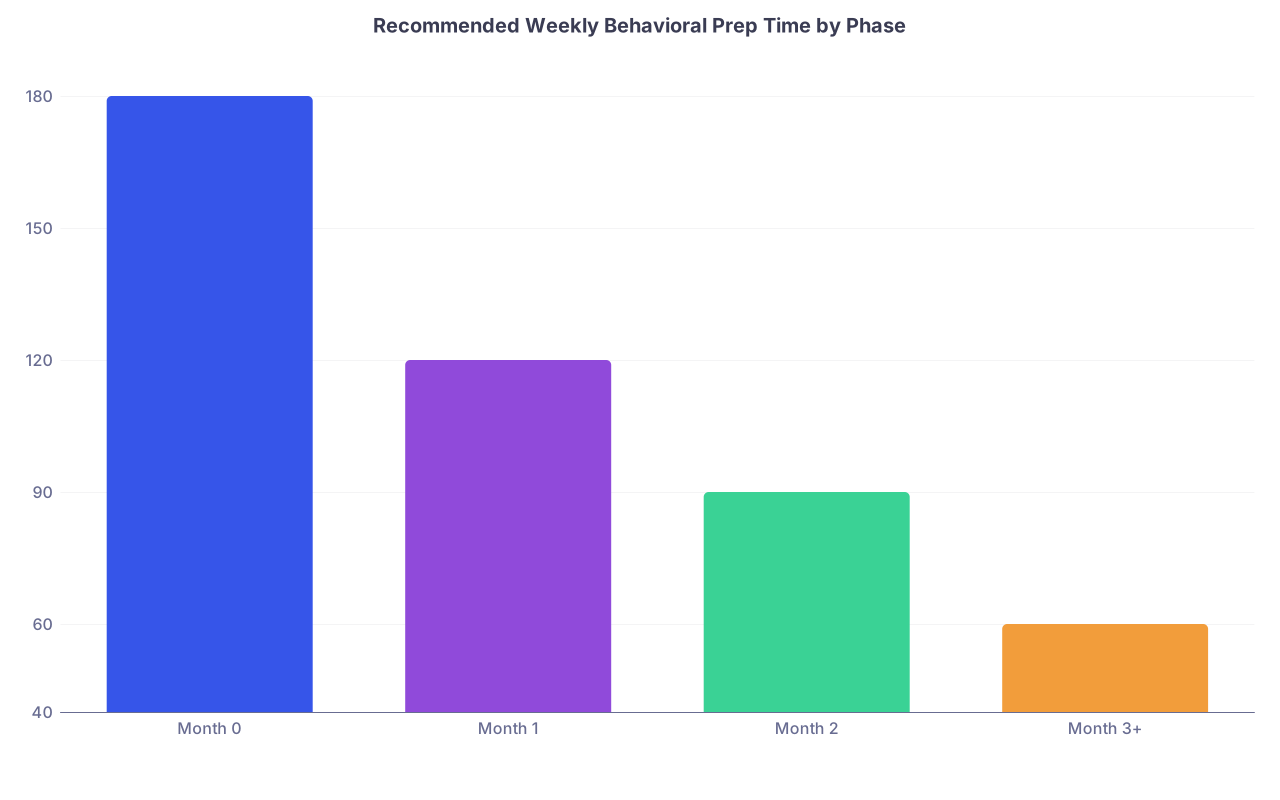
| Category | Value |
|---|---|
| Month 0 | 180 |
| Month 1 | 120 |
| Month 2 | 90 |
| Month 3+ | 60 |
Mid-Season: Fixing Common Behavioral Mistakes (When You Notice Them)
Around your 4th–6th interview, patterns appear. You’ll notice what keeps going wrong. This is where you do targeted repairs.
Problem 1: Rambling Stories
Signs: you lose the interviewer’s eyes halfway through; they check the clock; they interrupt.
At this point you should:
- Pick your 3 longest answers and:
- Cut the setup in half.
- Reduce side characters. One attending, one nurse, one patient. Not six.
- Replace vague reflections (“I learned the importance of communication”) with one concrete change you made next time.
Run each problem story against a hard 90-second limit three times in a row. Practice ending cleanly.
Problem 2: Everything Sounds the Same
If your “conflict” story and your “failure” story and your “feedback” story are all from the same rotation with the same attending, it feels lazy.
At this point you should:
- Force diversity:
- Different rotations
- Different years (M3 vs M4 vs pre-clinical)
- Clinical vs non-clinical (research, leadership positions, volunteer work)
Add 2 fresh stories that don’t involve patients at all—e.g., research team conflict, student group leadership, tutoring challenges. Programs like to see you functioning outside the hospital bubble.
Problem 3: Over-Rehearsed, Robotic Answers
If faculty stop asking follow‑ups, or if you’re getting a “polished but generic” vibe from yourself, you’ve over-scripted.
At this point you should:
- Strip your scripts back to 5 bullet words per story:
- “night float – sepsis – nurse pushback – closed-loop – family update – QI idea”
- Practice telling the story from those anchor words, not from memorized sentences.
You want consistency of content, not identical phrasing.
Late Interview Season: Staying Sharp and Sane
By the last 3–4 interviews, you’re tired. You’ve told the same stories a dozen times. This is where applicants leak frustration, boredom, or over-share.
Weekly: Emotional and Behavioral Check
Once a week, at this point you should ask:
- “Am I getting shorter and snappier in a bad way?”
- “Am I venting about previous programs in my answers?”
- “Do I sound resentful when discussing hours, call, or burnout?”
If yes, pick one trusted person (friend, SO, mentor) and do a single 30‑minute mock focused only on tone:
- Have them watch for eye contact, warmth, and how you talk about:
- Nurses
- Other residents
- Administration
- Previous programs you’ve seen
No one wants the resident who already sounds jaded and hostile as a fourth-year student.

Day-Of Interview Behavioral Checklist
Day of, behavioral prep is light. At this point you should be reviewing, not constructing.
60 Minutes Before
- Skim your:
- 10 core behavioral question bullet-scripts
- 3 key themes for this program
- 3–4 go-to stories you want to use if they fit
No more than 15–20 minutes of total review.
15 Minutes Before
- Do a one-minute out-loud answer to:
- “Tell me about yourself”
- Then stop talking. Breathe. You’re warming up the pipes, not rewriting the speech.
Immediately After
That night, spend 10 minutes to:
- Log:
- Which stories you used
- Any new questions you got
- Any stumble you want to fix before the next one
Update one answer if needed. Not five. Keep changes incremental so your narrative stays coherent across all interviews.
Quick Reference: Month-by-Month Behavioral Prep
| Timeframe | Main Focus | Key Output |
|---|---|---|
| Month 0 (Post-ERAS) | Story inventory & tagging | 15–20 stories, 8–10 STAR outlines |
| Month 1 | Core answers & first mocks | 10 core questions, 1–2 mocks |
| Month 2 | Weekly routines & debriefs | Debrief log, risky-topic scripts |
| Month 3+ | Micro-prep & consistency checks | Program-aligned themes, tone tune-ups |
FAQ (Exactly 3)
1. How many behavioral stories do I really need for residency interviews?
You can survive with 10, but you’ll perform with about 15–20 distinct stories, of which 8–10 are “core” you use repeatedly. The rest are backups to avoid repetition, cover different rotations/settings, and plug gaps (ethics, resilience, non-clinical leadership). The point isn’t volume for its own sake; it’s having enough variety that you don’t sound like a one-rotation wonder.
2. Should I write out my answers word-for-word or just wing it?
Neither. Fully scripted answers sound fake. Winging it leads to rambling and omissions. The sweet spot is bullet‑level structure: one line for setup, 2–3 action bullets, one line of outcome/learning. That keeps you consistent but still natural. If you catch yourself memorizing sentences, delete them and go back to keywords only.
3. How do I practice behavioral questions without sounding rehearsed by interview #10?
Rotate stories and change emphasis. Keep your structure the same, but let details breathe. Use your pre‑interview 20‑minute warm‑ups to experiment with slightly different framings and examples. Also, keep a short list of “fresh” stories you rarely use; deploy one or two each week to keep yourself mentally engaged. Bored candidates sound canned; engaged candidates sound authentic.
Key points to leave with:
- Build your story bank immediately after ERAS and structure it gradually; don’t wait for invites.
- Shift from heavy prep to short, consistent weekly and pre‑interview rituals once interviews start.
- Use debriefs and targeted fixes mid-season to keep your behavioral answers sharp, honest, and consistent across every program.