
You finish your Sub-I and already know. Nobody has to say it out loud.
Maybe the eval language felt lukewarm. Maybe the senior who promised to "work with you closely" barely knew your name by the end. Maybe you were solid but not impressive, and solid was not the plan. Now you're staring at the calendar asking the question students always ask too late:
Do I pivot now, or do I wait?
This is where "backup aways" usually begin. Not from panic. From pattern recognition. A weak Sub-I is a signal, and signals matter. Not because one rotation defines you. It doesn't. But because residency applications run on timing, capacity, and momentum. If your home Sub-I didn't produce the letter, advocacy, or confidence boost you needed, you have a narrow window to adjust.
By pivot timing, I mean the moment you decide to change strategy after a weak Sub-I:
- pursue backup away rotations,
- replace a shaky letter pipeline,
- create new faculty touchpoints,
- and shift your application positioning before deadlines harden.
That timing question matters more than students think. The data on match outcomes is messy and probabilistic, but the operational pattern is clear: rotation slots fill, letters take time, and late pivots usually produce weaker outputs. That's the whole game.
So here's the promise of this guide: I'm going to walk you through this month by month, week by week, and day by day. At each point, you'll know what you should assess, what you should request, and what you should stop wasting time on.
Let's be blunt. There is no magical paper proving that "one backup away done exactly 7.5 weeks after a weak Sub-I increases match odds by X%." That study does not exist.
What we do have is the next best thing:
- match analyses showing that audition-type experiences can influence interview offers and rank positioning in some specialties,
- program behavior patterns around letters, schedule availability, and known faculty signals,
- and application-season timing effects that every dean's office quietly knows are real.
Here's what the evidence and lived reality support.
What the data supports
1. Away rotations are often strongest as signal amplifiers, not signal creators. If you already look plausible on paper, an away can help confirm fit, maturity, work ethic, and specialty commitment. If your file is deeply weak, one away usually doesn't save you. Students over-romanticize this. Programs don't.
2. Early operational timing matters because availability is finite. The practical issue isn't just educational value. It's slot scarcity. Competitive surgical fields often fill earlier and more aggressively. Internal medicine and pathology may offer more flexibility, but "more flexible" does not mean "available forever." Once schedules clog, your choices get dumb fast, bad month, wrong service, weak mentorship, no letter writer.
3. Letters have a lag time. A late away can still help if it produces advocacy or interview-season support, but if your main reason for pivoting is to secure a strong letter for application season, the clock is ruthless. Faculty need time to know you, then write, then upload. Students forget that a great letter requested too late is functionally a mediocre asset.
4. Programs respond to coherent recovery, not flailing. A weak Sub-I followed by a targeted backup plan reads better than a weak Sub-I followed by six random applications to unrelated places. Your pivot should look intentional. Not desperate. There's a difference, and program directors can smell it.
What the data does not prove
- It doesn't prove away rotations are always beneficial.
- It doesn't prove more aways are better.
- It doesn't prove a weak Sub-I automatically means you need to pivot.
- It definitely doesn't prove that spending money on any available away is smart. Often it's the opposite.
I've seen students burn cash and time on low-yield aways that produced nothing but exhaustion and a generic evaluation. That's not strategy. That's fear wearing business casual.
The planning rule that actually works
Here's the rule I'd use if you were my advisee:
Pivot early enough to protect your letter and evaluation pipeline, but not so early that you grab junk opportunities that don't fit your specialty story.
Operationally, that usually means:
- best-case pivot window: around 8-10 weeks before the away would need to happen,
- workable pivot window: 4-7 weeks,
- high-risk late pivot: under 4 weeks.
That's not a law of nature. It's a planning truth. And it should shape what you do next.
Timeline Guide: When You Should Pivot (Month-by-Month), Backup Aways After a Weak Sub-I
Now let's make this concrete. Assume your Sub-I just ended, or you're in the final stretch and can already tell the signal is weaker than you needed.
At this point you should think in months, not vibes.
Month 0: The week the weak signal becomes obvious
At this point you should do three things immediately:
- Name the weakness correctly
- Was the problem performance?
- Was it rapport?
- Was it a likely lukewarm letter?
- Was it one bad evaluator dragging down an otherwise decent month?
These are not the same problem. Don't treat them the same.
Figure out whether your home letter pipeline is damaged
- Do you still have 2-3 realistic letter writers?
- Is one of them strong enough to anchor your file?
- Are you relying on someone who said "sure" in that dead-eyed way that means absolutely nothing?
Decide what kind of backup away you actually need
- a full audition away,
- a clinically aligned elective with strong faculty access,
- or a home substitute elective with better letter potential.
If you're in a fast-filling specialty, this is the month to move. Not next month. Not after "seeing how things feel."
Month 1: Build the pivot packet and make contact
At this point you should have your materials ready before sending a single request:
- updated CV snapshot,
- unofficial transcript,
- short personal statement paragraph about specialty interest,
- available dates,
- immunization/compliance documents if needed,
- professionalism examples or mini accomplishments from recent rotations,
- and 2-3 specific letter targets by name.
Why so much structure? Because scattered students get ignored. Organized students get responses.
You should also contact:
- your specialty advisor,
- your clerkship director if appropriate,
- one trusted attending who will tell you the truth,
- and any faculty with ties to outside programs.
This is where students waste time. They ask vague questions like, "Do you think I should do an away?" Wrong question.
The right questions are:
- "Do you think my current letter set is enough?"
- "If not, what kind of rotation gives me the best chance at a stronger evaluation?"
- "Which programs still realistically have room?"
- "Who can I email this week?"
Month 2: Secure the highest-yield option available
At this point you should stop fantasizing about the perfect away and choose the best realistic one.
For competitive surgical fields:
- speed matters more,
- earlier slots are better,
- and faculty access is everything.
For IM, pathology, pediatrics, and some less capacity-constrained fields:
- you may have a bit more flexibility,
- but the letter timeline still rules the decision,
- and a later elective only helps if someone can actually observe you enough to advocate for you.
This month, your goal is simple:
- secure the rotation,
- confirm who you'll work with,
- and identify who could write a letter by the end.
If you can't answer "Who might write for me?" before the rotation starts, that's a yellow flag.
Month 3: Execute for signal, not just attendance
At this point you should treat the backup away like a recovery mission. Because that's what it is.
Your goals are:
- show reliability immediately,
- get known by attendings early,
- ask for mid-rotation feedback before it's too late to adjust,
- and document concrete cases, presentations, and growth points.
Do not drift through the rotation hoping hard work is self-evident. It isn't. Faculty are busy. You have to be memorable in the right way:
- prepared,
- calm,
- coachable,
- easy to work with,
- and useful.
Month 4: Convert the rotation into application assets
At this point you should be translating the away into actual outputs:
- a strong letter request,
- a polished impact summary for your recommender,
- possible program advocacy,
- updated experiences in ERAS or supplemental materials,
- and refined talking points for interviews.
This is also when you should audit whether the pivot worked.
Ask:
- Did I get a stronger evaluator relationship than I had at home?
- Did I fix the original weak signal?
- Did I learn that this specialty/program fit is worse than I thought?
That last one matters. A backup away can rescue your file, or reveal that your original plan was too brittle.
Before requests: your must-have checklist
At this point you should already have:
- updated CV,
- unofficial transcript,
- current schedule,
- list of open date ranges,
- brief specialty-interest statement,
- 2-3 possible letter writers,
- names of faculty/alumni contacts,
- examples of professionalism, leadership, or improvement,
- and one sentence explaining the ask clearly.
Week-by-Week + Day-by-Day Playbook (Operational Tasks, Not Just Advice)
Assume Week 0 is the moment you realize the Sub-I landed weakly.
Week 0-1: Stabilize
At this point you should:
- request frank feedback from a supervising resident or attending,
- ask what is still fixable versus already baked into the evaluation,
- identify your biggest weakness: knowledge gaps, presentations, initiative, organization, or team fit,
- and build your away packet.
Your Week 0-1 checklist:
- update CV,
- gather transcript and availability,
- draft short outreach email,
- list 10 target programs or faculty,
- identify 2 home mentors for honest counsel.
Don't mope for 10 days. That's how students miss the only workable window.
Week 2-3: Outbound
At this point you should be contacting 2-5 programs or attendings per week. More, if the field is tight.
Prioritize:
- places where your school has alumni or faculty ties,
- programs with realistic scheduling availability,
- rotations where students actually interact with letter-capable faculty,
- and settings aligned with your actual specialty plan.
If formal away slots are scarce, ask about:
- short elective openings,
- service-specific add-ons,
- shadow-to-clerk transitions if institutionally allowed,
- or home-based alternatives with stronger faculty visibility.
Week 4+: Execute
Now the rotation starts, or your substitute plan does.
At this point you should:
- ask for expectations on day 1,
- seek mid-rotation feedback by the end of week 1 or early week 2,
- keep a daily impact log,
- and identify the letter writer before the final days.
Students ask for letters too late because they're waiting for a perfect moment. Bad move. The perfect moment is usually after a solid observed interaction and before everyone disappears into end-of-rotation chaos.
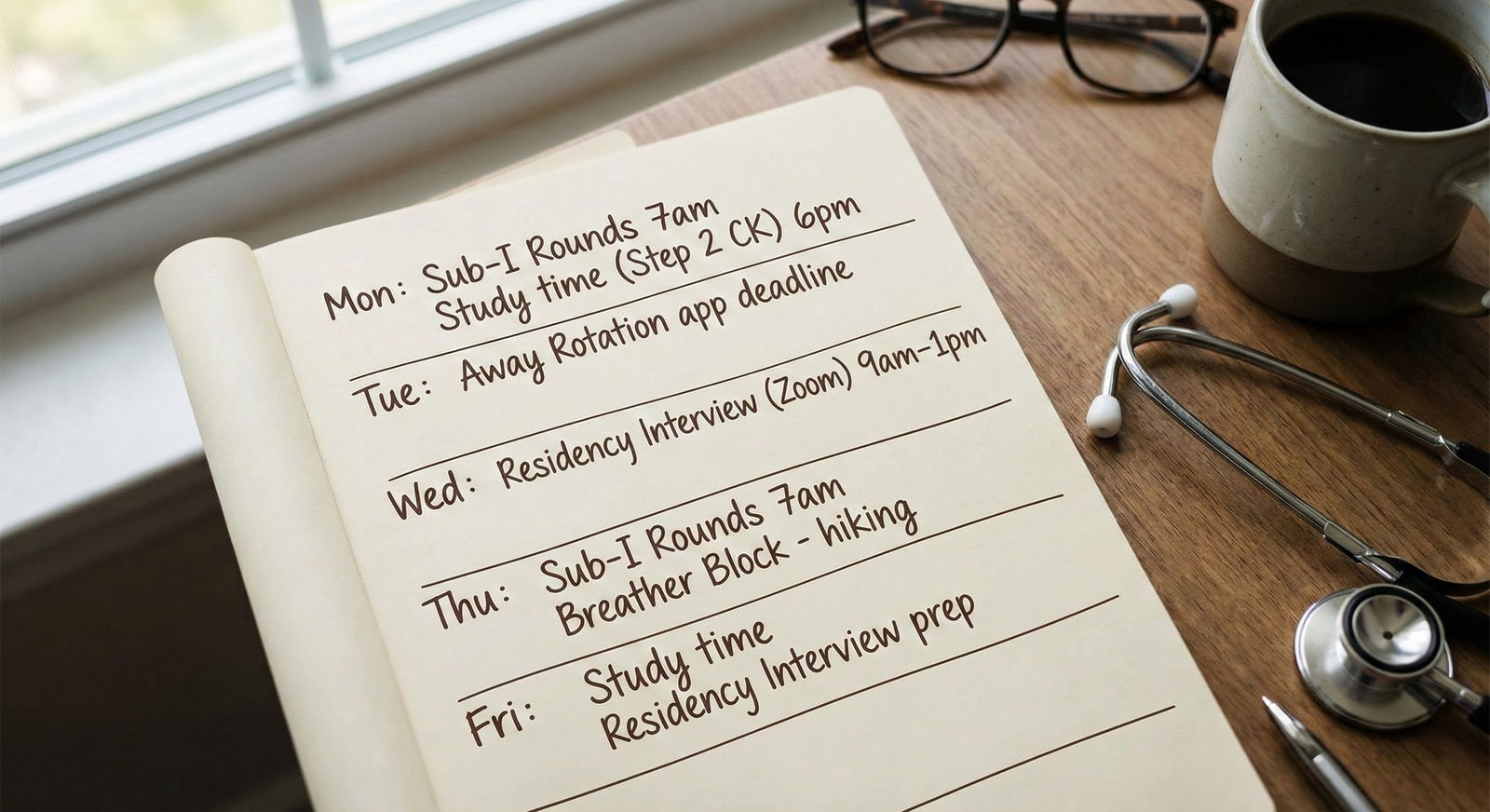
Day-by-day checklist for one away week
Day 1
- Learn names.
- Clarify workflow.
- Ask what a strong student looks like here.
Day 2
- Show up earlier.
- Volunteer for one concrete task.
- Start your case/procedure log.
Day 3
- Ask for one targeted improvement point.
- Fix it that same day if possible.
Day 4
- Contribute something memorable: concise presentation, follow-up on a patient, useful literature point.
Day 5
- Thank residents.
- Send a brief follow-up to attending if appropriate.
- Write down names, cases, and moments for future letter support.
Repeat weekly. Boring? Yes. Effective? Very.
If no slots appear: pivot again
At this point you should not freeze. Use higher-signal alternatives:
- a home elective with a known strong teacher,
- a subspecialty service where your work will be seen,
- a legitimate observership if your school and specialty allow it,
- a quick-turn research or QI project with a clinician mentor,
- and a sharper letter strategy using people who actually know your work.
A weak Sub-I plus no away is survivable. A weak Sub-I plus no away plus no letter plan is how people get blindsided.
How to Judge "Backup Away Success" Using Data-Informed Outcomes
Success is not "I completed the away."
That's attendance. Not success.
At this point you should judge the backup away by four outcomes:
Evaluation strength
- Did the comments sound specific, favorable, and comparative?
Letter quality
- Can this person write more than "hardworking and pleasant"?
Reliability signal
- Were you seen as organized, responsive, and easy to trust?
Specialty alignment
- Did this experience strengthen your application story?
Ask for the letter while the rotation is still fresh. Then make it easy to write:
- send your CV,
- personal statement draft,
- impact log,
- cases or presentations,
- and your deadline.
Your rotation impact log should include:
- notable patients,
- presentations given,
- procedures observed/performed,
- feedback received,
- and examples of improvement.
Then do a final timing audit:
- Did you pivot soon enough?
- Did you get enough faculty exposure?
- Should you now adjust your personal statement, signals, or interview prep to reflect this recovery arc?
Summary
A weak Sub-I is not the end of your match season. But it is a deadline disguised as disappointment.
At this point you should remember two rules.
First: pivot earlier than feels emotionally comfortable. Operationally, that often means 8-10 weeks when possible, or at least quickly enough to protect letters and meaningful evaluations.
Second: don't pivot blindly. Pick backup aways and substitutes that can actually change your application, not random slots that just fill your calendar.
The practical sequence is straightforward:
- Week 0-1: get honest feedback and build the packet.
- Week 2-3: send targeted outbound requests.
- Week 4+: execute with daily documentation, mid-rotation feedback, and timely letter asks.
- If no slots open: move immediately to higher-signal alternatives.
That's the real lesson from the data. Timing doesn't guarantee a rescue. But bad timing absolutely makes rescue harder. And in match season, harder is often enough to lose ground you didn't need to lose.