
The residency Match isn't a marathon. It's a series of sprints through a minefield. You're staring at the calendar, trying to decide if you should rush your Step 2 CK or wait for that shiny Honors grade on your away rotation to post. Get the timing wrong, and you're invisible to program directors. Get it right, and you control the narrative.
I map out the chronology of the Match. I don't deal in guesswork; I deal in deadlines. Here is exactly how to time your away rotations, score releases, and application submissions to maximize your match rate.
The Chronology of Crisis: When Does Timing Matter Most?
Understanding the critical junctures of this timeline is essential; see our guide on scheduling traps clerkship timing errors that hurt your match for common pitfalls to avoid.
To understand timing, you must first respect the rigidity of the Match Cycle timeline. The baseline is unforgiving. ERAS (Electronic Residency Application Service) typically opens for submissions in early September. Interview invitations surge in late September and peak in October. The interview season itself runs straight through January.
Identify the critical junctures immediately. You have the Application Submission window (August/September) and the Interview Season (September-January). These are two entirely different battlegrounds.
Choosing to apply 'Before' implies a massive competitive advantage in score visibility. You are handing reviewers a complete, quantifiable packet the second they open your file. Choosing to apply 'After', or delaying your submission to wait for late-summer rotation grades, leverages recent clinical performance and availability. It bets on your subjective narrative over your objective metrics.
At this point you should map your personal academic calendar against these fixed dates. If your away rotation ends in late August, you have a narrow two-week window to secure a Letter of Recommendation (LOR) before ERAS opens. If your Step 2 CK exam is scheduled for mid-August, your score won't release until mid-September. You are already behind the early-adopter curve. The chronology dictates the strategy. You cannot negotiate with the calendar.
The 'Before' Strategy: Maximizing Score Visibility for Interviews
At this point you should ensure your Step 2 CK score is released before you submit ERAS. This is the gold standard for a reason.
Programs heavily weight Step scores during initial screening. Many use automated filters to manage the sheer volume of applications. If your Step 2 CK score is missing, your application often gets flagged as incomplete or dropped to a lower priority queue. You risk auto-rejection due to missing data before a human ever reads your personal statement.
Having your score ready early provides a distinct benefit: it allows you to self-select into programs where your score is competitive. You stop wasting money and time applying to reach specialties that will filter you out anyway. You build a realistic, data-driven program list.
But there is a risk. If your exam date falls in late spring or early summer, you enter the application season blind to your final clinical year performance. You might overestimate your competitiveness based on a high Step 2, only to bomb your Sub-Internship (Sub-I) in July. Conversely, if you take it late and score poorly, you have zero time to pivot your specialty choice.
If you commit to the 'Before' strategy, your timeline looks like this:
- May/June: Take Step 2 CK.
- July: Complete core away rotations.
- August: Score releases. Finalize program list based on hard data.
- September 1: Submit ERAS on day one.
The 'After' Strategy: Capitalizing on Recent Clinical Excellence
Waiting until after your final clerkships allows for much stronger Letter of Recommendation narratives. When an attending writes an LOR in late August about a rotation that just ended, the details are fresh. The narrative is tied to specific, recent clinical performances rather than vague recollections from six months prior.
Use this to your advantage. Strategy checkpoint: if your older metrics (like Step 1 or early clerkship grades) are weak, use your interview questions to address these perceived weaknesses. Highlight your recent rotation grades. Point to the upward trajectory.
The data supports this in specific contexts. While some programs prefer early scores, many value the recency of evaluation in core clerkship reports and the MSPE (Dean's Letter) more than a static test score from months prior. A glowing, detailed Sub-I evaluation from a respected academic physician can easily override a mediocre Step 2 CK in less quantitative specialties.
Caution is mandatory here. This strategy requires impeccable timing. You must avoid delaying your application submission past the optimized window. If you wait until October to submit because you were waiting for a grade, you miss the "First 100" applications that programs review in September. You become an afterthought. If you wait, you wait for a maximum of two to three weeks after ERAS opens. No more.
Specialty-Specific Nuances: Where Data Deviates
You cannot apply a blanket timeline to every specialty. The data deviates wildly depending on competitiveness. At this point you should tailor your rotation timing based on target specialty volatility rather than personal comfort.

For highly competitive specialties like Dermatology, Orthopedics, and Plastic Surgery, the data is clear. These programs almost exclusively require Step 2 CK before interviews. They have too many applicants with perfect metrics to gamble on an incomplete file. Waiting for a late-summer away rotation grade to post is statistically detrimental here. You need your score ready by August.
For less competitive core specialties like Internal Medicine, Pediatrics, and Family Medicine, slight flexibility exists. However, do not mistake flexibility for apathy. Missing the score still drops your priority ranking significantly during the initial sort.
Consider the clinical context. In Internal Medicine, a strong clinical year and a stellar Sub-I evaluation may offset a later Step 2 score release. The program directors are looking for reliable ward residents. In contrast, in General Surgery, a low Step 1 or Step 2 combined score without immediate redemption is rarely forgiven. Surgery programs use scores as a proxy for the ability to pass the ABSITE and board exams.
Align your away rotation to the specialty's historical data preferences. If you are applying Ortho, your away rotation needs to happen in June or July so the LOR is ready by September. If you are applying IM, an August or September away rotation is perfectly acceptable, provided your baseline metrics are already in the ERAS system.
The Final Countdown: Your Pre-Interview Checklist
Regardless of whether you choose the 'Before' or 'After' strategy, the clock stops ticking on October 15th. This is the peak invite surge time. By this date, your application must be fully optimized for the programs that haven't reviewed it yet.
At this point you should run through this exact checklist:
- Verify LOR Context: Ensure your Letters of Recommendation explicitly mention the timing context of your rotations if they were recently completed. "Dr. Smith just finished his Sub-I with us in August..." grounds the letter in reality.
- Audit the MSPE: Check your medical school's timeline for MSPE release (usually October 1st). Ensure there are no clerical errors holding it up.
- Frame the Delay: If you applied 'After' and are missing a metric, use your Personal Statement or the "Additional Information" section to frame the delay positively. Focus on research, additional clinical exposure, or a deliberate choice to master a specific clinical skill.
- Confirm Interview Availability: Ensure your ERAS calendar is updated. If you are still on an away rotation in October, block out those dates so programs don't invite you to interview when you are physically scrubbed into a 10-hour case.
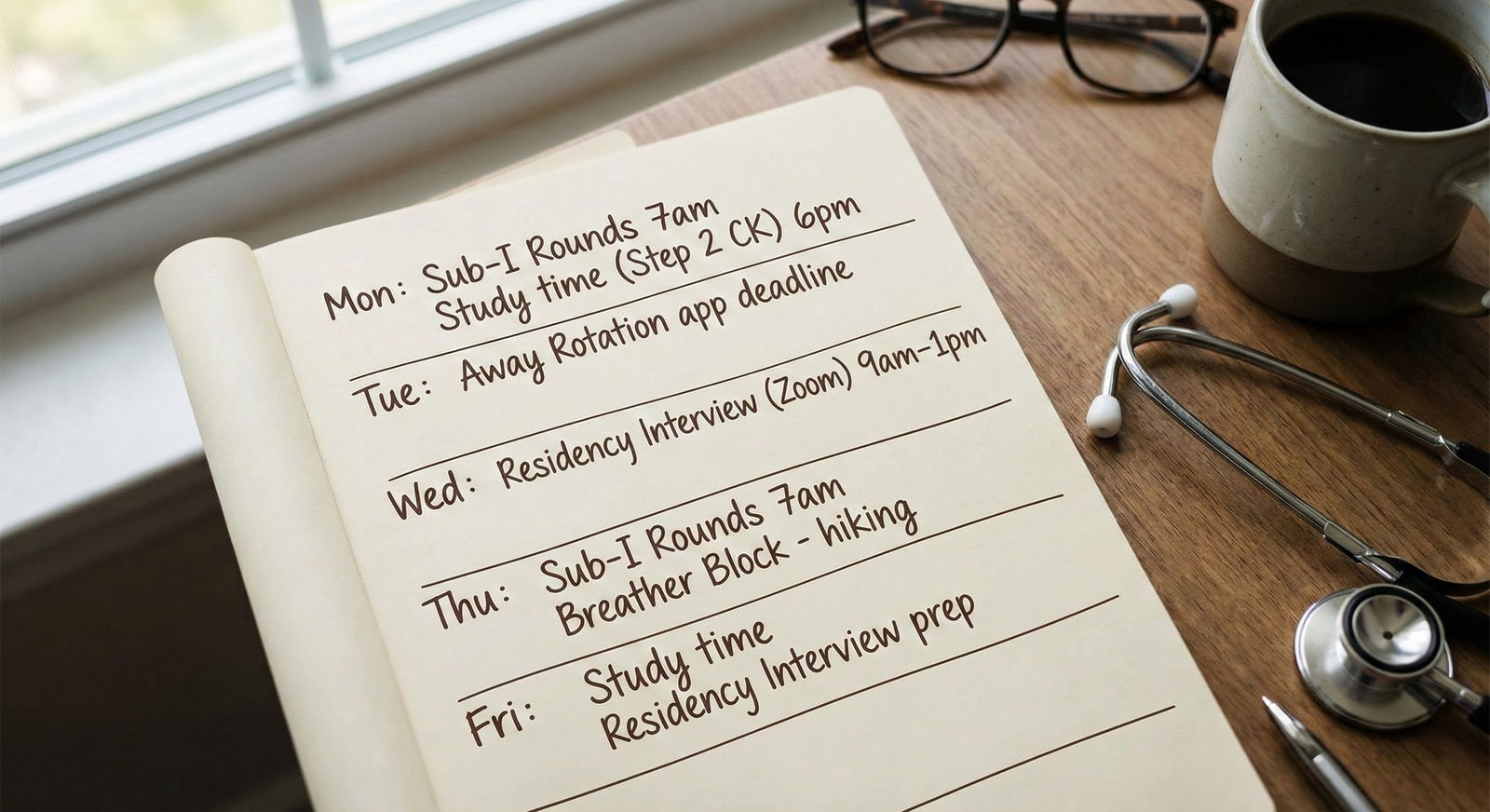
The summary of trade-offs is simple. Applying 'Before' maximizes objective data access for reviewers. It gets you past the automated filters. Applying 'After' maximizes subjective narrative strength. It gives you the best possible clinical letters. Choose based on your individual profile strengths. If your numbers are your best asset, apply early. If your clinical charm and work ethic are your best assets, get the recent letters and apply slightly later.
Key Takeaways
- For highly competitive specialties, securing your Step 2 CK score BEFORE submitting applications provides a significant statistical advantage in initial screening.
- If you must wait for your score or grades, ensure your application is submitted within the first few weeks of ERAS opening to maintain visibility despite missing metrics.
- Align your away rotation timing with your target specialty's historical data preferences, not just your personal convenience.