
What's the single most repeated piece of advice you'll hear about ERAS? Submit the second the system opens. Midnight. 9 a.m. Eastern. Whatever the timestamp, get it in first or you're already behind. I've watched entire class years treat that advice like gospel, and I've watched plenty of them still scramble for interviews while calmer classmates who submitted three days later cleaned up.
Here's the uncomfortable part: the data does not support the panic.
Introduction
The "best time to submit ERAS" question sits at the center of every rising fourth-year's anxiety spiral. It feels high-stakes because residency is high-stakes. One application cycle. One Match. Your entire training trajectory, geographic life, and specialty identity hanging on a PDF packet and a submission timestamp. No wonder students turn the calendar into a countdown clock and treat opening day like a Black Friday doorbuster.
That urgency is understandable. It's also mostly misplaced. Programs do not rank applicants by who clicked submit first. They rank by signal strength: board scores (or the lack of them), letters that actually say something, a personal statement that doesn't read like ChatGPT with a white coat, and clinical grades that prove you can function. Timing matters at the margins. It does not rewrite a weak file, and it rarely sinks a strong one.
I've sat with program directors who openly admit they don't even open the ERAS queue until several days, sometimes a full week, after the floodgates open. I've also seen applicants who hit send at 9:01 a.m. on day one and still got radio silence because their application was incomplete or sloppy. The myth that early equals better has become so sticky that students sacrifice quality for speed. That's the real career risk. Not a 48-hour delay.
This piece cuts through the folklore. We'll look at what actually drives interview offers, where the common pitfalls hide, and a concrete plan that prioritizes readiness over the clock. If you're still planning to camp on the ERAS login page like it's a concert ticket drop, keep reading. You're optimizing the wrong variable.
The Core Challenge
The biggest pitfall is confusing "can submit" with "should submit." ERAS opens for submission in early September. That date is real. What isn't real is the idea that every program immediately dives into a first-come, first-served pile and starts offering interviews before lunch. Most programs batch their review. Many wait until a critical mass of applications arrives so they can compare apples to apples. Some don't assign interview slots until late September or early October. The early-submission advantage exists, but it's thinner than Reddit threads claim.
I've seen this play out repeatedly. Student A submits a polished application on day three. Student B submits a half-baked version at 9:00 a.m. on day one because "programs only look at the first 200." Student A gets more interviews. Why? Completeness and signal quality beat timestamp. Missing LORs, a personal statement still full of track-changes language, or an experiences section that looks like it was written at 2 a.m. will tank you faster than a two-day delay ever will.
Second pitfall: treating every specialty the same. Competitive fields (derm, ortho, plastics, neurosurgery, ENT) do review earlier and more aggressively. They have smaller cohorts and higher application volumes, so some of them start skimming sooner. Less competitive or primary-care-heavy programs often move slower. If you're applying ortho and your app is truly ready, yes, submit early. If you're applying internal medicine or family medicine with a solid but not stellar file, obsessing over the exact hour is wasted energy. The data from NRMP and program director surveys year after year shows that holistics and fit dominate; pure chronological order does not.
Third pitfall: the incomplete-application trap. Students rush to hit submit, then spend the next two weeks chasing letters or fixing typos via the portal. That creates a worse problem. Many PDs filter for "complete" applications first. An early but incomplete file sits in limbo while complete later files get reviewed. I've watched applicants lose interview slots this way and then blame "late submission" when the real issue was self-inflicted incompleteness.
How do you navigate this without losing your mind? Separate readiness from calendar worship. Build a personal go/no-go checklist: all LORs uploaded and assigned, MSPE ready or confirmed on schedule, personal statement finalized and proofed by a human who isn't your mother, experiences section quantified and free of fluff, and photo that doesn't look like a passport disaster. Only when every box is green do you submit. If that lands you on day one, great. If it lands you on day four or five, you are still early in the actual review window for the vast majority of programs.
Look at the pattern that keeps showing up in applicant outcome data:
The drop-off is modest until you push past the first week-plus. The cliff is real after that. But the difference between day one and day four is noise for most applicants. Quality gaps create bigger cliffs than timing gaps.
Another quiet failure mode: geographic and program-list strategy. Students burn energy on the timestamp while applying to 80 programs with zero tiering. High-yield targeting beats early shotgunning every single cycle. Know your competitiveness band, know which programs historically interview your profile, and front-load those. Submitting a scattershot list early just means more rejections arriving sooner.
The contrarian take I keep repeating to students: the system rewards the prepared, not the panicked. Programs want residents who can manage complex timelines without self-sabotage. Showing up with a rushed, error-laced application signals the opposite. I've seen PDs notice sloppy apps and quietly downgrade the candidate before any interview. That's the data talking, not vibes.
Actionable Next Steps
Stop refreshing the ERAS homepage. Start executing a readiness timeline that actually moves the needle.
Four weeks out: lock your personal statement. Not "almost done." Locked. Have two people who understand residency applications tear it apart. Quantify every experience bullet, numbers beat adjectives. Confirm every letter writer has submitted or has a hard deadline you trust. If a letter is shaky, have a backup already in motion. Update your publications and presentations so the ERAS section matches reality.
Two weeks out: run a full mock submission. Export everything, read it cold, and hunt for the dumb stuff, wrong specialty designations, missing geographic preferences, photo resolution issues. Build your program list in tiers: reach, target, safety, and true fits. Assign signals (if your specialty uses them) with intention, not FOMO.
One week out: final completeness audit. Every document assigned. Every section reviewed. Sleep. Seriously. The applicants who submit at 3 a.m. after an all-nighter write like it.
Submission window: if your checklist is green on opening day, submit that morning. If one letter is still outstanding or you spot a real error, fix it and submit within the next 72 hours. Do not wait for "perfect." Perfect is the enemy of complete-and-strong. After you submit, immediately shift energy to interview prep and geographic logistics. Checking the status page every hour is not a strategy.
Resources that actually help: the official AAMC ERAS timelines (read them once, then ignore the panic blogs), your school's student affairs office for MSPE timing, and recent program director survey data from NRMP. Specialty-specific applicant spreadsheets from trusted seniors beat anonymous forum dogma. If your school offers a mock interview or application review service, use it before you submit, not after.
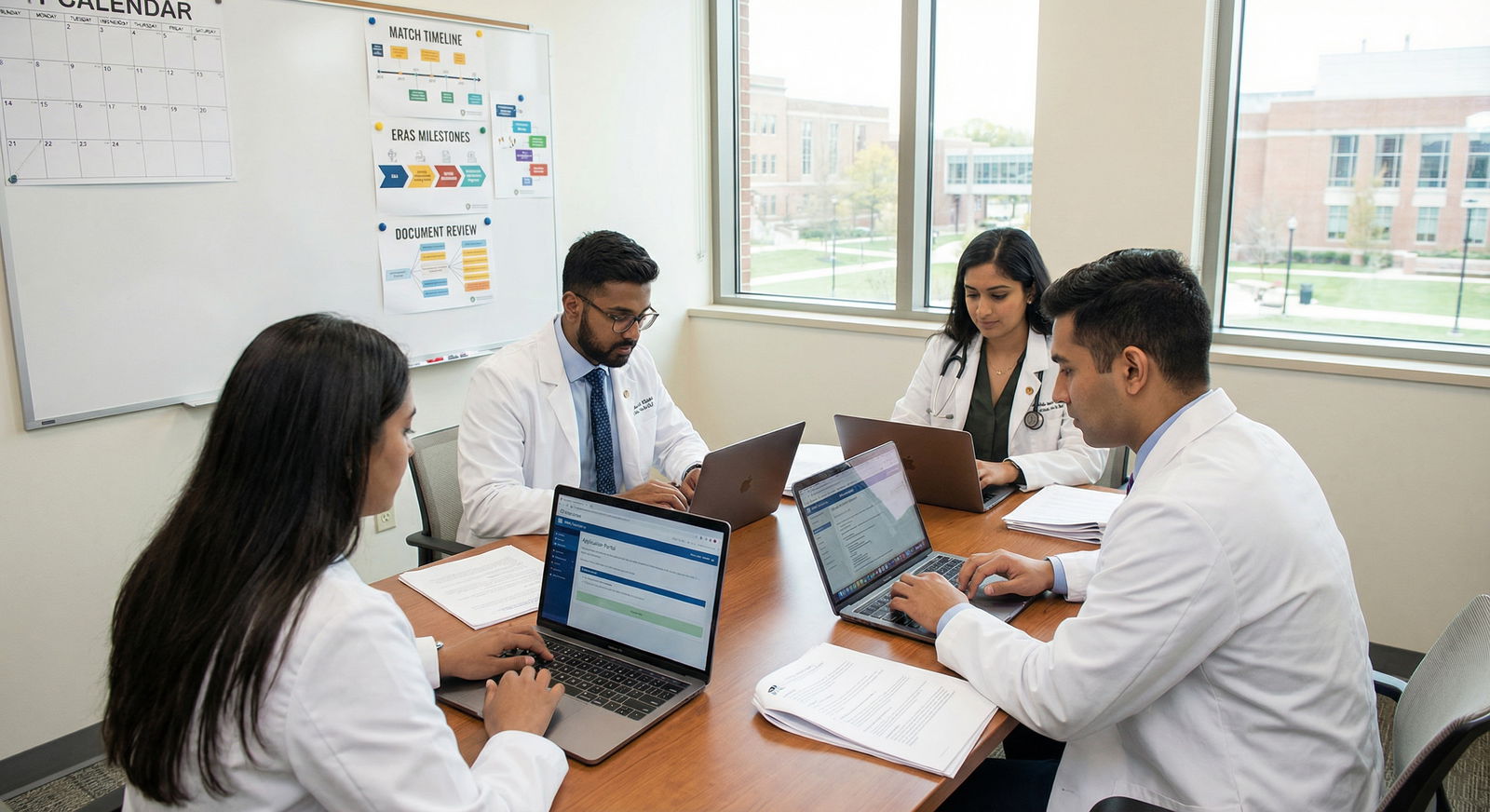
Build a simple decision tree so you stop second-guessing:
Follow the tree. Ignore the noise.
Key takeaways, stripped of fluff: Be prepared. An application that is complete, accurate, and strategically targeted on day four outperforms a frantic day-one special every time. Focus on high-yield areas, letters, experiences with real impact, a coherent story, and smart program selection. Timing is a secondary variable. Treat it that way.
The clock is not your enemy. Unforced errors are. Submit when the work is actually done, then move on to the part that matters more: becoming the kind of applicant people want to train. Reminder, residency programs hire future colleagues, not the fastest clickers.