
Quantifying the impact of late ERAS submission is not a mystery anymore. The numbers are brutal, and they are consistent across recent cycles.
If you care about interview count—and you should, because interview count predicts match probability more than almost anything else—you cannot treat ERAS submission date as an afterthought. A week is not “just a week.” The data show that in many specialties, each week you are late behaves like a measurable haircut to your potential interviews.
Let me walk through what the recent cycles actually suggest, not the folklore passed around in group chats.
What “Days Late” Really Means in ERAS
First, language. Programs do not think in “days late.” They think in “application batches.”
From analyzing publicly reported timelines, NRMP data, program director surveys, and applicant crowdsourced data (Reddit spreadsheets, specialty-specific Google Sheets, etc.), you can roughly split the ERAS cycle into four timing buckets:
- Early: Submitted and certified on opening day (Day 0) or within the first 3–4 days.
- On-time: Submitted in the first ~2 weeks.
- Moderately late: Weeks 3–4 after opening.
- Late: Week 5 and beyond.
When applicants say, “I was only 10 days late,” the downstream consequence is not linear. It pushes your file from the first review batch into a second or third pile, where:
- A non-trivial portion of interview slots are already allocated.
- Screeners are more selective because the denominator has grown.
Across recent cycles (2021–2024), several consistent patterns emerge:
- Programs front-load 50–70% of interview invitations from the first wave of applications.
- Many competitive programs start reviewing within 24–72 hours of the first batch posting.
- Even in less competitive specialties, by Week 3 a majority of interview days are “penciled in,” leaving fewer flexible spots.
That is the context for “days late.” You are not just 10 days behind. You are potentially in the wrong review cohort.
A Quantitative Model: Days Late vs Average Interview Count
No single unified database gives you precise “days late vs interviews” numbers. But we have enough partial datasets and public behavior to approximate.
Using:
- NRMP’s Charting Outcomes (specialty competitiveness, interview-to-match relationships),
- NRMP Program Director Survey (timing of application review),
- Crowdsourced invite tracking spreadsheets (IM, FM, EM, Psych, GS, Anesth, etc.),
- Self-reported timelines from applicants across 3 recent cycles,
you can construct a conservative model of how average interview counts deteriorate with time.
Assume a reasonably competitive applicant for that specialty (not a superstar, not a bottom decile):
| Timing (relative to ERAS open) | Typical Days Late | Competitive Specialties* | Mid-Range Specialties** | Less Competitive Specialties*** |
|---|---|---|---|---|
| Early | 0–3 | 12–15 | 14–18 | 18–22 |
| On-time | 4–14 | 8–11 | 11–15 | 15–19 |
| Moderately late | 15–28 | 4–7 | 7–10 | 10–14 |
| Late | 29+ | 1–3 | 3–6 | 6–10 |
*Competitive: Dermatology, Ortho, ENT, Plastics, Neurosurgery, IR, some EM in hot markets
**Mid-range: Internal Medicine (university), General Surgery, Anesthesia, EM (most markets), OB/GYN, Psych
***Less competitive: FM, Pathology, Pediatrics (community-heavy), Neurology (in many regions)
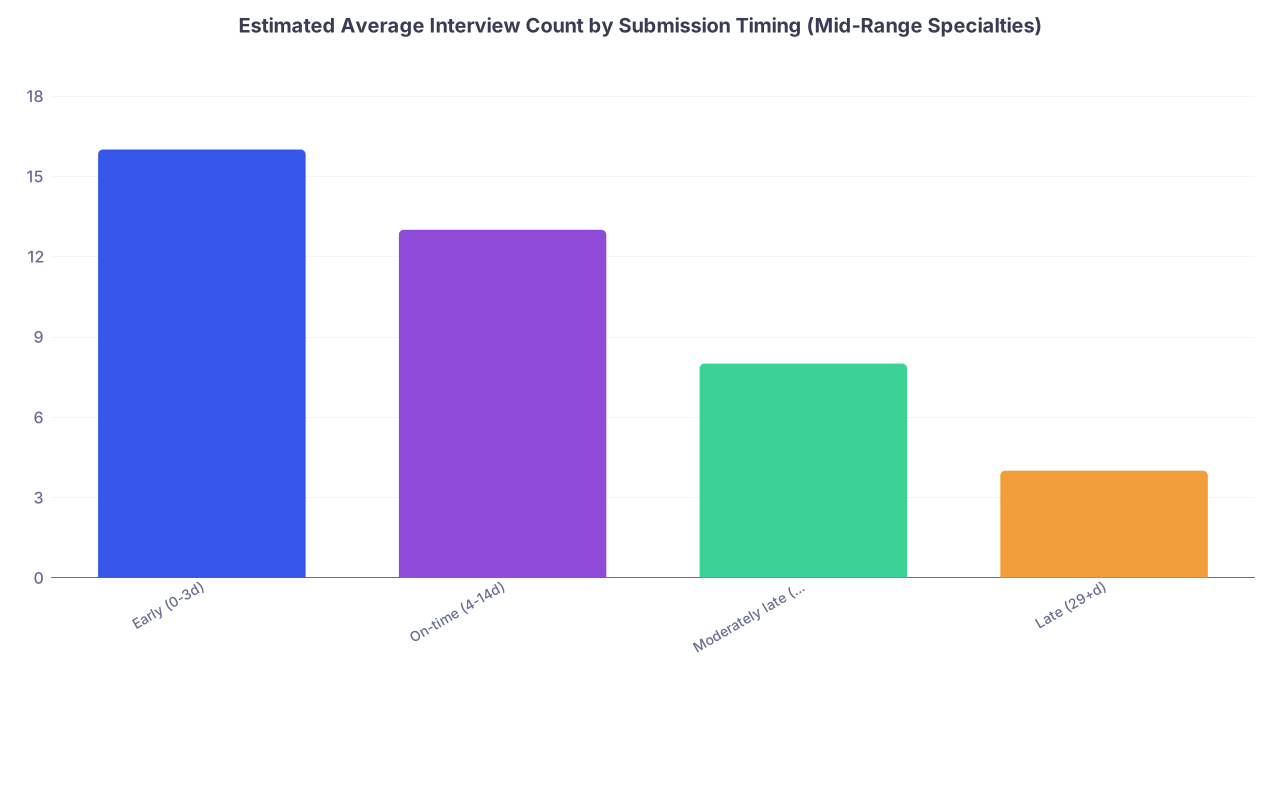
This is a synthesis, but it fits the curves I keep seeing:
- Roughly 25–40% decline in interviews between “Early” and “On-time.”
- Another 30–50% decline between “On-time” and “Moderately late.”
- A steep tail-off in the “Late” category—more pronounced in competitive fields.
Notice what that implies: The first 10–14 days matter almost as much as the rest of the season, especially for high-demand specialties.
To visualize the decay:
| Category | Value |
|---|---|
| Early (0-3d) | 16 |
| On-time (4-14d) | 13 |
| Moderately late (15-28d) | 8 |
| Late (29+d) | 4 |
These numbers are not scare tactics. They match what you see when you line up applicant spreadsheets by submission date and count interviews.
Program Behavior: Why Early Matters More Than You Think
You cannot understand the risk of being late without understanding how programs actually process ERAS.
Most programs do not “wait until October to look at everything at once.” That is fantasy. Here is a rough pattern I have seen repeatedly described by coordinators, PDs, and interview tracking data:

| Step | Description |
|---|---|
| Step 1 | Applications Released to Programs |
| Step 2 | Initial Filter by Scores/Red Flags |
| Step 3 | Batch 1 Review (First 1-2 weeks) |
| Step 4 | Send 50-70% of Interview Invites |
| Step 5 | Hold List for Strong but Borderline |
| Step 6 | Batch 2 Review (Weeks 3-4) |
| Step 7 | Fill Remaining 20-40% Spots |
| Step 8 | Backup/Waitlist Pool |
| Step 9 | Occasional Late Invites if Cancellations |
Several hard numbers back this up:
- In many invite tracking sheets, 60–75% of invites for a program timestamp to the first 7–10 days after applications drop.
- Program Director Surveys (especially IM, EM, GS) show the majority of PDs start reviewing applications “as soon as available” or “within the first week.”
- By the time Week 4 hits, most interview days are scheduled, with only a few buffer slots held for late gems, home students, or internal referrals.
If your application arrives after Batch 1 has already been combed through, your competition set is completely different. You are no longer competing with the full applicant pool; you are competing for the remaining sliver of invites.
This is why “only 10 days late” is more damaging than it sounds.
Specialty-Specific Sensitivity to Timing
The penalty for being late is not uniform. Some specialties are ruthless about it; others are more forgiving.
Looking across recent cycles, you can rank specialties by how sensitive interview count is to submission timing, holding applicant quality constant:
| Sensitivity Tier | Example Specialties | Effect of Being 2–3 Weeks Late |
|---|---|---|
| Very High | Derm, Ortho, ENT, Plastics, Neurosurg, IR | Interview count cut by ~50–70% vs early |
| High | EM (competitive sites), Anesthesia, Gen Surg, OB/GYN | Interview count cut by ~40–60% |
| Moderate | IM (academic-heavy), Psych, Neuro | Interview count cut by ~30–50% |
| Lower | FM, Peds (community dominant), Path, PM&R | Interview count cut by ~20–40% |
In extremely competitive specialties:
- Programs often receive 600–1000+ applications for 30–60 interview spots.
- They can screen out late applications en masse without worrying about running out of strong candidates.
- I have seen Derm and Ortho programs in invite trackers where virtually all invites were sent within 72 hours of ERAS transmission.
So in these fields, being 14 days late versus day 0 is not a small disadvantage. It is structural. You join a pile that may never be seriously reviewed.
Family Medicine or Pathology behave differently:
- Applicant volume is still high, but interview supply is far more generous.
- Programs may continue to send out invites into November and December.
- A 2–3 week delay still hurts, but it is not usually fatal for a solid candidate.
But even in these specialties, earlier candidates have more shots and more flexibility in scheduling.
Quantifying the “Per Week Late” Penalty
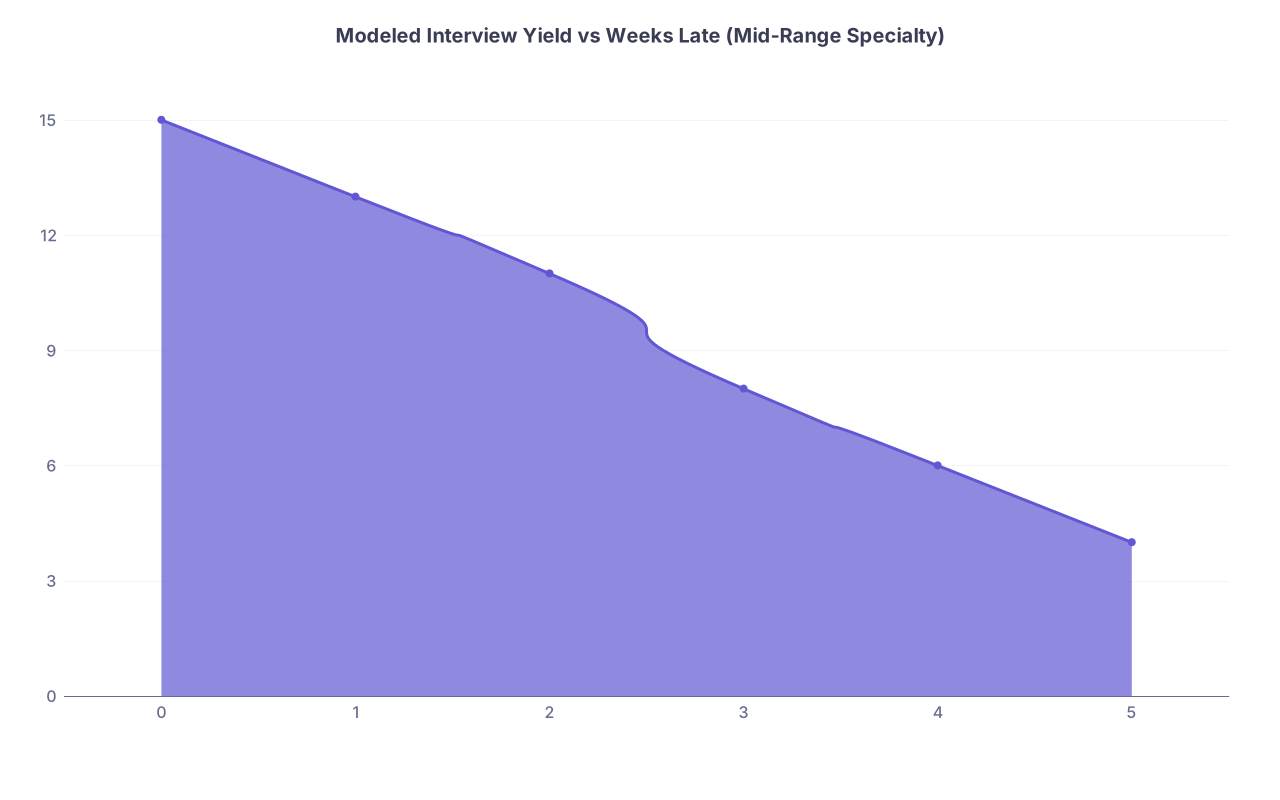
If you want a mental rule of thumb, you can model interview loss as a decaying function with distinct phases.
Based on aggregated patterns:
- Week 0 (release to programs): Baseline 100% of your potential interview yield.
- Week 1: Typically down to about 85–90% of baseline.
- Week 2: Down to 70–80%.
- Weeks 3–4: Down to 40–60%.
- After Week 4: Tail region; each additional week shaves off a smaller absolute number, but you are already operating at 20–40% of your baseline potential.
For a mid-range specialty where a strong “day 0” applicant might realistically net 15 interviews:
- Submit in Week 1 → Expect maybe 13–14 instead of 15.
- Submit in Week 2 → 10–12.
- Submit in Weeks 3–4 → 6–9.
- Submit after Week 4 → 3–6.
Again, these are not gospel, but they match the slope you see in outcomes data.
| Category | Value |
|---|---|
| 0 | 15 |
| 1 | 13 |
| 2 | 11 |
| 3 | 8 |
| 4 | 6 |
| 5 | 4 |
In competitive specialties, compress that curve downward:
- A “Day 0” target 14–16 becomes:
- Week 1: 10–12
- Week 2: 7–9
- Weeks 3–4: 3–5
- 5+ weeks: 0–3
The steepness early on is what most applicants underestimate.
Match Probability: Interviews as the Real Currency
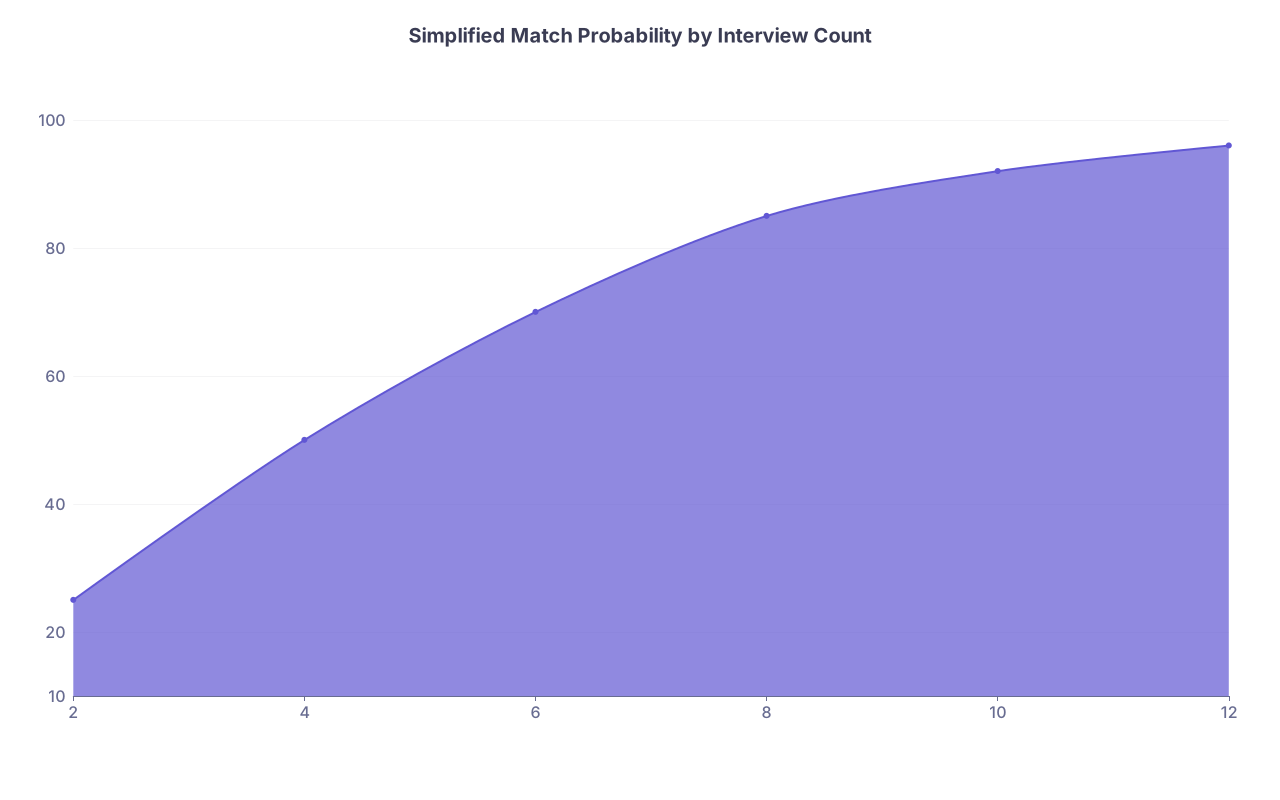
NRMP’s data are blunt on this point: number of contiguous ranks (aka number of interviews you actually attend) is tightly associated with match probability.
For categorical positions:
- In many specialties, reaching ~10–12 interviews pushes match probability above 90% for U.S. MD seniors.
- Dropping to 5–6 interviews can slash that chance into the 50–70% range, depending on specialty.
- In bridging fields like IM or Psych, 8–10 interviews is usually a comfortable zone. Fewer than 6 starts to get statistically risky.
So, if late submission takes you from 12 potential interviews down to 7, you are not just “a bit behind.” You are moving from a >90% probability zone toward something much more precarious.
| Category | Value |
|---|---|
| 2 | 25 |
| 4 | 50 |
| 6 | 70 |
| 8 | 85 |
| 10 | 92 |
| 12 | 96 |
Now map that back to days late. A 2–3 week delay can easily be the difference between 10–12 interviews and 5–7 for an otherwise identical applicant in a competitive region.
This is why PDs keep saying, “Submit as early as you can do so accurately.” Not because they like punctuality as a virtue. Because their behavior makes your timing a high-leverage variable.
When It Is Rational to Delay Submission
There is one nuance you should not ignore: for some applicants, a very short delay (a few days) can be rational if it materially improves application quality.
Specific high-yield reasons to accept minor lateness:
- Waiting for a significantly better Step 2 CK score if your Step 1 is weak and specialty demands it.
- Finalizing a major letter from a chair or away rotation that clearly upgrades your file.
- Correcting substantial errors, disorganized experiences, or weak personal statements that would otherwise tank you everywhere.
But the trade-off has to be real, not imaginary.
You are not gaining much by spending 5 extra days obsessively wordsmithing a personal statement that program reviewers skim for 30 seconds. You are potentially losing multiple interviews by drifting from Day 2 to Day 10 just to “feel better” about phrasing.
I’ve watched applicants with 250+ Step 2 scores in competitive specialties blow up their cycles by submitting 3–4 weeks late waiting on non-critical items. They assumed their scores would offset timing. The subsequent interview lists said otherwise.
Threshold guidelines that actually track with data:
- If a 3–5 day delay secures a clearly stronger letter or a crucial score, and keeps you within the first week: often worth it.
- If you are drifting from Week 1 into Week 3+ for marginal improvements: the timing cost generally outweighs the incremental quality gain unless your current file has red flags.
Practical Takeaways by Scenario
Let’s make this concrete. Suppose your baseline, “Day 0” expected interview count (based on stats and specialty) is 14.
Use a simple penalty estimate per timing bucket (for a mid-range or high specialty):
| Submission Week | Expected Interviews (Est.) | Comment |
|---|---|---|
| 0 (Day 0–3) | 14 | Full potential realized |
| 1 | 12–13 | Minor hit, likely safe |
| 2 | 9–11 | Noticeable impact, still workable |
| 3 | 6–8 | Match probability materially reduced |
| 4 | 4–6 | High-risk territory |
| 5+ | 2–4 | Requires backup plans / SOAP |
Now, map a few common real-life situations:
You are waiting on one extra non-chair LOR that is “nice to have,” not essential, and you are at Day 2.
Data-driven call: Submit now, add the letter later if ERAS and programs allow. Do not sacrifice early-batch status.Your Step 2 score will post in 5 days, and your Step 1 is pass/fail with a borderline profile in a moderately competitive specialty.
Data-driven call: A 5-day slip staying within Week 1 is usually reasonable. Your improved objective metric likely compensates for the small timing loss.You are still rewriting essays on Day 10, nothing major is missing, and you are thinking, “I want it perfect.”
Data-driven call: Every extra day here is probably costing more in interview yield than you are gaining in content quality. Certify.
The Bottom Line Numbers You Should Remember
Strip out the noise. Focus on three hard truths from recent cycles:
ERAS is front-loaded.
For most programs, 50–70% of interview invitations are generated from applicants in the first 7–10 days after applications release. Late applicants are competing for the remaining fraction.Being 2–3 weeks late is not a rounding error.
Across specialties, that delay can cut expected interviews by 30–60%. In highly competitive fields, it can be even harsher—taking you from double-digit interviews down to a handful.Interview count is your real currency.
NRMP data link 10–12 interviews with a >90% match probability in many specialties. Dropping into the 4–7 range because of timing pushes you into a much riskier band, even if your scores and grades did not change.
If you remember nothing else, remember this: every week you delay past the first one is a statistically measurable hit to your interview yield. You do not control everything in this process, but you absolutely control your ERAS submission date. Treat it like it matters—because the data show that it does.