
What actually happens if you submit ERAS on the first day vs two or three weeks later—do programs really care, or is this just applicant panic dressed up as strategy?
Let me be blunt: “Submit ERAS the first second it opens or you’re screwed” is one of the most overhyped myths in the Match world. It’s not completely wrong. But it’s nowhere near as absolute as Reddit and group chats make it sound.
You are not competing to click “submit” the fastest. You are competing to look like someone worth interviewing when your application is actually reviewed.
Let’s separate the superstition from the parts that actually matter.
What Programs Actually See And When
First, mechanics. Because a lot of the anxiety comes from not understanding the basic pipeline.
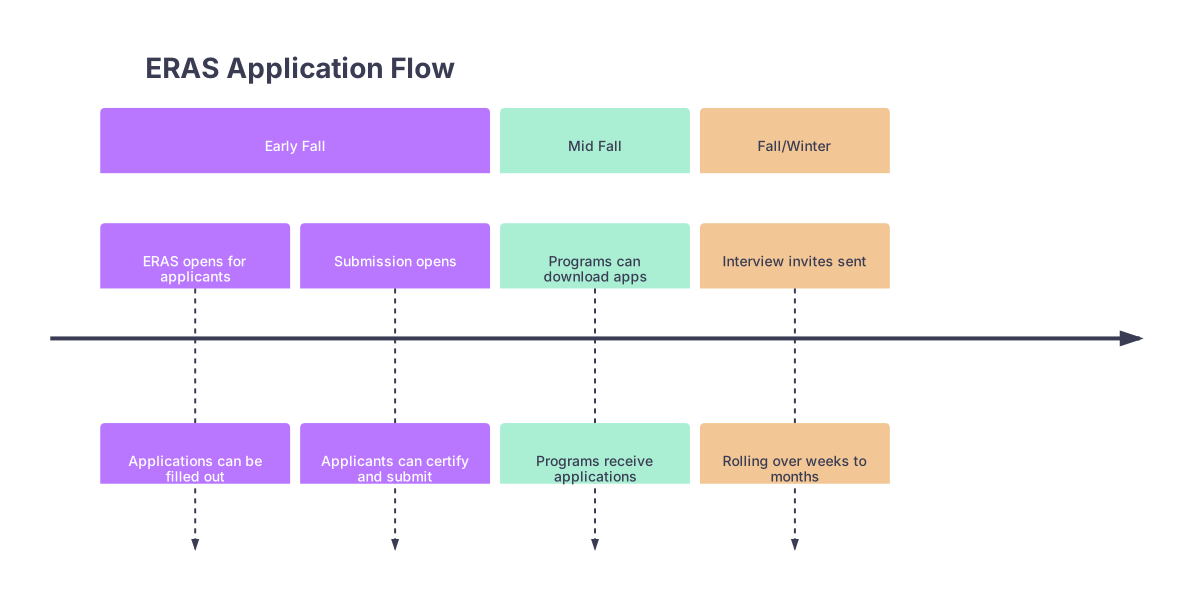
In a typical ERAS cycle (dates shift slightly each year):
| Period | Event |
|---|---|
| Early Fall - ERAS opens for applicants | Applications can be filled out |
| Early Fall - Submission opens | Applicants can certify and submit |
| Mid Fall - Programs can download apps | Programs receive applications |
| Fall/Winter - Interview invites sent | Rolling over weeks to months |
The important part: there’s a gap between when you can submit and when programs can first see your application. If you submit during that initial window (say, in the first week or two), your application is just sitting in the queue until programs download. You’re not getting “extra early” ahead of other people also in that window.
This is why that “I submitted at 9:01 AM on opening day” flex is mostly theater.
Where the timing starts to matter is once programs begin downloading and screening.
Where “Earlier” Actually Helps (And By How Much)
There are real advantages to being early. They’re just not as magical as people think.
1. You Avoid the “Already Have Enough Applicants” Problem
Programs don’t wait until every application is in and then calmly review them all. They review in waves. Different places do it differently, but the pattern I’ve seen over and over is something like:
- Download initial batch when ERAS opens to programs
- Start screening quickly for obvious interviews
- As more apps roll in, screen a smaller fraction more aggressively
- Once they’ve filled most interview slots, they stop looking very hard
If your application arrives after they’ve already flagged a large pool of solid candidates, you’re now fighting against their fatigue and their limited remaining spots. Not ideal.
Submitting in the first 24–72 hours after programs can download is generally “early enough” to be in that initial serious review wave.
Does submitting 2 weeks later destroy your chances? Not automatically. But the later you go, the more you’re relying on:
- Programs that review continuously and thoroughly (many academic IM programs do this; some surgical and competitive specialties don’t)
- Your application being strong enough to force a second look
- Sheer luck of timing with their review meetings
2. Certain Specialties Really Do Penalize Late Apps
Let’s talk competitiveness. In fields like dermatology, plastic surgery, ENT, ortho, urology (SF but same principle), late applications can absolutely hurt you.
Programs in these specialties are drowning in high-stat applicants. They do not need to dig late in the pile for more. They can easily fill their interview docket from the first big wave.
In those fields, “early” actually means: in the first batch when programs download, not three weeks later. If you’re applying there, timing is not a myth. It’s leverage.

3. Earlier Gives You More Time for Interview Logistics
This isn’t about getting more invites—it’s about having more control.
Earlier invites → more calendar flexibility → less double-booking, fewer forced declines. If you’re applying broadly, this matters. I’ve seen people submit late, get invites compressed into a shorter time window, and have to decline perfectly good interviews because everything stacked into the same two weeks.
So yes, earlier can indirectly improve your interview yield, even if the number of invites would have been similar.
Where “Earlier Is Always Better” Is Flat-Out Wrong
Now let’s flip it. There are several situations where “submit as soon as possible” turns from smart to stupid.
1. Rushing Out a Mediocre or Incomplete Application
This is the classic self-sabotage move: “I know my personal statement is iffy and one of my letters isn’t in, but I HAVE to submit on day one.”
No. You don’t.
Programs would rather see:
- A polished, coherent personal statement 10 days later
- A complete set of strong LORs a week later
- An updated CV with a new poster or recent leadership role
…than a sloppy early submission missing half your story.
Here’s the part people don’t want to hear: being “on time and forgettable” is worse than being “a bit later and clearly strong.” Reviewers rarely say, “We should interview this person; they submitted early.” They say, “We should interview this person; they look good.”
If waiting 7–14 days lets you:
- Fix a clumsy personal statement
- Get that key letter from the PD or chair
- Update a major accomplishment
- Clean up red-flag grammar/errors
Then waiting is the correct choice.
2. Applying Early with a Weak Step 2 or No Step 2 When It Matters
In some specialties and for some applicants, Step 2 timing matters more than application timing.
If you had a weak Step 1 (or it’s pass/fail and you’re unproven statistically), your Step 2 CK is your chance to show you’re not a liability. Submitting early without that data just means more auto-filters and quiet rejections.
For borderline or non-traditional applicants, I’d rather see:
- ERAS submitted a week or two after the opening
- Step 2 score that actually changes how you’re perceived
…instead of an on-time app that gets silently triaged because your board profile looks risky.
3. Believing That “First Day vs First Month” Is the Deciding Factor
This is the big myth: that there’s a sharp cliff after which programs basically ignore you. That might happen in some hyper-competitive fields after weeks go by. It does not happen universally at day 2.
Look at this simplified reality:
| Submission Timing (vs programs' download date) | Practical Impact for Most Applicants |
|---|---|
| Before programs can download | No advantage vs other “on-time” apps |
| First 3 days | Ideal; in initial review wave |
| Days 4–14 | Still reviewed seriously at most places |
| Weeks 3–4 | Some loss of visibility at selective/overwhelmed programs |
| After 4+ weeks | Increasingly harmful, especially in competitive fields |
The difference between submitting on the exact minute vs that evening vs two days later? Statistically meaningless.
The difference between submitting in the first 1–2 weeks vs a month late? Now we’re talking.
How Programs Actually Screen: Why Perfect Earliness Is Overrated
Most applicants imagine a neat, FIFO process. “They’ll see apps in the order submitted.” That’s not what happens.
Real screening looks more like this:

| Step | Description |
|---|---|
| Step 1 | Applications downloaded |
| Step 2 | Filter by cutoff criteria |
| Step 3 | Automatic rejects or low priority |
| Step 4 | Faculty/PD review short list |
| Step 5 | Rank for interview invitations |
| Step 6 | Send invites in waves |
Programs often:
- Filter by Step 2, Step 1, or COMLEX cutoffs
- Prioritize home students, rotators, specific schools, or signalers
- Use residents or faculty to pre-screen a subset of applications
- Review categories in blocks (e.g., all rotators, all high-board applicants, all “maybe” pile)
None of that cares whether you clicked submit at 9:01 or 9:37 on opening day. What matters much more:
| Factor | Relative Importance vs Exact Submission Time |
|---|---|
| Board scores | Far higher |
| Clerkship grades | Far higher |
| Strength of letters | Far higher |
| Home/away rotations | Far higher |
| Personal statement quality | Higher |
So yes, be early. But stop obsessing about “first minute” and start obsessing about “first impression.”
When You Should Delay (On Purpose) — And When You Should Not
There are scenarios where I’d tell you to delay, and others where I’d tell you to hit submit even if it’s not perfect.
Reasonable reasons to delay submission a bit
You’re not being flaky. You’re being strategic if you wait a short time for:
- A clearly stronger Step 2 CK score that will materially change your competitiveness
- A critical letter (PD, chair, big-name mentor) that’s promised within days
- Fixing a clearly weak personal statement that multiple people flagged
- Correcting factual errors or inconsistencies that could look dishonest or sloppy
We’re talking days to a couple of weeks. Not months.
Bad reasons to keep delaying
On the flip side, people over-correct and start “perfecting” forever. Bad reasons to push submission back:
- Tweaking commas in your personal statement for the 9th time
- Waiting for a minor case report that won’t even be PubMed indexed this cycle
- Hoping a shaky attending will maybe write a letter that might be slightly better than your solid existing ones
- Generalized anxiety and “I just don’t feel ready”
At some point, good-enough and early-ish beats imaginary perfect and late.
The One Group That Really Cannot Be Late
If you’re in any of these categories, timing matters more for you than the average applicant:
- Applying to very competitive specialties (derm, ortho, ENT, plastics, neurosurgery, IR, etc.)
- Applying with a weaker academic profile and hoping for the maximal number of looks
- Applying as an IMG or DO to programs historically biased toward MD grads
- Applying without a strong home program in that specialty
You are more vulnerable to being cut early by crude filters. That means you want:
- Your strongest possible application
- In the earliest reasonable wave
- Without self-inflicted weaknesses like missing letters or unreported Step 2
For these groups, “early enough and strong” is not optional. It’s survival.
| Category | Value |
|---|---|
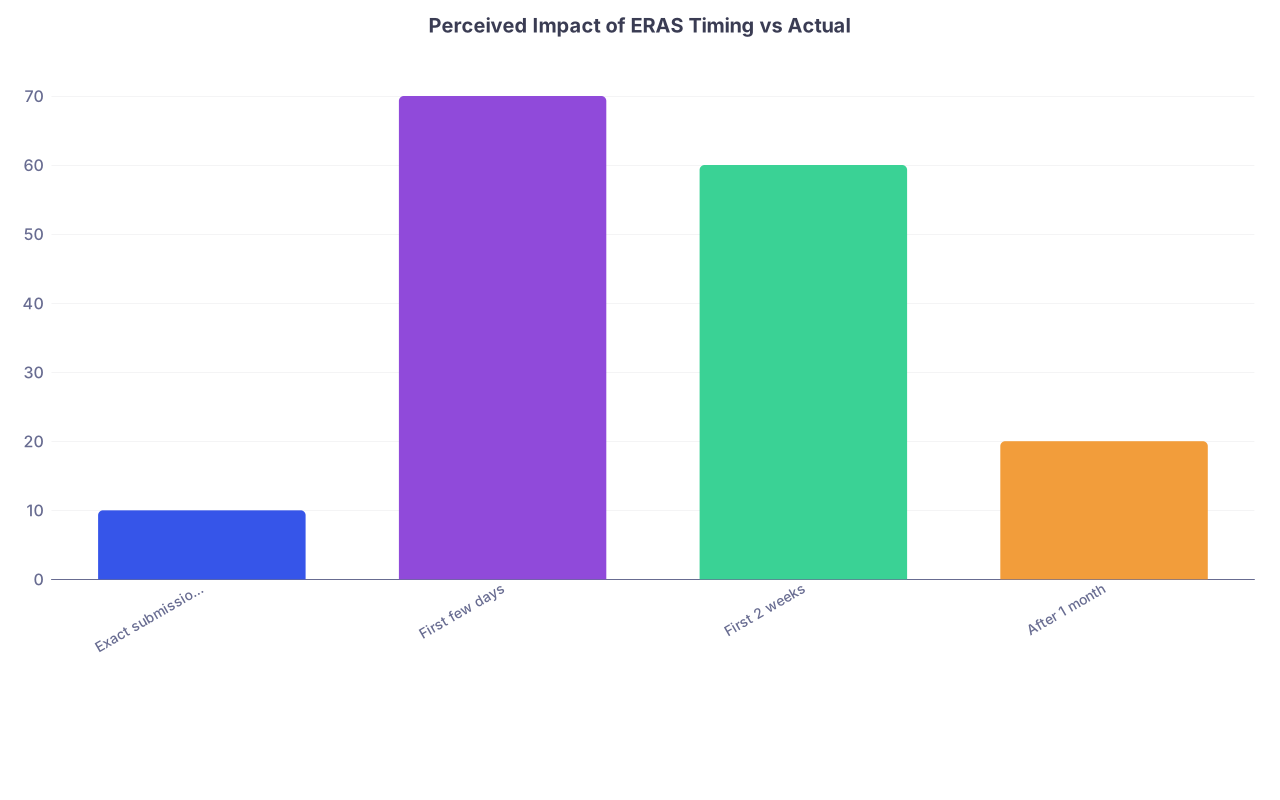
| Exact submission minute | 10 |
| First few days | 70 |
| First 2 weeks | 60 |
| After 1 month | 20 |
(Think of those numbers as rough “importance” scores out of 100 based on how programs behave, not literal percentages. The myth is that the first bar is 100. It’s not.)
Concrete Takeaways: How To Actually Time ERAS
Let’s turn all this into something practical.
If you’re a typical applicant to a non-ultra-competitive specialty:
- Aim to submit in the first 3–10 days after ERAS opens for submission
- Do not sacrifice a major improvement (better PS, critical LOR, big red-flag fix) just to shave 3 days
- Do not drift so far that you’re weeks behind when programs download apps
If you’re applying to highly competitive specialties or you’re an at-risk applicant:
- Plan your Step 2 and letters backward from ERAS submission so you can be ready very early
- Target being fully ready to submit on or near day 1 of submission
- Only delay if the thing you’re waiting for genuinely moves your competitiveness tier
If you’re already “late” as you’re reading this:
- Submitting now is almost always better than agonizing for another 2 weeks
- Focus on clarity, coherence, and completeness; you can’t control the calendar anymore
- Some programs will still review you; others won’t—worry about what you can still influence
FAQ (Exactly 5 Questions)
1. Is submitting on the first day always better than submitting one week later?
Not “always.” If your app is fully polished, yes, submit on day one. But if waiting a week gets you a stronger letter, a cleaner personal statement, or a Step 2 score that actually changes how programs see you, that one-week delay is worth more than the micro-advantage of being in the absolute first batch.
2. Do programs review applications strictly in the order they’re received?
No. They batch download, filter by criteria (scores, school, home/away status, signals), and then reviewers go through subsets in whatever order they choose. Your relative strength and category matter far more than your timestamp, as long as you’re within the early review window.
3. If my Step 2 score won’t be ready by submission, should I still submit early?
If your Step 1 is strong and your record is solid, yes, you can submit without Step 2 and update later. If your Step 1 is weak or pass/fail and Step 2 is your only shot at proving yourself statistically, waiting for Step 2—within reason—is usually smarter than blasting out a weak-looking file early.
4. How late is “too late” to submit ERAS?
Once you’re several weeks past when programs can first download applications, you start to see real damage, especially in competitive specialties. After a month, many places have already identified most of their interview pool. Late submissions can still match, but your odds drop. Submitting months late is usually a self-inflicted handicap.
5. Does being early help if my application is below average for my specialty?
It helps a bit but doesn’t magically rescue you. Early weak apps get filtered out just as easily as late weak apps. Being early mainly helps strong or borderline applicants get seen sooner and more often. If your stats are significantly below your specialty’s norms, you need realistic expectations and a smart list more than you need a perfect submission timestamp.
Key points: “Earlier” helps, but only up to the point where your application is actually strong. Submitting in the first review wave matters; obsessing over the first minute does not. If a short, strategic delay meaningfully improves your file, take it—then hit submit and stop rewriting the same sentence for the 11th time.