
No, You Don’t Need to Submit ERAS at 9:00:00 AM on Opening Day
What exactly do you think happens at 9:00:01 AM on ERAS opening day? That some invisible gate slams shut and every program fills with whoever mashed “Submit” the fastest?
Let me be blunt: the “submit ERAS at 9:00:00 AM or you’re screwed” myth is one of the more persistent, anxiety-fueling pieces of nonsense in residency application culture.
You do not need to be first. You need to be ready.
Let’s walk through what actually happens behind the curtain, what the data and program behavior really show, and when submitting early does matter versus when you’re just sacrificing quality for superstition.
How ERAS Actually Works (Not the Urban Legend Version)
Here’s the core misunderstanding: people imagine ERAS as a first-come, first-served queue, like Taylor Swift tickets.
That’s not how it works.
ERAS has two distinct phases:
- Application opens to applicants – You can start and eventually submit your application.
- Programs gain access to applications – There’s a program download date when programs can first see applications.
Between those, there’s a gap.
Historically:
- ERAS opens for applicants in early June/July (depends on cycle).
- Programs cannot start downloading apps until a specific later date (often mid-late September).
What matters is:
- If you submit before programs can download:
You are in the first download batch. Whether you hit submit at 9:00:00 AM or 4:48 PM on that same day does not change your position. - If you submit after they can download:
Then you’re late to their review process, and yeah, that can start to matter.
So the critical line isn’t 9:00:00 AM vs 9:05 AM.
It’s: “Was this complete and submitted before programs started pulling files?”
The “9 AM” obsession is like arguing over which seat you take in a bus that hasn’t left yet. You’re all going to the same place at the same time.
What Programs Actually Do With Early Applications
I’ve watched PDs and coordinators on opening week. Nobody is sitting there at 8:59:59 AM with a trigger finger ready to accept or reject you by 9:03.
Reality looks more like this:
- Programs often batch-download applications once systems open.
- They do a first pass over days to weeks, not minutes.
- Many have filters (Step scores, school, visa status, etc.) that run on all received applications, not “the first 200”.
- Committee review, spreadsheet sorting, and faculty assignments all take time.
And remember: most programs receive hundreds to thousands of applications.
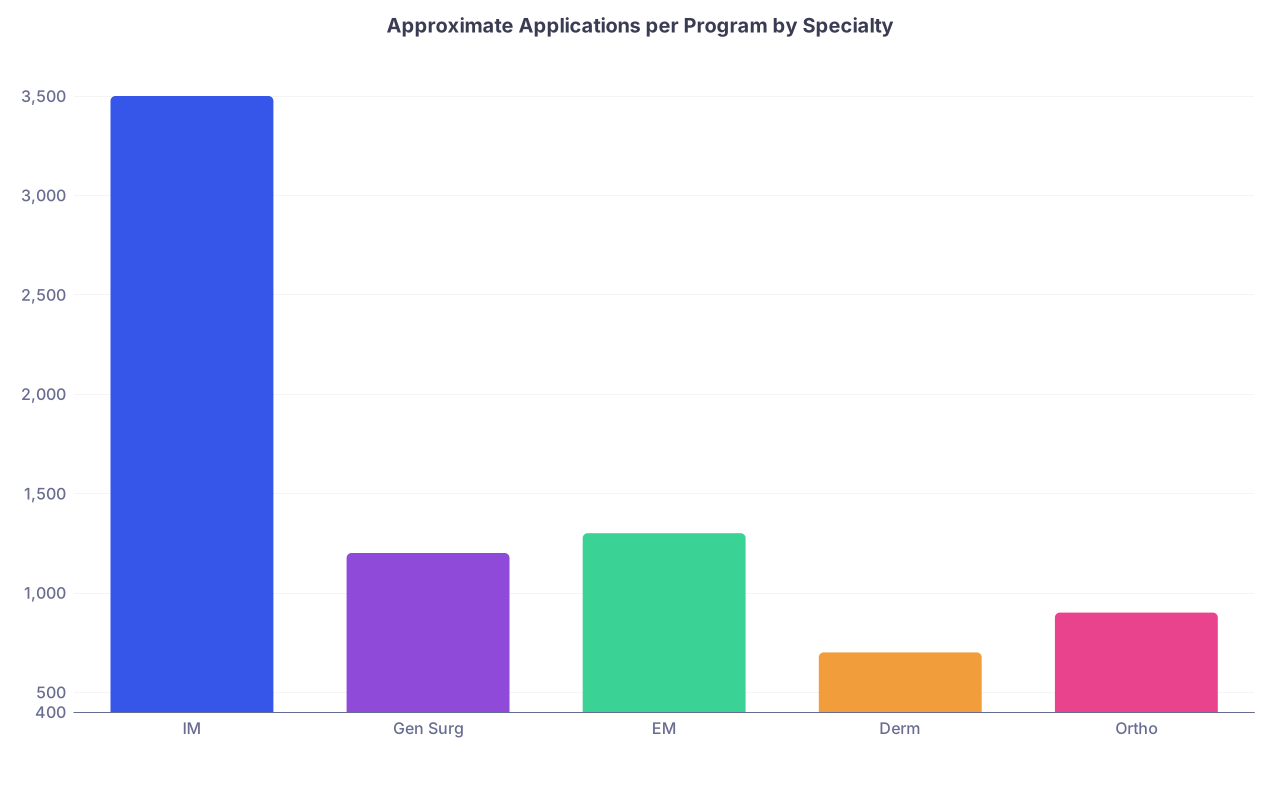
| Category | Value |
|---|---|
| IM | 3500 |
| Gen Surg | 1200 |
| EM | 1300 |
| Derm | 700 |
| Ortho | 900 |
Does a PD care which person clicked submit at 9:00:00 vs 3:15 PM on the same day?
They don’t even see that.
What they do see:
- Whether your application is complete
- Whether you met any stated deadlines
- Whether you look like a reasonable fit compared to thousands of peers
Nowhere in that list: “microsecond submission timing.”
Where Timing Does Matter (And Where It Absolutely Doesn’t)
Let me be precise. Timing is not irrelevant. It’s just wildly misunderstood.
Timing That Actually Matters
Being in the first wave programs see
You want your application fully submitted and complete before programs start downloading. That usually means:- Application submitted
- Letters assigned
- USMLE/COMLEX scores in
- Personal statement(s) attached
- Photo uploaded (yes, they look)
Not trailing weeks behind
Submitting one or two days after programs can download? Usually fine.
Submitting two weeks after? Now you’re late to the party. Some interview slots will already be provisionally earmarked.Specialties that front-load invites
Hyper-competitive fields (Derm, Ortho, ENT, Plastics, IR, etc.) often:- Download early
- Set up quick filters
- Start sending interview invites relatively fast
For those, being in the first few days of available applications is strategically important. But again: days, not seconds.
Timing That Does Not Matter
- 9:00:00 AM vs 9:11 AM on opening day
- Submitting 3 days before the program download date vs 10 days before, as long as it’s done and complete
- Being “Application #37” vs “Application #683” in the first download batch
Programs are not handing out interviews chronologically as apps trickle in over a single day. They’re working through piles with filters, score ranges, and institutional priorities.
The Real Risk: Rushing a Sloppy Application to Hit 9:00:00
Here’s the part people conveniently ignore when they’re bragging about their 9:01 AM submission in group chats:
Rushing to submit earlier that same morning does not meaningfully improve your chances. But it can absolutely tank your quality.
I’ve seen:
- Personal statements with the wrong program name: “I am excited to apply to the Emergency Medicine program at [Different Institution].”
- Experiences with obvious typos: “Researched the epidiomlogy of…” in the top entry.
- Misassigned letters: pediatric letter accidentally sent to neurosurgery.
- Wrong personal statement version uploaded (the one where you trashed community programs then applied only to community programs).
All in the name of being “right on time.”
Most admissions people don’t know exactly when you submitted. But they instantly notice:
- Disorganized experiences
- Half-baked descriptions
- Clumsy PS that reads like a last-minute edit
- Missing letter from your supposed “strongest mentor” because they needed “one more day”
Given a choice between:
- Submitting at 9:00 AM with those problems
vs. - Submitting at 4:00 PM the same day with everything clean and polished
The second one wins. Every time.
What Data and Patterns Actually Suggest About Early Submission
There’s no giant multi-center randomized trial of “9:00 AM vs 4:00 PM ERAS submission.” But we do have:
- NRMP data on application volumes and interview offers
- Program director surveys
- Observed behavior across cycles
Two key realities:
Programs are overwhelmed, not timestamp-obsessed
Most are trying not to drown in the sheer volume. They’re not splitting hairs on same-day timing.Early vs Late in the Season Clearly Matters
Not same-day early. Season early.
| Submission Timing | Relative Impact on Chances* |
|---|---|
| Before program download date (complete) | Baseline / Ideal |
| 1–3 days after download opens | Slightly less ideal, still fine |
| 1–2 weeks after download opens | Noticeable disadvantage |
| >3 weeks after download opens | Significant disadvantage |
*Not numerical risk ratios, but real-world trend: season timing matters a lot; same-morning timing does not.
If you want something more concrete: when PDs are surveyed, they consistently emphasize:
- Passing scores
- LOR strength
- Clerkship and sub-I performance
- Fit for the specialty
- Red flags (failures, professionalism concerns)
Nobody lists: “Whether the applicant submitted at 9:00:00 AM sharp.”
Letters, Scores, and the Myth of the “Incomplete but Submitted” Application
Another dumb move people make under the 9 AM pressure: submitting an application that’s technically “in” ERAS but obviously incomplete.
For example:
- Only 1–2 letters uploaded when your target programs want 3–4
- Step 2 pending when your Step 1 was shaky and you need that score
- No sub-I or away rotation letter for competitive fields
Submitting early with glaring holes doesn’t impress anyone. It just places your file in the “meh” pile sooner.
Programs don’t sit there thinking: “Ah yes, brave applicant, they applied 90 minutes earlier but with half the required materials. We should reward that.”
No. They see an incomplete or weak-looking app and move on.
Often, your best move is:
- Wait a few extra days (or even a week) for a key letter to arrive.
- Make sure Step 2 is at least pending with a reasonable test date if Step 1 is marginal.
- Confirm your most important experiences are correctly entered and described.
Being complete and strong within the first week of program access beats being weak and incomplete at 9:00:00 AM.
The One Scenario Where Same-Day Timing Starts to Matter
Let’s be fair. There is one edge case where earlier in the day might matter a bit:
Some extremely competitive programs, in ultra-competitive fields, with tiny class sizes, may:
- Download applications very early
- Use aggressive filters
- Start sending out some interview invites quickly
Even here, the key variable is “Did your stuff show up in that first serious pass?”, not “Were you first in line that morning?”
If your:
- Application,
- Letters,
- Scores,
are all present in the system by the time that program runs its first major review, you’re in the same bucket as everyone else.
That first review is typically:
- Later that day,
- Over the next few days,
- Or packed into a scheduled meeting, not a real-time feed refresh at 9:01.
The risk of missing the first wave has more to do with days than the first minute.
How to Actually Think About “When” to Submit ERAS
Here’s the practical, non-myth version of timing strategy.
Forget the second-by-second obsession. Focus on three thresholds:
Internal deadline: 7–10 days before programs download This is when you aim to be basically done:
- Personal statement(s) final
- Experience descriptions proofread
- Program list structured (reach/target/safety)
- Letters requested with clear expectations
Hard goal: Complete before program access date That means:
- Application submitted
- Most, ideally all, letters uploaded
- Scores reported
- Photo attached
If you’re complete by then, you are in that first massive chunk of files everyone reviews.
Acceptable leeway: 1–3 days after program access Still fine for most specialties, especially less competitive ones. Just don’t drift 2–3 weeks behind.
For many of you, the correct attitude on the morning ERAS opens is:
“I’ll submit today or tomorrow once I’ve triple-checked everything, not the second the clock hits 9:00.”
A Saner Submission Checklist (Instead of “Be the First!”)
Before you hit submit, ask:
- Did at least one trusted person (advisor, mentor, resident) read my personal statement?
- Did I carefully check every program name in my PS if I customized them?
- Are my most important experiences clearly written and free of obvious typos?
- Are my letters either all uploaded or realistically coming in within days?
- Have I confirmed my exam score reporting is correct?
- Does my application tell a coherent story for this specialty?
If the answer is “yes” to those, submitting at:
- 9:00 AM,
- 1:32 PM,
- or even the next day
is functionally the same in the eyes of almost all programs.
If the answer is “no,” and you’re about to hit submit just to brag you did it “right at opening” — you’re not being strategic. You’re being superstitious.

| Step | Description |
|---|---|
| Step 1 | Start ERAS Application |
| Step 2 | Focus on quality & completeness |
| Step 3 | Submit anytime before download date |
| Step 4 | Revise, wait up to a few days |
| Step 5 | Submit ASAP with quality check |
| Step 6 | Submit but expect some disadvantage |
| Step 7 | High disadvantage, still submit |
| Step 8 | Programs can download yet? |
| Step 9 | App polished and complete? |
| Step 10 | How late are you? |
The Bottom Line
Three key truths, without the anxiety fluff:
You do not get bonus points for a 9:00:00 AM timestamp. Programs care about completeness, fit, and strength, not your ability to spam the submit button at the exact opening second.
Being ready before programs start reviewing is what matters. Early in the season, not early in the minute. Days and weeks, not seconds.
A polished application submitted later that day beats a sloppy one submitted at 9:00:00. Every. Single. Time.
So stop worshiping the clock. Fix your PS, clean your experiences, confirm your letters, and then submit when your application is actually ready — not when the group chat tells you the magic moment has arrived.