
Programs do not sit there refreshing ERAS and reading every application the second it comes in. They batch you. They queue you. And depending on which batch you fall into, your chances change more than anyone wants to admit.
Let me tell you what really happens on the other side of that “Submit” button.
1. The Myth vs. The Reality of “Submission Date”
Students think in three buckets:
“Early,” “on time,” and “late.”
Program directors and coordinators do not think that way. They think in batches:
- Pre-load batch
- First-pass batch
- Second-pass batch
- Panic batch
- Leftovers
You’re not “an applicant who submitted September 25.” You’re “in the first-pass batch” or “stuck in the second-wave scrub.” And that’s what actually matters.
How the calendar really looks behind the scenes
This is the pattern I’ve seen at multiple places: mid-tier IM, competitive EM, cush prelim, you name it.
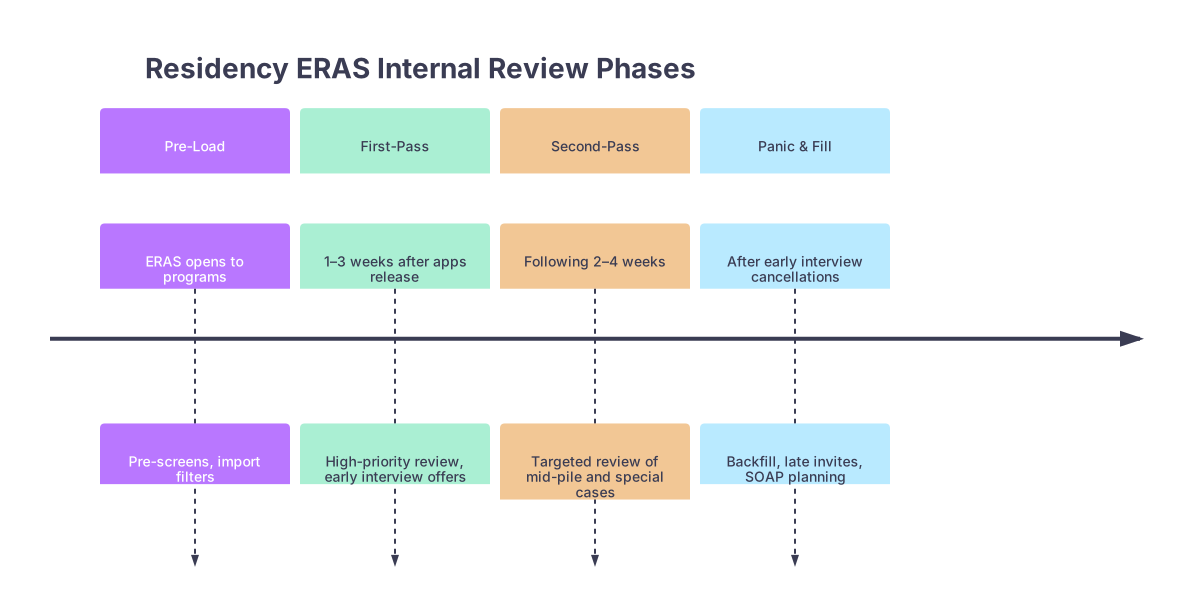
| Period | Event |
|---|---|
| Pre-Load - ERAS opens to programs | Pre-screens, import filters |
| First-Pass - 1–3 weeks after apps release | High-priority review, early interview offers |
| Second-Pass - Following 2–4 weeks | Targeted review of mid-pile and special cases |
| Panic & Fill - After early interview cancellations | Backfill, late invites, SOAP planning |
There are 3 practical truths:
Once ERAS transmits to programs, “same-day early” isn’t that different from “within the first week.” You’re in the same first-pass universe, unless a program is insanely front-loaded.
Being in the second-pass batch absolutely hurts you at many programs. Not a death sentence, but you’re fighting inertia. Interview spots are already mentally half-filled.
Truly late submissions (weeks after programs start reviewing) drop you into the panic/leftover zone. You might still get love from weaker or underfilled programs, but for competitive places you’re functionally done unless you have a big hook.
You’re not just racing the deadline; you’re racing the formation of the review batches.
2. How Programs Actually Set Up Their ERAS Review System
Let’s walk through what really happens from the program side, from the coordinator’s first login to the first interview invite.
Step 1: Filters and auto-screens
Coordinators are brutal about this, because they have to be.
They’ll set filters on:
- Step 2 CK minimum (or “USMLE passed” if they’re checkbox types)
- IMG vs US grad
- Visa status
- YOG (year of graduation)
- Maybe med school region or DO/MD depending on their culture
Do they miss people because of rigid filters? Yes. Do they change the filters mid-season sometimes? Also yes. But your initial fate is often decided by a dropdown that took 10 seconds to set.
Step 2: Batching the downloaded apps
Here’s one of the big secrets: most programs don’t constantly download new ERAS data. They pull in a batch, work that batch, then pull another.
Typical patterns I’ve seen:
Day 1–3 after apps release:
They pull everything up to that point. That’s the pre-load batch. Often 70–90% of applicants for the entire cycle are already in there.Then:
They pull new apps weekly or every few days, depending on volume.
So when you submit on “Day 1 vs Day 4,” at almost all programs, you ended up in the same giant first dataset. The real cutoff is “before first official download/review session” vs “after they’ve already started triaging.”
Step 3: Internal “buckets” you never see
Every program has their own language, but the buckets are eerily similar:
- A-pile / auto-interview
- Strong review
- Maybe / hold
- No interview
- Special cases (nepotism, PD requests, chair’s letter, “friend of the department”)
Those buckets get assigned either:
- Directly by filters (e.g., Step 2 < 220 = probably no interview in some competitive fields), or
- By quick first-pass eyeballing from faculty or chief residents
This is where being in the first-pass batch matters: the A-pile is built early. And everyone else is compared to whoever is already in that A-pile.
3. What “Early,” “On-Time,” and “Late” Actually Mean at Different Programs
Let’s be concrete. Programs differ a lot in how fast and how rigidly they work. But the categories fall into a few patterns.

Type 1: Hyper-organized academic program
These are your larger university programs with a PD who lives in spreadsheets.
- They usually start serious review immediately after apps drop.
- They have pre-agreed numbers: “We’re sending 80 invites, we want 60 out in the first wave.”
- They meet as a file review committee early, often within the first 1–2 weeks.
In these places, if your app isn’t there by the time they run the initial filtered export, you’re in trouble. You’ll be tagged as “late submission” in their notes whether they say that out loud or not.
Type 2: Busy but disorganized mid-tier
This is a lot of community programs and some mid-tier academics.
They open ERAS. Coordinator groans. PD says “we’ll get to it soon.” Two weeks pass.
Then they panic and do a big review push.
Here, submitting “day of release” vs “within that first 10–14 days” changes almost nothing. But showing up after their big push? Huge disadvantage. Because then you’re in the “do we really need more applicants?” conversation.
Type 3: Low-volume or newer programs
These folks are trying to fill. They know they’re not pulling 3,000 apps. They might only see 300.
They’ll review more continuously. They may actually open new submissions regularly. So “late-ish” can still be salvaged here. But if they’re in a specialty that over-applies (like IM or FM), they’ll still do an early sweep to lock in solid candidates.
4. How Batches Form: What Actually Happens In Those First Few Weeks
Here’s where the sausage is made.
Week 0–1: The pre-screen and “obvious yes” phase
Programs are doing three things:
- Running filters.
- Skimming top of the list by score/school signals.
- Flagging obvious “yes” and “no” with barely any nuance.
If you’re in their pre-load batch, your file is being compared against the whole pool. If you submit after this first intense week or two, you’re now being compared to:
- The people they already invited
- The “hold” pile
- The PD’s mental sense of “we’re almost full”
You don’t want to be competing with a full invite schedule.
Week 2–4: First-pass invites and refining the “maybe” pile
Most early interview invites come from this window. It’s not mysterious. It’s just:
- “Here are the obvious yes’s.”
- “We need geographic diversity.”
- “We owe this school a favor.”
- “We need some higher scores to balance the median.”
And then they send the first wave.
This is also where your sub-I, away rotation, or an advocate in the department can promote a mid-pile application into the A-pile. But that only works if you’re already in the system.
Late submission = you’re not even in the room when those conversations happen.
Week 4–8: Second-pass and panic
By now:
- Some highly desired applicants already declined or double-booked
- Some interview days look oddly empty compared to others
- The PD sees gaps: “We have no DOs / no IMGs / too few local candidates / not enough high-scorers”
So they go back to the database, now with targeted needs:
- “Show me everyone from X region”
- “Show me IMGs who passed first attempt”
- “Show me Step 2 > 250 with home institution letters”
If you submitted in this time window, you’re being slotted into a narrow role. You’re no longer competing as “best candidate overall.” You’re competing as “best candidate in category X that we still need.”
Better than nothing. But less freedom.
5. Submission Date vs. Complete Date (Step 2, MSPE, LORs)
Here’s another thing students consistently misunderstand: programs don’t only care when you hit submit. They care when your application becomes reviewable.
, MSPE Released](https://cdn.residencyadvisor.com/images/articles_svg/chart-key-components-programs-wait-for-before-full-revie-1746.svg "Key Components Programs Wait For Before Full Review")
| Category | Value |
|---|---|
| ERAS Submitted | 100 |
| USMLE/COMLEX Available | 85 |
| [Letters of Rec](https://residencyadvisor.com/resources/best-time-submit-eras/updating-eras-after-uploading-lors-timing-mistakes-to-avoid) | 75 |
| MSPE Released | 95 |
Let’s talk realities:
- Some programs will not seriously review you without Step 2 CK. They’ll park your file. So you might be “early submitted” but functionally “late reviewable.”
- Many programs wait for the MSPE release date (late October) for borderline candidates. So if you’re not an obvious yes, they’ll hold off final decisions until that comes out.
- If you’re missing letters, your file is weaker in the A vs B pile decision, even if technically “complete enough.”
On the faculty side, I’ve heard versions of:
“Yeah, we saw him early, but no Step 2 at that time. By the time the score came in we’d already filled most of our early slots.”
That’s the kind of quiet death you never hear about as an applicant.
So, no, submitting ultra-early with a half-baked or incomplete app doesn’t magically help you. Being in the early reviewable cohort does.
6. Where Submission Timing Really Changes Your Odds
This is what you actually care about: when is “good enough,” and when are you just shooting yourself in the foot.

The real tiers of timing
Forget “exact release day” hysteria. Think like this:
Tier 1: Prime window (for most programs and specialties)
- ERAS submission: by the time programs first download and start review
- Translation: submit on or very soon after ERAS submission opens to applicants, with Step 2 done and major letters in progress.
Tier 2: Still viable, but slipping
- Submission: within the first 2–3 weeks after programs get access and begin reviewing
- You’ll land in their later first-pass or early second-pass batch. You can absolutely still get interviews, especially mid-tier or less competitive specialties.
Tier 3: Late
- Submission: >3–4 weeks after programs start actual review
- Now you’re at the mercy of:
- Underfilled programs
- Places that do truly rolling review
- Programs that misjudged and need more candidates later
Yes, you might get some looks. But the high-yield doors are quietly closing.
Specialty-specific reality
Highly competitive fields (Derm, Ortho, ENT, Ophtho, Plastics, competitive EM/Anes in some cycles):
- These fill their interview slots early.
- Submitting late is not “lower chance.” It’s “almost no meaningful chance anywhere that isn’t extremely low-tier or brand-new.”
For bread-and-butter IM, FM, Peds, Psych:
- You have more wiggle room, but you still don’t want to miss that first-pass wave.
- Late submissions can still match—but you’ll be more region-limited, often at less selective programs.
7. How Committees Literally Move Through the Pile
Let’s go inside the committee room for a minute.

Typical workflow I’ve watched or been part of:
- Coordinator sends out: “Here is the first batch of 200 apps meeting basic criteria. Please review by next Friday, and mark ‘Yes / Maybe / No’.”
- Faculty skim 15–40 files in an evening, with variable attention and consistency.
- They meet, compare “Yes” overlaps, lock early interview invites.
- They mark a big chunk of “No” — quietly and permanently.
- They leave a big “Maybe” bucket for later if they need to fill more.
Notice what’s missing: there’s no constant “let’s keep checking if any new applications trickle in today.” The mental energy is poured into the early batches.
If you’re in that first batch, your chances are simply better because you’re first in line for real consideration. The faculty aren’t fatigued yet. The schedule isn’t crammed. PD not yet cynical about the 27th “I’m passionate about your program” sentence.
8. Strategic Takeaways: How to Time Your ERAS Submission Intelligently
You want straight answers. Here they are.
| Timing Category | What Programs Actually Do With You | Impact on You |
|---|---|---|
| Very Early (Day apps open to you) | Held until programs get access; then included in first big download | Optimal as long as Step 2 and letters are solid |
| Early (First 0–7 days after programs receive apps) | Included in first-pass batch; high odds of full review | Best shot at broad interview yield |
| Moderate (Days 8–21) | Often part of late first-pass or early second-pass; compared to an already forming A-pile | Still viable, but fewer total interview spots left |
| Late (After ~3–4 weeks) | Secondary or panic review only; used to plug gaps | Highly variable; depends on program desperation and your profile |
Key moves:
- Submit in the first wave of realistically complete, polished applications. That usually means: don’t play games waiting weeks for micro-edits.
- Do not submit substantially later than your peers in competitive specialties unless you have no choice.
- Prioritize being reviewable early, not just “clicked submit.” Step 2 in, LORs reasonably intact, personal statement not a disaster.
And if you’re already late? Then you stop fantasizing about top-10 programs and start thinking volume + realism. Target under-the-radar programs, newer ones, and regions that struggle to fill.
FAQ: How Programs Actually Batch-Review ERAS
1. If I submit on the first possible day vs 3–4 days later, does it matter?
At most programs, no. As long as you’re in the first batch they download and start reviewing, you’re functionally “early.” The fake race is “first hour vs second hour.” The real race is “first-pass batch vs second-pass batch.”
2. I’m waiting for a slightly better Step 2 score release. Should I delay submission?
If that delay pushes you past the first 1–2 weeks of real program review, you’re probably hurting yourself. A solid but unspectacular Step 2 in the early batch is usually better than a marginally higher score in the second-pass pile. Exception: if your current score is truly toxic for your specialty, then yes, wait.
3. Do programs actually notice my exact submission date?
They don’t sit around judging the timestamp. But your submission date quietly decides which review batch you land in, and that batch absolutely affects how many interview slots still exist when they look at you.
4. If one letter is missing, should I still submit early?
Usually yes, as long as the missing letter isn’t your only specialty-specific or home program letter. Many letters trickle in after submission; programs are used to that. Better to be in the early reviewable cohort than perfectly complete but functionally late.
5. I’m clearly going to be a “late” submitter this year. Am I doomed?
Not doomed, but you’re playing on hard mode. You’ll need to apply more broadly, be realistic about program tier, consider less saturated regions, and lean hard on any connections or signal-strength advantages you have. You can still match—but you are unlikely to suddenly pick up multiple interview offers from highly competitive programs that already filled their early slots.
With this mental model of how batching really works, you’re past the fairy tales and into the grown-up version of ERAS strategy. Next step is pairing this with smart school lists, signal usage, and targeted communication to programs. But that’s a story for another day.