As a US citizen IMG, your residency application is not just about what you submit, but when you submit it. Timing can strongly influence interview volume, program impressions, and ultimately Match outcomes. This guide focuses on the application timeline and timing strategies, tailored specifically for US citizen IMGs and Americans studying abroad.
Understanding the Overall Residency Application Timeline
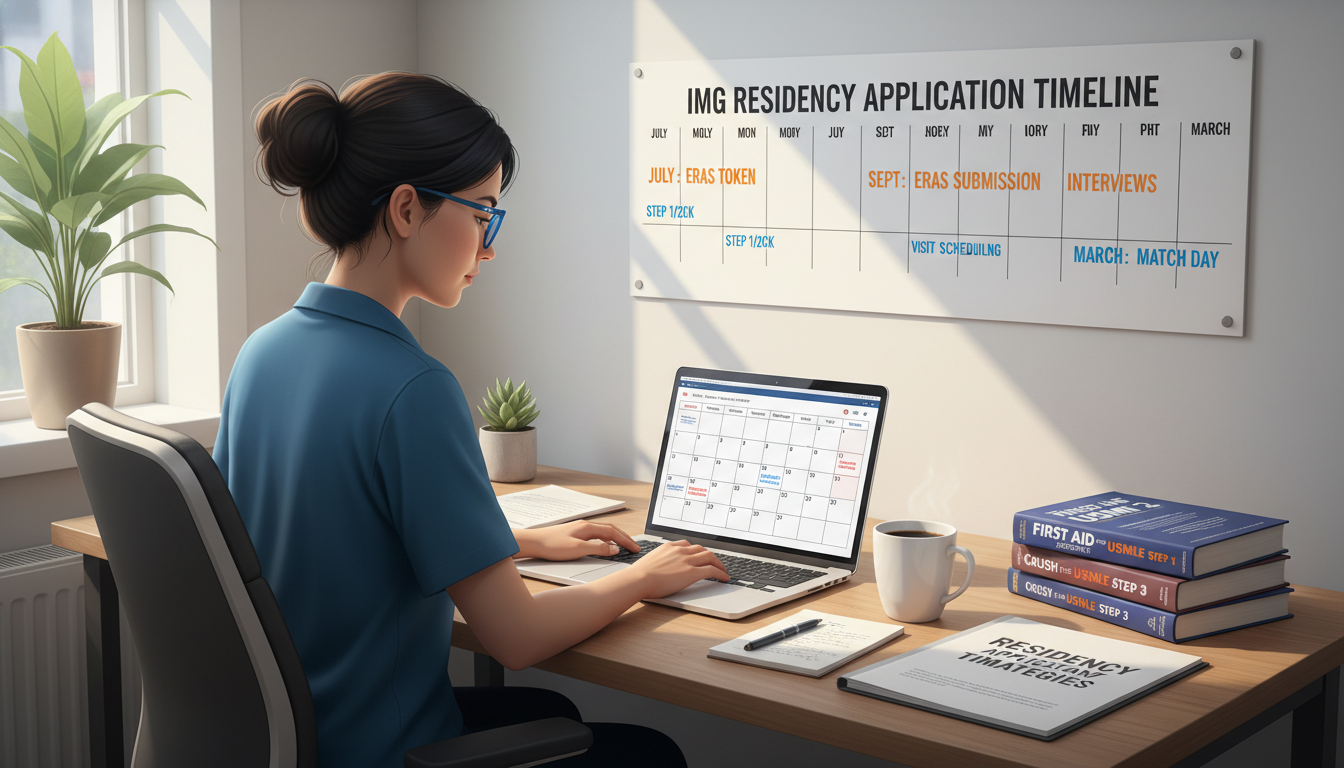
Before you can optimize timing, you need a clear picture of the residency application timeline. While exact dates change slightly year to year, the sequence is predictable. Below is the typical structure for a single Match cycle (for example, applying in September 2026 for July 2027 start).
1. Early Planning: 18–24 Months Before Match
Timeframe: January–December, roughly 1.5–2 years before the Match you are targeting.
Goals:
- Decide target Match year (e.g., Match 2027 vs 2028)
- Plan USMLE/COMLEX exam schedule
- Map out US clinical experiences (electives, observerships)
- Identify target specialties and competitiveness level
For a US citizen IMG / American studying abroad, this period often overlaps with:
- Clinical years abroad
- Arranging US electives if your school allows final-year clerkships in the US
- Determining whether you will need a gap year for Step studying, research, or more USCE
Key actions:
- Review recent NRMP and specialty-specific data on competitiveness.
- Discuss realistic specialties and timelines with:
- Your dean’s office or international office
- Recent grads from your school who matched as US citizen IMGs
- Plan when you’ll take:
- USMLE Step 1 (if not already taken)
- USMLE Step 2 CK (ideally before ERAS opens)
- Start tracking visa-free status (as a US citizen, no work visa is needed, which is an advantage) and focus your attention instead on clinical experience and letters of recommendation.
2. Pre-ERAS Prep: 8–12 Months Before ERAS Submission
Timeframe: October–March of the year before you apply.
Goals:
- Complete (or nearly complete) Step 2 CK
- Secure major US clinical experiences (USCE)
- Line up letter writers
- Create first drafts of your CV and personal statement
Even though the critical question “when to submit ERAS” is usually answered in September, your ability to submit early depends on how prepared you are here.
Key actions for US citizen IMGs:
- Schedule US rotations strategically: internal medicine, family medicine, pediatrics, or your chosen specialty.
- Speak with attendings early about letters of recommendation (LoRs):
- Confirm they are comfortable writing strong letters.
- Give them your CV and a draft personal statement a month before the end of rotation.
- Start a document to:
- List every activity, work, volunteer experience, and research project.
- Record start/end dates and detailed responsibilities (this will go into ERAS experiences section).
3. ERAS Season: Application Year Month-by-Month
Timeframe: May–March of your application year
Here is a typical residency application timeline for one cycle (dates are approximate and should be verified each year):
May–June
- ERAS system opens for applicants (you can register and start entering data).
- Updated ERAS tokens distributed by ECFMG for IMGs.
- Begin serious work on:
- ERAS application entries
- Personal statement(s)
- Program list
July–August
- Finalize USMLE exams (especially Step 2 CK if possible).
- Confirm LoR writers and send them instructions for uploading through the ERAS portal.
- Refine specialty choice and program list.
Early September
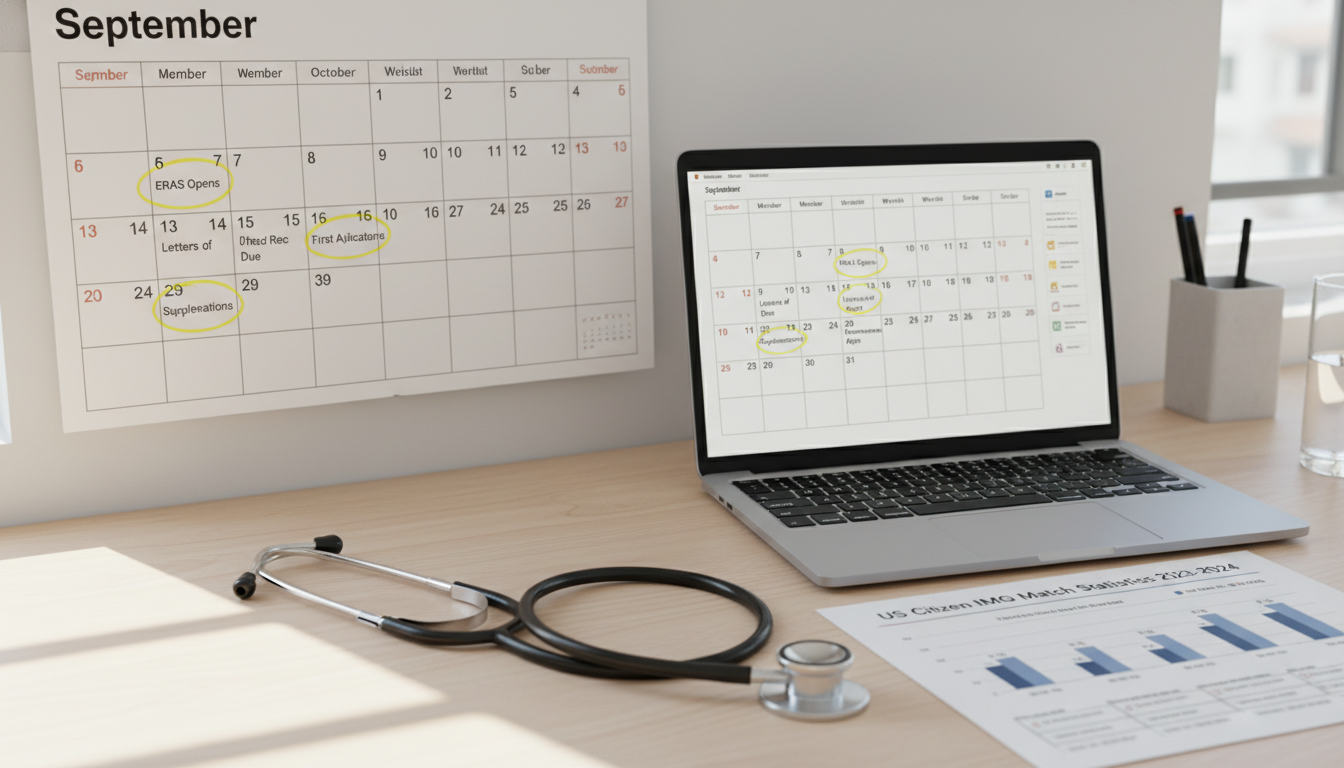
- ERAS opens for applicant submission.
- You can certify and submit your application—but programs generally cannot review it until the ERAS release date (typically around mid-September).
Mid-September
- ERAS applications are released to programs.
- Programs begin reviewing applications and sending interview invitations.
- This is the critical window that makes the question "when to submit ERAS" so important.
October–January
- Peak interview season.
- You continue receiving invites (especially October–November).
- Interviews conducted mostly October–January, varying by specialty.
February
- Rank Order List (ROL) opens and closes.
- You submit your final preferences for the Match.
March
- Match Week:
- Monday: Did I match?
- Thursday: Match results (where you matched).
- Friday: Supplemental Offer and Acceptance Program (SOAP) final day.
- Match Week:
For US citizen IMGs, the earlier part of this timeline (May–September) is where you can leverage your status and planning to maximize interviews.
When to Submit ERAS: Early, On Time, or Late?
The single most influential tactical decision you make in application season is exactly when you submit your ERAS application.
Why Timing Matters So Much
Most programs begin screening applications as soon as ERAS releases them in mid-September. They:
- Often batch-review early applications.
- Start sending out interview offers very early (sometimes within days).
- May fill the majority of interview slots before later applications are fully reviewed.
Because of this, your residency application timeline should aim toward early readiness, especially as a US citizen IMG, who may be competing both with US MD/DO graduates and non-US IMGs.
Ideal Submission Strategy for US Citizen IMGs
Best practice:
Submit a complete and polished application as close to the first possible submission date as realistically possible—preferably on the first day ERAS allows submission, or within the first 2–3 days.
Key principles:
Early is better than on-the-deadline.
- Waiting until the last week of September or later puts you at a disadvantage.
- Some programs may not explicitly close applications, but interviews might already be almost fully allocated.
Complete is better than rushed—but only up to a point.
- If waiting one day improves a major part (e.g., fixing an error-heavy personal statement), that’s worth it.
- Waiting weeks to add a small update (e.g., a minor research poster) is usually not worth missing early review.
Early + complete + strategically targeted is your goal:
- Application submitted early.
- All expected elements in place.
- Programs chosen based on realistic competitiveness and fit.
What Needs to Be Ready Before You Submit
To confidently submit early, aim to have these core components complete:
- USMLE scores (Step 1 and Step 2 CK ideally both reported)
- Personal statement(s) finalized
- Letters of recommendation uploaded or confirmed
- MSPE / Dean’s letter (this is released later by ERAS, but should be in process)
- Medical school transcript submitted to ECFMG
- ERAS experiences and activities carefully proofread
- Photo (professional, but this can be updated later if absolutely needed)
For a US citizen IMG, having Step 2 CK by the time programs first see your application is especially important. Some programs may wait for this score to offer interviews; others may overlook your file if key data is missing when they first screen.
Early vs Late Submission: Practical Scenarios
Scenario 1: Everything ready by early September
- All scores in, LoRs uploaded, personal statement polished.
- Strategy: Submit on day 1 of ERAS submission.
You maximize visibility for earliest rounds of interview invitations.
Scenario 2: Step 2 CK result pending for 1–2 weeks after early September
- You took CK in July/August; score will come out late September.
- Strategy (for most US citizen IMGs):
- Still submit your ERAS on day 1 with Step 1 + “Step 2 CK pending”.
- When the score arrives, update ERAS (it will be transmitted to programs automatically when available).
- Waiting to submit until your CK score posts can push you into late-review territory, which is usually worse than being early with CK pending.
Scenario 3: One key letter isn’t uploaded yet
- You have 3 strong letters in ERAS; a 4th from a big-name attending is delayed.
- Strategy:
- Submit ERAS on day 1 with the 3 letters assigned to programs.
- As soon as the 4th letter is uploaded, add it to selected programs (you can re-assign letters).
- Most programs consider 3 letters sufficient; the 4th is a bonus, not worth delaying submission.
Scenario 4: Personal statement weak and needs major revision
- You realize shortly before submission that your personal statement is generic or poorly structured.
- Strategy:
- Take a few days (not weeks) to revise with feedback.
- Aim to still submit within the first 3–5 days of the submission window.
Delaying into late September or October should only happen if something major (e.g., missing exam score, incomplete transcript) truly prevents submission.
Key Milestones for US Citizen IMGs: A Month-by-Month Guide
Below is a detailed, month-by-month residency application timeline focused specifically on US citizen IMGs / Americans studying abroad, highlighting what you should be doing and watching for.
January–March (Year of Application)
- Confirm your target specialty (or primary + backup specialties).
- Review Match data: fill rates, IMG match rates, typical score ranges.
- Meet with mentors (US faculty if possible) about:
- Specialty choice
- Number of programs to apply to
- Whether a research year is needed
- Plan for Step 2 CK (if not already taken) to be done by June–July.
April–May
- Register on the ECFMG OASIS portal and ensure your credentials are updated.
- Confirm your graduation date (or expected date) with your school.
- Make sure your USMLE transcripts will be available for ERAS.
- Start drafting:
- A base personal statement
- A running program list spreadsheet with columns for:
- Program name
- Location
- Requirements (USMLE scores, cutoffs, USCE, graduation year cutoff)
- IMG friendliness
- Your interest level
- Look up typical application deadlines for your specialty and programs of interest, noting that:
- Most don’t have explicit “hard” deadlines pre-interview, but some do.
- Even without formal deadlines, earlier submission is advantageous.
June–July
- ERAS opens for editing (not submission).
- Get your ERAS token from ECFMG.
- Begin filling in:
- Personal information
- Education and training
- Experiences (work, research, volunteer)
- Publications and presentations
- Ask letter writers to submit LoRs by early September.
- Take Step 2 CK if you haven’t yet or schedule it no later than early August.
August
- Refine personal statement and tailor versions if you are applying to more than one specialty (e.g., IM vs FM).
- Build your final program list:
- Target a sufficient number of programs—many US citizen IMGs apply to 80–150 programs depending on specialty competitiveness.
- Include a good mix of:
- Community-based programs
- IMG-friendly university-affiliated programs
- Confirm the status of:
- USMLE score reports
- Medical school transcript submission to ECFMG
- LoR uploads
Early September: When to Submit ERAS in Practice
On the first day ERAS allows submission:
- Review all entries once more for:
- Typos
- Mismatched dates
- Unclear descriptions
- Certify and submit your application on the first available day (or within 1–3 days).
- Pay application fees and assign:
- Programs to your application
- LoRs to each program
- Proper personal statement versions to each program
Remember: certifying locks the application text, so ensure content is final—but you can still update items like photo and USMLE transcript later.

Timing Beyond Submission: Interviews, Deadlines, and Ranking
Submitting ERAS early starts the process. After that, timely responses and organization become your biggest assets.
Interview Invitation Timeline
- First invitations: Often begin within days of ERAS release in mid-September.
- Peak invitation period: Late September through November.
- Straggler invites: December–January.
How timing affects you:
- Programs may offer interview slots on a first-come, first-served basis.
- Many applicants lose opportunities by responding late to invitations.
Strategies:
- During late September–November:
- Check your email and ERAS inbox multiple times daily.
- Use professional, concise replies to confirm interviews quickly.
- Use online scheduling tools promptly when links are provided.
Program Application Deadlines
Application deadlines vary:
- Some programs post explicit deadlines (e.g., “We accept applications through November 1”).
- Others do not list deadlines but practically stop reviewing after October or once they have enough interviews scheduled.
As a US citizen IMG, you should:
- Try to submit to all target programs by ERAS opening in mid-September.
- If you discover new programs later (via advice, research, or disappointment with early interview yield), it can still be worthwhile to apply in October or even early November, but:
- Expect a lower response rate.
- Expect that some programs will already be heavily scheduled.
Ranking and Match Week Timing
- February: Rank order list opens and closes.
- Submit your rank list well before the deadline, not at the last minute.
- Use your interview impressions, program culture, and long-term goals.
- March: Match Week:
- If you don’t match, you may enter SOAP.
- Timing is extremely compressed in SOAP; organization and rapid communication are critical.
While the ranking portion is less about application deadlines, it is still a vital part of the overall residency application timeline.
Special Timing Considerations for US Citizen IMGs
Being a US citizen IMG carries a few distinct timing advantages and considerations compared to non-US IMGs.
1. No Visa Processing Delays
- Programs do not need to sponsor a visa for you, eliminating a potential barrier.
- This can make you more appealing to some community programs on tight budgets.
- However, this does not compensate for late applications; programs still prioritize early, complete files.
2. US Clinical Experience Planning
As an American studying abroad, you may:
- Have limited windows for US rotations (e.g., final-year electives only).
- Need to coordinate travel and scheduling with your overseas curriculum.
Timing tips:
- Aim to complete crucial USCE 6–12 months before ERAS submission, so:
- Letters arrive in time.
- You can include these rotations in your application.
- If you have a strong US-based rotation in July–August right before ERAS:
- Ask your attending for a quick-turnaround LoR.
- Provide them with your CV and prior PS draft early to speed the process.
3. Graduation Date and Recency
Many programs have preferences or cutoffs like “within 3–5 years of graduation.” As a US citizen IMG:
- Avoid large gaps between graduation and residency start unless used for:
- Recognized research
- Advanced degrees
- Meaningful clinical work
- If you must take a gap year, time it to:
- Boost your application (USCE, research, or a preliminary year)
- Maintain clinical currency close to the Match.
4. Backup Specialty Timing
If your primary specialty is competitive (e.g., dermatology, ortho, radiology):
- Work on a backup plan simultaneously (e.g., IM, FM).
- This requires:
- Additional tailored personal statement(s)
- Possibly more LoRs aligned with the backup specialty
- Extra program research and applications
- You must align all this with the same early ERAS submission strategy; do not wait to see if you get interviews in your primary specialty before applying to a backup.
Actionable Checklist: Timing Strategy for US Citizen IMGs
Use this as a quick reference to align your timing with the residency application cycle:
12–18 Months Before ERAS
- Decide approximate Match year and target specialty.
- Map out Step 1 and Step 2 CK dates.
- Arrange US clinical experiences and electives.
- Start talking with mentors and recent grads.
6–9 Months Before ERAS
- Register with ECFMG and confirm documentation.
- Take or schedule Step 2 CK (ideally by July).
- Start listing experiences and draft your CV.
- Identify 3–4 potential letter writers.
3–4 Months Before ERAS Submission
- Obtain ERAS token and open your application.
- Enter education, experiences, and publications into ERAS.
- Draft personal statement(s) and request feedback.
- Build and refine your preliminary list of programs.
1–2 Months Before ERAS Submission
- Confirm school has sent transcript to ECFMG.
- Remind letter writers to submit LoRs by early September.
- Polish personal statement and experiences for clarity.
- Confirm Step 2 CK testing date and expected score report timeline.
Early September
- Proofread ERAS one final time.
- Assign LoRs, personal statements, and programs in ERAS.
- Certify and submit ERAS on day 1 (or within 2–3 days).
- Prepare for interview season: test your technology, update your professional attire, create a basic answers bank for common questions.
October–January
- Check emails several times daily for invitations.
- Schedule interviews promptly and track them in a calendar.
- Send concise, polite thank-you messages when appropriate.
- Reflect after each interview and take notes for ranking.
February–March
- Construct and submit your Rank Order List on time.
- Prepare a SOAP plan ahead of time as a contingency.
- Respond rapidly to any SOAP communication if needed.
FAQs: Application Timing for US Citizen IMGs
1. As a US citizen IMG, is it okay to wait to submit ERAS until my Step 2 CK score is available?
Generally no. It is usually better to submit early with Step 2 CK pending than to wait weeks and submit late. Programs will see your application in the first wave of review, and your CK score can be added automatically once released. The only exception might be if you are absolutely certain that a large number of your target programs will not consider your application at all without CK, and your score will arrive only a few days after ERAS opening. Even then, weigh the cost of losing early-review advantage.
2. What happens if my letters of recommendation are not all uploaded by early September?
You should still submit your ERAS application on time with whatever strong letters you currently have (typically at least 3). As additional LoRs arrive, you can assign them to programs later. Waiting weeks for one more letter is usually not worth missing early review by programs.
3. Is it ever too late to apply to new programs in the same cycle?
Practically, yes. While many programs keep their ERAS portal formally open into November or December, the interview pool may be mostly filled by October. Late applications (October–November) can still yield interviews, especially for less competitive specialties or IMG-friendly programs, but your chances are lower. Beyond mid-November, adding new programs rarely changes your outcome significantly unless they are very IMG-friendly and explicitly welcome late applicants.
4. How many programs should a US citizen IMG apply to, and when should I finalize my list?
Numbers vary by specialty and applicant profile, but many US citizen IMGs apply to 80–150 programs for core specialties like internal medicine and family medicine, and even more for competitive fields. You should aim to finalize most of your list by late August and certainly before ERAS submission in early September. You can add a small number of additional programs in October if early interview response seems weaker than expected, but your primary strategy should not depend on late additions.
By mastering the application timeline, being deliberate about when to submit ERAS, and planning months in advance, you can turn your status as a US citizen IMG / American studying abroad into a strength rather than a barrier. Early, complete, and strategic timing will significantly improve your chances of securing more interviews and ultimately matching into a residency program that fits your goals.