
The worst ERAS mistakes do not happen in October. They happen quietly between July and September of M4 when you “feel on track” but are actually drifting a month behind.
Let’s fix that.
From July 1 to September 30, every week has a job. If you hit the right milestones on time, ERAS submission and interview season feel controlled. Miss them, and you’ll be panic-editing personal statements on call and uploading letters the night before programs download.
I’m going to walk you through July–September, week by week, with concrete targets. At each point, you’ll know: “By now I should have X done. If not, here’s how to catch up.”
Big-Picture Timeline: July–September ERAS Milestones
Before we slice it week by week, you need the 10,000-foot view.
For a typical September ERAS opening / late September program download year, your goals in this window are:
- July: Lock in specialty choice (if not already), finalize letter writers, draft personal statement and experiences.
- August: Polish and freeze core ERAS content, confirm letters are uploaded, complete program list, finish away rotations strategically.
- September: Convert “almost done” into “submitted early,” double-check everything, and prepare for interview season.
Here’s the overall structure:
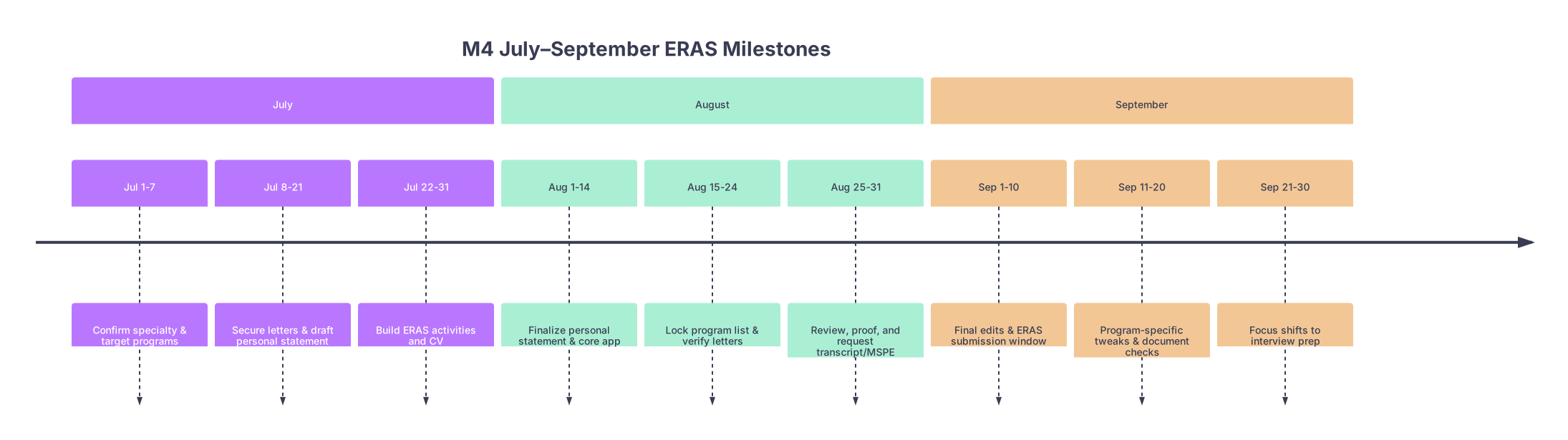
| Period | Event |
|---|---|
| July - Jul 1-7 | Confirm specialty & target programs |
| July - Jul 8-21 | Secure letters & draft personal statement |
| July - Jul 22-31 | Build ERAS activities and CV |
| August - Aug 1-14 | Finalize personal statement & core app |
| August - Aug 15-24 | Lock program list & verify letters |
| August - Aug 25-31 | Review, proof, and request transcript/MSPE |
| September - Sep 1-10 | Final edits & ERAS submission window |
| September - Sep 11-20 | Program-specific tweaks & document checks |
| September - Sep 21-30 | Focus shifts to interview prep |
Now let’s go month by month and then week by week.
July of M4: Foundation Month (Decisions and Drafts)
If you treat July like “vacation before ERAS,” you will pay for it in August. July is when you quietly build 80% of your application.
July 1–7: Commit and Map
By the first week of July, you should:
Lock primary specialty (and backup if needed).
- If you’re still waffling between, say, IM vs EM, this is the last week for serious indecision.
- Talk to: your specialty advisor, at least one PD or APD, one senior resident who matched recently.
- Outcome by July 7: “I am applying to X. I will also apply to Y as insurance / not at all.”
Rough program strategy.
- Build a draft list of target programs (doesn’t need to be perfect).
- Consider:
- Geographic constraints (partner, kids, visa).
- Competitiveness (Step scores, class rank, research).
- Home program strength.
Check ERAS and NRMP dates for your year.
- Confirm:
- ERAS token availability
- Application open date
- When programs can start downloading apps
- Put those dates on your calendar in bold red.
- Confirm:
At this point you should have:
- A primary specialty decision.
- A rough number of programs you’ll likely apply to (e.g., “about 60 IM programs,” not “somewhere between 20 and 100”).
If you don’t, book two urgent meetings with advisors this week. No more drifting.
July 8–14: Letters and Personal Statement Skeleton
This week is about securing your narrative and the people who will vouch for you.
By mid-July you should:
Identify and ask all letter writers.
- Typical targets:
- 2–3 specialty-specific attendings.
- 1 department chair / PD letter if customary for your field (e.g., IM, surgery).
- 1 “character” or sub-specialty letter if helpful (continuity clinic, research PI).
- When you ask, give:
- Your updated CV.
- Draft personal statement (even if ugly).
- ERAS due date you’d LIKE them to hit (earlier than real deadline).
- Typical targets:
Outline your personal statement.
- Not a masterpiece yet. A solid outline:
- Opening story / hook (specific case, moment, not “I’ve always wanted to be…”).
- 2–3 core themes: clinical strengths, values, career goals.
- Why this specialty.
- What you want in training.
- Not a masterpiece yet. A solid outline:
Schedule PS review.
- Identify 2–3 people to review it: resident, faculty, and maybe a non-medical friend for clarity.
- Book a “send draft by” date for yourself and “give feedback by” dates for them.
At this point you should have:
- Verbal (or email) yes from all letter writers.
- A clear outline for your personal statement.
If you’re still “thinking about who to ask,” you’re behind. Stop over-optimizing and send the requests.
July 15–21: Drafting Core Narrative
Now you write.
By the third week of July, your focus is:
First full personal statement draft.
- Sit down and write the whole thing in one shot, then revise.
- Length: usually 1 page, single spaced.
- Avoid:
- Generic “I love helping people.”
- Rehashing your CV line by line.
- Aim: imperfect but complete draft you’re not embarrassed to send.
Start ERAS Work/Activities entries (offline for now).
- Open a document and list:
- All experiences from M1–M4: research, leadership, jobs, volunteering.
- For each:
- Role, dates, ~700-character description. Focus on impact and your actions, not just duties.
- Flag the 3 “most meaningful” (even if ERAS doesn’t label it that way, you should know your top 3).
- Open a document and list:
Compile application data.
- Make a folder (cloud + local) with:
- USMLE/COMLEX score reports.
- CV (updated).
- Headshot plan (photographer booked or DIY scheduled).
- Any awards/honors documentation.
- Make a folder (cloud + local) with:
At this point you should have:
- A complete first PS draft sent to at least 2 reviewers.
- A nearly complete list of all ERAS activities, even if descriptions are rough.
If you’re blocked on writing, give yourself a 2-hour, no-email, no-phone block. First draft only needs to be honest, not polished.
July 22–31: Structure and Verification
Late July is where you move from “pieces” to “organized application.”
By the end of July, you should:
Revise personal statement based on first feedback round.
- Integrate comments.
- Strip clichés.
- Make sure the specialty is obvious even if the title were removed.
Build early program spreadsheet.
- Include columns for:
- Program name
- City/state
- Academic vs community
- Cutoffs (Step/COMLEX, visa)
- “Definitely apply / maybe / probably no”
- You don’t need perfection, but you do need visibility.
- Include columns for:
Check in with letter writers (gently).
- Send each a thank-you + info email:
- Your CV, PS draft, how to upload to ERAS.
- Requested date: “If possible, I’d love to have the letter in by [mid/late August] so everything’s ready.”
- Send each a thank-you + info email:
Confirm away rotations / sub-Is.
- Make sure August and September schedules are accurate.
- If you’re doing aways, align expectations:
- Ask: “Could I potentially request a letter from you if the rotation goes well?”
At this point you should have:
- A solid second draft PS.
- Organized program data.
- All letter writers clearly informed and resourced.
If it’s July 31 and you haven’t written a full PS yet, you’re now officially late. Not doomed—but your August just got tighter.
August of M4: Lock, Polish, and Proof
August is the month where strong applicants quietly win. The chaos looks lower from the outside because their work is basically done.
August 1–7: Finalize Narrative and Activities
First week of August: finish the content of your ERAS, not the formatting.
By early August you should:
Finalize personal statement (90–95% done).
- One more review round from someone who understands your specialty.
- Check:
- No typos.
- Clear story arc.
- Specialty-specific values: e.g., continuity and complexity for IM, procedures and teamwork for EM, etc.
Polish ERAS experiences descriptions.
- Focus each description on:
- What you did.
- Scale (how many patients, how often, time commitment).
- Impact (improvement, results, outcomes).
- Trim fluff like “I learned the importance of communication” unless it’s tied to a concrete story.
- Focus each description on:
Rank experiences by importance.
- Decide your top 3–5 that define you.
- Make sure those have your best writing and strongest outcomes.
At this point you should have:
- Personal statement essentially complete.
- Experiences written in near-final form, ready to paste into ERAS.
If your PS is still a disaster here, freeze further opinions. Two reviewers max. Too many cooks kill the voice.
August 8–14: Program List and Letters Reality Check
Middle of August is when procrastinators finally open ERAS. You should be past that and into refinement.
Your tasks:
Refine program list to realistic numbers.
- Use your school’s match data, NRMP Charting Outcomes, and advisor input.
- Typical ranges (ballpark, not gospel):
- IM categorical: 40–60 for average applicant, more if weaker.
- Gen surg: 40–80.
- EM: 25–40 (depending on competitiveness changes).
- Derm, Ortho, ENT: much higher, often >70.
Check letter status.
- Log into ERAS and see:
- How many letters assigned vs received.
- If a key letter isn’t in progress, send a polite reminder with a concrete date: “Programs can begin downloading apps on [date]; having the letter by [earlier date] would help a lot.”
- Log into ERAS and see:
Plan specialty-specific PS variants if needed.
- Example: A general PS for most IM programs and a slightly tailored one for physician-scientist tracks.
- Do NOT create 10 versions. That’s how you introduce errors.
At this point you should have:
- A nearly final program list spreadsheet.
- At least half of your expected letters already uploaded or confirmed in progress.
If you find out a letter writer ghosted you, act now—identify an alternate and ask immediately.
August 15–24: Freeze Core ERAS Content
Late August is your “freeze” phase. Content stops shifting; you move into proofreading and mechanics.
Your goals:
Enter everything into ERAS.
- Copy/paste:
- Personal statement(s).
- Experiences.
- Honors/awards.
- Upload:
- Photo (professional or at least clean and neutral).
- Double-check:
- Exam scores are correctly imported.
- Name, AAMC ID, contact details.
- Copy/paste:
Run a brutal proofread.
- Read entire application out loud once. Yes, the whole thing.
- Look for:
- Repeated phrases.
- Typos.
- Inconsistent date ranges.
- Ask one trusted person to read key sections (PS + experiences) INSIDE ERAS view, not just in Word.
Confirm transcript & MSPE logistics.
- Your school usually handles MSPE and transcript, but:
- Make sure you’ve signed any necessary release forms.
- Check the timeline: MSPE doesn’t release until Oct 1, but everything else should be ready.
- Your school usually handles MSPE and transcript, but:
At this point you should have:
- A complete ERAS profile that could be submitted tomorrow if needed.
- Only micro-edits left.
If you’re still writing new content now, compress your schedule. No new experiences unless absolutely crucial. Focus on clarity, not expansion.
August 25–31: Dress Rehearsal and Final Letter Check
End of August is your full systems check.
By August 31, you should:
Verify letters are uploaded or imminently done.
- Ideal: All letters marked as received in ERAS.
- Minimum: Enough letters to submit a credible app (usually 3–4), with clear confirmation that remaining ones are on the way.
Match personal statements to program types.
- In ERAS:
- Assign default PS to each program.
- Assign alternate PS where appropriate (e.g., research track vs community).
- In ERAS:
Review program list with an advisor.
- Quick 20–30 minute meeting.
- Ask directly:
- “Do I have enough reach programs?”
- “Am I overspending on programs where I have no realistic shot?”
- Tweak list accordingly.
Plan finances and calendar.
- Budget for:
- ERAS fees.
- Possible travel (if any in-person interviews).
- Block off interview season windows on your calendar loosely.
- Budget for:
At this point you should have:
- A fully built, proofread, advisor-reviewed ERAS.
- Program list solid unless a major life event forces changes.
If letters are still missing and writers are unresponsive, escalate: involve your dean’s office or a department coordinator. Waiting silently is how apps go out incomplete.
September of M4: Submit Early, Then Shift Focus
This is the month everyone panics. Your goal is to do the opposite.
Early September (1–10): Submission Window
Once ERAS opens for submission (not just editing), you should be ready to move quickly.
Your tasks:
Final micro-edits (1–2 days max).
- One last pass over:
- PS.
- Experiences blurbs.
- Program assignments (correct specialty, PS, letters).
- Stop editing after this. Perfectionism becomes the enemy.
- One last pass over:
Submit ERAS within the first few days of the submission window.
- For most specialties, submitting on day 1–3 of the “programs can see apps” window is ideal.
- Submitting a week late is not the end of the world, but beyond that, you start losing ground for interview invites in competitive fields.
Here’s how submission timing typically affects you:
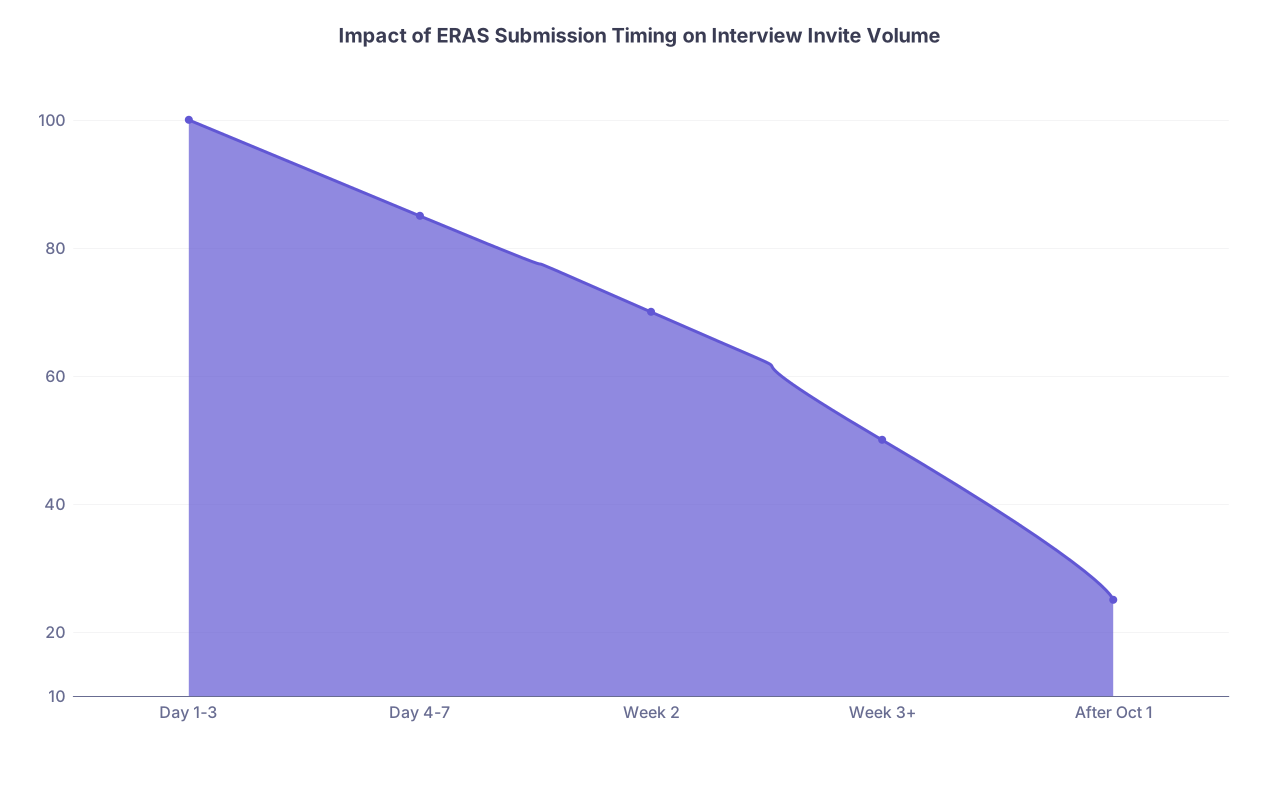
| Category | Value |
|---|---|
| Day 1-3 | 100 |
| Day 4-7 | 85 |
| Week 2 | 70 |
| Week 3+ | 50 |
| After Oct 1 | 25 |
(Numbers illustrative, not literal—but the pattern is real. Earlier gets you in the first review bins.)
- Confirm all materials attached to each program.
- In ERAS, verify:
- Correct PS assigned.
- Correct letters attached (especially if you’re mixing chair / non-chair or specialty vs backup specialty).
- Cross-check with your spreadsheet.
- In ERAS, verify:
At this point you should have:
- ERAS submitted or scheduled for submission within days.
If you’re not ready by mid-September, aggressively cut scope. Don’t expand the program list; tighten it and get something submitted.
Mid-September (11–20): Clean-Up and Contingency
Now you’ve submitted. You’re not “done,” but the heaviest lift is over.
Your focus:
Monitor ERAS for any missing pieces.
- Verify:
- All intended programs received your application.
- No odd errors or missing uploads.
- If a letter finally appears that you want to add:
- Assign it to programs that accept additional letters (within limits).
- Verify:
Send targeted thank-you / update notes (optional, not spam).
- To letter writers: sincere thanks, confirmation that application is in.
- To mentors who helped with PS or program list: quick update and appreciation.
Start light interview prep.
- Outline responses for:
- “Tell me about yourself.”
- “Why this specialty?”
- “Why our program?”
- Review a few common ethical and conflict scenarios.
- Outline responses for:
At this point you should have:
- Zero outstanding panic tasks inside ERAS.
- Mental shift from “application building” to “interview performance.”
If your app went out significantly later than peers, talk with an advisor about whether a brief, professional email to a very small number of programs is appropriate. Do not blast 80 programs with “I applied late but I’m very interested.”
Late September (21–30): Interview Season Prep
The last stretch of this window is about getting ahead of the next tidal wave: interviews.
Your tasks:
Tighten logistics.
- Update:
- Voicemail (professional, clear).
- Email signature.
- Set up:
- Calendar system that won’t let you double-book (Google Calendar with alerts, etc.).
- Update:
Mock interviews.
- Aim for 1–2 practice sessions:
- One formal with your school’s career office or advisor.
- One informal with a resident/friend who will be honest.
- Aim for 1–2 practice sessions:
Program research system.
- Build a simple framework:
- For each program: 3 reasons you’d want to be there + 1 question to ask.
- You do NOT want to be doing this from scratch the night before your first interview.
- Build a simple framework:
Emotional reset.
- Schedule a literal off-day. No ERAS, no emails.
- You need to hit interview season not already burned out.
At this point you should have:
- ERAS long since submitted.
- Interview prep underway and logistics dialed in.
If you’re still tinkering with ERAS content on September 30, stop. That time is better spent preparing to actually talk to people.
Quick Reference: What Should Be Done When?
Here’s a condensed milestone snapshot for July–September:
| Timeframe | Core Milestone |
|---|---|
| July 1–7 | Decide specialty & rough program count |
| July 8–21 | Secure letter writers & PS first draft |
| July 22–31 | Second PS draft & activities list ready |
| Aug 1–14 | Finalize PS & polish activities |
| Aug 15–24 | Complete ERAS entries & refine programs |
| Aug 25–31 | All letters requested & content frozen |
| Sept 1–10 | Final proof & submit ERAS |
| Sept 11–30 | Clean-up tasks & begin interview prep |
Final Check: Are You On Track Right Now?
Wherever you are today—July, August, or September—anchor yourself:
- Look at the week you’re in.
- Compare to the milestones above.
- Identify the one major task you’re behind on.
Then do this, today: open a blank document and write the first 3 bullet points of your experience section, or send the missing email to a letter writer, or schedule the advisor meeting you’ve been dodging.
Start with that. Right now, open your calendar and block a 2-hour window this week labeled “ERAS – Non‑negotiable.” That’s how you stop drifting and start driving this process on your terms.