
Most students ruin ERAS timing by “waiting to feel ready.” That is exactly how you end up late.
You cannot wing the months from MS3 spring to ERAS submission and expect a strong outcome. The calendar will beat you. So let me lay it out week-by-week: what you do when, so that by the time ERAS opens you are not scrambling, begging attendings for letters, and rewriting your personal statement at 2 a.m.
This is the timeline I wish more students followed.
Big Picture: The ERAS Timing You Are Aiming For
Before we zoom into weeks, anchor the year:
- MS3 Spring: Roughly March–May
- MS4 Early: July–September
- ERAS Token / App Opens: Typically mid-late June
- Programs Can View Apps: Typically mid-September
- “On-time” submission: Within the first 3–5 days of programs being able to receive applications (functionally by that key September date)
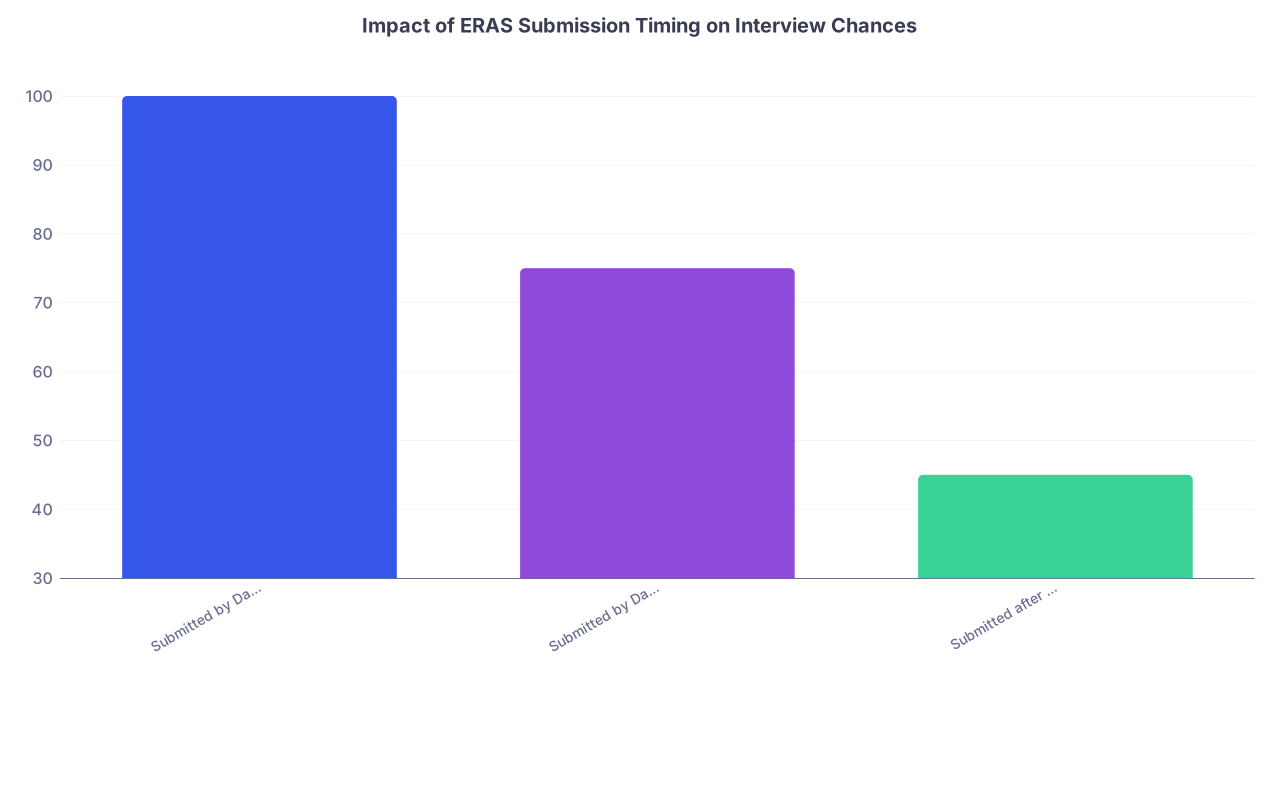
| Category | Value |
|---|---|
| Submitted by Day 1-3 | 100 |
| Submitted by Day 4-10 | 75 |
| Submitted after Day 10 | 45 |
You want your application fully ready to submit the day programs can see it. Not “mostly done.” Ready.
Now the timeline.
Phase 1: MS3 Spring (March–May) – Foundations and Decisions
At this point you should be:
- Locking in your specialty (or at worst, choosing between two)
- Planning for letters, Step 2, and aways
- Clearing clutter from your future self’s plate
March (MS3 Spring – Early)
Weeks 1–2 (First half of March)
Focus: Specialty decision and realistic competitiveness check.
At this point you should:
- Do a brutal, honest review of:
- Step 1 result (if you have one; yes, even if it is Pass)
- Class rank / clerkship performance
- Any red flags (LOA, failures, professionalism issues)
- Narrow your specialty choice:
- If undecided, set up 2–3 specialty-specific meetings:
- Talk to: program director, clerkship director, or a resident in each field.
- If undecided, set up 2–3 specialty-specific meetings:
- Build a draft school/program tier list:
- “Reach,” “realistic,” and “safety” programs based on your metrics.
Weeks 3–4 (Second half of March)
Focus: Flags and planning Step 2.
At this point you should:
- Create a Step 2 CK plan:
- Identify: target test month (often June–August).
- Backward-plan: 6–8 dedicated weeks if possible around rotations.
- If you have any academic red flags:
- Talk to your dean’s office now about how they will be explained in your MSPE.
- Start your ERAS CV skeleton:
- Open a document with headings:
- Education
- Experiences (Work, Volunteer, Research)
- Leadership
- Publications/Presentations
- Honors/Awards
- Bullet out everything with dates and supervisors’ names.
- Open a document with headings:
You are not “working on ERAS.” You are building data so June is painless.
Phase 2: Late MS3 (April–May) – Letters, Experiences, and Aways
April – Letter Strategy and Application Content
Weeks 1–2 (Early April)
At this point you should:
- Map out your LOR strategy:
- Core: 3–4 strong clinical letters from your specialty + 1 non-specialty if needed.
- Identify exact attendings you want.
- During current rotations:
- Tell 1–2 attendings: “I am planning to apply in [specialty]. I would value feedback on whether I am on track for a strong letter.”
- Start jotting bullets for ERAS descriptions:
- For each major activity, answer:
- What did I actually do?
- What impact did it have?
- What skills does it show (leadership, communication, etc.)?
- For each major activity, answer:
Weeks 3–4 (Late April)
At this point you should:
- Finalize which rotations will generate letters:
- Ideally: your home specialty rotation + sub-I/acting internship + maybe away rotation.
- Check your school’s process for:
- MSPE timeline
- Dean’s letter meeting
- Uploading LORs (who handles what, by when)
- If you are doing away rotations:
- VSLO applications should already be submitted or nearly done.
- Fix any missing immunization/document issues now, not in June.

May – First Drafts and Reality Check
Weeks 1–2 (Early May)
At this point you should:
- Write a terrible first draft of your personal statement:
- 650–800 words.
- Do not aim for perfection. Aim for something on the page.
- Build your preliminary program list:
- Use FREIDA, program websites, and talk to residents:
- Target number depends on specialty:
- Competitive (Derm, Ortho, ENT, Plastics): often 60–80+
- Mid-competitive (EM, Anesthesia, OB/GYN, Gen Surg): ~40–60
- Less competitive (FM, Peds, Psych, IM community): ~20–40
- Target number depends on specialty:
- Use FREIDA, program websites, and talk to residents:
- Start a simple spreadsheet:
- Columns: Program, City, Type, Notes, “Apply?” Y/N, Priority.
Weeks 3–4 (Late May)
At this point you should:
- Get one trusted reviewer to read your personal statement draft:
- Not 7 random classmates. One or two people who know the field or writing.
- Tighten your CV entries:
- Convert bullets into ERAS-style 700-character experience descriptions (roughly 3–6 sentences).
- If Step 2 is in June/July:
- Confirm dedicated period is real, not hypothetical. Switch rotations if necessary.
Phase 3: Early MS4 Summer (June) – ERAS Opens and Step 2 Crunch
June is elastic for different schools, but roughly:
Early June – ERAS Opens
Week 1 (First week of June)
At this point you should:
- Log into ERAS as soon as the system opens.
- Populate:
- Demographics
- Education history
- Basic experiences (copy from your document)
- Create your experience prioritization:
- Mark which 10 experiences you want to highlight as “most meaningful” (if using a system that mirrors that concept; if not, still know your top experiences mentally).

| Step | Description |
|---|---|
| Step 1 | MS3 Spring |
| Step 2 | Decide Specialty |
| Step 3 | Plan Letters & Aways |
| Step 4 | Draft PS & Experiences |
| Step 5 | ERAS Opens in June |
| Step 6 | Finish Entries & Program List |
| Step 7 | Submit Around Mid-September |
Weeks 2–3 (Mid June)
At this point you should:
- Refine personal statement:
- Implement feedback, cut fluff, remove clichés (“I have always wanted to be a doctor” etc.).
- Keep Step 2 studying as top priority if your date is near:
- Application work can expand infinitely and destroy your score. Do not let that happen.
- Begin LOR conversations if you have not:
- Ask in person or via a very clear email:
- “Would you feel comfortable writing a strong, supportive letter for my residency application in [specialty]?”
- Ask in person or via a very clear email:
Week 4 (Late June)
At this point you should:
- Confirm attendings have accepted your letter requests.
- Make sure they know:
- Deadline: Tell them “by August 15” even if ERAS is mid-September. You need buffer.
- How to upload: Provide ERAS letter request forms and instructions.
| Component | Ideal Target Date |
|---|---|
| Personal Statement | Solid draft by June |
| Experiences Entered | July 1 |
| Letters Requested | By late June |
| Step 2 CK Taken | June–August |
| Program List Draft | July |
Phase 4: Deep Summer (July–August) – Build the Finished Application
July and August are where people either get ahead or start drowning. You want to be in the first group.
July – Locking Down Content
Week 1 (Early July)
At this point you should:
- Have all ERAS experience entries at least drafted:
- No blank sections. Maybe not perfect, but written.
- Revisit your personal statement with fresh eyes:
- Fix clunky sentences. Tighten to 650–750 words max.
Weeks 2–3 (Mid July)
At this point you should:
- Take Step 2 CK (for many, this is the sweet spot):
- If you are taking it now, your only ancillary work should be minor ERAS tweaks.
- If you already took Step 2:
- Reassess program list with your score in hand.
- Update competitiveness assumptions. Be honest.
Week 4 (Late July)
At this point you should:
- Polish ERAS:
- Make sure dates and hours for experiences are consistent and realistic.
- No “80 hours/week” nonsense. PDs know you are exaggerating if you do that.
- Check in politely with letter writers:
- One short, respectful reminder email:
- “I wanted to check in and see if you needed any additional information from me for my letter.”
- One short, respectful reminder email:
August – Final Application Polishing and Program Strategy
Week 1 (Early August)
At this point you should:
- Aim for 90–95% completion of ERAS:
- Only small edits and program list remain.
- Draft any specialty-specific or dual-application personal statements if needed:
- Example: One for IM, one for Neurology if you are hedging.
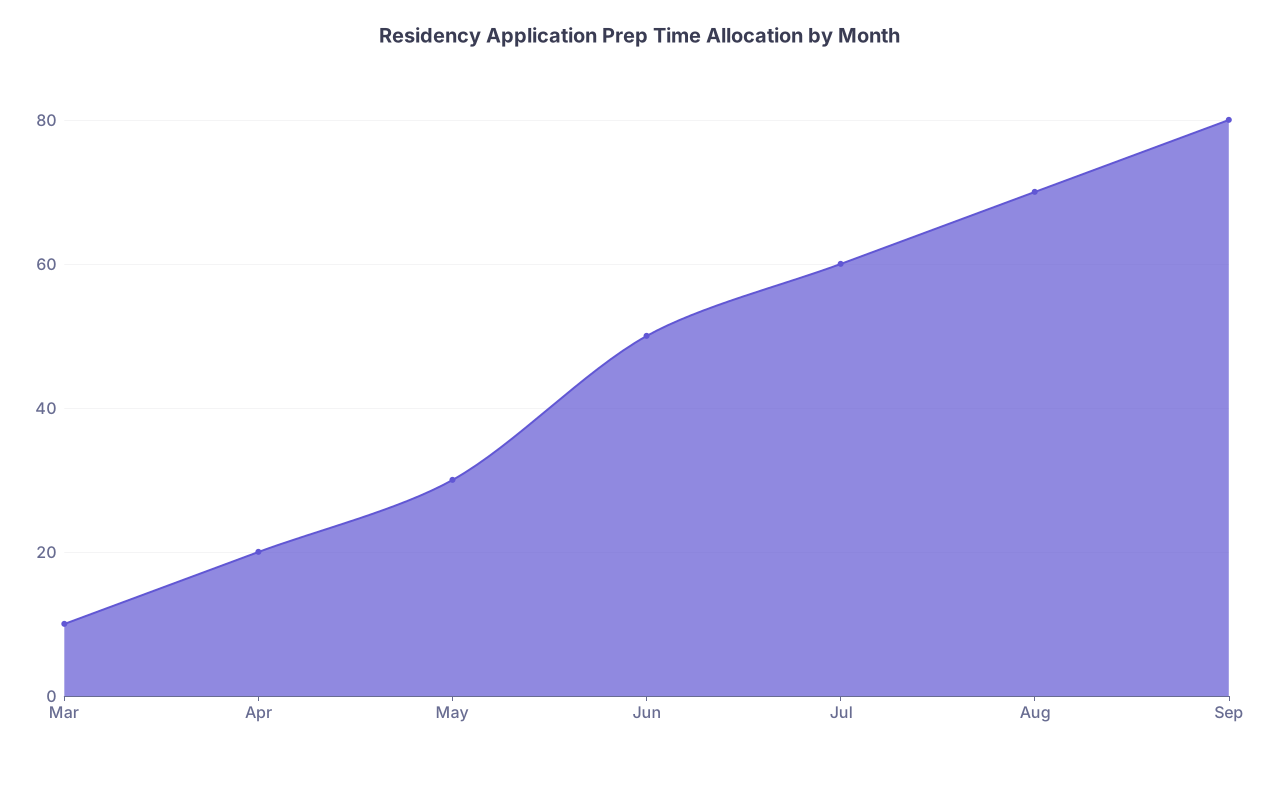
| Category | Value |
|---|---|
| Mar | 10 |
| Apr | 20 |
| May | 30 |
| Jun | 50 |
| Jul | 60 |
| Aug | 70 |
| Sep | 80 |
Week 2 (Mid August)
At this point you should:
- Finalize your base program list:
- Sort by:
- Geography preference
- Academic vs community
- Your competitiveness
- Sort by:
- Add a small safety margin:
- 5–10 extra realistic programs if your metrics are borderline.
Week 3 (Late August)
At this point you should:
- Confirm that all letters are either in or imminently coming:
- If a writer is non-responsive, you need a backup now.
- Clean up:
- Remove typos
- Standardize formatting (capitalization, punctuation in entries)
Week 4 (End of August)
At this point you should:
- Have a mock ERAS review:
- Ask a mentor, advisor, or recent graduate in your specialty to skim:
- Personal statement
- Experience list
- Program list
- Ask a mentor, advisor, or recent graduate in your specialty to skim:
- Make only necessary substantive changes. No endless tinkering.
Phase 5: ERAS Submission Month (September) – The Exact Week-by-Week
This is where timing actually matters for interview chances.
Your objective: be fully ready to click “submit” the first day ERAS applications can be sent to programs or within 1–3 days at most.
Early September – Final Checks
Week 1 (First week of September)
At this point you should:
- Do a line-by-line read of your entire application:
- Look for: inconsistencies, silly abbreviations, unexplained gaps.
- Confirm:
- Photo uploaded (professional, neutral, not a selfie).
- USMLE/COMLEX scores properly authorized for release.
- You assigned the correct personal statement to the correct specialty.
Week 2 (Second week of September)
At this point you should:
- Freeze major content:
- No more big rewrites. You are in proofread mode.
- Double-check:
- Letters are correctly assigned to each program.
- You are not accidentally sending a “pediatrics letter” to a surgery program, etc.

ERAS Submission Week – The Exact Days
Now assume ERAS allows submission to programs starting around mid-September (the exact date moves year to year, you must confirm).
Here is how to handle that week:
7–5 Days Before Programs Can View Applications
At this point you should:
- Do a final mentor review if it has not happened yet. Quick, not a rewrite session.
- Confirm payment method, NRMP registration status (if open), and any couples match status.
2–3 Days Before Programs Can View Applications
At this point you should:
- Lock your program list:
- You can add more later, but your core list should be stable.
- Reconfirm:
- Personal statement assignments
- Letter assignments
1 Day Before Programs Can View Applications
At this point you should:
- Be ready to submit now, not tomorrow:
- Many applicants submit as soon as the system allows application submission (even if programs only download them on “Day 0”).
- Do a final, slow proofread of:
- Personal statement
- Experience section
Day 0: Programs Can View ERAS Applications
This is the money day.
At this point you should:
- Have already submitted or submit that morning:
- Morning US time, not late at night.
- Confirm submission:
- Download or screenshot confirmation.
- Check that every program on your list shows as “Applied.”
Days 1–3 After Programs Can View Apps
At this point you should:
- Resist panic-refreshing your email every 2 minutes.
- Expect silence. Many programs batch review.
- Use this time to:
- Polish your interview answers.
- Prepare a short paragraph on “Why this program” that you can adapt.
Submitting in this window keeps you in the first wave of applications nearly everywhere. Submitting a week or two later does not instantly kill your chances, but it absolutely can reduce interviews at more competitive programs.
Common Pitfalls That Break This Timeline
You want to avoid these:
- Waiting for your Step 2 score to “decide if you should apply to a competitive field” and then realizing ERAS is in 10 days.
- Asking for letters in late August and discovering your attending is on vacation until October.
- Changing your personal statement three days before submission and introducing typos.
- Spending August obsessing over one paragraph instead of finishing 20 experience entries.
I have watched students with better scores lose out to slightly weaker applicants who simply respected the calendar. Do not be that case study.
FAQ (Exactly 4 Questions)
1. What is the absolute latest I can submit ERAS without hurting my chances?
For most specialties, submitting more than 7–10 days after programs can view applications starts to hurt you, especially at competitive or academic programs. Some community programs are more forgiving, but you have no guarantee. Your target should be Day 0–3, not “as late as possible without dying.”
2. Should I delay application submission to wait for a better Step 2 score?
Usually no. If your current testing timeline means the score will not be back until after programs can see applications, you still submit on time. Programs can update with your Step 2 score when it arrives. The exception: if your current score profile absolutely cannot support your chosen specialty and Step 2 is your only rescue, then discuss with an advisor. But that is the exception, not the rule.
3. How early should letters of recommendation be uploaded to ERAS?
You want all core letters uploaded by mid-August, ideally. That gives you time to check they are assigned correctly and to replace any missing letters. Some writers will push to the last second no matter what you do, which is exactly why you tell them your “deadline” is weeks before you really need them.
4. Is it better to submit fewer applications early or more applications later?
Earlier wins almost every time. You should aim to have your full intended list ready for early submission. If you must choose, submitting a slightly smaller but well-chosen list on Day 0–3 is better than submitting a bloated list two weeks late. Early, targeted, and realistic beats late and desperate.
Key points:
- Work backward from ERAS Day 0 and treat that as a hard deadline for a polished application, not a draft.
- Front-load decisions (specialty, letters, Step 2 timing) into MS3 spring so MS4 summer is execution, not chaos.
- Submit in the first 1–3 days programs can see applications. “On time” in this game means “early.”