
Most applicants get ERAS timing directionally right and still lose ground because they ignore one thing: home vs. away programs do not play by the same clock.
You cannot treat your home program, your aways, and your “cold” programs like they all live in the same ERAS universe. They do not. The apps arrive the same day. The context does not.
Let me break this down specifically.
The Real ERAS Clock: What “On Time” Actually Means
First, anchor the basic truth: for most specialties, you should aim to be complete (ERAS submitted + letters + Step scores + transcript + MSPE pending) on or very near the opening date for program download.
But that simple rule hides three different “timelines”:
- Your home program(s)
- Away rotation programs you rotated at
- Everyone else (cold programs)
They look at you differently. They tolerate delay differently. They interpret “early” and “late” differently.
Key calendar realities (typical year patterns)
You know this broadly, but I want you thinking like a PD:
- ERAS applicant submission opens: mid-September
- Programs can start reviewing applications: late September
- MSPE (Dean’s letter) release: October 1 (most years)
- Early interview offers: 1–3 weeks after programs get access
- Bulk of interview invites: October–November
Where people get burned: they think “I submitted on September 28, that is still early.” Technically yes. Functionally? Programs in competitive fields may already have pre-screened, flagged their home and away students, and started building interview lists.
So we will talk about:
- When your application must be ready for home programs
- How much delay away programs will realistically tolerate
- How late you can apply to “cold” programs without self-sabotage
Home Programs: The Only Place You Are Never a Cold Applicant
Your home program is on a different wavelength from every other program on your list. They know you exist months before ERAS opens. You are on someone’s spreadsheet already.
They are asking two questions about you:
- Are you a “must interview”?
- Are you a “maybe, if the file supports what we think”?
Your ERAS timing either confirms their positive bias, or makes them start to doubt your reliability.
Timing rules for home programs
You want your home program to see:
- A complete application
- No obvious loose ends
- No drama
Target: Your ERAS should be submitted by the first day programs can download applications. For your home program, being late sends a louder signal than you think.
Why?
Because they compare you to:
- Other home students they know well
- Their own internal expectations for their seniors
I have literally sat in meetings where someone said, “Wait, why has X not submitted yet? Are they switching specialties?” That is not what you want.
Letters and timing specific to home
For your home program, the main nuance is letters:
- You usually will have at least:
- 1–2 letters from home faculty
- Sometimes a letter from your home PD or APD
Timing expectations:
- By ERAS download date, you want:
- At least 2 specialty-specific letters uploaded
- Ideally 3 total letters in the system
- A fourth can come later, but should not be the first good letter
Will home programs wait a bit on your “big name” home letter? Yes, if they know it is coming and they already know you well. But they should not be staring at:
- No specialty letters
- No core clerkship narrative uploaded
- Missing key score (like Step 2 in competitive fields that care)
They have less tolerance for incompleteness from one of their own.
Away Programs: Your Clock Starts Before ERAS Opens
Away programs are a separate game. They have seen you on the wards, they have informal opinions. You are no longer just a cold PDF. You are a face, a work ethic, a “this student wore out the consult pager” story.
But away letters and away timing are commonly mishandled.
The hidden away-timing problem
Picture this:
- You rotate at Program A in July
- ERAS submission opens mid-September
- Your away letter is requested at the end of the rotation
- The attending is busy, sits on the letter until mid-October
You decide to “wait to submit ERAS until my away letter comes in so my app is complete.”
You just traded away your timing advantage at every other program—including your home—for one letter.
Bad deal.
For away programs, the timing equation is:
Your ERAS file must be in their system early enough that they still have open interview spots when your away letter shows up.
They will often flag you based on the fact that you rotated there. The letter is additive. Not foundational.
Optimal strategy for away programs
Here is the structure that works best:
- Submit ERAS as early as you can with existing strong letters.
Do not wait for the away letter to press submit. - Assign that away program to your list from day one, even if the away letter is pending.
- When the away letter arrives:
- Add it and assign it to that specific program
- Programs will see the updated letter set when they re-open files
Most away programs will:
- Know you rotated there
- Recognize your name before clicking the file
- Be much more forgiving of a letter arriving a week or two later
They will not be forgiving of an application that hits their queue so late that interview spots are mostly gone.
Timing for early vs. late away rotations
Now break it down by rotation month.
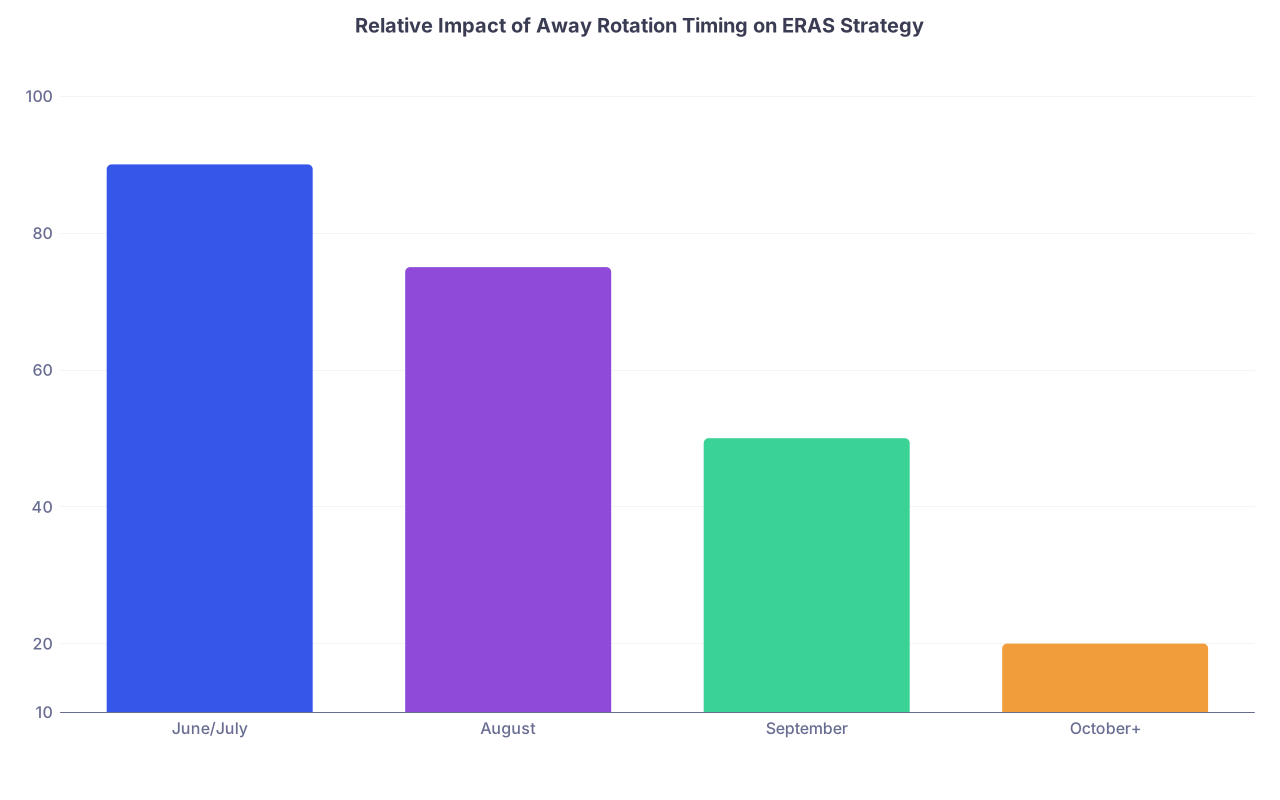
| Category | Value |
|---|---|
| June/July | 90 |
| August | 75 |
| September | 50 |
| October+ | 20 |
Interpretation (rough, but directionally right):
June / July away
- Maximum value for ERAS
- Attending has time to write letter before ERAS opens
- Program has time to debrief internally about you
- You should be 100% complete for that program by download date
August away
- Still strong, but now you are racing the calendar
- Your goal: get the letter request in the week before the rotation ends
- Faculty need a due date: tell them clearly “ERAS opens ___; would you be able to upload by then?”
September away
- This is where people get into bad timing decisions
- You cannot hold your entire ERAS hostage waiting for a September-away letter
- You treat this away letter as a mid-season booster, not a launch pad
October+ away
- Almost no influence on initial interview offers
- Can help for:
- Post-interview communication
- Rank list advocacy
- Rare late-season interview offers
- But it does not justify delaying ERAS submissions anywhere
Bottom line: for aways, the timing of ERAS submission should be driven by the application as a whole, not by the perfect moment when the away letter appears.
“Cold” Programs: Where “Late” Hurts You First
By “cold programs,” I mean those that:
- Do not know you
- Have not seen you on the wards
- Do not share a med school or hospital network with you
This is where classical timing advice matters the most.
How they actually review applications
Most PDs and selection committees:
- Preload filters (Step cutoffs, red flag flags)
- Start review right when ERAS opens
- Have a finite number of interview spots
- Extend a big wave of invites early, then trickle
So if you submit:
On or before program download date
- You are in the first batch
- Your file can be reviewed before early interview slots are filled
1–2 weeks after download date
- Still realistically in the running at many places
- You are just not first wave
>3–4 weeks after download date
- Now, in competitive specialties, you are functionally “late”
- Some residency programs are already near interview capacity
Cold programs do not have a reason to wait for you. They do not know you exist until your file appears.
The nuance with MSPE and Step 2
People ask every year:
“Should I delay my ERAS submission until my MSPE or Step 2 score is in?”
The honest answer depends heavily on competitiveness of specialty and the quality of your Step 1 / early metrics.
As a rule:
- Do not delay submission purely for MSPE. Programs expect it to arrive October 1. They are used to reviewing without it initially.
- Step 2 is more nuanced:
- If you have:
- Strong Step 1 (when still scored) or strong preclinical/clinical performance
- You are not applying to the absolute most competitive specialties
→ Submit early and let Step 2 follow.
- If:
- Your Step 2 is a critical “rescue” score
- And you know it will be significantly better than your existing record
→ You might delay a short time, but not past the point where programs begin sending invite waves.
- If you have:
How Home vs. Away vs. Cold Interact on One Common List
You are not managing these groups in isolation. You are making tradeoffs.
Let us get concrete.
Scenario 1: Mid-tier competitive specialty, strong home support
Facts:
- You have:
- Solid but not elite scores
- Strong performance at your home institution
- One away in July, one in September
Strategy:
- ERAS submission:
- Aim to submit on or the first 1–2 days after program download opens.
- Letters in system by then:
- Home PD or APD letter
- Another home faculty letter
- July away letter (if ready)
- September away letter:
- Do not delay ERAS waiting for it
- Add when it arrives
- Home program:
- You are complete enough for them on day one
- July away program:
- They see your application early; letter may be in or come shortly after
- Cold programs:
- They see you in the first review wave
What you do not do: hold the entire application until mid-October “to wait for both away letters.” That is where you quietly crater your chances at half your list.
Scenario 2: Very competitive specialty, late strong away
Facts:
- Specialty: derm, ortho, plastics, ENT, etc.
- You did a killer away in August, letter promised “soon”
- Step 2 is strong, Step 1 (if scored) was borderline
Strategy:
- Have your entire ERAS body ready before the August away ends.
- As soon as the away rotation ends:
- Request the letter with a hard internal deadline (for yourself) of 1 week prior to ERAS download date.
- If the letter is not in by your deadline, you still submit on time with your best available letters.
- Once the away letter appears:
- Immediately assign it to that program (and others if appropriate)
These specialties are hyper-timing sensitive. PDs absolutely start building their shortlists immediately. Being two weeks behind because of a single letter can be fatal.
Where Timing Flexibility Actually Exists
So far I have been pretty uncompromising. Let me show you where you actually have room to breathe.

| Step | Description |
|---|---|
| Step 1 | ERAS Download Date |
| Step 2 | 0-7 days after |
| Step 3 | 8-21 days after |
| Step 4 | >21 days after |
| Step 5 | High tolerance if pre-known |
| Step 6 | Moderate tolerance |
| Step 7 | Decreasing tolerance |
| Step 8 | Late / Low yield window |
Practical interpretation:
0–7 days after download date
- Basically still “on time” everywhere, assuming everything else is strong.
- Home: fine
- Away: fine
- Cold: still good, especially in less competitive fields
8–21 days after
- Home: still safe, but people may notice if you asked them for support earlier
- Away: they might already have you in mind; still OK but weaker
- Cold: You are increasingly late at popular programs in competitive regions/specialties
>21 days after
- Home: if they love you, they may still interview you, but they might ask why
- Away: can still help at that one site if they really liked you
- Cold: now you are counting on:
- Less popular programs
- Places that review in later batches
- Or just good luck
This is why I tell people: if you cannot be early everywhere, at least be early where you are “cold.” Home and strong away programs have some reason to keep you in mind. Everyone else does not.
Program-Specific Preferences: Why You Must Read Their Pages Carefully
Some programs quietly telegraph their timing culture. They often bury it in one line on their website.
Examples I have seen:
- “We strongly encourage applicants to apply as early as possible.”
- “Applications received after October 15 may receive less consideration.”
- “We review applications on a rolling basis until all interview spots are filled.”
If you see any language like this, interpret it as:
- They front-load reviews
- Being significantly late hurts you more here than average
On the other hand, a few programs (particularly in some IM, peds, psych settings) explicitly say:
- “We review all applications after the MSPE release date”
- “We do not begin sending interview invitations until after October 15”
For those programs, being a week or two later is less toxic. But you will not know if you do not read.
| Program Phrase | What It Really Means |
|---|---|
| "Apply as early as possible" | Rolling review, early apps favored |
| "Apps after Oct 15 may receive less consideration" | There is a soft deadline; late = disadvantage |
| "Review begins after MSPE release" | Less penalty for slightly later submission |
| "Interviews sent in multiple waves" | Early is best, but some later flexibility |
| "All applications reviewed equally" | Usually aspirational; still do not be late |
Putting It All Together: A Practical Timing Blueprint
Let me outline a clean, realistic plan that respects the home vs. away vs. cold split.
Step 1: Build a timing map of your rotations and letters
You list:
- Home program(s) for your specialty
- All away programs (with months you rotate there)
- Your cold programs
Then next to each, you write:
- Home: “Must be complete by download date”
- Early away (June–Aug): “Letter ideally in by download date; OK if 1–2 weeks after”
- Late away (Sept+): “Letter is a bonus, not a driver of submission timing”
- Cold: “Treat as most timing-sensitive group”
Step 2: Decide your absolute latest acceptable submission date
For most applicants aiming at moderate to competitive fields, that should be:
- On or within ~3–5 days of the program download date
If something catastrophic happens (illness, tech disaster, extreme personal issue), pushing to 1–2 weeks after is survivable. Beyond that, you are in damage-control territory.
Step 3: Lock this rule in your head
You do not delay your entire ERAS submission solely to:
- Wait for one away letter
- Wait for MSPE
- Hope a single additional minor publication gets accepted
You might consider a brief delay (days, not weeks) if:
- Your Step 2 score is about to post
- And it is pivotal for your specialty competitiveness
- And you are still before the main download/early review phase
But you never trade weeks of timing advantage across 60 programs for one cosmetic improvement.
FAQs
1. If my home program knows me well, can I safely submit my ERAS a week or two late?
You can get away with it, but it is a bad look. Home programs often track their own students informally—if your classmates are all in by day one and you are not, someone notices. They may still interview you, but you have planted a question in their mind about reliability and commitment. I would not do it unless there is a real, explainable reason.
2. Should I prioritize getting my away letters in before my home letters?
No. You prioritize having a strong core of letters in the system early, regardless of source. For most students, that means at least one strong home letter plus another specialty letter (home or away) by the time programs can download applications. Away letters are excellent, but they are not worth sacrificing early completeness across your list.
3. What if my best away rotation is in September—does that help my application at all?
It can still help, but mainly at that one program and mostly for fine-tuning, not for getting on their initial radar. The letter often arrives after the first invite wave. It can help secure or justify an interview, or help with rank-list advocacy later. But it should not drive your ERAS submission timing. Your core application needs to stand on its own before that.
4. Is it ever smart to submit ERAS to home and away programs first, then add cold programs later?
No, that is backwards. If anything, you have the most timing cushion with home and strong away sites because they already know you. Cold programs are the ones where you are purely competing on paper and where timing matters more. If you must phase anything (not ideal), you would prioritize cold programs first, then add less time-sensitive ones—but really, you should aim to submit everything together.
5. How much does being 1–2 weeks “late” actually hurt in a mid-competitive specialty?
In a middle-of-the-road specialty, one week late is often survivable, especially at programs that review after the MSPE release. Two weeks starts to cut into early invite waves at some places, particularly popular coastal or urban programs. You might still get a decent interview yield, but you will probably lose out on some marginal invitations you might have earned if fully early. Beyond that, the drop-off is noticeable.
6. My away letter writer is famous in the field. Is it worth delaying to get that letter attached to every application?
No. A famous name helps only if the underlying content is strong and programs actually see it while they still have room to invite you. A big-name letter that arrives after most interviews are filled is mostly decorative. The rational move is: submit ERAS on time with solid letters, then add the big-name letter as soon as it posts. Programs that re-open files, especially for borderline decisions, will see it in context without you sacrificing timing.
Key takeaways:
- Treat home, away, and cold programs as separate timing problems—your home and aways can tolerate some imperfection, your cold programs cannot.
- Submit ERAS on or near the program download date and never delay weeks for a single letter, MSPE, or cosmetic update.
- Early completeness beats late perfection; away and home letters are amplifiers, not the foundation of your timing strategy.