
What if the program that would’ve ranked you actually never saw your application… because you hit submit two weeks too late?
Let me be blunt: most people do not miss the Match because they’re bad applicants. They miss it because they misjudge timing. They drift. They “almost finish” ERAS. They tell themselves they’re still early when programs have already built their interview lists.
You’re not competing only on scores and letters. You’re competing on when your file is complete and in front of eyes that still have open interview spots.
This is about the procrastination patterns that quietly push your ERAS submission outside the safe window. You will absolutely recognize some of these. The question is whether you fix them now or explain them to yourself in March after you don’t match.
The Real “Safe Window” for ERAS (That Nobody Explains Clearly)
Let’s first kill one dangerous myth: “As long as I submit by the ERAS deadline, I’m fine.”
No. That is how you end up on the wrong side of the statistics.
For most specialties, the functional safe window is:
- ERAS submission: In the first 24–72 hours after applications open for submission (not the program download date).
- Letters, MSPE, scores, transcript: Ideally complete by the time programs first download apps and start reviewing.
After that? Every week you wait, your odds of getting looked at drop. Not to zero. But enough that you start burning perfectly good applications.
Here’s how the timing typically works (varies slightly by year and specialty):
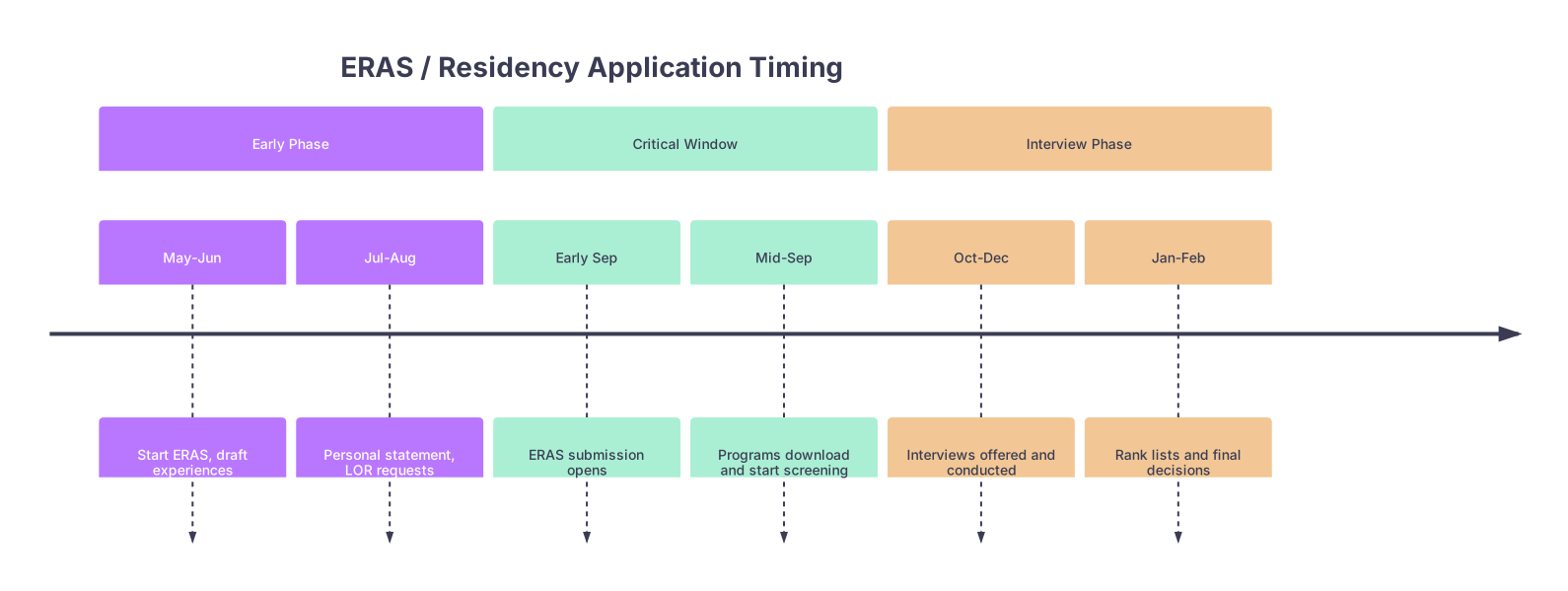
| Period | Event |
|---|---|
| Early Phase - May-Jun | Start ERAS, draft experiences |
| Early Phase - Jul-Aug | Personal statement, LOR requests |
| Critical Window - Early Sep | ERAS submission opens |
| Critical Window - Mid-Sep | Programs download and start screening |
| Interview Phase - Oct-Dec | Interviews offered and conducted |
| Interview Phase - Jan-Feb | Rank lists and final decisions |
The key danger: procrastination that pushes you from “early/normal” into “late/ignored.” You can be a 250+ Step 2, AOA, solid research applicant and still get skipped if your file is incomplete when they build their first interview batch.
So let’s talk about the patterns that actually push you over that invisible line.
Pattern #1: “I’ll Just Polish It a Bit More” (Perfectionist Delay)
This is probably the most common trap among strong applicants. And one of the most expensive.
The script in your head sounds like:
- “My personal statement isn’t quite there yet, I’ll wait a week.”
- “I want to rethink how I ordered my experiences.”
- “I should really get one more person to review it.”
Reasonable? Sure. For May, June, July. But I’ve watched people still “polishing” on the night before programs download applications. Some finish. Some don’t. Both pay a price.
How this pushes you out of the safe window:
- You move from submitting in the first 1–3 days to 1–2 weeks later.
- You submit after programs have already:
- Filtered by Step scores, school, and red flags
- Pulled their first (sometimes biggest) batch of interview invites
- Your app gets reviewed, if at all, when:
- They’re already near capacity for interviews
- They’re comparing you only to other late applicants instead of the full pool
The ugly truth: many programs don’t keep reviewing with the same intensity after the first wave. They triage. They get tired. They start protecting time.
Red flags you’re in this pattern:
- You’ve rewritten your personal statement more than 6–7 times and are still not satisfied.
- You’re doing cosmetic edits (moving commas, reordering sentences) instead of fixing actual content.
- You catch yourself thinking “Better to be a little late but perfect.”
Let me be very clear: A “B+ but on-time” personal statement beats an “A+ but late” personal statement every single time.
How to avoid this mistake:
- Set a hard final-draft date for your personal statement at least 2 weeks before ERAS submission opens.
- Limit yourself to 3–4 full revisions, not endless tinkering.
- Use a rule: If an edit doesn’t clearly improve clarity or content, delete the edit and move on.
Perfection is a luxury. Timing is not.
Pattern #2: “I’ll Submit Now and Fix Later” (Incomplete-File Fantasy)
The opposite group fools themselves in a different way.
They say: “I’ll just submit ERAS on day one to be early. I can always update as letters and scores come in.”
Then they’re shocked when:
- Programs don’t invite them.
- Their application was technically “submitted” early, but not complete when programs made decisions.
Here’s what actually matters: when your file is meaningfully reviewable — not just when you hit submit.
That means:
- Your personal statement: Final.
- Your experiences: Filled and edited.
- Your key letters of recommendation: Uploaded or at least realistically coming very soon.
- Your Step scores: At least Step 1 and ideally Step 2 if your Step 1 is pass-only and not spectacular.
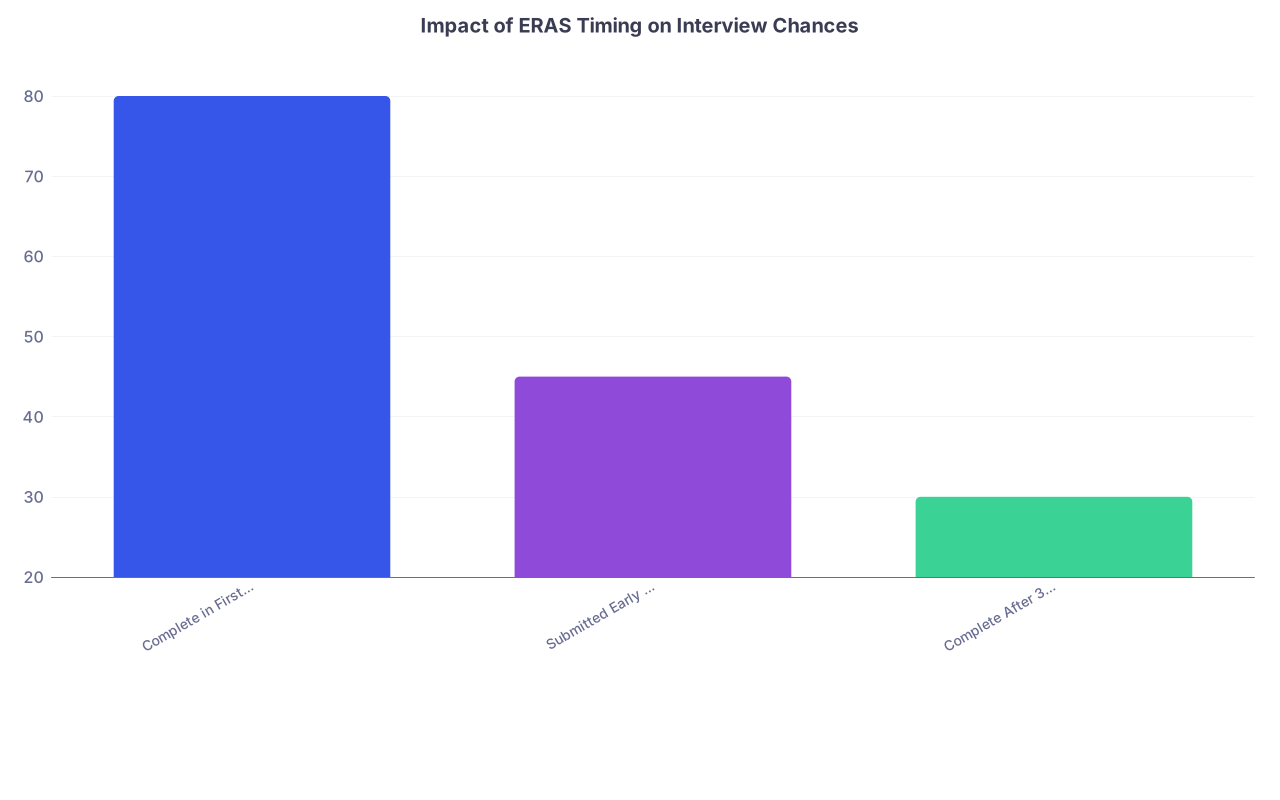
| Category | Value |
|---|---|
| Complete in First Week | 80 |
| Submitted Early but Incomplete | 45 |
| Complete After 3+ Weeks | 30 |
You don’t want to be in the second bar. That’s the fake-early crowd.
How this pattern pushes you past the safe window:
- Programs filter by “complete applications” first. If yours is incomplete, you’re not in the first sweep.
- Your letters come in after they’ve already created their main invite list.
- Some programs barely go back to late-completers unless they’re outrageously strong or have a connection.
Red flags you’re doing this:
- You’re submitting without your strongest specialty-specific letter in place.
- You’re assuming a late letter from a “big name” will rescue a weak early file.
- You’re spreading applications before your Step 2 score posts, even though your Step 1 is just pass or marginal.
How to avoid this mistake:
- Identify your minimum viable complete file:
- Personal statement for that specialty
- 2–3 letters, at least 1–2 in specialty
- All experiences entered and proofread
- Board scores that don’t raise avoidable questions
- Make a simple rule: If a program downloaded today, would I be okay being judged on what they see? If the answer is no, you’re not ready to submit.
Better to take 2–3 more days and send a solid, complete application than to LARP as an “early applicant” with a half-built file.
Pattern #3: “I Can Finish Everything in One Big Push” (ERAS Underestimation)
Students consistently underestimate how long ERAS actually takes if you do it right.
They leave the bulk of it for “when I have more time.” Usually August. Then sub-internships hit, Step 2 scores come back, life happens, and suddenly they’re trying to build their application in one caffeine-fueled week.
That’s how you miss the safe window without even realizing it slipped by.
Here’s what usually gets underestimated:
Experience entries
Writing meaningful bullet points, choosing meaningful responsibilities, not sounding like ChatGPT wrote your entire section.Program list research
Not just “I’ll apply to 60 internal medicine programs” but a filtered, realistic list based on:- Your scores
- IMG vs AMG
- Geographic ties
- Visa requirements if applicable
Tailored personal statements
At least:- One per specialty
- Sometimes a version for academic vs community or for competitive vs mid-tier programs
I’ve watched students say:
“I’ll crank out ERAS over one weekend.”
Then Monday comes, and they’ve written half a personal statement and four experiences. The rest spills into weeks.
How this pushes you out of the safe window:
- Your intended “submit on opening day” becomes “submit 10–14 days later.”
- You start cutting corners — sloppy experiences, generic PS, rushed proofreading.
- You delay program selection until after submission, then slowly add more programs later, when they’re already full of apps.
How to avoid this mistake:
Break ERAS into bites, not one massive project.
Start early with a loose schedule like this:
| Timeframe (Pre-Submission) | Main Tasks |
|---|---|
| 8–10 weeks before | Draft experiences, basic CV data |
| 6–8 weeks before | First PS draft, identify letter writers |
| 4–6 weeks before | Program research, refine experiences |
| 2–4 weeks before | Finalize PS, confirm letters uploaded |
| Final 1–2 weeks | Proofread, finalize program list, submit |
This is not “over-prepared.” This is what it takes to not panic at the end.
If you’re telling yourself you’ll “do ERAS” right before the deadline, you’re planning to be late and just haven’t admitted it yet.
Pattern #4: “I’ll Just Wait for That One Last Thing” (The Moving Goalpost)
This one looks rational on the surface. You delay submitting because:
- A new letter might come in from a well-known attending.
- A paper might be accepted.
- A Step 2 retake might go better.
- A rotation might generate a stronger narrative.
So you wait.
Then:
- The paper is still “under review.”
- The attending is late with the letter.
- The Step 2 score posts after many interview invites already went out.
- The rotation ends right when programs are already deep into invite season.
I’ve watched someone delay submitting ERAS for 10 days waiting for a department chair letter that never uploaded. Then they matched at a place far below their potential with their already-solid existing letters.
How this pushes you out of the safe window:
You keep moving your “submit date” based on something uncertain and outside your control. Each week of delay:
- Drops you lower in program review queues.
- Moves you from “initial screening” to “maybe we’ll circle back if we still have spots.”
There are only two categories worth waiting for:
A Step 2 score that you know will significantly fix a Step 1 problem
Example: Step 1 = Pass with marginal school performance, Step 2 practice tests are much higher and will demonstrably change how you look on paper.A truly critical letter in a hyper-competitive specialty
Example: Derm, ortho, neurosurgery, ENT — and you’re waiting on a letter from the PD or a famous faculty who knows you well and actually writes.
But even then, there’s a limit. You don’t hold your entire application hostage indefinitely.
Better approach:
- Submit on time with the strong materials you already have.
- Let new letters and updates supplement your app, not determine whether it exists.
If something “might” come in, don’t push yourself out of the safe window for it. ERAS rewards the good and early more than the perfect and late.
Pattern #5: “Program Selection? I’ll Just Add More Later” (Slow-Add Trap)
I’ve seen this more times than I like.
Student submits ERAS with 20–25 programs “just to get something in” and plans to “add more later if needed.” By the time they finally pad their list to a reasonable number, many programs are already post-first wave of interview offers.
Here’s the problem: programs can only review what’s in their pile at the time they’re doing their major screening. If you don’t apply to them until three weeks after downloads open, you’re walking into a half-empty grocery store at closing time and expecting fresh fruit.
How this pattern hurts you:
- You’re “technically early” with ERAS but late for many programs.
- Your late-added programs are seeing you when:
- Interview slots are mostly filled.
- They already have a full spread of applicants across score ranges.
Especially dangerous if:
- You’re in a competitive specialty (Ortho, Derm, EM in tight years, ENT, etc.).
- You’re an IMG or DO applying to a historically MD-heavy field.
- Your geography is restricted (you only want one state/region).
What to do instead:
- Have your full target list ready before you submit.
- Aim to submit to the majority of your programs in the first batch, not as a trickle.
- Only add programs later as:
- Strategic backups if interviews are clearly limited
- Geographic expansions when original regions underperform
Procrastinating on program selection is just a stealth way of procrastinating on your entire cycle.
Pattern #6: “I Don’t Want to Think About It Yet” (Avoidance by Overwhelm)
This one’s simple and brutal: ERAS feels huge and scary, so you avoid it. You “focus on rotations.” You “will do it on your off week.” You convince yourself everyone else is also behind.
They’re not.
Your avoidance might look like:
- Constantly asking classmates “When are you planning to submit?” while not opening ERAS yourself.
- Tweaking your CV, but never actually transferring it into ERAS.
- Endlessly reading online forums instead of writing your experiences or PS.
This isn’t laziness. It’s anxiety. But the effect is the same: you start late, you move slow, and by the time you feel “ready,” the safe window is closing.
Specific warning signs:
- You haven’t logged into ERAS in over a week while telling people you’re “working on it.”
- You keep asking detailed process questions as a way to avoid actually writing anything.
- The thought of opening a blank personal statement document makes you physically tense.
How to protect yourself:
- Use very small, mechanical tasks to break the avoidance:
- Log into ERAS and fill in your demographics. That’s it.
- Next day: enter 2 experiences only.
- Next: draft a bullet list for your PS, not full paragraphs.
- Commit to time-based work, not outcome-based:
- “I’ll work on ERAS for 25 minutes today” instead of “I’ll finish my PS today.”
You don’t have to feel ready. You have to be moving.
Pattern #7: “My School Will Guide Me” (Institutional Complacency)
Another quiet killer: assuming your school’s timeline equals a safe timeline for you.
Some schools:
- Have late MSPE release cultures.
- Encourage students to wait for faculty feedback on PS drafts that takes weeks.
- Hold mock interview seasons that distract you from actually submitting early.
Your Dean’s Office cares about you, but they’re not the ones facing a blank interview calendar in November.
Common institutional traps:
- “We’ll review your PS in September” — which is when you should already be done.
- “We recommend you request letters by this date” — but faculty actually write 3–4 weeks later.
- “We’ll help build your program list” — except group sessions run close to or even after submission opens.
What to do instead:
- Use your school’s resources, but build your own earlier timeline.
- Ask upper-year residents from your school:
“When did you actually submit? When do you wish you had submitted?” - If your school timeline feels late, it probably is. Adjust.
Your application risks are personal. Your school’s process is generic.
The One Thing You Cannot Afford to Get Wrong
If you remember nothing else:
Do not let perfect, or fear, or hope for some future “upgrade” push your ERAS submission and completion beyond the early window.
You cannot control how competitive the year will be.
You cannot control who else applies to your specialty.
You can control whether your application is:
- Complete
- Coherent
- In front of programs while they still have open chairs at the interview table
Final Takeaways
- Early and complete beats perfect and late. A solid, on-time file is safer than a slightly better version submitted after programs already pulled their first interview list.
- Watch for the seven patterns. Perfectionism, fake-early submission, underestimating ERAS, waiting for “one last thing,” slow program adding, anxiety avoidance, and blind trust in school timelines all quietly push you out of the safe zone.
- Set your own hard deadlines. Decide now when your PS, experiences, letters, and program list will be done — and treat those dates as if your Match depends on them. Because it does.
Protect your candidacy from your own delays. The Match is unpredictable enough without you sabotaging your timing.