
Most residents who get burned by ERAS letters of recommendation do not get burned on content. They get burned on timing.
You can write a beautiful personal statement, crush Step 2, have glowing LORs—and still quietly damage your application because you misunderstood how ERAS handles letters, locks, and timing. I’ve watched people do it every single cycle.
Let’s walk through the traps so you do not join them.
The Biggest Myth: “I’ll Just Wait To Submit Until All My LORs Are In”
This is the first and most expensive mistake.
People tell themselves:
“I’ll submit ERAS once all my letters are uploaded. I don’t want to send an incomplete application.”
That thinking costs interviews every year.
Here’s the truth you need burned into your brain:
- Programs see your application submission date, not the exact time your final LOR arrives.
- You can submit ERAS and assign letters later as they come in.
- Being early with a complete-enough application usually beats being late with a “perfect” one.
Programs start reviewing applications right when they’re released. If you hold your whole app hostage waiting for that last “superstar” letter, you’re voluntarily stepping into the late-review pool.
What this delay really looks like in practice
Scenario I’ve seen too many times:
- You have 2–3 solid letters already uploaded by early September.
- You’re waiting on the “big name” chair letter that keeps getting “I’ll get to it this weekend” emails.
- You tell yourself: “I’ll submit once that one is in. It’s important for academic programs.”
Result:
- ERAS opens for submission. You don’t submit.
- Programs download applications on opening day. You’re not in that first wave.
- Your chair letter finally appears two weeks later.
- You submit then—now you’re late for a lot of top programs that front-load their reviews.
Do not do this.
Submit on time with the letters you already have, then add and assign new LORs as they arrive. Most programs will not sit there judging you because one more letter came in a week later. But they will absolutely notice if your entire application showed up late.
How ERAS LOR Timing Actually Works (Where People Get Confused)
Most timing mistakes come from misunderstanding what’s locked and what isn’t. Let’s straighten it out.
Key rules you cannot afford to get wrong
- You can create, edit, and delete LOR entries in ERAS as long as the letter has not yet been uploaded by the writer.
- Once an LOR is uploaded, the entry is locked. You cannot:
- Edit the letter type
- Change the writer’s name
- Convert a “non-specialty specific” letter to a “chair” letter, etc.
- You can still choose which programs each letter is assigned to at any time (before you apply to that program).
- After you hit “Apply” to a program, the LOR assignments to that specific program are locked for that program.
That last line is where people sabotage themselves.
You’re allowed to:
- Add new LORs later in the season
- Assign new LORs to programs you haven’t applied to yet
- But for a program you already applied to? Once you submit that application, the letter mix that program sees is frozen.
If you don’t internalize that, you’ll make the next mistake.
Mistake #1: Applying to Programs Before You’ve Assigned the Right LOR Mix
This one happens in a late-night panic around the ERAS submission opening.
You think:
“I just need to hit submit to be early—I’ll fix the letters and personal statements later.”
No. That is not how this works.
Once you apply to a program:
- Your LOR selections for that program are locked.
- You cannot later switch out the random generic medicine letter for the strong specialty letter that arrives next week.
- That program will never see that better letter. Ever. Unless you waive ERAS and email them begging (which rarely works and can look disorganized).
What you should avoid doing
- Applying to all your programs on Day 1 with:
- 1 generic internal medicine letter
- 1 outdated letter from a preclinical mentor
- 1 “To Whom It May Concern” research letter
- And telling yourself: “I’ll assign the away rotation letter when it’s ready”
Wrong. That away letter won’t attach retroactively to the programs you already applied to.
The safer approach
Before you hit apply on any program:
- Make sure you’ve assigned an acceptable set of letters to that specific program—even if it’s not your “perfect dream combo” yet.
- Then submit.
- For higher-priority programs, you might reasonably wait a few days if a critical letter is truly imminent—while still meeting that early-to-mid submission window.
Use strategy, not panic.
Mistake #2: Treating All Specialties the Same for LOR Timing
Different specialties care about different letter patterns. If you ignore that, your timing decisions can quietly kneecap you.
Here’s where timing bites:
- Some specialties strongly prefer 3+ specialty-specific letters (e.g., ortho, derm, neurosurgery). Waiting on these may be more justified—but not by weeks.
- Some fields are fine with a mix of specialty + medicine/pediatrics letters, especially early on (e.g., EM, psych, FM).
If you apply like all fields behave the same, you either:
- Submit too early with the wrong letters for competitive specialties, or
- Submit too late waiting on “ideal” combinations in fields where that doesn’t matter as much as timing.
| Specialty Type | Priority of Specialty-Specific LORs | Risk of Submitting with General Letters Only |
|---|---|---|
| Ortho / Derm / ENT | Very High | High |
| Gen Surg / Neuro Surg | Very High | High |
| Internal Med | Moderate | Moderate |
| Pediatrics | Moderate | Moderate |
| Family Med / Psych | Low–Moderate | Lower |
You still do not delay 3 weeks. But if you have to make trade-offs, do it intelligently based on the field’s norms, not your imagination.
Mistake #3: Confusing “Creating” an Application With “Submitting” It
Another quiet timing killer: people don’t understand that building your ERAS and submitting it are two different things.
Here’s the pattern:
- You spend weeks filling out ERAS details, experiences, personal statement uploads, etc.
- You think “My app is basically in the system; programs will see I was early.”
- You do not actually click submit when the window opens. You’re waiting on that last LOR.
Programs do not care that you “had it all ready in the system.” They see when you submitted.
So what’s the mistake?
- Confusing “ERAS is 90% complete” with “I’m early.”
- Letting one missing letter stall the submission of everything else.
Here’s what you should actually do:
- Have your whole ERAS ready to submit (minus maybe 1 letter) before the submission window.
- Submit as early as strategically safe. Aim for that first wave once applications can be transmitted.
- Then continue to add letters and assign them to programs you haven’t applied to yet or build them into a second wave of applications if needed.
Mistake #4: Not Labeling and Organizing LORs Before They’re Uploaded
This one is subtle but nasty. It won’t kill your timing, but it will cause assignment errors that you can’t fix later.
Common screw-ups:
- You create vague letter entries like “Dr. Smith letter #1” and “Dr. Smith IM.”
- You forget which one is the sub-I letter vs clinic letter.
- The writer uploads to the wrong slot.
- Now you have a “Sub-I IM” label on a generic outpatient letter that can’t be relabeled.
Then you start assigning the wrong-letter-wrong-label mix to programs.
Do not wait until late September at midnight to sort this out.
Set up your LOR entries cleanly before anyone uploads a thing:
- Label by specialty + rotation type + writer
Example: “Internal Medicine – Sub‑I – Dr. Jones (Hospital A)” - Double-check which ERAS category you’re choosing:
- Chair letter
- Department letter
- Specialty letter
- General letter
Once uploaded, the entry type and title are locked. If you messed it up, you may have:
- A “Chair letter” that’s not actually from the chair
- A “Dermatology letter” from your primary care preceptor
- Confusion when assigning letters to derm vs prelim medicine programs
Mistake #5: Not Matching LOR Timing With Your Personal Statement & Program Type
You’re not just sending letters into the void. They should match the story you’re telling with:
- Your personal statement
- Your experience entries
- The type of program (categorical vs prelim vs transitional, academic vs community)
Timing screw-up I’ve seen:
You apply to:
- Advanced specialty + prelim year + transitional programs
- With one generic personal statement and a pile of LORs mis-timed and mis-assigned.
You then realize in October:
- “I should have sent my prelim programs the strong medicine letter instead of my derm research letter.”
Too late. Once you applied, that letter assignment is frozen for those programs.
Plan this before you submit a single application:
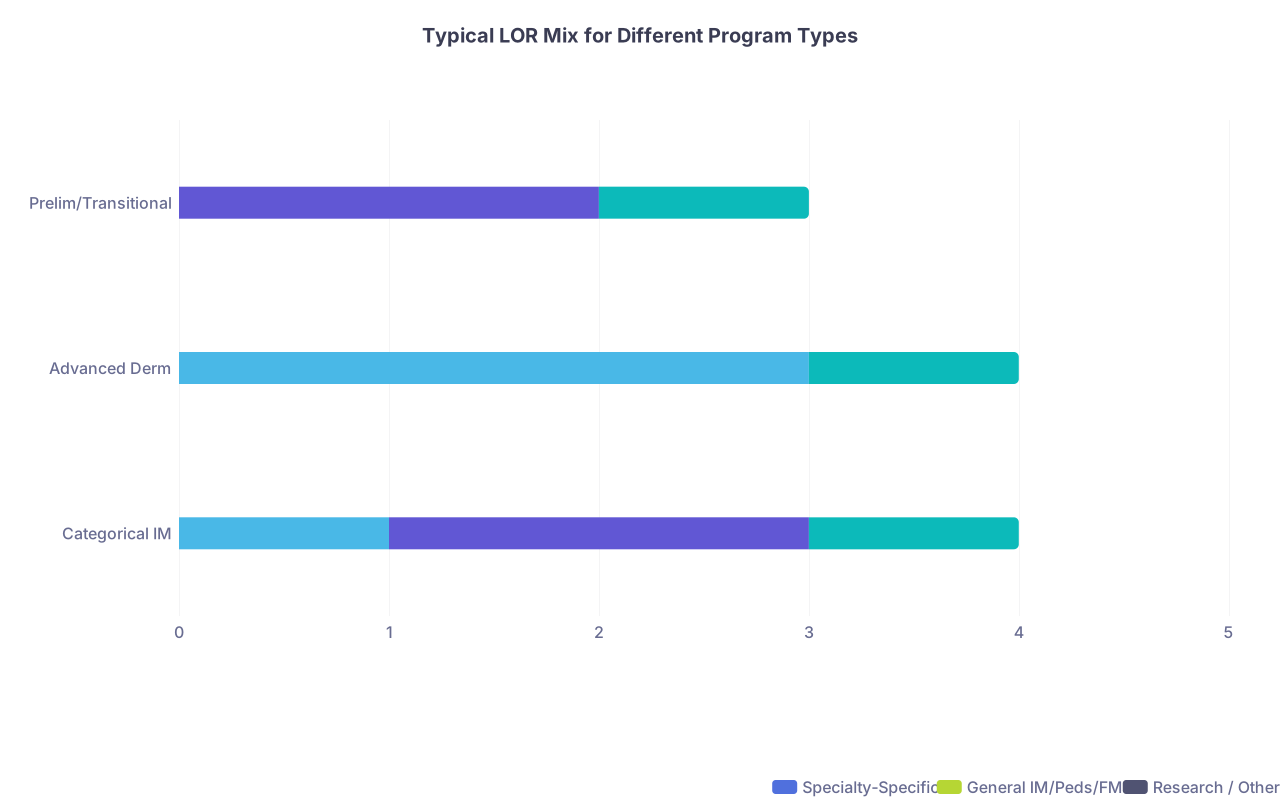
| Category | Specialty-Specific | General IM/Peds/FM | Research / Other |
|---|---|---|---|
| Categorical IM | 1 | 2 | 1 |
| Advanced Derm | 3 | 0 | 1 |
| Prelim/Transitional | 0 | 2 | 1 |
Does this exact distribution apply to every situation? No. But it reminds you that different program types need different letter strategies, and those strategies only work if you assign correctly before you apply.
Mistake #6: Ignoring Program-Specific LOR Requirements Until After You Submit
Another timing failure: you submit broadly, then start reading program websites later.
Then you discover:
- Some programs require a chair letter
- Some insist on at least two specialty-specific letters
- Some strictly cap letters at 3 and won’t consider extras
- Some want one letter from your home institution specifically
If your assigned LORs don’t meet those requirements when you apply, your file may:
- Sit as “technically incomplete”
- Get auto-screened out
- Or look like you didn’t bother to read instructions
And again: for programs you’ve already applied to, you usually cannot fix the letter mix later.
At minimum, before you apply to any given program:
- Glance at their website’s application requirements
- Confirm your currently available LORs can satisfy their basics
- If not, decide whether you:
- Wait a few days for a missing required letter (if it’s truly imminent), or
- Accept that this year that program is not realistic for you
Mistake #7: Assuming More Letters = Better, Regardless of When They Arrive
ERAS lets you assign up to four letters per program. People interpret that as: “I should have four for every single program, even if that means waiting.”
No.
Programs are not sitting around thinking: “This applicant has three letters instead of four; immediate rejection.”
But they do sort you into batches by when your full application (including enough letters) was available to review.
I’ve seen plenty of strong applicants:
- Submit on time with 3 very solid letters
- Get tons of interviews
- Then add a 4th later for a few later-applied programs or updates
That’s much better than:
- Waiting weeks so you can hit some magical “4-letter perfection”
- Sliding into the late-review group for no good reason
Would I prefer 3 excellent letters early or 4 letters late? Every cycle, I’d take the early three.
Mistake #8: Believing You Can “Fix” Letter Timing With Post-Submission Emails
Here’s the fantasy:
“I’ll just email programs once my new LOR is in and ask them to consider it. They’ll update my file manually.”
Reality:
- Many programs do not have capacity to manually attach late letters to already-downloaded files.
- Some explicitly say: “We only review documents in ERAS as of initial download.”
- Your email with an attached PDF letter often:
- Goes to a generic inbox
- Gets politely acknowledged
- Never truly integrates into your evaluation
Don’t build a timing strategy around hoping coordinators will patch your application by hand. That’s not a strategy; that’s wishful thinking.
Your best shot is getting the right letter mix assigned in ERAS before you hit “Apply” for each program.
Smart, Safe Workflow: Minimizing LOR Timing Mistakes
Let me lay out a saner way to handle this, step-wise.

| Step | Description |
|---|---|
| Step 1 | Identify Letter Writers Early |
| Step 2 | Create Clear LOR Entries in ERAS |
| Step 3 | Request Letters 2-3 Months Before Deadline |
| Step 4 | Track Upload Status Weekly |
| Step 5 | Assign Letters to Priority Programs |
| Step 6 | Reminder Emails / Backups |
| Step 7 | Submit ERAS Early |
| Step 8 | Assign New Letters to Later Programs |
| Step 9 | At Least 2-3 Solid Letters Uploaded? |
Core principles in that flow:
- You don’t wait for perfection to submit.
- You do wait to apply to a program until it has a minimally acceptable set of letters assigned.
- You don’t assume you can change letters for a program once you’ve applied.
- You keep watching for new letters and use them strategically for second-wave programs or for specialties/program tiers where they matter most.
Final Red Flags to Watch in Yourself
If you catch yourself saying any of these, stop and reassess:
- “I’ll just wait on submitting ERAS until all four letters are in.”
- “I’ll apply now and fix the letter assignments later once my away rotation letter is uploaded.”
- “I’ll just send them an email with my updated letter and they’ll add it.”
- “It doesn’t matter what order I do this in; the important thing is everything is in by October.”
That’s how strong candidates quietly downgrade their own applications.
The Bottom Line
Three things to keep front and center:
- Submit ERAS early with a good-enough letter set, then add letters for later programs—don’t hold your entire application hostage to one slow writer.
- Once you apply to a program, your LOR assignments to that program are frozen. Get the mix right before you click “Apply.”
- Organize, label, and plan your LORs by specialty and program type in advance; timing errors here are rarely fixable later and quietly cost you interviews.