
“I’ll submit after my Sub-I” is the quiet sentence that tanks more ERAS applications than a mediocre Step score.
You think you are being strategic. “I’ll crush my sub-internship, get a great letter, then submit a stronger application.” What you are actually doing, in most specialties, is volunteering to start the race after everyone else has already run two laps.
Let me be blunt: in the current residency match environment, late ERAS submission is a self‑inflicted wound. And tying that delay to your sub-I “so I can get that one more letter” is one of the most common, most preventable mistakes I see.
You are not playing 4D chess. You are handing away interview slots.
The Reality You Do Not See: How Programs Actually Handle Timing
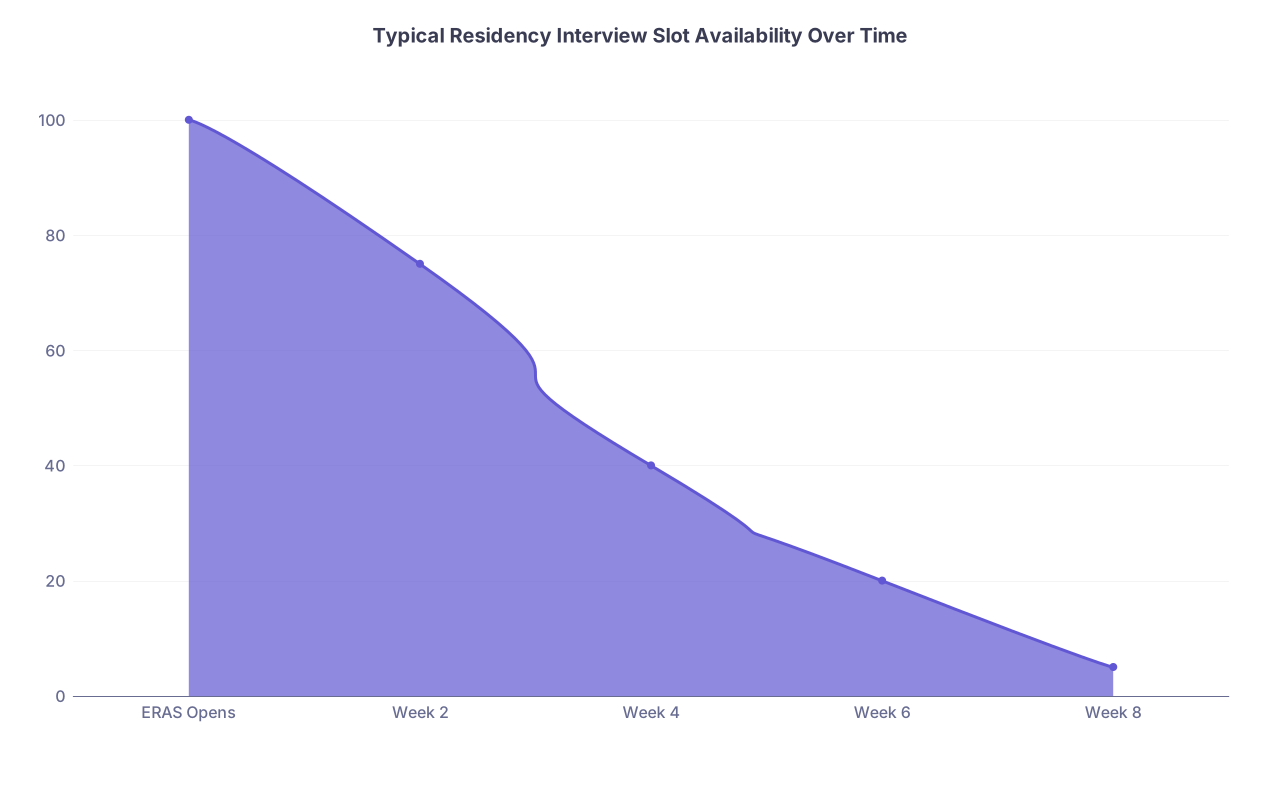
| Category | Value |
|---|---|
| ERAS Opens | 100 |
| Week 2 | 75 |
| Week 4 | 40 |
| Week 6 | 20 |
| Week 8 | 5 |
You see your individual application. Programs see piles.
There are a few ugly truths students consistently underestimate:
Programs start screening as soon as applications are available.
- Many PDs and coordinators block time in the first 1–3 weeks after ERAS opens to review applications and send the first wave of invites.
- By the time you “finally submit after my sub-I,” they have already pre-screened hundreds or thousands of files.
Early batches get disproportionate attention.
I have literally heard versions of this from PDs and selection committee members:- “We do our serious screening in the first two weeks.”
- “After that, it is mostly spot-checking and backfilling no-shows.”
- “Late files only get a look if they are clearly exceptional.”
Interview spots are not infinite.
- Many competitive programs fill 60–80% of their interview calendar from the first serious screening batch.
- The remaining spots are used for:
- Internal candidates
- Couples match logistics
- Late board scores for already-flagged applicants
- Rare, stand-out late finds (this is not you “hoping” to be the exception)
Your application is timestamped.
They can see when you submitted. A mid-October “completed” date in something like ortho, derm, plastics, ENT, EM, or anesthesia is a giant red flag. It often reads as: disorganized, under-informed, or scrambling.
So when you tell yourself, “I’ll wait until I have that Sub-I letter, then I’ll submit a really strong ERAS,” what you are doing is trading:
- A maybe slightly stronger application on paper
for - A definitely smaller pool of interview spots and much less thorough review.
That is a bad trade.
The “After My Sub-I” Fantasy vs. The Actual Timeline
Here is the fantasy script I hear every year:
“My Sub-I is in August. I’ll do amazing, get a letter, get it uploaded quickly, and submit ERAS in late September when I look my best.”
Now, let’s look at what actually happens on the ground.
The Real Timing Disaster
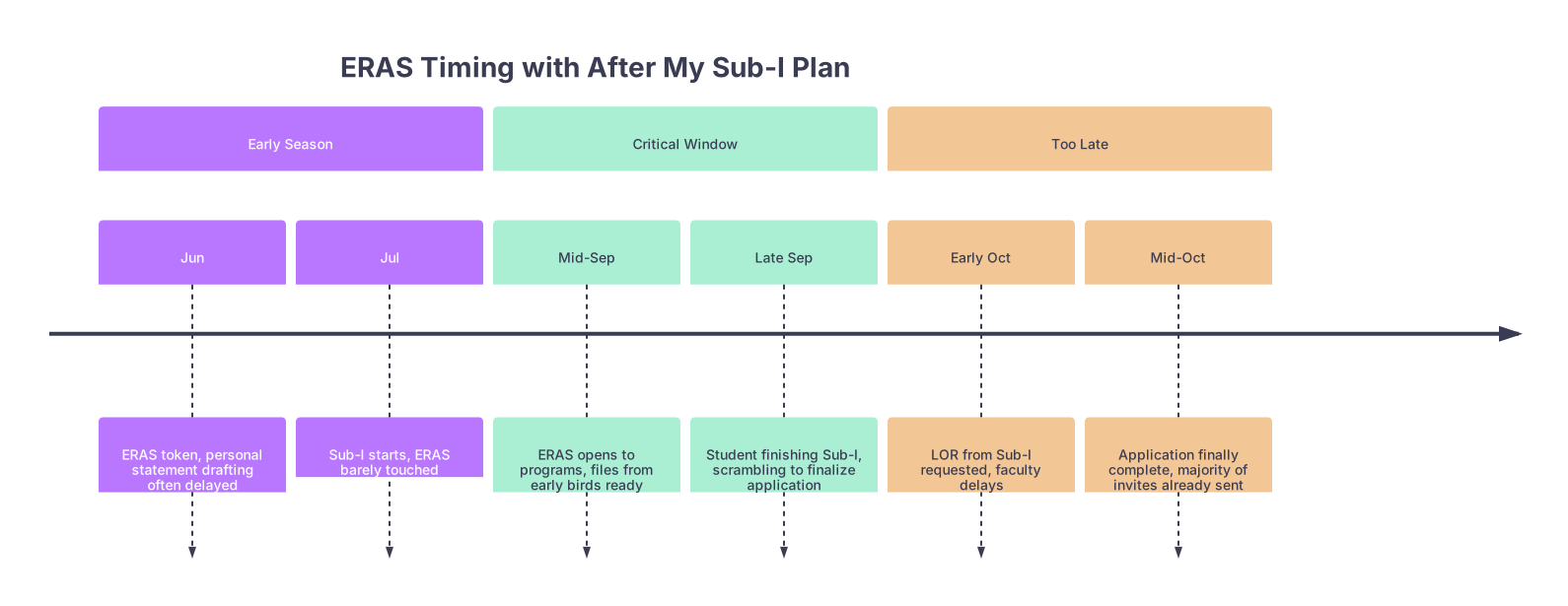
| Period | Event |
|---|---|
| Early Season - Jun | ERAS token, personal statement drafting often delayed |
| Early Season - Jul | Sub-I starts, ERAS barely touched |
| Critical Window - Mid-Sep | ERAS opens to programs, files from early birds ready |
| Critical Window - Late Sep | Student finishing Sub-I, scrambling to finalize application |
| Too Late - Early Oct | LOR from Sub-I requested, faculty delays |
| Too Late - Mid-Oct | Application finally complete, majority of invites already sent |
Let me walk through the bottlenecks you are pretending do not exist:
Faculty do not write letters on your timeline.
- You finish your sub-I on August 31.
- You request the letter September 1.
- Faculty says, “Sure, happy to write it this week.”
- It gets uploaded… September 28. Or October 10. Or never.
I have watched this play out dozens of times. Faculty are busy. Your “needed urgently” email is not their top priority.
You do not magically become hyper-efficient after a busy sub-I.
- You tell yourself you will “use nights and weekends” of that month to refine your personal statement, update CV entries, polish everything.
- In reality: you are exhausted, you barely keep up with notes, and ERAS sits half-finished.
- By the time the sub-I ends, you are sprinting to patch together last-minute edits, fight with ERAS formatting, and chase letter writers.
ERAS ‘complete date’ matters more than you think.
Programs do not treat “submitted but missing key letters” and “fully complete and ready” as equivalent. Many run filters only on complete files.
Your effective timeline is when:- Application submitted
- USMLE scores in
- Required letters (often 3, sometimes 4) uploaded
If your third or fourth letter is the Sub-I one and it arrives in mid-October, you are late, even if you technically clicked “submit” in September.
Earlier letters are usually “good enough.”
This is the cruel part. The marginal benefit of one more letter vs the cost of being considered late? It rarely favors delay.
The typical PD is asking:- Are there solid clinical letters?
- Does anyone say “I do not recommend this student”?
- Is this person safe, teachable, reasonable to work with at 3 AM?
Your fantasy of a “glowing Sub-I letter that changes everything” is usually not how these decisions really get made.
Specialties Where “I’ll Submit After My Sub-I” Is Especially Dangerous
Some fields are more forgiving on timing. Some are absolutely not.
Here is where you really cannot afford this mistake.
| Specialty | Risk of Delaying for Sub-I Letter | Notes |
|---|---|---|
| Dermatology | Extreme | Hyper-competitive, early reads |
| Orthopedic Surgery | Extreme | Early invites dominate |
| ENT | Extreme | Programs front-load interviews |
| Plastic Surgery | Extreme | Very few spots, early screens |
| Emergency Medicine | High | Early SVI/standardized letters |
| Anesthesiology | High | Early wave fills many slots |
If you are applying to a competitive specialty:
- Late September submission is already drifting into risky territory.
- October completion is usually a problem.
I have seen solid applicants – >250 Step 2, strong home letters, real research – get predictably clobbered in interview numbers simply because their file only became complete in mid-October. Then I have to listen to them say, “But my sub-I letter was great. He said I was one of the best students.”
Yes. But the committee never read it. They had already filled most invitations three weeks earlier.
The Real Opportunity Cost: What You Are Giving Up
The cost of “I’ll submit after my Sub-I” is not theoretical. It shows up concretely:
1. Fewer Interview Invitations
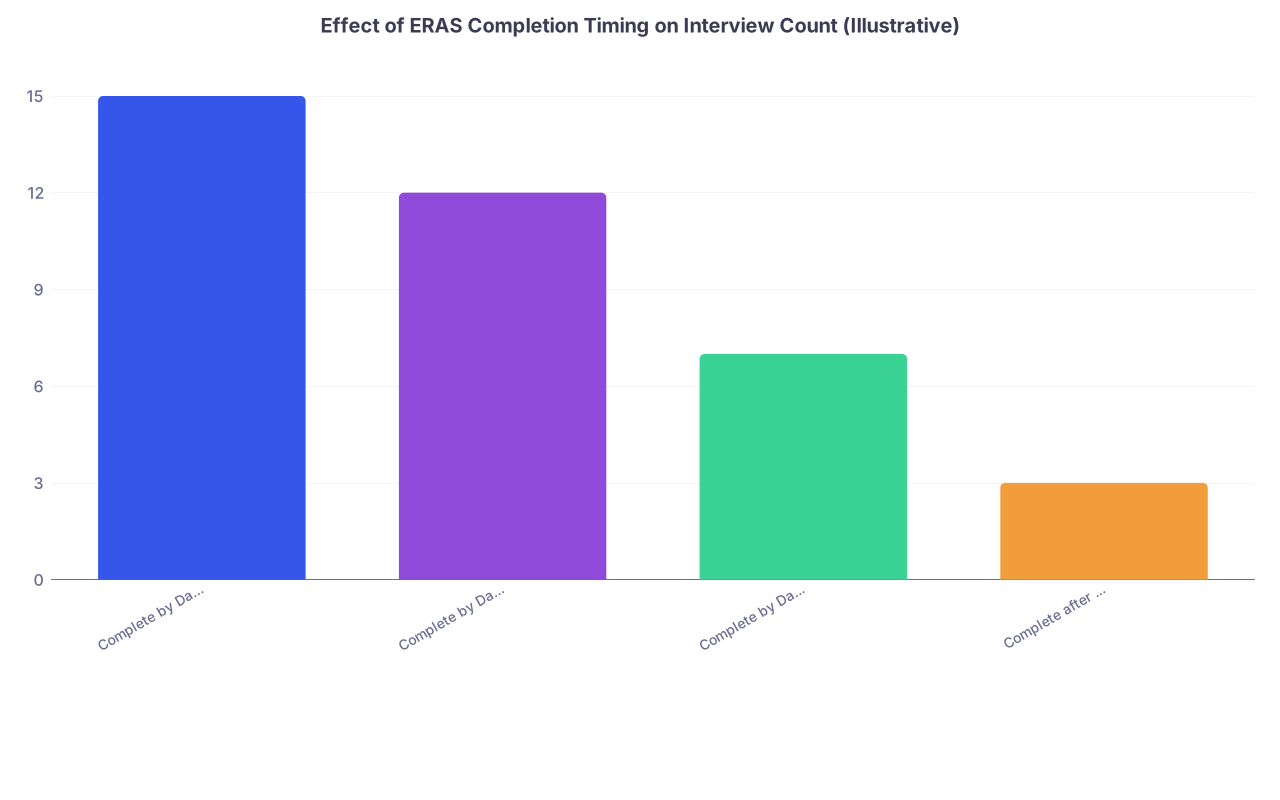
| Category | Value |
|---|---|
| Complete by Day 1 | 15 |
| Complete by Day 14 | 12 |
| Complete by Day 30 | 7 |
| Complete after Day 45 | 3 |
The pattern I see over and over:
- Early complete (Day 1–7):
- Interview numbers in a competitive range for their stats and specialty.
- Moderately early (Day 8–21):
- Slight drop, but still fine.
- Late (after Day 30):
- Uncomfortable interview counts for the same level of applicant.
- Very late (after Day 45):
- Panic. Scramble. SOAP discussions.
The painful part? Often the later group is not academically weaker. Just slower. And “slower” is a fixable problem.
2. Less Flexibility for Red Flags
If you have any of the following:
- Step 1 failure or big gap
- A leave of absence
- Lower-than-average Step 2
- Limited home support in the specialty
You cannot afford to handicap yourself with poor timing. You need:
- Maximum number of programs actually reading your file
- Maximum chance for someone to say, “Let us invite them and see”
Instead, by delaying, you are asking overworked committee members to dig into a late file with red flags when they already have more-than-qualified applicants who were early and clean. They will not.
3. Compressed Season = More Stress, Worse Performance
When you delay submission:
- You get:
- Later interview offers
- Compressed interview schedules
- Travel chaos (if in-person) or back-to-back Zoom days with no breaks
You then perform worse because you are exhausted, anxious about low numbers, and constantly refreshing email. That spirals, and you feel it.
A Better Strategy: Submit Early, Update Smartly
You do not need to choose between “early” and “complete.” You need to understand how ERAS actually works and use that to your advantage.
Core Rule: Submit Early, Do Not Wait for Every Last Thing
Here is the safer, smarter version:
Aim to submit ERAS as early as reasonably possible once transmission opens to programs.
Not sloppy. But not perfectionist paralysis either.Submit with enough letters to be credible.
- For most specialties: 3 strong letters (ideally 2 in the specialty if you can)
- Do not stall your entire file over one Sub-I letter.
Add the Sub-I letter when it arrives.
- Programs can see new letters.
- Many will still review late-added information for applicants they have marked as “hold” or “maybe.”
- This is where that excellent sub-I performance actually helps: as a tiebreaker, not as your entry ticket.
What This Looks Like in Practice
Let me spell out a more realistic plan.
June–July:
- Draft personal statement.
- Build ERAS experiences thoughtfully.
- Identify 3 letter writers and request letters early (including at least one from a prior rotation in your chosen field, even if you have a Sub-I later).
Early August (or whenever ERAS opens / editing period starts):
- Polish application.
- Decide on a final-ish program list.
- Finalize personal statement enough that you are not ashamed of it.
When ERAS can first be submitted to programs:
- Submit in that first week or very shortly after.
- Make sure USMLE scores are in.
- Confirm at least 3 letters are uploaded or imminent from reliable writers.
During your Sub-I:
- Work hard.
- Tell your attending you would appreciate a letter, but do not hinge your entire timing on it.
- When the letter eventually appears, you add it into ERAS as an additional letter and assign it to programs strategically (home program, high-priority programs, etc.).
This keeps you in the early or mid review waves while still giving you a path to let your Sub-I shine.
Common Rationalizations – And Why They Are Dangerous
I have heard all the justifications. Most are just fear wrapped in fake strategy.
“But my Sub-I is at my dream program. I need that letter before I apply.”
No.
You need:
- To apply there early so you are not dismissed as a late, disorganized applicant
- To have them see you as already committed when they review applications
Your home / dream program will know you are doing a sub-I there. The letter will matter. But they do not need it to decide to look at you. If anything, early application plus strong in-person performance is more coherent than “We did not see their package until weeks after everyone else.”
“I heard programs keep interviewing into December and January. So timing is not that important.”
Programs run interviews late. They do not do their major reviewing late. There is a difference.
A lot of December/January interviews are:
- Waitlist movements
- Spots created by cancellations
- Extra slots for couples match accommodations
You do not want your plan to depend on end-of-season randomness.
“But my application is weak without that Sub-I letter.”
If your entire candidacy hinges on one month of performance, you have a bigger problem than timing. And guess what delayed timing does? Makes you weaker.
You would do better to:
- Strengthen the parts you can control early (experiences, clear story, solid existing letters)
- Apply more broadly
- Use the Sub-I to potentially bump you from “maybe” to “yes” at a subset of programs
instead of betting everything on that one letter arriving before review waves.
When Waiting Might Be Reasonable – And How Not To Screw It Up
I am not going to pretend there is never a reason to delay. There are rare cases where waiting a brief period makes sense:
- You had a serious health or personal crisis and your file is objectively incomplete.
- You had a Step 2 score pending that would clearly change your competitiveness tier (e.g., you know you did far better than Step 1 and you are applying to a now-score-conscious specialty).
- You made a major, late specialty switch and needed a tiny bit of time to get basic letters and experiences aligned.
Even then, you need discipline:
- Define exactly what you are waiting for (e.g., “Step 2 result on X date”).
- Set a hard stop: “If X is not in by this date, I submit anyway.”
- Do not tie your fate to multiple uncontrollable variables (Sub-I performance, faculty speed, ERAS bugs, your future energy level).
Your bar for “I must delay” should be high. Much higher than “I want one more letter that might be slightly shinier.”
Concrete Warning Signs You Are Drifting Into the “Too Late” Zone
Here are red flags I see in September every year that almost always predict a rough interview season:
- You are still “workshopping” personal statement drafts after ERAS opens to programs.
- You have fewer than 2 letters fully uploaded when people around you are clicking submit.
- Your plan for the third or fourth letter is: “It will come from my Sub-I, which ends close to when programs start reviewing.”
- You are telling classmates, “I am going to wait so everything looks perfect” while they are quietly submitting and moving on.
If that is you, be honest: you are not optimizing strength. You are procrastinating under the guise of “strategy.”
The Short Version: How Not to Sabotage Yourself
Let me compress everything into what actually matters.
ERAS timing is not cosmetic. It is structural.
Submitting late does not just “look bad.” It moves you out of the primary review wave and into the scraps pile in many programs.“I’ll submit after my Sub-I” is a seductive but usually harmful plan.
You trade an imaginary “perfect” application for a very real loss of interview opportunities. The math almost never works in your favor.Submit early with a solid, not perfect, application—and let your Sub-I add value later.
Use that rotation to refine your story and maybe add a strong letter, not to delay your entry into the pool.
You do not control the match. You do control whether you walk into it already behind. Do not let a single month of wishful thinking about your Sub-I be the reason you spend an entire year explaining, “I could have matched if I had just submitted on time.”