
You just hit “submit” on ERAS, and now you’re staring at the calendar. Programs get access next week. Your friends are panicking in group chats about when programs actually start reviewing applications and whether submitting 2 days later is the end of the world.
Here’s the blunt answer: timing matters, but not the way most people think.
This is the guide you actually want: when most programs start reviewing ERAS applications, what “review” really means on their side, and how late is actually late.
The Short Answer: When Do Most Programs Start Reviewing?
Most programs begin actively reviewing ERAS applications within 24–72 hours of the ERAS release date for programs. Some highly organized programs are literally in there on day 1, sorting, filtering, and flagging applicants. Others take a few days to ramp up. A minority wait a week or more, usually smaller or less competitive programs, or programs that are chronically understaffed.
Typical pattern I’ve seen repeatedly:
- ERAS release morning:
Coordinators run filters (Step 2 cutoff, visa status, graduation year, etc.) and generate initial applicant lists. - First 3–5 days after release:
Faculty or PDs start in-depth review, flag top applicants, and create a “priority invite” list. - First 1–2 weeks after release:
First wave of interview invites at many programs, especially competitive specialties.
So if your question is:
“Do programs actually start reading my ERAS the same week they get it?”
Yes, many do.“If I submit a day or two after ERAS opens to programs, am I automatically screwed?”
No. But you are lowering the chance of being in that very first pass for some places.
How Program Review Really Works (From Their Side)
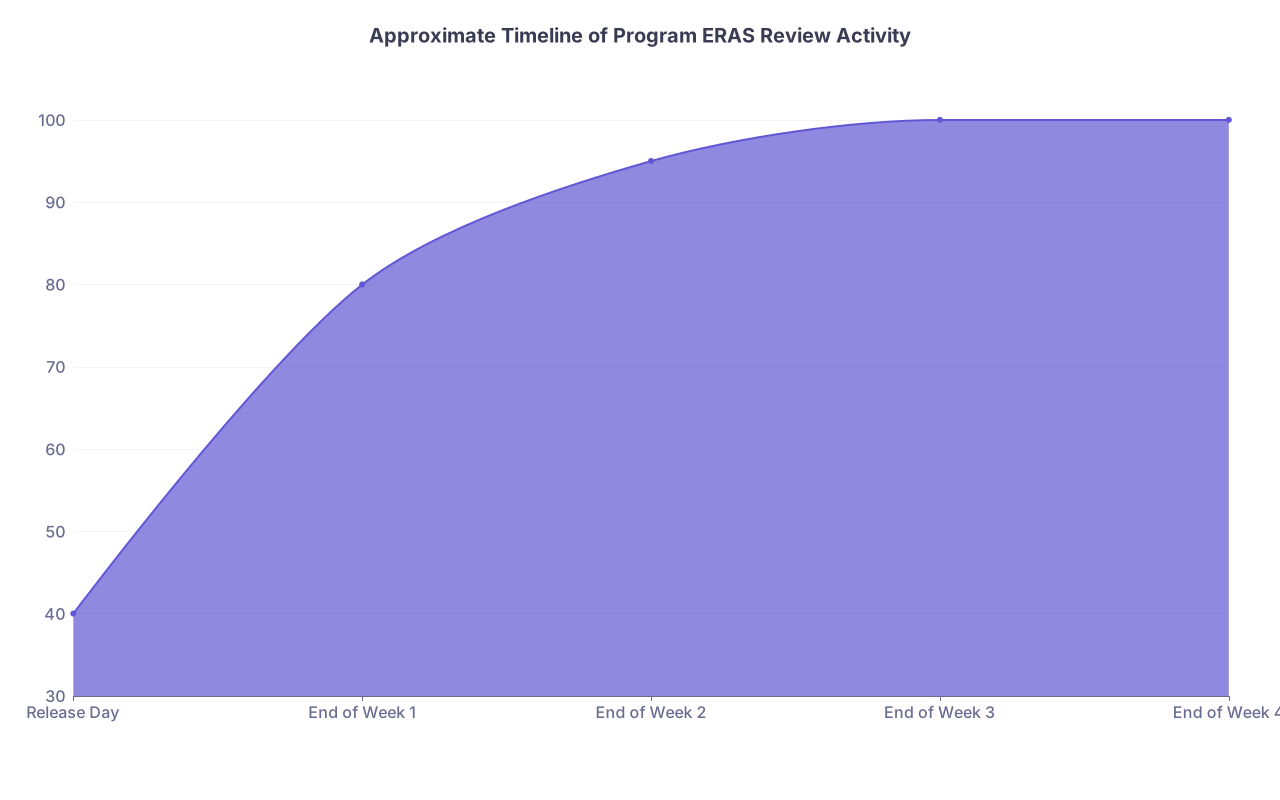
| Category | Value |
|---|---|
| Release Day | 40 |
| End of Week 1 | 80 |
| End of Week 2 | 95 |
| End of Week 3 | 100 |
| End of Week 4 | 100 |
You need to stop imagining one person “starting to review” on a single date. It’s messier than that. Here’s a basic structure most programs use.
Day ERAS Releases to Programs
Program coordinator:
- Logs into ERAS the day applications drop.
- Applies hard filters:
- US vs IMG
- Graduation year (e.g., no grads before 2021)
- USMLE/COMLEX thresholds
- Visa status
- Exports a filtered pool to spreadsheets or internal software.
At this point, your fate may already be partially determined if you don’t meet basic cutoffs. Those rejections can be essentially instantaneous once they run filters.
First 3–7 Days After Release
This is when “review” really starts.
- PDs and core faculty get assigned subsets of applicants.
- Some programs have each faculty member review a certain number per day.
- “Fast-track” categories get highlighted:
- Home students
- Rotators/sub-I’s
- High scores or strong home institutions
- Diversity or mission-fit flags
These first passes create three rough bins:
- Strong / likely invite
- Maybe / hold
- No
A lot of your interview fate at competitive programs is decided in these first 1–2 weeks.
2–4 Weeks After Release
- Second wave reviews for the “maybe” pile
- Filling interview slots that didn’t go to early, obvious choices
- Reviewing late-arriving apps if they still have room
By the end of week 4, many programs in competitive specialties have sent most of their interview invites.
How Early Is “Early Enough” for ERAS?
This is what you actually care about: how your submission date matches the program review curve.
Let’s create some concrete buckets.
| Submission Time (Relative to Program Access) | How Programs Typically See You |
|---|---|
| 7–10+ days *before* programs get access | In the system on release day; included in first full review wave |
| 1–3 days *before* access | Included in early review; basically same as ultra-early |
| Same day as program access | Often still in first pass, but may miss *day 1* filter runs at a few places |
| 1–3 days *after* access | Reviewed, but sometimes after first wave of “auto-invite” applicants |
| 4–7 days *after* access | Seen by many programs, but late for ultra-competitive spots |
| 2+ weeks *after* access | You are now late; only some programs will seriously review |
Bottom line:
If your ERAS is submitted and certified at least a couple days before programs get access, you’re generally in the “on time / early” bucket.
If you’re submitting days after they get access, your odds start dropping, especially for the most competitive programs and specialties.
Specialty Differences: Not All Programs Move at the Same Speed
Some specialties behave like Ticketmaster on Taylor Swift release day. Others are more chill.
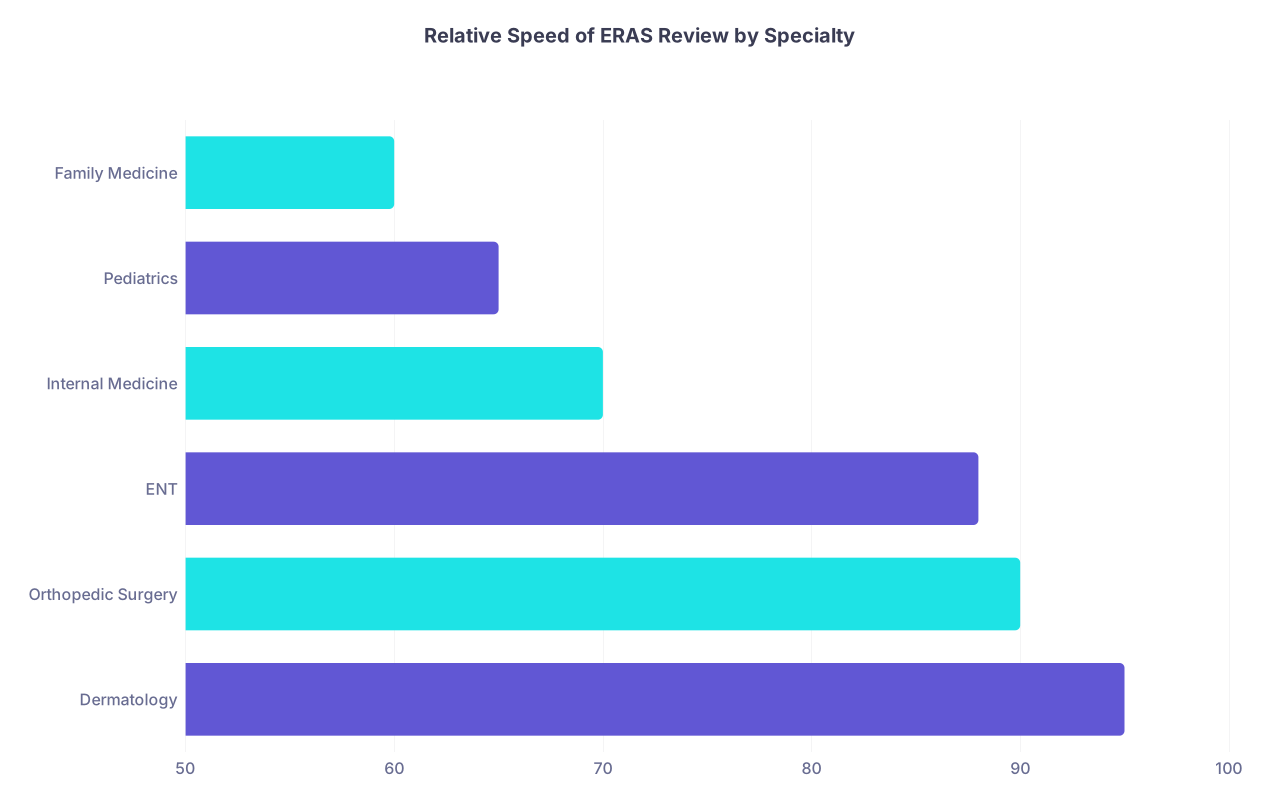
| Category | Value |
|---|---|
| Dermatology | 95 |
| Orthopedic Surgery | 90 |
| ENT | 88 |
| Internal Medicine | 70 |
| Pediatrics | 65 |
| Family Medicine | 60 |
(Values are a rough “urgency index” based on how aggressively they review early.)
Fast-Moving, Competitive Specialties
Derm, ortho, ENT, plastics, urology (SF Match but same vibe), neurosurgery, some EM and anesthesia programs.
Patterns here:
- Many are reviewing heavily in the first 72 hours.
- First wave of invites often goes out in the first 1–2 weeks.
- They care a lot more if your app isn’t there on day 1.
If you’re applying to these fields, you should aim to:
- Have ERAS fully complete and certified before programs get access.
- Avoid “I’ll submit after I tweak one more sentence” once you’re inside that last 48–72 hour window.
Core Specialties (IM, FM, Peds, Psych, OB/GYN)
These still move early, but there’s usually more buffer.
- Large IM/FM programs get flooded but also have big interview capacities.
- Many will review in waves over several weeks.
- Submitting within a few days of program access is usually still fine for most of these, though earlier is still better.
Less Competitive or Community-Heavy Programs
These programs may:
- Start real review a few days or even a week after access.
- Continue sending invites out well into the season.
- Take more time to fill all their spots.
That doesn’t mean you can coast and apply late. It just means the “submit by day 1 or die” panic is overblown here.
How Late Is Truly “Too Late”?
Let me be clear: ERAS doesn’t close early for you. You can technically submit weeks or even months after program access day.
The real question isn’t “Can I submit?” It’s “Will anyone still care?”
Rough Practical Cutoffs
0–3 days after access
Still okay for most specialties, not ideal for top-tier competitive ones.4–7 days after access
You’re now late for some programs, especially those that filled their early invite slots. Still viable for many IM/FM/peds/psych programs and some mid-tier places.2–3 weeks after access
You’re behind. You’ll miss out on a lot of early invites, especially in competitive markets. Some programs will still review; many will not prioritize you.4+ weeks after access
Realistically, you’re fishing for leftover spots, late cancellations, or lower-volume programs. Not impossible to land interviews, but absolutely not optimal.
If you’re in this last group due to a late Step score, red flags, or a re-applicant situation, your strategy needs to be different: more applications, more networking, more targeted reach-outs.
What Happens If You’re Missing a Component (LOR, Step 2, etc.)?
A very common situation: You can submit ERAS by the “ideal” time, but one letter, Step 2 score, or MSPE is delayed.
Programs generally start reviewing with what they have and update as new pieces arrive.

| Step | Description |
|---|---|
| Step 1 | Application Received |
| Step 2 | Auto Screened Out |
| Step 3 | Initial Faculty Review |
| Step 4 | Flag for Invite |
| Step 5 | Hold / Await Updates |
| Step 6 | Possible Late Review |
| Step 7 | Meets filters? |
| Step 8 | Strong candidate? |
| Step 9 | New info arrives? |
Key points:
- Missing one LOR at the time of initial review usually isn’t fatal, especially if you’ve got 2–3 others and the rest looks solid.
- Missing Step 2 when a program requires it to offer interviews is more serious. Some will:
- Put you in a “hold until score posts” bucket.
- Or just move on to others if they have enough applicants.
If you can submit a nearly complete app on time and let one letter trickle in a week later, do that. Don’t delay the entire application for a single letter unless it’s absolutely critical (e.g., your only specialty-specific letter in derm/ortho).
So When Should You Submit ERAS?
Here’s the practical framework.
Figure out your specialty competitiveness and target programs.
Applying ortho to big-name academic centers? Your margin for delay is small. Applying FM to a range of community programs? You have more wiggle room.Work backwards from the program access date, not the opening of ERAS for applicants.
Your internal deadline should be: “ERAS fully submitted and certified at least 2–3 days before programs can see it.”Only accept minor delays if they materially improve your app.
Example of a good reason to wait 24–48 hours:- You’re adding a solid specialty-specific letter.
- You’re finalizing a major publication that will be accepted before submission. Bad reasons:
- You want to reword three sentences in your personal statement.
- You’re tweaking the order of experiences for the 12th time.
If you’re going to be late, be intentionally late.
If life happens and you’re clearly missing the ideal window, don’t half-fix it. Take the time to:- Make the app as strong as possible.
- Adjust your program list upward in breadth.
- Use emails, mentors, and networking to offset the timing disadvantage.
FAQ: When Do Most Programs Start Reviewing ERAS Applications?
Do programs really start reviewing applications the day they get access?
Many do. Coordinators usually log in on day 1, run filters, and generate lists. Some PDs and faculty start actual reading on day 1 or 2, especially in competitive specialties. Not every program is that fast, but enough are that you should act like they are.If I submit ERAS on the same day programs get access, is that okay?
Usually, yes. Your application may not be in the very first wave of downloads at some places, but you’ll still be part of the early review for most programs. It’s not as good as being in the system the moment they log in, but it’s far from “too late.”Is submitting 3–5 days after program access a big problem?
It’s not ideal. For highly competitive specialties and top academic programs, yes, you’re probably missing the earliest and easiest interview slots. For IM/FM/peds/psych and many community programs, you’re still going to get reviewed, but you’ve lost some of the early advantage.Do all specialties review applications at the same pace?
No. Fields like derm, ortho, ENT, plastics, and neurosurgery tend to review very aggressively in the first 1–2 weeks. Large core specialties like IM and FM still review early but often spread the process over several weeks. Less competitive or smaller programs can move slower and continue inviting into the season.Should I delay submitting ERAS to wait for a better letter of recommendation?
Only if the delay is short and the letter is truly impactful. If waiting 2–3 days gets you a strong specialty-specific letter, that might be worth it. Waiting 1–2+ weeks and missing the main review window just to swap a decent letter for a slightly better one? Usually a bad trade.What if my Step 2 score isn’t back yet when programs start reviewing?
Many programs will review with Step 1 and your application as is, then update once Step 2 arrives. But some programs require Step 2 to offer interviews. If they say that explicitly, you may end up in a “hold” pile until your score posts, and some early slots can disappear in that time.If I’m applying very late (weeks after access), what’s my best move?
You compensate with strategy: apply more broadly, prioritize less competitive programs and locations, explicitly target places known to consider late apps, and use mentor emails or personal outreach to specific programs. You’re at a disadvantage, but you’re not automatically shut out—especially in less competitive fields.
Key takeaways:
- Most programs start some version of review within days of getting ERAS; competitive ones move fast in the first week.
- Having your ERAS fully submitted and certified before programs get access gives you the best shot at being seen in that critical first pass.
- A few days’ delay isn’t fatal, but weeks of delay absolutely hurt; if you’re late, adjust your strategy and expectations accordingly.