
Yes—ERAS submission timing matters more for competitive specialties than almost anything applicants want to admit.
If you’re shooting for derm, ortho, plastics, ENT, neurosurgery, urology, IR, or similarly competitive fields, “I’ll submit within the first week” is not good enough. You are competing with people who treat the ERAS open date like a deadline, not a suggestion.
Let’s break this down like an honest program director would.
How ERAS Timing Actually Works (Not The Myth You Heard)
There’s a lot of bad hallway advice about ERAS timing. Stuff like “Anytime before programs can download is fine” or “They don’t look at apps until October anyway.”
That’s not how it plays out on the program side.
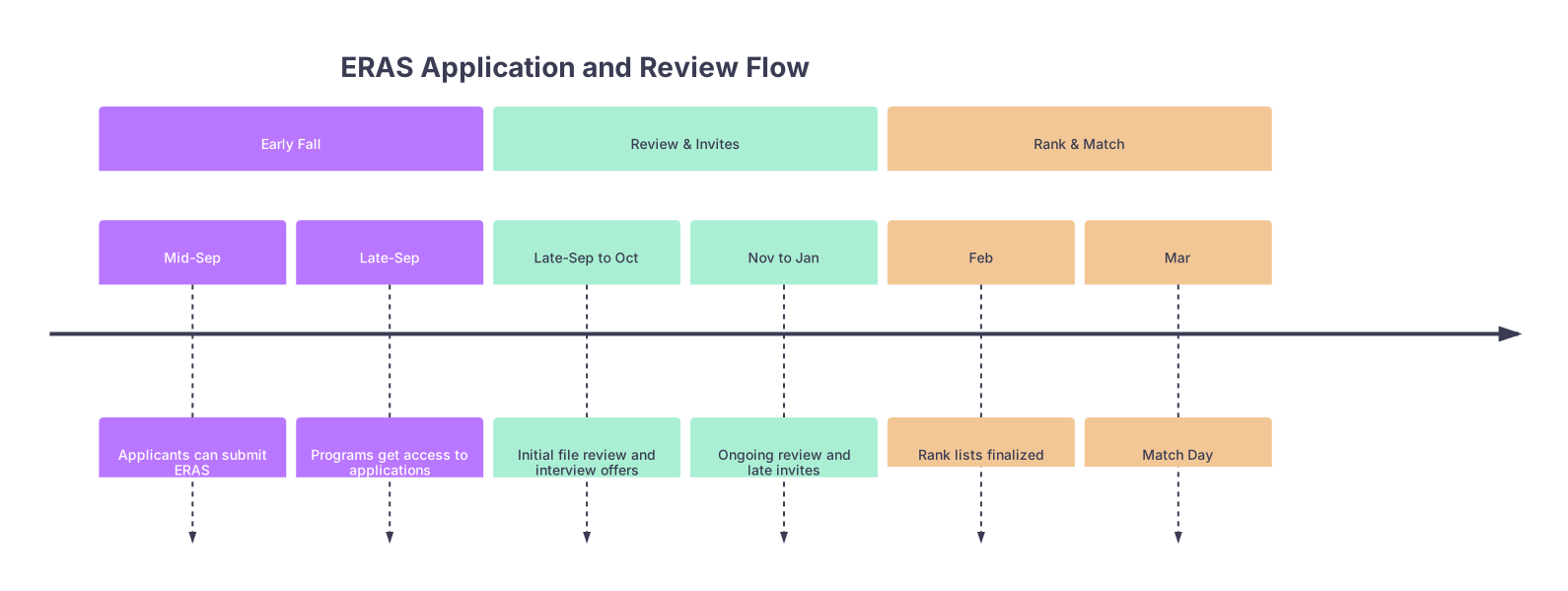
Here’s the real sequence every year (dates are approximate and shift slightly year to year):
| Period | Event |
|---|---|
| Early Fall - Mid-Sep | Applicants can submit ERAS |
| Early Fall - Late-Sep | Programs get access to applications |
| Review & Invites - Late-Sep to Oct | Initial file review and interview offers |
| Review & Invites - Nov to Jan | Ongoing review and late invites |
| Rank & Match - Feb | Rank lists finalized |
| Rank & Match - Mar | Match Day |
Key point: There are two distinct dates that matter:
- Applicant submission open date – when you can hit “submit.”
- Program download date – when programs can start seeing your application.
The high-yield truth:
- If you submit before the program download date → you’re in the first big batch that lands in their inbox.
- If you submit after that date → your application comes in as a “late arrival,” and for competitive specialties, that can absolutely hurt you.
Does that mean you’re dead if you submit a week late? Not automatically. But your odds drop, especially if your application is borderline and not a slam dunk.
Why Timing Matters More in Competitive Specialties
In low-to-moderately competitive fields (FM, psych in many regions, peds, IM at community programs), programs often have:
- More interview slots
- Broader filters
- Longer review windows
But competitive specialties are different beasts.
Here’s what I’ve seen repeatedly:
- Programs get hundreds to thousands of apps.
- They set strict filters (Step 2 cutoffs, AOA, home vs. away, etc.).
- Faculty block one or two afternoons to review that first big batch.
- Many interview offers go out from that early pool and fill 60–80% of their slots.
By the time your “late” application gets looked at—if it ever does—they may already have:
- A full or nearly full interview schedule
- A short list of “waitlist invites” if people cancel
- Less patience for anything that looks even slightly risky (exam failures, red flags, no big-name letters, etc.)
So yes, in derm, ortho, plastics, ENT, IR, neurosurg, urology, rad onc, etc., being in the first batch is a competitive advantage. Sometimes a big one.
Here’s how I’d summarize it:
| Specialty Type | Early Submission Impact | Late Submission Risk |
|---|---|---|
| Highly competitive | Critical | High |
| Moderately competitive | Important | Moderate |
| Less competitive | Helpful but not critical | Low–Moderate |
“How Early Is Early Enough” For Competitive Specialties?
You want a concrete answer. Here it is.
Assume this pattern (adjust for your specific year’s dates):
- Programs can download ERAS: Late September
For competitive specialties, aim for this:
- Target: Submit on the very first day ERAS allows submission.
- Acceptable: Submit within 24–48 hours of that date.
- Borderline: Submit more than 3–5 days after that date.
- Hurts you: Submitting >1 week late, especially without a strong reason.
For less competitive specialties, you’ve got more wiggle room:
- Early is still better, but a few days to even 1–2 weeks delay is usually survivable if your app is solid.
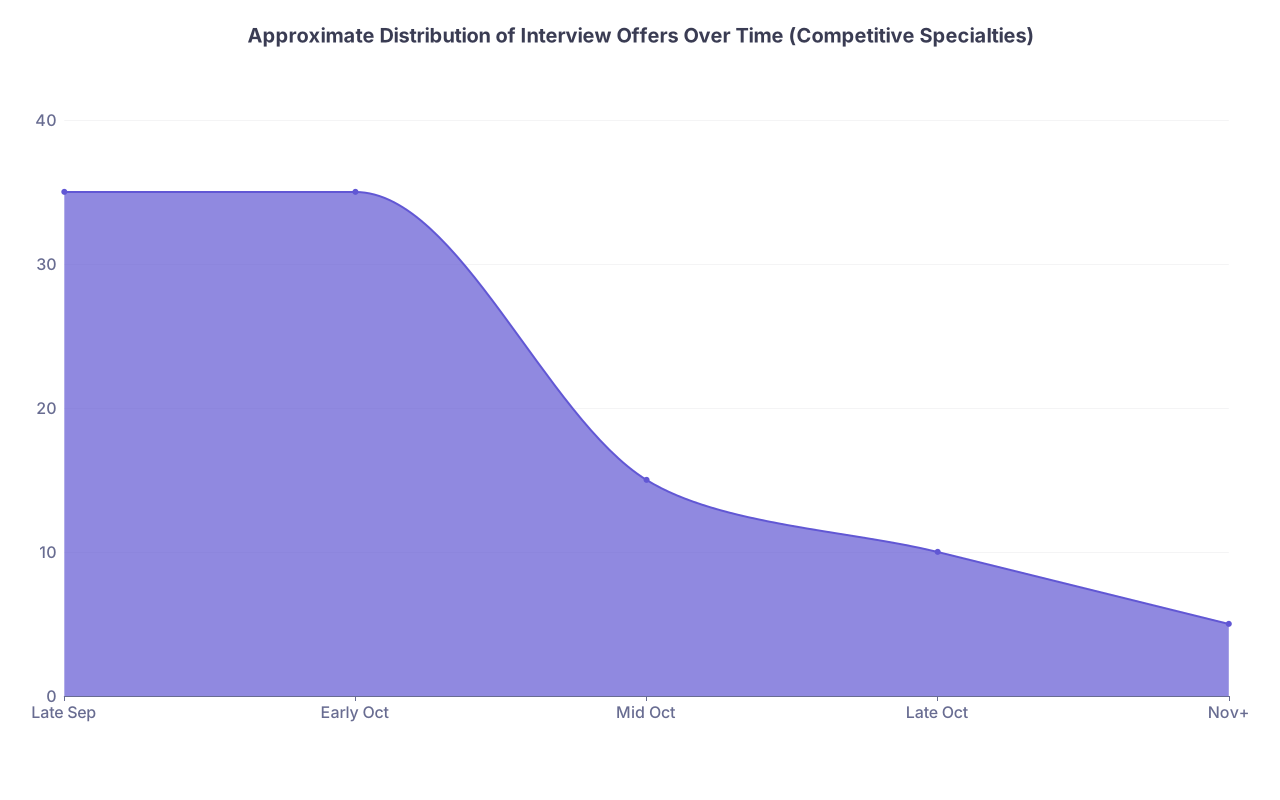
To visualize when invites tend to go out:
| Category | Value |
|---|---|
| Late Sep | 35 |
| Early Oct | 35 |
| Mid Oct | 15 |
| Late Oct | 10 |
| Nov+ | 5 |
By the time you hit mid-to-late October, many top programs in competitive fields have already sent most of their invites.
When It’s Worth Delaying Submission (And When It’s Not)
Here’s where people get stuck: timing vs. strength.
You’re wondering: “Is it better to submit early with an imperfect app, or later with something stronger?”
Let’s be blunt.
Real improvements that can justify a short delay:
- Adding a strong Step 2 CK score if:
- Your Step 1 is pass-only and you need a numerical strength marker, or
- Your Step 1 is weak and Step 2 could “rescue” your app.
- Uploading a major new letter from:
- A well-known faculty in your specialty
- A chair or PD who really knows you and can advocate strongly
- Correcting a real problem:
- Fixing mis-entered experiences or research
- Cleaning up obvious professionalism issues or errors
Things that are NOT worth delaying a week or more for:
- Tinkering with wording on your personal statement
- Adding another minor poster or low-impact project
- Slightly reorganizing your experience descriptions
- Waiting on “maybe” letters from people who don’t know you well
If adding something will materially and clearly improve how PDs see you, then a small delay (1–3 days) can be justified. But if you’re staring at a fully functional, accurate application and just feel uneasy because it’s not “perfect,” hit submit.
How Programs Actually Filter and Review Early Batches
You need to understand what your application looks like from the other side of the screen.
Common pattern at competitive programs:
- They get hundreds of applications in the first download.
- Apply automatic filters:
- US MD/DO vs. IMG
- Step 2 CK minimum score
- Failures yes/no
- Maybe research count or home/away rotation status
Then, from that filtered batch:
- Faculty or a small committee reviews a subset more closely.
- They move people into buckets:
- Strong: offer interview
- Maybe: hold, revisit later
- No: reject or never formally reviewed again
If you’re in that first big wave and you’re competitive on paper, you’re far more likely to end up in “strong” or “maybe.” If you arrive 10 days later, many programs’ “strong” buckets are already mostly full.
In competitive fields, there’s also review fatigue. Faculty are excited and fresh for the first review session. By the time they’re looking at late-arriving apps, they’ve already rationalized their choices and mentally committed to a bunch of favorites.
Timing vs. Geography vs. Backup Specialty
One more nuance people ignore: your whole application strategy changes how sensitive timing is.
If you’re:
- Applying to a competitive specialty (e.g., ortho)
- From a lower-ranked or lesser-known school
- Without a home program
- Without brand-name letters
Then timing is even more critical. You need every small edge.
If you’re:
- From a strong academic center with a home program in that field
- Strong board scores, good research, known faculty
You still should submit early—but you have more “buffer” if something legitimately delays you a couple days.
Same idea for dual-applying:
- If you’re applying to derm + IM or ENT + prelim surgery, early timing matters more for the competitive specialty than the backup.
- Do NOT delay submitting both applications just because you’re fussing with the backup PS.
Submit for the competitive specialty as polished and early as possible. Your “safety” specialty can tolerate minor timing flexibility.
Concrete Submission Strategy By Scenario
Here’s how I’d call it in common situations.
| Applicant Profile | Specialty Type | Timing Advice |
|---|---|---|
| Strong, competitive, academic CV | Highly competitive | Submit on opening day or within 24 hours |
| Average stats, no big red flags | Highly competitive | Opening day; never later than 3–4 days |
| Below-average scores, strong Step 2 coming | Highly competitive | Delay 1–3 days only if Step 2 is excellent |
| Strong app, less competitive specialty | Less competitive | Within first week is usually fine |
| Dual-applying (competitive + backup) | Mixed | Prioritize early submission for competitive |
What To Do If You’re Already “Late”
Let’s say you missed the early window. It’s October 5th. You’re not doomed, but now you need to be strategic.
Three things you can still control:
Program list
Cast a wider net. Add more mid-tier and community programs in your specialty if available. The “reach only” strategy is deadly if you’re late.Communication
Once your application is complete:- Consider a concise, professional email to a few key programs where you have ties (home, away rotations, research collaborators).
- Don’t spam 80 programs with the same generic email. Target real connections.
Back-up planning
If your specialty has a high unmatched rate and you’re late with a borderline app, be honest with yourself:- Strengthen your backup specialty list.
- Start mapping what you’ll do if you need to SOAP or reapply.
You lost the timing edge. Don’t pretend you didn’t. Just shift focus to everything else you can still influence.
The Real Answer: Does Timing Matter More For Competitive Specialties?
Yes. Absolutely yes.
For competitive specialties:
- Early submission doesn’t automatically guarantee interviews.
- But late submission absolutely closes doors that might’ve been slightly open.
- It’s a leverage point you fully control in a process where you control very little.
For less competitive specialties:
- Timing still matters—nobody’s getting bonus points for submitting in November—but as long as you’re within the first week or so of downloads, the penalty for slight delay is much smaller.
If you’re applying to a competitive field and you’re even asking this question, treat timing like a hard deadline.
Submit on day one, or have a damn good reason you didn’t.
FAQ: ERAS Submission Timing for Competitive Specialties
1. If I submit ERAS on the last day before programs can download, am I “on time”?
You’re technically on time but practically borderline. For competitive specialties, I’d want your application in as early in that window as possible, not at 11:59 p.m. on the last day. Systems sometimes lag, letters can be delayed, and any hiccup could push you into the “late” group.
2. Should I wait to submit until all my letters of recommendation are uploaded?
No. Submit as soon as your application, personal statement, and core experiences are ready. Letters can be assigned to programs later as they come in. The exception: if you’re missing a critical letter (like your specialty chair or PD) and it’ll be in within a day or two, that short delay may be worth it—especially for competitive specialties.
3. Does submitting early help if my Step 2 CK score isn’t back yet?
For competitive specialties, yes—if your overall app is still strong enough to get you through initial filters without a Step 2 score. If your Step 1 is weak or you need Step 2 to “save” your application, waiting a few days for a strong score can be justified. A late but clearly stronger app can beat an early but obviously weak one. But this is a tough call—don’t delay weeks for it.
4. I’m dual-applying to a competitive and a less competitive specialty. Do I need separate submission strategies?
Yes. Treat the competitive specialty as the priority for timing. Get that personal statement and program list finalized first and submit as early as possible. Your backup specialty can tolerate slightly later PS tweaks or program list adjustments, but don’t delay everything just to over-polish your backup application.
5. Do programs really review applications immediately when they download them?
Competitive programs? Many do. They often have scheduled “application review days” as soon as ERAS opens to them. Interview offers start going out quickly at many places. Not every program moves fast, but enough do that being in that first batch is a real advantage—especially in small, competitive fields.
6. What’s the single worst timing mistake I can make with ERAS?
Easy: sitting on a basically complete, solid application and not submitting on the earliest possible day because you’re obsessing over tiny wording changes or waiting on a mediocre letter. In competitive specialties, perfectionism that delays submission is a self-inflicted wound.
Open your ERAS application today and look at the official submission date. Then look at this year’s program download date. If you’re not locked in to submit on or before that date—with a complete, accurate, strong-enough application—fix that now.