Understanding the Big Picture: Why Timing Matters So Much for Non‑US Citizen IMGs
For a non-US citizen IMG, timing can make or break your residency application.
Programs in the US receive thousands of applications within days of ERAS opening. Many use filters (USMLE scores, YOG, visa status) and start reviewing in the first week. If your application arrives late or incomplete, you may be screened out before anyone even reads your personal statement.
On top of that, as a foreign national medical graduate, you must manage:
- Visa considerations (J‑1 vs H‑1B sponsorship)
- ECFMG certification
- USMLE score report timing
- Dean’s Office or school document delays
- Time zone challenges for communication and interviews
This is why understanding the residency application timeline and knowing when to submit ERAS are especially critical for non‑US citizen IMGs.
In this guide, we’ll walk through:
- A month‑by‑month residency application timeline
- How timing differs for non‑US citizen IMGs vs US grads
- Strategic decisions about when to submit ERAS
- How to handle delayed scores, LORs, or ECFMG certification
- A practical timing checklist you can follow
Core Timeline: Key Milestones for Non‑US Citizen IMGs
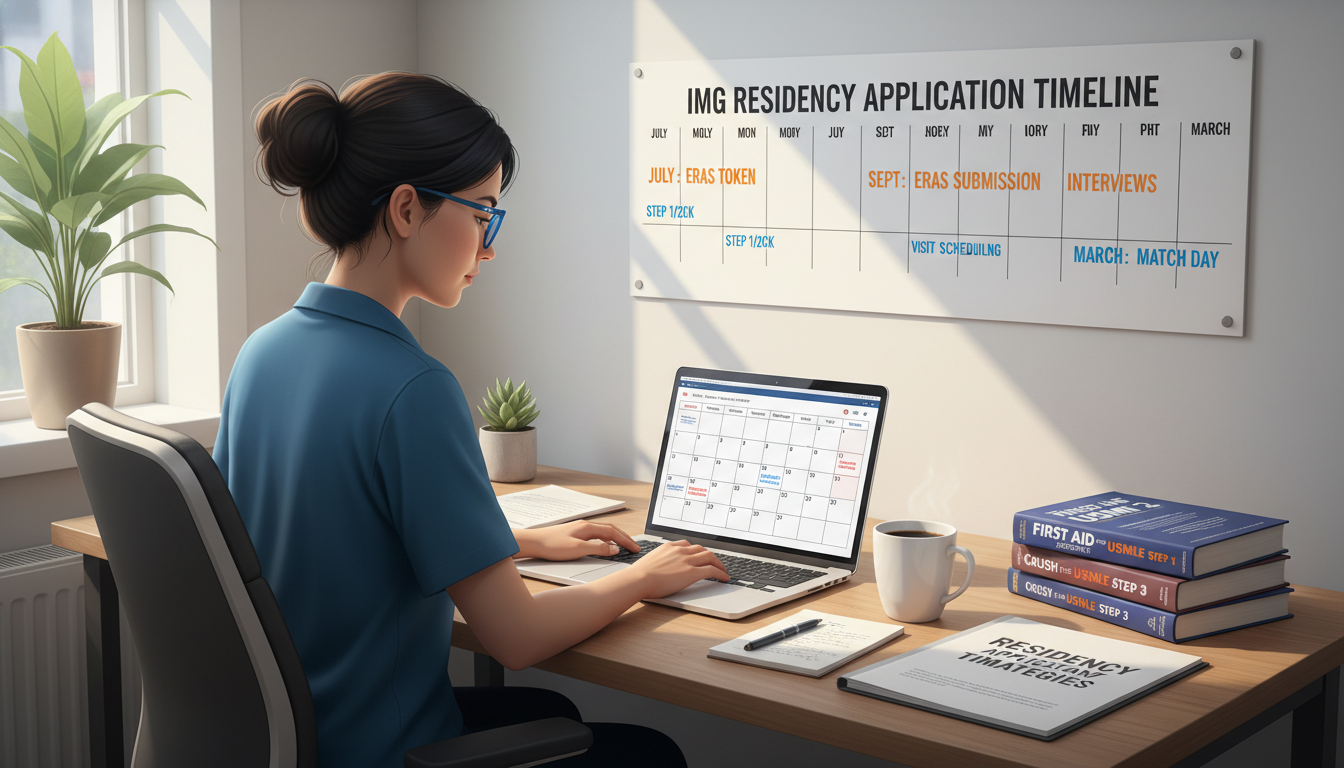
The exact dates shift slightly each year, but the structure remains stable. Below is a generalized timeline for a typical ERAS cycle aimed at July start of residency (Match Year X → Residency starts July X).
For example: Match 2026 → Residency starts July 2026.
You usually begin active preparation mid‑2024 to early‑2025.
1. 18–24 Months Before Residency Start: Early Planning Phase
Timeframe: January–July, ~1.5–2 years before you want to start residency.
Goals in this phase:
- Decide your target Match year
- Plan your USMLE step sequence with reporting deadlines in mind
- Identify your specialty and competitiveness level
- Start building US clinical experience (USCE) plan if possible
- Clarify visa needs and limitations
Key tasks:
Set your target Match year and specialty
- Example: Want to start residency July 2027 → you are in the 2027 Match → ERAS opens June 2026 → NRMP registration September 2026.
- Decide your primary specialty and, if needed, a backup (e.g., Internal Medicine + Family Medicine).
Mapping USMLE timing
- Aim for:
- Step 1: Completed at least 12–18 months before Match
- Step 2 CK: Completed and reported by August–September of the application year (earlier is better)
- Factor in possible retake delays if you are not confident about passing on the first attempt.
- Aim for:
Research visa policies
- Identify if you require a J‑1 or hope for H‑1B sponsorship.
- Shortlist programs that:
- Explicitly sponsor visas (filter by “J‑1 visa sponsorship” / “H‑1B sponsorship”)
- Have a track record of matching non‑US citizen IMGs
ECFMG certification planning
- For non‑US citizen IMGs, ECFMG certification is mandatory to start residency.
- Certification usually requires:
- Passing Step 1
- Passing Step 2 CK
- Medical school credentials verified
- You can apply via ERAS without ECFMG certification, but certification must be completed by the deadline defined by NRMP/ACGME (usually before residency starts, but many programs expect it earlier).
2. 12–15 Months Before Residency Start: Academic and Document Preparation
Timeframe: July–December, about one year before Match.
Goals:
- Finalize USMLE exam schedule
- Begin or complete USCE
- Build relationships for Letters of Recommendation
- Draft core documents (CV, PS)
Key tasks:
USCE planning (if possible)
- Schedule observerships, externships, or electives in the US.
- Ideally, time them such that:
- You finish at least one USCE by spring/early summer before ERAS opens → gives you time to obtain strong LORs.
- Aim for 2–3 months of USCE if possible. Even 4–8 weeks can help.
Letters of Recommendation (LORs)
- Target 3–4 strong LORs, at least 2 from US physicians if possible.
- Ask letter writers early (ideally right after finishing your rotation or by late spring).
- Make sure they understand:
- How to upload letters via the ERAS Letter of Recommendation Portal (LoRP)
- The importance of including your clinical performance, communication, and potential as a resident.
Personal Statement (PS) and CV drafts
- Begin drafting:
- A core personal statement
- A detailed US‑style CV (to help letter writers and for ERAS)
- As a non‑US citizen IMG, highlight:
- Your adaptability to new systems
- Communication skills in English
- US clinical experiences and what you learned about the US healthcare system
- Begin drafting:
Plan for Step 2 CK score release
- Ideal: Score available before ERAS applications can be submitted (mid‑September).
- If you are late:
- Understand how that affects your application deadlines and strategy (discussed below).

The ERAS Application Year: Month-by-Month Strategy
Now we move into the critical year where you actually apply: from June before ERAS opens through Match Day the following March.
June–July (Application Year): ERAS Opens & Preparation Intensifies
What typically happens:
- ERAS (MyERAS) platform for residency applicants opens (June).
- You can register and start filling out your application.
- You can input program lists, write experiences, and assign LORs as they are uploaded.
Action steps:
Register early on ERAS
- As a non‑US citizen IMG, you register through ECFMG (ERAS Support Services) rather than a US medical school.
- Do this as soon as possible when the system opens.
Populate your application
- Fill in:
- Biographical information
- Medical education and graduation date
- USMLE scores (will auto-populate when available)
- Experiences (clinical, research, volunteer)
- Publications and presentations
- Be thorough and honest; programs may verify details, and discrepancies can damage your credibility.
- Fill in:
Monitor LOR uploads
- Send your letter request forms to writers.
- Check regularly if letters are uploaded to ERAS.
- Gently remind them if needed (e.g., 2–3 weeks before September submission target).
Keep working on exam or clinical plans
- If Step 2 CK is pending, keep studying with a clear target date that allows score release by early October at the latest.
- If in active USCE, continue building relationships and taking feedback seriously.
August–Early September: Finalize and Polish Your Application
This is the finishing phase before the application release to programs.
Key activities:
Finalize your personal statements
- You may create:
- One main PS for most programs
- Slight variations for different specialties (e.g., Internal vs Family Medicine)
- A special PS for particularly competitive or desired programs
- Proofread: Use mentors, IMG advisors, or trusted peers to review.
- You may create:
Strategic program list building
- For a non‑US citizen IMG, program selection is critical:
- Confirm visa sponsorship policies (from program websites, FREIDA, forums, or email).
- Check historical IMG friendliness (NRMP Charting Outcomes, program websites, alumni networks).
- Apply broadly, especially if:
- You have older YOG (e.g., >5 years)
- Multiple exam attempts
- Limited USCE
- For a non‑US citizen IMG, program selection is critical:
Check ECFMG and document status
- Ensure your medical school credentials have been sent and processed.
- Confirm there are no pending verifications that could delay ECFMG certification.
Clarify your strategy on when to submit ERAS
- ERAS typically allows applicants to submit applications to programs in early September.
- Programs receive them on a later common date (e.g., mid‑September).
- Your goal: Have a complete, polished application ready for submission on the first possible day or as close to that as you can.
When to Submit ERAS: Optimal Timing for Non‑US Citizen IMGs
For a foreign national medical graduate, when to submit ERAS can be a strategic decision with real consequences.
Ideal Strategy: Submit as Early as Possible (First Week Window)
Most experts recommend:
- Submit ERAS as soon as it opens for submissions (usually early September), or at worst within the first week.
- Ensure your application is:
- Fully filled out
- Personal statement and CV polished
- At least 3 LORs assigned (even if one or two are still pending upload)
- Step scores available (if possible)
Why early submission matters:
- Many programs start reviewing applications immediately when they receive them.
- Interview invitations often go out within the first 2–4 weeks after programs receive applications.
- Some programs fill most interview slots before late applicants are even read.
As a non‑US citizen IMG, you’re already facing filters related to:
- Visa sponsorship
- IMG status
- YOG cutoffs
Being early and complete gives you the best chance of getting in front of a human reviewer.
Is It Ever Worth Delaying Submission?
Sometimes applicants wonder if they should wait to submit until a new score, USCE completion, or letter is available.
Consider the trade‑offs:
- Delaying by a few days (e.g., to fix an error or assign a late LOR):
- Usually acceptable and not harmful, especially if still before mid‑September.
- Delaying by 2–4 weeks:
- Risky: Many programs begin heavy screening and sending out early invites in that window.
- You may be filtered out before your new data even appears.
- Delaying for Step 2 CK score:
- If your Step 1 is borderline or a pass with concerns, having a strong Step 2 CK uploaded early helps.
- Still, you can often submit ERAS and then release Step 2 CK later; do not wait to submit if you can avoid it.
Practical rule of thumb:
- If the new information will be available within a few days and meaningfully strengthen your file (e.g., an important LOR from a US PD), waiting a short time is reasonable.
- If it will be delayed more than 1–2 weeks, submit anyway and let documents be added as they become available.

Late Scores, Missing Documents, and ECFMG Certification: How to Adapt
Even with careful planning, timelines often slip—especially for non‑US citizen IMGs managing exams, visas, and international paperwork. This section addresses how to handle:
- Late Step scores
- Incomplete LORs
- Delayed ECFMG certification
1. Step Scores Coming After Application Submission
Scenario A: Step 2 CK scheduled close to ERAS submission
- You sit Step 2 CK in late August/early September.
- Score is not available when you submit ERAS.
Strategy:
- Submit ERAS on time (don’t wait).
- Once the score is released, update ERAS to release it to programs.
- Some programs may screen you earlier based on Step 1, but many will consider the new score as your file is reviewed over time.
Scenario B: You have failed or borderline previous scores
- If your Step 1 is low or repeated, a strong Step 2 CK is your redemption.
- Consider:
- If you can take Step 2 CK early enough to have results by early October, still submit ERAS on time and let the score follow.
- If results won’t be available until November or later, your chances may be lower in more competitive programs, but you still benefit from applying—especially to IMG‑friendly, visa‑sponsoring programs.
2. Missing LORs at the Time of Submission
You don’t need all letters uploaded on day one, but aim to have:
- At least 2–3 LORs uploaded and assigned when you submit.
- You can add and assign more letters later.
Tips:
- Use a mix:
- 1–2 US clinical LORs
- 1–2 home country academic/clinical LORs, if needed
- If a highly influential writer (e.g., PD from a US rotation) is delayed but committed:
- Submit ERAS on time.
- Add the letter as soon as it uploads.
- For key programs, you may email the coordinator briefly when an important letter is added (if appropriate).
3. Delayed ECFMG Certification
As a non‑US citizen IMG, ECFMG certification timing is often confusing.
Key points:
- You do NOT need to be ECFMG‑certified on the day you submit ERAS.
- You must be certified by:
- A date specified by NRMP/ECFMG to participate fully in the Match (often by May–June), and
- In practice, by the time you begin residency on July 1.
- However, many programs prefer or require applicants to either:
- Already be certified by the application date, OR
- At least have all exams passed and credentials verification in progress.
What you should do:
- Ensure all components for certification are progressing:
- Step 1 and Step 2 CK passed
- Primary source verification documents submitted
- Track your ECFMG status online.
- If certification is near complete, you can mention “ECFMG certification pending, all examinations passed” in your ERAS application or CV.
Some programs filter out non‑certified applicants, but many do not. As a non‑US citizen IMG, applying to a broad range of IMG‑friendly programs helps mitigate this risk.
Interview Season & Rank List: Critical Dates for Non‑US Citizen IMGs
Once your application is in, attention shifts to interview invites and Match logistics.
October–January: Interview Season
What typically happens:
- Interview invitations start arriving from late September and continue through December.
- Actual interview days are usually from October to January (in recent years, mostly remote/virtual).
Timing considerations for foreign national medical graduates:
Be responsive despite time zones
- Check email multiple times per day.
- Some invitations fill spots on a first‑come, first‑served basis.
- Use your phone’s email app and consider email alerts.
Scheduling constraints
- As a non‑US citizen IMG, you may be overseas.
- Virtual interviews help avoid travel issues, but:
- Plan for time differences (late‑night or early‑morning interview slots).
- Secure a quiet, professional environment with strong internet.
Communicate about visas carefully
- Do not open residency application conversations with visa demands.
- If programs already indicate they sponsor J‑1/H‑1B, you can:
- Confirm your eligibility and intent if asked.
- For uncertain programs, allow them to raise the topic or ask politely during the appropriate moment (e.g., when they ask if you have any questions).
February–March: Rank Order List & Match Week
Main deadlines:
- NRMP Rank Order List (ROL) deadline: Typically in late February.
- Match Day: Mid‑March.
What you should do:
Register for NRMP early
- Usually opens in September; register well before interview season or at least before ROL deadline.
- Your NRMP and ERAS information must align (especially name, AAMC ID).
Construct your rank list strategically
- Rank programs in true order of preference, not guessing where they will rank you.
- Include all programs where you would truly be willing to train.
- As a non‑US citizen IMG, more ranks → better match probability, especially if visa options are limited.
Plan for contingencies
- If you don’t match, know about:
- SOAP (Supplemental Offer and Acceptance Program): extra positions filled during Match Week.
- Re‑application strategy for the next cycle (including improving scores, getting new USCE, research, or degrees).
- If you don’t match, know about:
Putting It All Together: A Practical Timeline Checklist
Below is a condensed, action‑oriented residency application timeline for non‑US citizen IMGs planning for a July start date.
18–24 Months Before Start (Approx. January–July, 2 Years Before)
- Decide Match year and primary specialty (+ backup if needed).
- Map USMLE plan (Step 1 → Step 2 CK).
- Begin or plan USCE.
- Research visa-sponsoring, IMG‑friendly programs.
12–15 Months Before Start (Summer/Fall Before Application Year)
- Complete Step 1 (if not already done).
- Start/continue USCE; aim for at least one rotation with potential for strong LOR.
- Draft early versions of CV and personal statement.
- Approach potential letter writers and explain ERAS process.
9–12 Months Before Start (Winter–Spring Before Application Year)
- Take Step 2 CK such that scores are available no later than early October of the application year.
- Ensure medical school transcripts and credentials are sent to ECFMG.
- Confirm timeline and readiness with your school or Dean’s Office.
June (Application Year)
- Register with ERAS via ECFMG.
- Start filling out application details.
- Monitor USMLE transcripts and exam status.
- Continue LOR follow-up.
July–August (Application Year)
- Finalize personal statements.
- Build and refine target program list with attention to visa sponsorship, IMG-friendliness, and YOG cutoffs.
- Check ECFMG status and address any document issues.
Early September (Application Year)
- Submit ERAS as soon as it opens for submission (or within the first week).
- Ensure at least 2–3 LORs are assigned.
- Confirm USMLE transcript release to programs.
Mid‑September–January
- Programs receive applications and send interview invitations.
- Attend virtual/onsite interviews; maintain professional communication.
- Continue updating programs if major new positive information arises (e.g., new Step 2 CK score).
February–March
- Submit NRMP Rank Order List by deadline.
- Prepare for Match Week and possible SOAP participation.
- Once matched, start visa and onboarding process early with your program’s GME office.
FAQs: Application Timing for Non‑US Citizen IMGs
1. What is the best time for a non‑US citizen IMG to submit ERAS?
Aim to submit as early as possible once ERAS begins accepting applications—typically the first day or within the first week. Being early helps ensure your application is in the initial pool that programs review for interview invitations. Delays of weeks, especially past late September, can significantly reduce your chances.
2. Can I apply if my Step 2 CK score is not ready yet?
Yes. You can submit ERAS without a Step 2 CK score as long as you have at least Step 1 (or the necessary exams for your ECFMG pathway) completed. However, for many programs—especially for a non‑US citizen IMG—a strong Step 2 CK score improves your competitiveness. If your score will be available within a few weeks, submit on time and release the score as soon as it appears.
3. Do I need ECFMG certification before I submit my application?
No. You do not need to be fully ECFMG‑certified at the moment of ERAS submission. You generally need certification before starting residency, and in practice many programs prefer that all exams are passed and credentialing is well underway at the time of application. Monitor your ECFMG account and ensure there are no avoidable delays in your certification process.
4. How late is “too late” to submit ERAS as a non‑US citizen IMG?
Submitting after programs begin downloading and reviewing applications (usually mid‑September) already puts you at a disadvantage. Submitting in October or later greatly reduces interview chances, especially in competitive specialties or at programs with many applicants. If you must submit late due to personal or exam circumstances, focus on IMG‑friendly programs known to review applications later and consider a more strategic plan for the next cycle if necessary.
By understanding the residency application timeline and being intentional about when to submit ERAS, you can significantly strengthen your position as a non‑US citizen IMG. Precise planning is one of the few factors in this process that you can fully control—use it to your advantage.