
The most common reason ERAS applications are delayed isn’t laziness. It’s waiting too long to request letters, MSPE, and transcripts—and then getting trapped in other people’s timelines.
You cannot control when programs read your application. But you can absolutely control whether every required document is sitting in ERAS on day one. That’s your job. And it starts months earlier than most students think.
Below is a month‑by‑month, then week‑by‑week guide so you know exactly when to request:
- Letters of Recommendation (LORs)
- MSPE (Dean’s Letter)
- Transcripts
…so your ERAS is complete and ready to go the first hour applications open to programs.
I’ll assume a “typical” ERAS cycle where:
- ERAS opens for applicants in early June
- You can submit in early September
- Programs view applications in mid‑to‑late September
- MSPE releases on October 1
Adjust exact dates for your year, but keep the same relative timing.
12–9 Months Before Submission: Set the Foundation
At this point you should stop thinking “I’ll deal with ERAS later” and start building your recommender list.
November–December (MS3, 10–12 months before ERAS submission)
Your focus now:
- Identify likely letter writers
- Start signaling your interest
- Avoid the classic mistake of asking the wrong people too late
Who you’re targeting:
- Core clerkship attendings who know your clinical work
- Subspecialty faculty in your target field
- Research mentors if you have substantial, ongoing work
- Program directors or rotation directors who directly evaluated you
What you should do this month:
Track strong clinical relationships in real time.
End of each rotation, write down:- Attending names
- Where you worked with them (service, hospital)
- Any positive feedback they gave you (“You did a great job with that presentation,” “You’re ready for residency”)
Start mentioning your specialty interest casually.
In workroom conversations:- “I’m leaning strongly toward IM.”
- “I’m planning on applying to EM next year.”
This primes them so a later LOR request isn’t out of nowhere.
Ask your school about MSPE and transcript processes.
Quick email to the registrar and student affairs:- How do we request official transcripts for ERAS?
- Do we need to do anything to initiate the MSPE, or is it automatic?
- When will drafts (if allowed) be available?
You’re not requesting anything yet. You’re just building your targets and understanding the process so you don’t get blindsided.
8–6 Months Before Submission: Lock in Your Letter Strategy
At this point you should know how many letters you need and from whom.
January–February (MS3, ~7–8 months before ERAS submission)
Your goal here: make a letter plan, not send requests.
Most specialties:
- Want 3–4 LORs total
- Prefer letters from the specialty you’re applying to, plus possibly one from another field or research
| Specialty | Core Letters | Optional Extras |
|---|---|---|
| Internal Med | 2 IM, 1 other clinical | 1 research |
| General Surgery | 2–3 surgery | 1 research or ICU |
| OB/GYN | 2 OB/GYN | 1 medicine or surgery |
| Pediatrics | 2 Peds | 1 medicine or research |
| EM | 2 SLOEs | 1 other clinical |
What you should do now:
Map out specific names.
Example for Internal Medicine:- IM ward attending from your best rotation
- Subspecialty cardiology attending who loved your presentation
- Research PI in outcomes research
- Backup: another strong IM or FM attending
Check specialty‑specific letter norms.
Some fields (EM, Ortho, Plastics) care a lot about standardized or specialty‑specific letters (e.g., SLOEs for EM). You should know this by now.Schedule future rotations strategically.
If you still lack strong faculty contacts in your specialty:- Try to schedule at least one more rotation with letter‑friendly faculty by April–May
- Consider an early sub‑I with someone known for writing good letters
You’re building the chessboard now so you’re not improvising in July.
5 Months Before Submission: Start Asking for LOR Commitments
At this point you should start asking for letters verbally, even if ERAS isn’t open yet.
March (MS3, ~5–6 months before ERAS submission)
This is the first real “do not miss this window” point.
Your reality:
- Faculty disappear on summer vacations, conferences, away rotations
- If you wait until July to ask, you’ll join the screaming pile of last‑minute requests
What you should do in March:
Ask in person at the end of strong rotations.
Exact script you can use:“Dr. Smith, I’ve really enjoyed working with you this month. I’m planning to apply to internal medicine, and I was wondering if you’d feel comfortable writing me a strong letter of recommendation for residency?”
The word strong is non‑negotiable. If they hesitate, you don’t want that letter.
Clarify timing explicitly.
When they say yes, follow with:“ERAS opens in June, and applications are submitted in September, but programs start reviewing early. I’d love to have your letter uploaded by early August if possible. Does that sound reasonable?”
Immediately follow up with an email.
Within 24 hours:- Thank them
- Confirm timing (early August)
- Mention you’ll send your CV, personal statement draft, and ERAS info once available
You’re not generating ERAS letter requests yet. You’re securing commitments.
4 Months Before Submission: Confirm MSPE and Transcript Timelines
At this point you should stop assuming the MSPE and transcript will magically appear.
April (MS3, ~4–5 months before ERAS submission)
This is when students either calmly line things up—or discover their school is slow and miss the early wave.
What you should do:
Meet (or email) Student Affairs. Ask:
- When do you begin working on MSPEs?
- Do we need to submit anything for our MSPE (CV, self‑reflection, etc.)?
- How and when will MSPEs be uploaded to ERAS?
- Do we have to request ERAS transcripts from the registrar, and when should we do that?
Create your internal deadline.
Even though MSPE release is October 1 nationwide, schools usually want your materials by late spring/early summer.Note any required forms.
Some schools require:- MSPE information forms
- “Notable achievements” bullet points
- Updated CVs
If you blow off these forms, your MSPE gets rushed. And it shows.
You’re not pushing anything through ERAS yet. You’re eliminating unknowns and making sure the pipeline is clear.
3 Months Before Submission: The Real Work Starts
At this point you should be coordinating three parallel tracks: letters, MSPE inputs, and transcript logistics.
May (MS3, ~3–4 months before submission)
This month is busy if you do it right. That’s good. It saves your September.
What you should do in May:
Prepare a “letter packet” for each recommender.
Before ERAS opens, have this ready:- Updated CV
- Brief “brag sheet” (bullet points: strongest rotations, leadership, research, awards)
- Rough personal statement draft or at least a one‑page summary of why this specialty
You’ll send this once ERAS opens or when they request material.
Check in with verbal letter commitments.
Light touch email:- Remind them of your plan to apply in September
- Confirm they’re still willing to write
- Mention you’ll generate the ERAS letter request as soon as the system opens
Start transcript prep.
- Log in to your registrar portal
- Find the process for sending ERAS transcripts
- Note if you’ll owe a fee per send
- Write down any specific ERAS ID needed (you’ll plug this in once ERAS opens)
This is setup month. You’re loading the spring.
June: ERAS Opens – Time to Trigger Requests
At this point you should stop planning and start pushing buttons.
Early June (ERAS opens to applicants)
You now have access to:
- ERAS application
- LOR entry pages
- Designation for your med school to upload MSPE and transcript
What you should do in the first week ERAS opens:
Register on ERAS immediately.
- Get your AAMC/ERAS token
- Create your profile
- Enter your medical school correctly so the system links to the right MSPE/transcript office
Enter all your letter writers into ERAS.
For each recommender:- Correct spelling of name and title
- Institution and department
- Email address (whatever they prefer for official matters)
- Set specialty (if applicable) so you can assign letters properly later
Generate letter request forms.
- Download or copy the ERAS‑generated LOR request form for each writer
- These forms include your AAMC ID and specific upload instructions
Email your letter writers that same week.
Template for your message:- Attach:
- ERAS LOR request form
- CV
- Personal statement draft or summary
- Include:
- Target date for upload: no later than August 1–15
- Where you’re applying (specialty, approximate competitiveness level)
- Specific strengths you hope they’ll highlight (clinical reasoning, teamwork, leadership, etc.)
- Attach:
You’ve now officially initiated letter uploads. You want those letters done before attendings vanish in late July.
Late June–July: Aggressive Follow‑Through
At this point you should act like a project manager, not a passive applicant.
Late June (about 11–12 weeks before application submission)
Your checklist:
- ERAS account created
- LOR requests sent
- School notified for transcripts
- MSPE inputs submitted (if required by your school)
Now your job is to reduce failure points.
Request your transcript through the registrar
As soon as your ERAS ID is confirmed and your school allows:- Submit the transcript order to ERAS
- Pay any fee
- Confirm it’s linked to the correct ERAS cycle
Target: transcript requested no later than late June / early July
Complete all MSPE questionnaires/forms.
If your school wants:- CV
- Reflection statements
- Professionalism self‑assessment
Get these in before their internal deadline, which is often in June. Late MSPE inputs = sloppier Dean’s Letter.
July (about 8–10 weeks before application submission)
This is where people either lock in a clean, on‑time ERAS—or start slipping.
At this point you should:
- Track letter uploads weekly.
In ERAS, you’ll see when each LOR is “uploaded.” Make a simple tracking table:
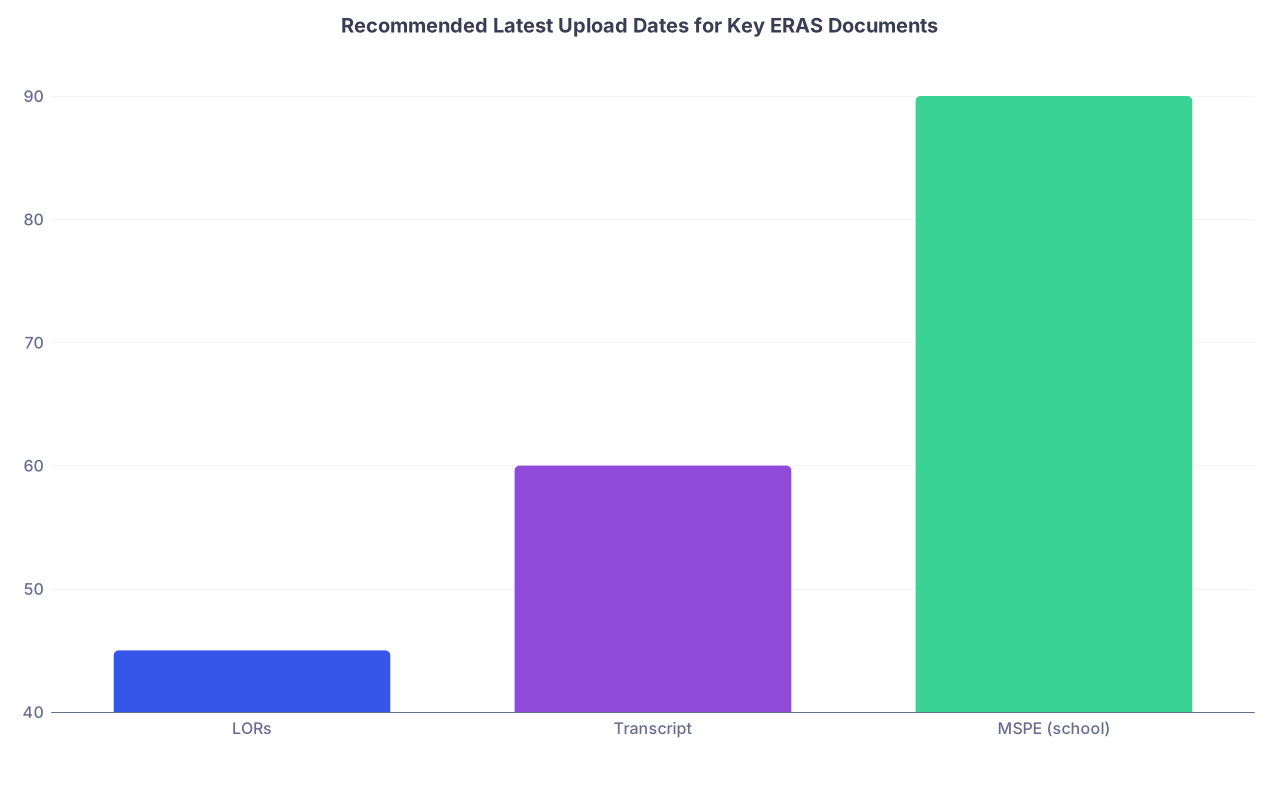
| Category | Value |
|---|---|
| LORs | 45 |
| Transcript | 60 |
| MSPE (school) | 90 |
(Interpreted as: days before submission you want them done—rough guide: LORs ~45 days, transcript ~60 days, MSPE is controlled by school but your inputs should be done ~90 days out.)
Send polite reminder emails mid‑July if letters aren’t in.
Subject: “ERAS Letter of Recommendation – Gentle Reminder”Content:
- Thank them again for agreeing
- Mention that ERAS submissions open in September
- Ask if there’s anything else they need from you
- Gently restate your target upload date (early August)
Confirm transcript and MSPE status with your school.
- Has your transcript been sent to ERAS?
- Have they started drafting your MSPE?
- Are you missing any forms?
You’re not being annoying; you’re protecting your timeline.
August: Finalizing for Day-One Submission
At this point you should assume anything not already in process is at risk.
Early August (about 4–5 weeks before submission)
Your ideal situation by August 1:
- All LORs uploaded (or at least 3 if your target is 4)
- Transcript received by ERAS
- MSPE draft complete or in progress at your school (you won’t see it yet)
- ERAS main application nearly done
If you’re not there, here’s what to do.
Missing letters? Trigger backup plan.
If a recommender has gone silent:- Send one more polite follow‑up
- At the same time, activate a backup writer (this is why you identified extras months ago)
- Do not sit hoping. Hope is not a strategy.
Re‑verify transcript receipt.
- Log into ERAS and confirm transcript status
- If it still shows as “not received” by mid‑August:
- Call or email the registrar
- Confirm the correct ERAS ID and delivery method
Lock in your personal statement and CV entries.
By late August, you do not want to be writing from scratch. You want to be polishing.
September: Submission Month – No Surprises
At this point you should be focused on polish, not panic.
Early September (ERAS submission opens)
Your goal: Submit ERAS on Day 1 or as early in that first week as possible.
Before you click submit:
-
- Are at least 3 letters uploaded?
- Are they correctly labeled with the right specialty?
- Do you have a strong, specialty‑relevant mix assigned to each program?
If one letter is still pending but you already have 3 solid ones, submit anyway. You can assign late letters later; don’t delay submission for a maybe.
Confirm transcript is “received.”
- If not, call the registrar immediately
- Your transcript doesn’t need to be perfect through all of MS4 (it won’t be), but it must exist
Submit your ERAS application.
Ideally on the very first submission day, not a week later. Programs notice early applicants first.
October 1: MSPE Release – The Last Piece Falls In
You don’t control MSPE release. It all drops on October 1.
At this point you should:
- Have already submitted ERAS in September
- Have programs assigned
- Have LORs and transcript in
On October 1:
Verify your MSPE appears in ERAS.
- If it doesn’t, contact Student Affairs that day
- Ask if there’s a technical issue or delay
Do not delay application waiting for MSPE.
That’s a national release. Programs expect it that day. Your part was getting everything else ready before.
Simple Timeline You Can Copy
Here’s a clean, no‑nonsense schedule you can literally paste into your calendar:
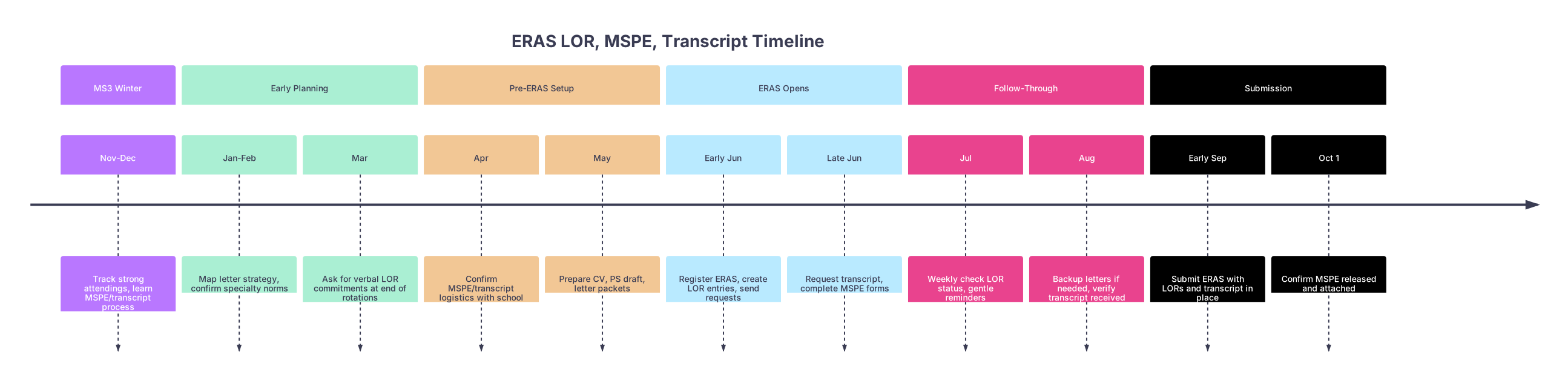
| Period | Event |
|---|---|
| MS3 Winter - Nov-Dec | Track strong attendings, learn MSPE/transcript process |
| Early Planning - Jan-Feb | Map letter strategy, confirm specialty norms |
| Early Planning - Mar | Ask for verbal LOR commitments at end of rotations |
| Pre-ERAS Setup - Apr | Confirm MSPE/transcript logistics with school |
| Pre-ERAS Setup - May | Prepare CV, PS draft, letter packets |
| ERAS Opens - Early Jun | Register ERAS, create LOR entries, send requests |
| ERAS Opens - Late Jun | Request transcript, complete MSPE forms |
| Follow-Through - Jul | Weekly check LOR status, gentle reminders |
| Follow-Through - Aug | Backup letters if needed, verify transcript received |
| Submission - Early Sep | Submit ERAS with LORs and transcript in place |
| Submission - Oct 1 | Confirm MSPE released and attached |
Common Timing Mistakes That Wreck Otherwise Good Applications
I’ve watched these derail smart students year after year:
- Asking for letters in August. Faculty are away. Clinics are chaos. Your letter ends up written in five rushed minutes or not at all.
- Assuming “the school handles MSPE and transcripts, so I’m fine.” Then discovering your MSPE input form was due in June.
- Not having backup letter writers. If one person flakes, your whole application weakens.
- Waiting to submit until every letter is in. As long as you have 3 strong letters, submit. Add the 4th later.
- Never checking the ERAS portal for document status. “I thought my transcript was in” is not a strategy.
You avoid every one of these by starting early and treating this like a project, not a vibe.
Open your calendar right now and block time in March, June, and July with specific tasks: “Ask for LOR commitments,” “Send ERAS LOR requests,” “Confirm letters/transcript received.” Turn this from vague intention into scheduled work today.