
The date you hit “submit” on ERAS is not neutral. Program directors read into it. A lot.
If you submit on Day One, they assume things about your organization, your risk level, even your personality. Some of it helps you. Some of it quietly hurts you if the rest of your file doesn’t match the message that ‘Day One’ sends.
Let me walk you through what actually happens behind those closed‑door meetings the first week ERAS opens.
What “Day One” Really Signals to Program Directors
Program directors are pattern recognizers. They’re not staring at the calendar thinking, “Wow, early bird, so impressive.” They’re asking one question:
“Does this timestamp match the story the rest of the file tells about this person?”
When an ERAS file arrives on Day One, the default inferences are:
- You are organized and motivated.
- You’ve been planning this for months.
- You are probably risk‑averse.
- You may or may not be “finished” (depending on Step 2, MSPE, and letters).
But here’s the part nobody tells you: those inferences get filtered through your stats, your specialty, and the culture of that specific program.
At one mid‑tier IM program I know, the PD literally said on the first filter meeting: “Day One apps with missing Step 2 in the bottom score range? That means they’re panicking. Move them to the ‘maybe’ pile until we see the exam.”
He wasn’t impressed by “early.” He was suspicious.
At a competitive derm program, same week, different interpretation: “She submitted Day One and already has a completed research section, strong LORs, Step 2 in, and a first‑author pub? That’s a machine. Flag for interview.”
Same behavior. Totally opposite reaction. Because the rest of the file matched—or didn’t match—the Day One signal.
The Actual First Week: What’s Going on in the PD’s Office
Let me show you what really happens that first week when you hit submit at 8:00 a.m.
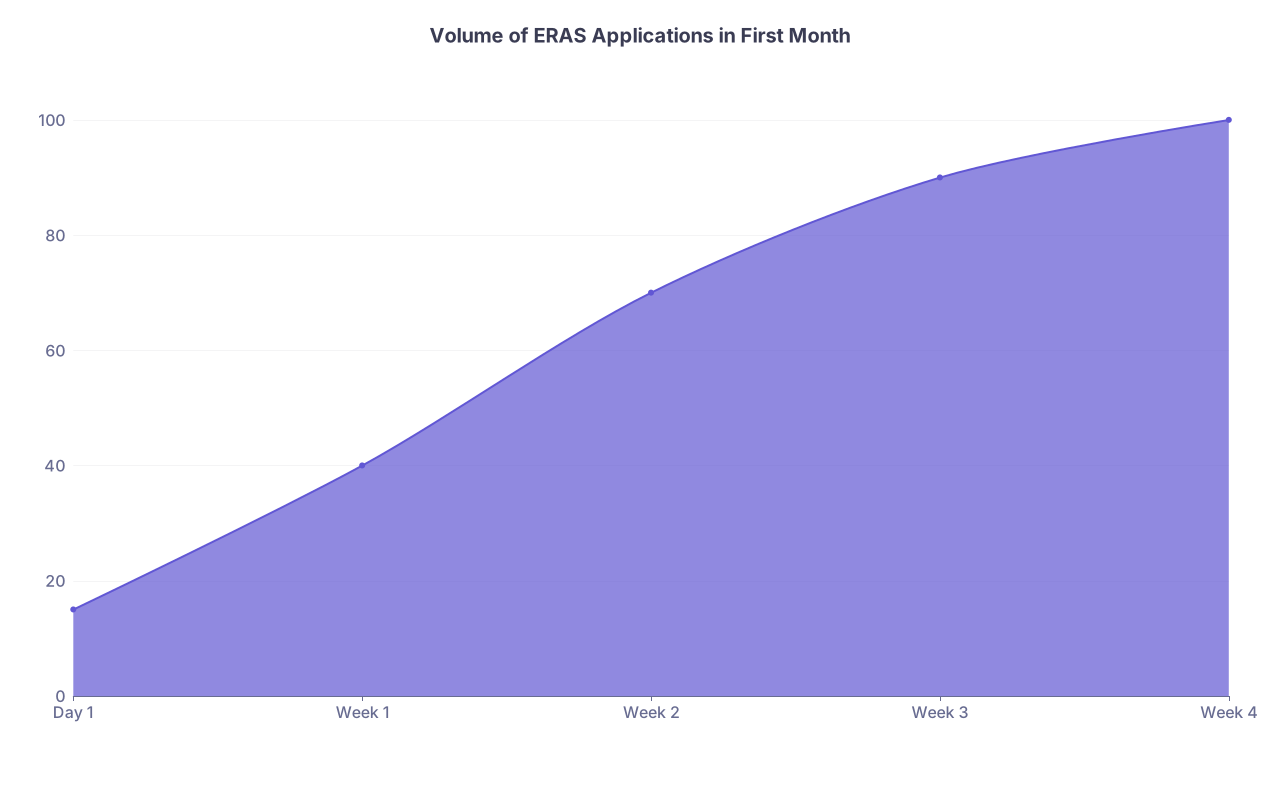
| Category | Value |
|---|---|
| Day 1 | 15 |
| Week 1 | 40 |
| Week 2 | 70 |
| Week 3 | 90 |
| Week 4 | 100 |
Most applicants think Day One = floodgates open. The reality is more nuanced.
At many programs, here’s roughly what happens:
- Day 1–2: Program coordinator logs in, tests filters, makes spreadsheets. PD glances.
- Day 3–7: PD and APDs start running queries: “Show me all apps with Step 1 pass, Step 2 ≥ X, and home school = ours or our region.”
- Week 2–3: Serious sorting starts, especially in competitive specialties.
- By 3–4 weeks: They’ve identified the bulk of their interview list or at least the “core” they expect to invite.
So where does a Day One submission land in this chaos?
If you’re complete early and your metrics are above that program’s internal bar, you get seen in the first pass. That’s to your advantage.
If you’re early but incomplete (no Step 2, weak or missing letters, half‑baked experiences), you get a mental sticky note: “Check back later.” And a lot of those “later”s never really happen once the interview slate is mostly full.
At one large IM program, the PD told me bluntly: “We say we’ll revisit incomplete early apps. Realistically, after our first big list build, we only go back if we’re short on numbers or we need a particular niche. People overestimate our free time.”
So early + incomplete is not a neutral choice. It can push you into the “will review later” pile that quietly turns into “never got back to it.”
What Different Specialties Infer from a Day One ERAS
Different fields carry different cultural assumptions. PDs aren’t robots; they’re shaped by who goes into their specialty.

Broadly, this is how Day One submissions are read behind the scenes:
| Specialty | Common PD Reaction to Day One Submission |
|---|---|
| Derm/Plastics | Expected from strong applicants; signals planning |
| Ortho | Ambitious, probably well-coached |
| Gen Surg | Organized; neutral unless file is weak |
| EM | Mild positive; helps if done before SLOEs crunch |
| IM/FM/Peds | Nice but not decisive unless file is strong |
| Psych | Neutral; content matters more than date |
At a top‑tier derm program, by the time MSPEs drop, they already have their “watch list” built from the first wave of complete apps. Day One complete with strong stats? You’re in the “serious contender” bucket early, which matters when they’re deciding who to read more deeply.
In EM, early complete apps—especially before the SLOE bottleneck—can give you a slight edge because they start building their rankable pool before the crazy flood.
In primary care fields (IM, FM, peds), many programs simply don’t have the capacity to do fine‑grained sorting on Day One. They often batch review by school or by initial filters. For them, Day One is mildly positive, but not magical.
The Three Profiles of Day One Applicants PDs Recognize
After a few cycles, PDs see patterns. Early apps tend to fall into three recognizable buckets.
1. The “Prepared and Competitive” Applicant
This is the group that actually benefits from Day One.
Their pattern:
- Step 1: pass (if applicable)
- Step 2: in, and clearly at or above that specialty’s comfort zone
- Letters: 3–4 strong letters already uploaded, including at least one from the specialty
- Experiences: polished, consistent, no obvious fluff
- Personal statement: specific, not generic “I love internal medicine because…”
When a PD sees this file on Day One, the inference is: “This person is intentional and is not scrambling. They’ve been on top of this process for months.” That’s attractive.
One surgical PD told me, “When the early file is clearly above our bar in scores and has clean letters, we tend to flag them fast. They’re easy wins for our first round of invites.”
So if you’re in this group, Day One is an asset. You’re matching the signal (organized, driven) with the evidence.
2. The “Anxious but Incomplete” Applicant
This is the big trap.
Profile:
- Step 1: pass
- Step 2: pending or taken but not yet released
- Letters: 1–2 uploaded, missing a key specialty letter
- MSPE: not yet visible (PDs know this is normal at first, but they still notice)
- Personal statement: often generic or slightly rushed
PDs know exactly what this is: “They’re hitting submit to feel safe, but their file isn’t actually ready.”
At one mid‑west IM program, I watched an APD scroll through Day One apps and say, “This one has one random letter, no Step 2, and weak clinical evals from their home school—why are they rushing? Mark ‘incomplete’ and move on.”
The cynical translation: early + obviously incomplete = anxiety, not confidence.
That doesn’t mean you’re doomed if you fall in this group. It does mean the timing isn’t doing what you think it’s doing. You’d often be better off waiting 1–2 weeks to submit a complete file than rushing out an incomplete one on Day One.
3. The “Overcompensating” Applicant
This one stings, but you need to hear it.
These are applicants with:
- Borderline or low Step 2 for their specialty
- Limited or generic letters
- Sparse or unimpressive clinical or research experiences
And they slam “submit” at the earliest possible second, clearly hoping timing will offset the rest. PDs do notice this dynamic.
A PD in a competitive surgical subspecialty once said in a review meeting: “The ones who submit at 8:01 a.m. with 230s in our pool and no meaningful research… it tells me they’re trying to squeeze advantage out of the only controllable variable they have left. It’s not a reason to interview.”
Harsh? Yes. Accurate? Also yes.
Early submission does not fix a fundamentally weak file. It just exposes that weakness sooner.
Timing vs. Completeness: What PDs Actually Prefer
There’s a persistent myth that “Day One or bust” is the rule. That’s not how PDs talk about it when the door is closed.
Most PDs I’ve worked with would state their preference like this:
“I would rather see your application 7–14 days after ERAS opens, fully baked, than Day One with missing pieces.”
They want:
- Step 2 in, especially if Step 1 is pass/fail or marginal
- At least 2–3 specialty‑relevant letters
- A coherent experience section
- A personal statement that looks like you thought about it for longer than a weekend
Where Day One truly matters is in combination with completeness.
Think of it like this:
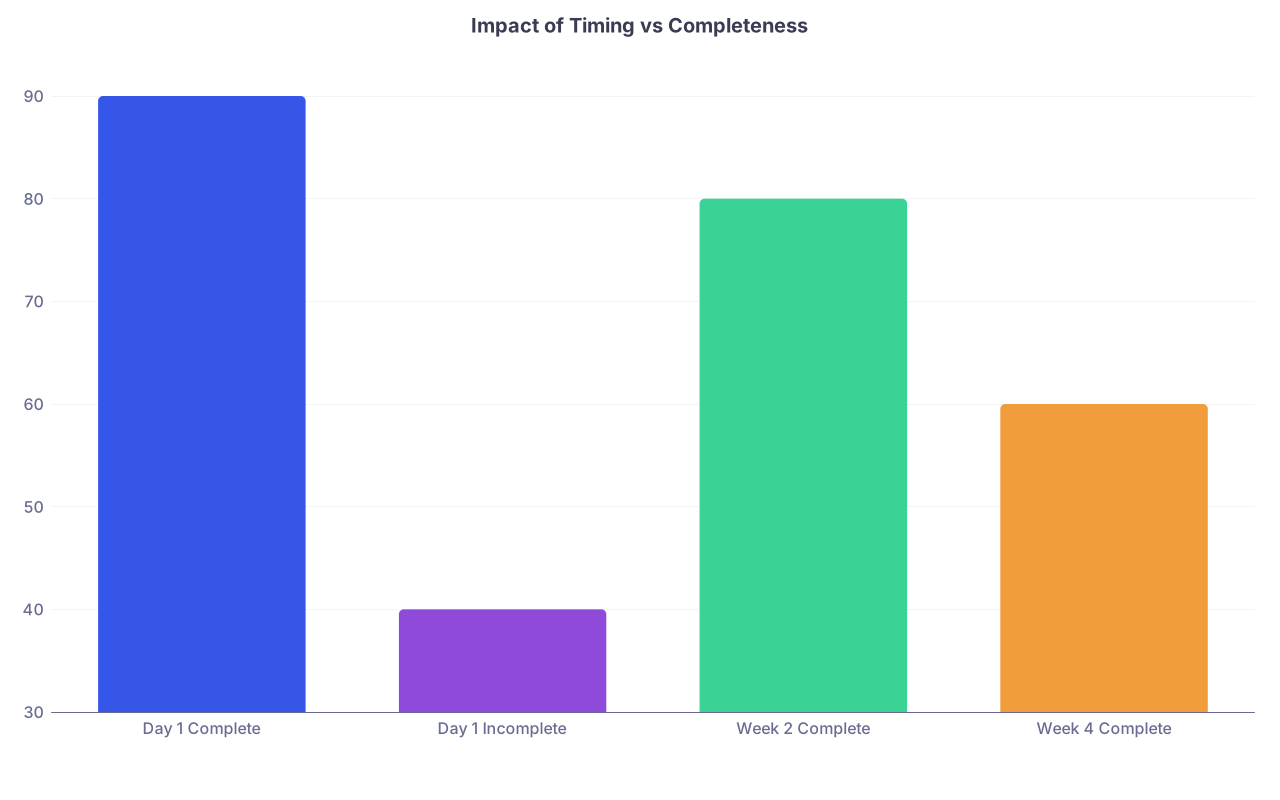
| Category | Value |
|---|---|
| Day 1 Complete | 90 |
| Day 1 Incomplete | 40 |
| Week 2 Complete | 80 |
| Week 4 Complete | 60 |
If we call that y‑axis “relative PD favorability,” the pattern I see year after year is:
- Day 1 + complete: Strong signal
- Week 1–2 + complete: Almost as good for most programs
- Any time + incomplete: Weak, regardless of timing
- Late (after most invites go out) + complete: Variable, often too late at high‑demand programs
So no, you don’t need to sacrifice quality for the illusion of punctuality.
How Programs Actually Filter Day One Applications
You need to understand the mechanics to understand how timing plays out.

| Step | Description |
|---|---|
| Step 1 | Day One Submission |
| Step 2 | Mark as Incomplete / Hold |
| Step 3 | Apply Score/Filter Cutoffs |
| Step 4 | Low Priority / Reject Later |
| Step 5 | Deeper File Review |
| Step 6 | Flag for Interview List |
| Step 7 | Maybe / Backup Pool |
| Step 8 | Complete? |
| Step 9 | Above Cutoffs? |
| Step 10 | Good Fit? |
On Day One, what matters is where you are when they run that first filter.
That filter is often something like:
- US MD/DO vs IMG
- Step 2 ≥ internal cutoff
- Geographic or school‑based preferences
- Visa status
If you meet the cutoffs and your file is complete, you enter that early “deeper review” stage. If not, you’re shunted into “incomplete/hold” or quietly deprioritized.
And here’s the hidden danger: busy programs rarely have time to keep re‑running filters on previously incomplete apps every few days. Once they’ve built a decent interview list, late‑completing files just don’t get as much oxygen.
One PD in EM told me flat out: “Our interview list is 70–80% built from the first serious pass. The rest is tweaks, special asks, or late gems. You want to be in that first wave.”
Being in that first wave requires not just early timing, but early completeness.
When Day One Helps You – And When It Quietly Hurts
Let me be uncomfortably clear.
Day One helps you if:
- You’ve already taken and received Step 2 with a score that’s solid for your specialty.
- Your core letters are in, including at least one from the field you’re applying to.
- Your faculty advisors have seen and blessed your personal statement and experiences section.
- Your school releases MSPE and transcripts automatically without delay or oddities.
In that scenario, Day One says: “This person is exactly as on top of their life as their application suggests.” PDs like that. It feels low risk.
Day One can hurt you if:
- You’re waiting on a make‑or‑break Step 2 that could move you from ‘borderline’ to ‘clearly in range.’
- Your specialty letter is coming in 7–10 days and is needed to offset weaker metrics.
- You’re changing specialties late and your narrative/experiences are still obviously disjointed.
At one strong but mid‑range applicant I advised, we intentionally didn’t submit on Day One for EM. Step 2 was pending, and his home EM SLOE was going to be uploaded about a week in. We waited until both hit, then submitted everything at once.
His PD afterward (at the program he matched) told me: “You showed up in our first serious read with Step 2 and a solid SLOE already in. That made it very easy to move you to the interview pile.”
If he had submitted Day One, missing the SLOE and Step 2, he would’ve been in that “check later” bucket. And I’ve watched that bucket vanish into the digital void more times than I can count.
What PDs Don’t Infer from Day One (That You Think They Do)
You’re giving them too much credit in some areas and not enough in others.
They do not think:
- “Day One means they love our program specifically.” They know you blasted the same file to 40 programs.
- “Day One means they are surely mature, kind, or great team players.” Timing says nothing about your clinical behavior.
- “Day One means they’re definitely ‘top tier’.” Plenty of average applicants hit submit early.
They do think:
- “Day One complete apps are usually from people who have had robust advising.”
- “Day One incomplete apps are often panic‑driven.”
- “Day One weak apps are trying to play games with timing.”
Their job is risk assessment. Early submission feeds into that, but only as one small data point.
Pragmatic Strategy: How You Should Actually Time Your ERAS
Here’s the part you actually care about: what should you do?

Use this mental framework instead of obsessing over “Day One or not.”
Identify the earliest date your application will be truly competitive for your target programs.
- That usually means: Step 2 back, key specialty letters in, personal statement and experiences vetted.
Look at when programs in your specialty usually start sending interview invites.
- Many competitive fields start within 1–2 weeks of ERAS opening.
Aim to be complete at least a few days before that wave, ideally in the first 7–10 days, rather than at the exact first minute of Day One no matter what.
In other words, the best time to submit ERAS is:
- As early as you can
- Without sacrificing the completeness and quality that PDs actually care about
If that happens to be Day One, great. If it’s Day Seven, also fine. If it’s Week Three for a moderately competitive specialty but your Step 2 jumped you into a stronger bracket, that trade‑off is usually worth it.
One caveat: in the ultra‑competitive specialties (derm, plastics, some ortho programs), being both early and complete can matter more. Those programs sometimes build a large chunk of their list from the first cohort of fully competitive files. For them, your target is: complete by Day One or very close to it.
Quick Reality Check: What PDs Remember at the End
By the time rank lists are built, here’s what PDs actually remember about you:
- Your interview performance.
- Your perceived fit with their program’s culture and needs.
- Your letters and whether faculty advocated for you.
- Your scores and red flags, if any.
Almost nobody sits around in January saying, “Remember that candidate? They submitted on Day One. What a star.” It doesn’t happen.
At best, Day One submission gave you earlier entry into the consideration pipeline when your file was strong. At worst, it got you labeled as “anxious and incomplete” and quietly sidelined.
Timing is a lever. Not a miracle.
FAQ (Exactly 3 Questions)
1. If my ERAS is fully complete on Day One, should I wait anyway?
No. If your application is genuinely complete and competitive for your specialty on Day One—Step 2 in, letters ready, narrative coherent—there’s no advantage to waiting. Submit. You’ll be in that first serious review wave at many programs, which is where you want to be.
2. I’m waiting on a Step 2 score that could move me from borderline to solid. Should I still submit on Day One?
Usually no. If your current metrics put you below or barely at the comfort zone for your target programs, it’s often better to wait for the stronger Step 2, even if that means submitting 1–3 weeks after ERAS opens. PDs care far more about the final strength of your application than whether it appeared in their queue on Day One versus Day Twelve.
3. Do programs see the exact time/date I submitted ERAS and use it directly in decisions?
They see when your application became available and whether it was complete when they first ran their filters. They don’t have a “timestamp score.” What matters is whether you were complete and competitive by the time they seriously started building their interview list. For most programs, that’s within the first 1–3 weeks, not just the first few hours. The key is alignment of timing + completeness, not chasing the earliest possible minute.