
It’s August 28th. ERAS opens in less than a week.
Your Step 2 score is “pending.”
Your latest COMLEX level is “pending.”
Your away rotation letter is “pending.”
And you’re telling yourself the same dangerous sentence I’ve heard a hundred times:
“I’ll just wait for this one more score and then submit. It’s only a couple of weeks.”
This is exactly where people quietly destroy their application. Not with some huge, obvious blunder. With “just a small delay” that snowballs into missed interview invites and a weak Match list.
Let me walk you through how applicants tank their chances by waiting for one more score—and how you’re going to avoid joining them.
The Biggest Lie: “Programs Will Wait For Me”
Here’s the ugly truth: programs are not waiting for your perfect file.
By the time your “one more score” posts, many programs have:
- Downloaded their first wave of applications
- Screened out a massive chunk
- Sent a big batch of interview invites to early applicants
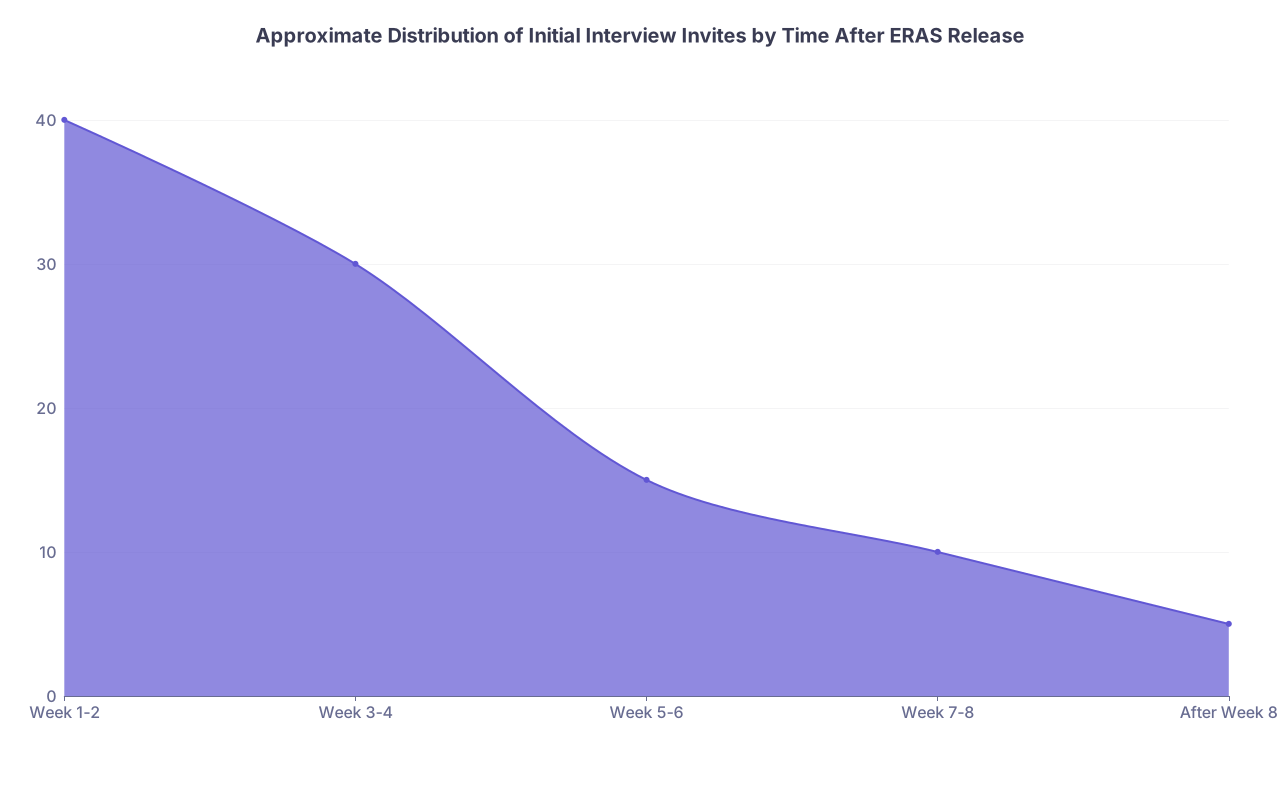
If you think I’m exaggerating, look at how screening and invites usually cluster.
| Category | Value |
|---|---|
| Week 1-2 | 40 |
| Week 3-4 | 30 |
| Week 5-6 | 15 |
| Week 7-8 | 10 |
| After Week 8 | 5 |
Does every program work this fast? No. But enough do that delaying your submission for a “maybe slightly better” score is often a bad trade.
Common timing delusions I hear:
- “They’ll wait to see my Step 2 because it’s more recent.”
- “They’ll hold my app until my new letter comes in.”
- “It’s only 2–3 weeks; that cannot matter that much.”
Wrong on all three.
Many programs:
- Batch-download early, then barely look at later arrivals.
- Auto-screen based on what’s there at the time of download.
- Are flooded with strong, complete applications that did arrive on time.
Late = invisible. Not “thoughtfully reviewed when complete.” Just buried.
Mistake #1: Waiting For A Hypothetical Score “Boost”
The classic scenario:
You have:
- Step 1: Pass
- Step 2: 238 (or COMLEX equivalent)
- Solid clinical evals, average research, okay letters
But you’re convinced: “If I wait for my next shelf/Step 2 CK/COMLEX Level score, I might jump 10–15 points. That could move me into a better tier of programs.”
Here’s the problem.
Programs don’t see your fantasy score. They see:
- An application that arrived late
- Or worse, an application that never reached their first screening batch at all
They are not comparing “238 vs 250.” They are comparing “complete on Day 1” vs “complete on Day 25.”
And that second one often never gets seriously looked at.
The math is brutal:
- Gaining 5–10 points: marginal bump in competitiveness
- Submitting 3–4 weeks late: major hit in visibility and interview volume
If you’re in a reasonable range for your specialty and your dream is mostly “nicer geography, maybe a bit more prestige,” do not trade early submission for a small score bump.
Where waiting might be worth it:
- You failed an exam and are waiting for a retake score that changes “auto reject” to “consider”
- Your current score is wildly below that specialty’s typical range, and you’re effectively not competitive without improvement
- You’re switching specialties and the new score is part of your reinvention story
Everyone else? You’re gambling for pennies while risking dollars.
Mistake #2: Confusing “Submit” With “Perfectly Complete”
You do not need every last piece in place to submit.
Read that again.
ERAS lets you:
- Submit your application
- Then have scores and letters arrive later and still be attached
Too many students think: “I should wait until my new LOR/updated transcript/extra poster is uploaded. I want it to look complete when they first open it.”
Reality:
- Programs see a submitted application.
- Some do a first-pass screen quickly.
- If you’re above a certain threshold, you’re in their “maybe” pile.
- When your new score/letter comes in, it can strengthen you. But only if you’re already in the pile.
The catastrophe is not being “seen without your best letter.”
The catastrophe is not being seen at all because you never made that first pass.
What you can safely add later:
- Extra letters beyond the 2–3 core strong ones
- Later research updates (posters, publications)
- Additional scores that aren’t fixing a red-flag failure, just slightly improving an already okay profile
What you must not delay for:
- A maybe-strong letter from someone who barely knows you
- An extra research line that’s mostly CV padding
- A small score bump when you already passed everything and are in range for your target programs
Mistake #3: Misreading Specialty Competitiveness and Timing
Different specialties punish timing mistakes differently. Some are ruthless.
| Specialty | Timing Sensitivity | Comment |
|---|---|---|
| Dermatology | Extremely High | Late = basically dead |
| Ortho / Plastics | Very High | Need early, polished apps |
| EM | High | Many early invites |
| IM / FM | Moderate | Some flexibility, not unlimited |
| Psych / Peds | Moderate | Early still gives clear edge |
If you’re applying:
- Derm, ortho, plastics, ENT, neurosurgery
- Or to big-name academic programs in any specialty
You cannot afford to play games with timing. Those programs are inundated. They don’t need to patiently wait for your file to be perfect.
I’ve seen applicants with:
- Great scores
- Strong research
- Confident they’d “shine”
…who applied 3–4 weeks late to ultra-competitive specialties and ended up scrambling for prelim spots or failing to match altogether.
Not because they weren’t good enough.
Because they were arrogant—or naive—about timing.
Mistake #4: Ignoring When Programs Actually Start Looking
A lot of you assume: “Programs won’t really start reviewing until October; I’m fine.”
No.
Many programs:
- Download apps as soon as they’re released to programs
- Start building “interview lists” early
- Send out their first big wave of invites earlier than applicants expect

| Step | Description |
|---|---|
| Step 1 | ERAS Opens for Submission |
| Step 2 | Applicants Submit Early |
| Step 3 | ERAS Released to Programs |
| Step 4 | Programs Download Early Apps |
| Step 5 | Initial Screening & Shortlist |
| Step 6 | First Wave Interview Invites |
| Step 7 | Late Applications Arrive |
| Step 8 | Reviewed Only If Spots Remain |
If you submit right at the time ERAS opens for applicants (mid-September), you are in the earliest review waves once programs can see files.
If you’re submitting 2–4 weeks after the opening:
You’re walking into a party where a lot of the food is already gone and tables are already reserved.
Are there still seats? Sometimes.
Are you competing with fewer people? Not at all. The early crowd is already there, and they look more responsible.
Mistake #5: Underestimating the Stigma of “Late = Disorganized”
Fair or not, a late application often reads as:
- Poor planning
- Poor test scheduling
- Poor time management
- Or “What went wrong?”
You and I know you might simply be a perfectionist waiting on that one extra thing. Programs don’t care. They see patterns, not intentions.
If your file shows:
- Step exams taken at the last possible window
- Clerkship grades finalized late
- Late transcript uploads
- Then a late ERAS submission
…it tells a story. Not a flattering one.
For competitive specialties, red flags are sometimes just “things that make me pick someone else when I have 200 great choices.”
Do not hand them an easy reason to move on.
When Waiting For A Score Is The Right Move
Not all waiting is dumb. Sometimes delay is your only sane play.
You should seriously consider waiting if:
You failed Step 1/Step 2/COMLEX and your retake is pending
- A fresh pass can move you from “auto reject” to “maybe”
- Submitting with only the fail visible is often suicide in competitive fields
You’re switching from a very competitive specialty to a less competitive one and your new score/rotation proves the pivot
- Example: You bombed trying to build a plastics application, pivoted to general surgery or IM, and your new grades/score show the upswing
You’re applying to an ultra-competitive specialty with a significantly below-average score and have realistic reason to believe a retake meaningfully changes your range
- Not from 235 to 242
- More like from 225 to 250 for a specialty that usually interviews 245+
But even then, you need a calendar, not vibes.
How To Decide: Submit Now vs Wait For One More Score
Here’s the mental framework I wish more applicants used.
Ask yourself three blunt questions:
Am I already “in range” for my specialty and program tier?
If yes, small score boosts aren’t worth major timing sacrifices.Is my current profile catastrophically disqualifying, or just not perfect?
Catastrophic (fail, very low score, huge gap) sometimes demands waiting. “Not perfect” does not.Will this delay push me past the first 2–3 weeks of review at most programs?
If yes, you’re gambling hard. You better have a very strong reason.
If your current record is:
- Pass Step 1
- Reasonable Step 2 or COMLEX in the ballpark for your specialty
- Decent clinical comments
- Normal timeline
Then your priority is early, polished submission, not chasing a slightly prettier number.
Mistake #6: Failing To Back-Plan From Your Score Release Date
A lot of students completely botch this. They schedule Step 2 or COMLEX with zero backward planning from ERAS deadlines.
Then August hits and they say, “Oh, I didn’t realize my score would cut it so close.”
You can avoid this with some basic planning.
| Category | Value |
|---|---|
| Test Date | 0 |
| 3 Weeks | 21 |
| 4 Weeks | 28 |
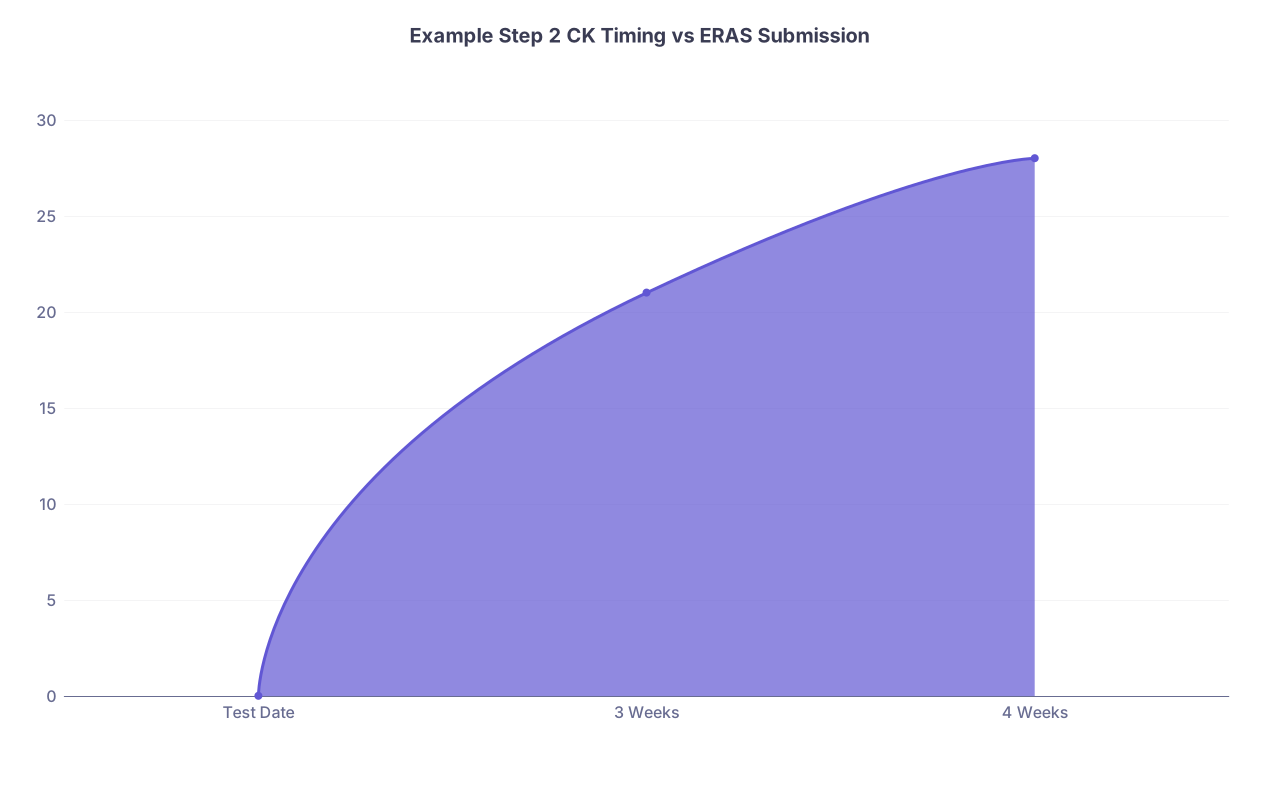
USMLE/COMLEX score reports usually come out about 3–4 weeks after your test. Sometimes slower. Sometimes with delays.
If you:
- Take Step 2 in late August
- Hope the score hits before the ERAS submission date
- And then there’s any delay
You’re suddenly forced to choose between:
- Submitting with no Step 2 on file
- Or applying late to get the score in first
This was avoidable.
Back-plan your exam dates so that:
- Scores arrive at least 2–3 weeks before ERAS opens for applicants
- Or you accept that you’ll submit without that score and let it arrive later
What you do not do is crowd Step 2 into the last possible test slot and then be shocked that timing is tight.
The Hidden Cost: Missed Interview Volume
We need to talk numbers because that’s where people finally get it.
Imagine you’re aiming for IM, Psych, or Peds. Not super-cutthroat, but not a joke either.
Scenario A – Early:
- Submit the day ERAS allows
- Programs see you in their first screening batch
- You get: 12–15 interview invites from a mix of reaches, matches, and safeties
Scenario B – Late (3 weeks delay waiting for Step 2 score):
- Submit after the main flood
- Many programs’ early waves are already full
- You get: 5–7 interview invites, mostly from lower-tier or less desirable locations
Same applicant. Same scores in the end. Very different outcome.
Match safety lives in interview volume. Not a single magical score.
If you end up with 5 interviews instead of 12 because you “waited for one more score,” you’ve turned a manageable Match into a dice roll.
How To Do This Right: Practical Rules
Let me be very clear and practical.
Plan to submit ERAS on the first possible day applicants can submit.
Not “sometime that week.” Not “when I feel ready.” The first day.Accept that something will always feel incomplete.
That missing poster, slightly late letter, or not-yet-posted extra score is normal. Everyone has loose ends. Do not chase 100% completeness.Use scores to upgrade, not unlock.
If your current file already unlocks the door to your specialty (i.e., you’re in range), early timing matters more than marginal upgrades.Let new scores arrive after submission when possible.
Submit on time. Let ERAS attach your Step 2/COMLEX when it’s ready. Programs will see it, and the early birds will already have their foot in the door.If you must wait (due to a fail or massive deficit), own the trade.
Understand you’re sacrificing some interview volume in exchange for basic eligibility. That’s sometimes necessary. Just don’t pretend there’s no cost.
Red Flags You’re About To Make A Timing Mistake
If you catch yourself thinking any of these, pause:
- “It’s only a few weeks, that cannot matter.”
- “I’ll be much more competitive with this one extra score.”
- “I want everything to be perfect before any program sees it.”
- “I heard some program directors say they don’t start reviewing until October anyway.”
- “I’m sure they’ll wait to see my full, updated record.”
This is how strong applicants quietly sink themselves.
If your advisor or mentor is telling you “Submit early anyway; you can update later,” listen. They’ve seen what happens to the late crowd.
FAQ (Exactly 5 Questions)
1. Should I submit ERAS if my Step 2 score is still pending?
Usually yes. If you’ve passed Step 1 and are in a reasonable range for your specialty, submit as early as possible and let Step 2 arrive later. The exception: if you failed a prior exam and the new score changes you from automatic rejection to viable, then waiting can be justified—but understand you’ll likely lose some interview volume.
2. Is it bad if my application is submitted but only has 2 letters initially?
Not necessarily. Two strong letters early are better than three letters late, especially if the third is from someone who barely knows you. Submit on time with solid letters; you can assign additional letters later as they come in. Programs care more about timing and content than hitting some arbitrary letter count on day one.
3. How late is “too late” to submit ERAS?
If you’re more than 2–3 weeks behind the first submission day, you’re already at a disadvantage for many programs, especially competitive ones. After a month, you’re meaningfully late, and in some fields that’s close to self-sabotage unless you have extraordinary mitigating circumstances.
4. Do community or less competitive programs care less about timing?
They care slightly less, but not “not at all.” Even community and less competitive programs still fill a lot of their interview slots from early applicants. Being much later than your peers still tells a story of poor planning, and it still cuts into your interview numbers.
5. My advisor says to apply early even with a mediocre score, but I feel I could do better. Who’s right?
Most of the time, your advisor. They’ve watched people bet on “I’ll do better later” and then either not improve much or torpedo themselves with late applications. Unless your current score makes you essentially noncompetitive for your specialty, early submission with that “mediocre but acceptable” score usually beats a slightly higher score that arrives after key screening periods.
Key points to walk away with:
- Early submission beats small score improvements in almost every realistic scenario.
- “Waiting for one more score” is how many otherwise solid applicants quietly tank their Match.
- Submit on the first day, accept imperfection, and let your later scores and letters strengthen a file that programs have already actually seen.