
Timing ERAS Around Step 2 CK Score Reporting Windows: A Deep Dive
It is early August. ERAS is open for drafting, your Step 1 is Pass, and you just walked out of the Step 2 CK exam two weeks ago. You are staring at three tabs:
- ERAS submission timeline
- NBME score reporting schedule
- A half-written personal statement
And the real question is not “How do I make my ERAS pretty?” It is:
“Do I wait for my Step 2 CK score before I certify and submit, or do I fire it off on day one and hope the timing works out?”
Let me break this down specifically, because this is where a lot of people quietly sabotage their cycle without realizing it.
We are going to talk about:
- How NBME/USMLE Step 2 CK reporting windows actually work (not the vague version you hear on Reddit).
- What different specialties and program types want to see regarding Step 2 at the time of application.
- Concrete timing strategies based on when you took (or will take) Step 2 and how strong or weak you expect the score to be.
- The “do I release now or wait?” trap when the score finally posts.
If you are looking for a one-size-fits-all rule like “Always submit ERAS as early as possible,” you are not going to like this. The real answer depends on your Step 1 status, specialty competitiveness, and your Step 2 test date.
1. Step 2 CK Reporting Windows: How the Score Actually Moves
The key mistake people make is thinking in single dates: “I took Step 2 on August 10; I’ll get my score in 2–3 weeks.”
No. You should think in windows and milestones:
- Test date → score release window (usually ~3–4 weeks, barring summer delays or updates).
- Score release → ERAS data transmission to programs.
- When programs actually start reviewing applications and sending interview invites.
The usual pattern (outside of any special delay notices)
Typical CK score release (non-summer):
- Exams taken: Monday–Friday
- Score release: About 3–4 Wednesdays later
So you are functionally operating with “exam date + ~3–4 weeks” as the median, not the guarantee.
Where people get burned is around:
- Late July–September: Historically, the NBME/USMLE announces potential delays when they make content or system changes. That can turn 3 weeks into 5–6. You cannot assume normal timing in those windows unless you have checked the current-year USMLE announcements.
How this intersects with key ERAS dates
Let’s outline the core ERAS dates as they affect Step 2 timing (U.S. MD/DO, typical cycle; the exact dates shift slightly year to year, but the logic holds):
- Mid–late June: ERAS opens for candidates to start working on the application.
- Early September: ERAS submission opens – you can certify and submit, but programs do not get your application yet.
- Mid–late September: ERAS transmission date – programs start receiving applications and USMLE transcript data. This is the true “start line” as far as programs are concerned.
- Late September – November: Programs do most of their initial screening and send the majority of interview invites.
So the question is always:
“Will my Step 2 CK score be posted, added to my USMLE transcript, and transmitted to programs by the time PDs start their first-pass screening?”
That is the actual operational question, not “Is it in ERAS on submission day?”
2. ERAS + Step 2 CK: What Programs Actually See and When
Your USMLE transcript is not a static PDF you upload. It is a living document:
- When you first authorize release in ERAS and assign it to programs, they get the current version of your transcript.
- When additional scores (like Step 2 CK) are reported, you can re-release the transcript, and programs see the updated version.
That means two concrete things:
- You do not have to delay ERAS submission to wait for Step 2 CK if you are happy initially being seen with just Step 1 (or just Pass).
- But you do have to time when you take the exam so the score exists and can be released before programs complete their first few waves of screening.
Here is where specialties split.
3. Specialty Expectations: Who Really Cares About CK Timing
Let us be blunt. Some specialties will screen you out silently if they do not like your Step 2 CK or if it is missing too long. Others will tolerate a pending CK for a while.
Broad strokes:
| Specialty Group | Step 2 CK Timing Sensitivity |
|---|---|
| Derm, Plastics, ENT, Ortho | Extremely High |
| Rad Onc, Neurosurgery | Very High |
| General Surgery, EM, Anesthesia | High |
| Internal Med (academic-heavy) | Moderate–High |
| OB/GYN, Pediatrics | Moderate |
| FM, Psych, Community IM | Lower |
Do not overinterpret the table; this is about timing, not about score thresholds.
Some concrete patterns I have seen repeatedly:
Competitive surgical subspecialties (Derm, Ortho, ENT, etc.):
Many programs want a CK score in the file by the time they sit down to do their first serious spreadsheet sort in late September / early October. If it is missing by mid-October, you start falling into “maybe later” pile. And “later” often turns into “never.”EM, Anesthesia, General Surgery, competitive academic IM:
Very CK-focused after Step 1 went Pass/Fail. They will still look at an early file with Step 1 Pass and pending CK, but your file usually does not make it to the “top candidate” column until the number is in.FM, psych, community-focused programs:
Much more forgiving. They may interview you off a pending CK, especially if other parts of your application look strong. But even here, a weak or late CK can quietly drop your chances without a formal “requirement.”
Bottom line:
For the top 1–2 tiers of competitiveness, if Step 2 CK is a major strength for you, having it in the file early is a weapon. If it is a weakness, the timing calculus changes.
4. The Core Decision: Early Submission vs Waiting for CK
Here is the trap people fall into:
They think their choice is:
- Submit ERAS in early September with no CK
vs - Wait until CK is out in early October, then submit
This is usually the wrong framing.
Most of you should be doing both:
- Submit ERAS as soon as it opens for submission (early September) so you are in the first wave.
- Plan your exam date so that the CK score posts before or near the ERAS transmission date, or at worst early in the review season, then re-release the transcript.
So the real variable is not “when to submit ERAS,” it is:
“When to take Step 2 CK so that my score is reported by the time programs seriously start screening?”
Let me give you actual scenarios.
5. Scenario-Based Timing: When You Took (or Will Take) Step 2
Scenario 1: You tested in June or early July
You: CK done, expected score release before or very shortly after early September.
Reality:
- You will almost certainly have your CK score by the time ERAS opens for submission.
- You can submit with Step 2 CK already on your transcript, and everything will be in place when programs first pull applications on the transmission date.
Strategy:
- This is ideal. Do not wait. Certify and submit as soon as it opens.
- Release your USMLE transcript with CK included the moment it posts.
- Your timing question is basically solved. Now the issue is just: Is it a score you are proud of?
Exception:
- If Step 2 CK unexpectedly comes back drastically lower than a strong Step 1 (for pre-Pass/Fail people), then there is a different damage-control conversation. But for the current era (Step 1 Pass), your CK is usually the anchor, and earlier is better.
Scenario 2: You tested late July to mid-August
This is where it gets tricky.
Example: You took CK on August 10.
- Normal world: score release ~early September. You are fine.
- Year with reporting delays: release could slip to mid–late September, maybe even into October.
Here is the decision tree.
If there are no official delay announcements:
- Submit ERAS on the first day possible in early September.
- Check your NBME/USMLE account every Wednesday like a hawk.
- As soon as the score appears, re-release your USMLE transcript in ERAS.
What happens program-side?
- When ERAS transmits applications in mid–late September, some programs will get your file with CK already on it, others may initially see it with just Step 1, then see the update later.
- As long as the score is present by early October, you will still be in the primary wave for most programs, especially non-ultra-competitive specialties.
If there are announced summer delays:
Now you have uncertainty. Maybe your August 10 exam becomes a late September or October release.
Now you have three hard options:
- Submit ERAS on time (early September) with no CK and accept that some programs may prelim-screen you based only on Step 1 Pass and the rest of your application.
- Delay ERAS submission into October waiting for CK, knowing you’ve just voluntarily taken yourself out of the “early” pool for many programs.
- Hybrid: Submit on time, but strategically decide for certain ultra-competitive programs whether you even bother applying if you know they live and die by CK and you will not have it till too late.
I will be blunt: Option 2 (delaying ERAS submission significantly) is usually worse for you than option 1. Programs do not sit politely waiting for your file to be “perfect.” They are filling interview slots.
Unless your Step 1 is a disaster and CK is your one and only savior, you usually:
- Submit on time
- Take your chances with a late CK
- And let the rest of the application pull its weight
Scenario 3: You tested late August to September
Example: September 5 CK date.
Typical release: Late September or early October, right as programs are deep in first-pass review.
This is salvageable but not ideal. For competitive fields, this is a problem. Let’s walk it.
Your moves:
- You still submit ERAS as early as possible in September.
- Authorize your transcript even though it only has Step 1 Pass (or maybe no score yet if Step 1 was also late).
- The moment the CK score posts, re-release the transcript.
What to expect:
- By the time your CK shows up, many programs in competitive specialties will have already run an initial filter. You may miss out on being auto-flagged by “Step 2 ≥ X” criteria if they pre-screened before your score posted.
- For less competitive fields or community programs, many will still be pulling from the pool throughout October and even November. Your CK coming in a bit later can still help you.
Where I see people hurt themselves:
- They assume, “Since my CK is late, I may as well wait to submit ERAS until the score posts.” That compounds the problem. Now you are late in two dimensions: missing score and late submission.
In this scenario, early submission plus late CK is still better than late submission plus CK in almost every specialty.
Scenario 4: You are planning CK after ERAS opens (October or later)
This happens more than it should.
Maybe you had a brutal third-year. Maybe you misjudged CK prep. Maybe your school advisors were not paying attention.
Harsh truth: For competitive specialties, this is a serious handicap. Programs cannot base early decisions on a score that does not exist until November.
Your realistic paths:
If you are aiming at highly competitive fields and your CK will not be available until November, you either:
- Reconsider specialty this cycle, or
- Accept that you are applying with a major structural disadvantage and may need to reapply.
For less competitive fields (FM, psych, many community IM/OB/GYN/peds):
- You still submit ERAS early.
- You add a brief line in your personal statement or experiences: “Step 2 CK scheduled for [Date].”
- You email select programs once you have the score in November if it is strong and you have not heard back.
But no, waiting till CK is done to submit ERAS is not going to “fix” the timing. It just makes everything later.
6. Should You Delay or Accelerate Step 2 Just for Timing?
Here is the more subtle question:
You are 3–4 weeks out from your planned CK date in mid-August. You feel underprepared. Do you push the exam later into September / October to get more study time, knowing it will push your score into late October/November?
This is a tradeoff between:
- A better score that arrives late
vs - A weaker score that arrives right on time or slightly early
My opinion, especially for competitive fields:
- If your projected score is catastrophic (e.g., borderline fail or something that will absolutely keep you from matching anywhere in that specialty), you delay. A “timely 204” is not better than a “late 240.” Timing does not rescue a fatally weak score.
- If your projected score is “okay but not amazing,” do not blow up the timing just to chase 5–10 more points. Late but slightly better is not the hero move you think it is.
For mid- to low-competitiveness fields, the calculus shifts slightly:
- Passing on first try, with a reasonably decent score, and having it show during the main invite window is usually more important than squeezing for maximal theoretical points.
Bottom line: Delay only for meaningful score improvement that changes your competitiveness tier. Do not delay for vanity increments if it will push you out of the primary review window.
7. CK as a Strength vs CK as a Liability: Different Timing Playbooks
You cannot talk about timing independently of performance expectations.
Case A: CK is your strength (or you expect it to be)
Examples:
- Step 1 is Pass, but you have always tested higher in clinical material.
- Your NBME forms are consistently strong (e.g., predicted 245–255+).
- You are aiming for competitive specialties.
You want programs to see this number as early as humanly possible.
Best practice in this situation:
- Schedule CK for late June to late July, ideally, to avoid the worst of summer reporting volatility.
- Submit ERAS on the first submission day in early September.
- Ensure your transcript shows CK by the time ERAS transmits to programs mid–late September, or no later than first week of October.
- For ultra-competitive programs, you can even email a brief update after score release if your CK is a stand-out strength and you suspect they pre-screened before the updated transcript hit their system.
Case B: CK is likely average or weak
Examples:
- Practice scores are hovering around low 220s / barely above pass.
- Your Step 1 (when it had a number) was already mediocre.
- You are aiming for moderately competitive fields or “stretch” IM programs.
Your priorities shift:
- You still want an early submission. Being late plus weak is lethal.
- But you are no longer on a mission to rush your score into the file ahead of everything else; you are on a mission to pass solidly and not have multiple attempts.
Your best approach:
- Give yourself enough time to avoid failing. One fail is much worse than a few weeks of delay in reporting.
- Still submit ERAS in early September; do not hold your entire file hostage to CK perfectionism.
- If the score comes back weaker than hoped but passing, you leave it. Re-release the transcript. Let the rest of your application (clinical grades, letters, away rotations) work.
- If you fail, that’s a separate remediation + reapply strategy conversation.
8. The “Do I Wait to Release My CK Score?” Question
The moment your CK posts, you get one last temptation:
“Should I even release this to programs yet? Maybe I can wait, see if I get interviews first. If I am already getting enough interviews, maybe I hide this weak CK.”
Two realities:
- Many programs will require a Step 2 CK score at some point before ranking you. Withholding it indefinitely is not an option.
- If Step 1 is Pass and CK is your only numeric board, programs will assume the worst if you delay release abnormally long into the season.
The only rational reason to briefly delay release:
- If your CK came back in early September shockingly low and you are still in damage-control mode deciding whether to pivot specialties mid-cycle, you might wait a week or two while talking with advisors. But by October, not releasing is a red flag.
For 95% of applicants:
- As soon as your CK posts, you release the updated transcript and move on.
- Programs will see what they see. Trying to “game” timing at that level usually backfires.
9. Putting It Together: Timing Patterns That Actually Work
Let me give you four “clean” archetypes that tend to work well.
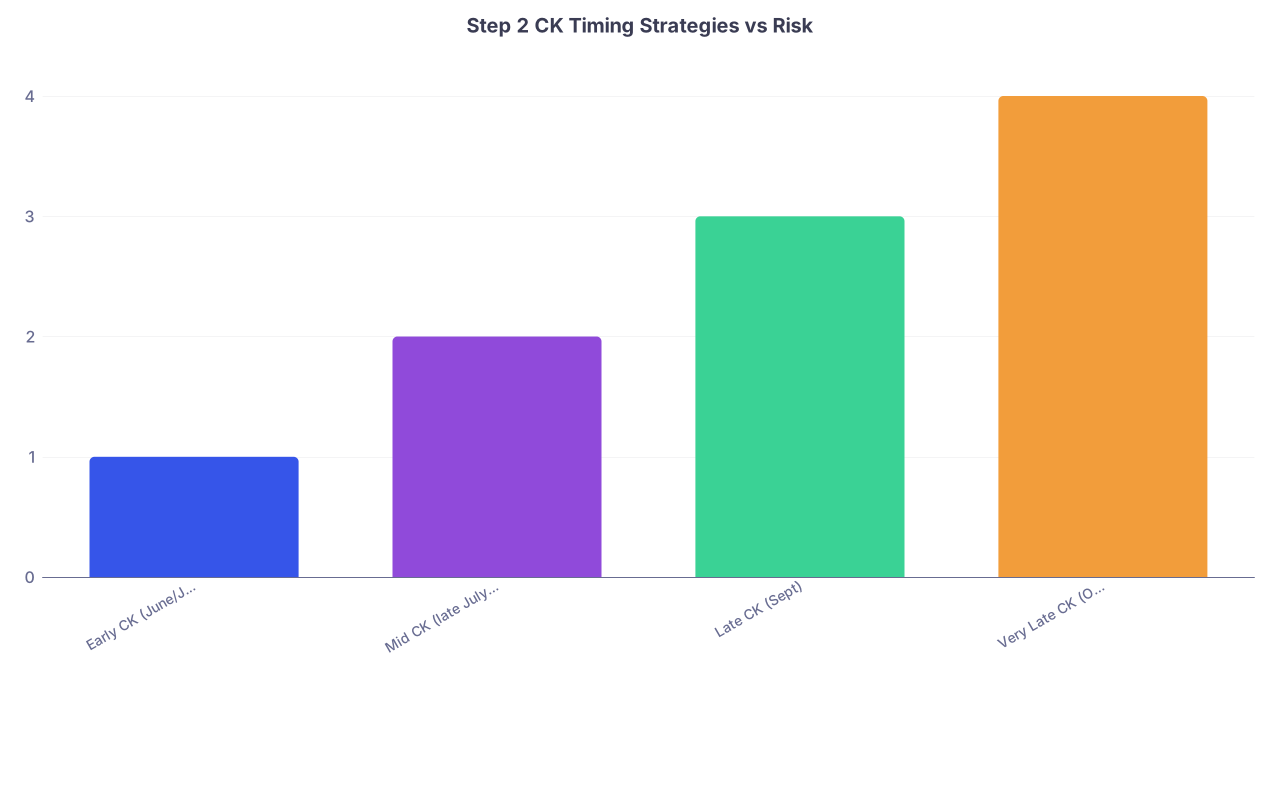
| Category | Value |
|---|---|
| Early CK (June/July) | 1 |
| Mid CK (late July/Aug) | 2 |
| Late CK (Sept) | 3 |
| Very Late CK (Oct/Nov) | 4 |
Think of “1” as lowest risk, “4” as highest risk regarding ERAS timing.
Archetype 1: The Ideal Planner
- CK date: Late June or early July
- Score release: Late July or early August
- ERAS submission: First day in early September
- Transcript: Already showing CK at initial transmission
Result: Programs see your full package from day one. You are in the earliest wave with your strongest data point.
Archetype 2: The Reasonable Middle
- CK date: Late July or early August
- Score release: Late August or early-mid September
- ERAS submission: First day in early September
- Transcript: May or may not have CK on literal first transmission day, but updated very soon after
Result: A small fraction of programs may pre-screen you without CK; many will see the updated score while they’re still sending first- and second-wave invites. For most non-ultra-competitive specialties, this is good enough.
Archetype 3: The Tight Squeeze
- CK date: Late August to early September
- Score release: Late September or early October
- ERAS submission: Still done early September
- Transcript: Initially missing CK, updated during active invite season
Result: Risk is higher. Some especially competitive programs may not reconsider your file once they have done first-pass sorts. But many community and mid-tier programs will still view your updated score and may offer interviews throughout October and sometimes November.
Archetype 4: The Late Gambit
- CK date: October or later
- Score release: November or later
- ERAS submission: Early September (you still submit early, hopefully)
- Transcript: No CK during prime invite window, maybe only available as programs finalize rank lists or not until after they have already filled interviews
Result: Huge disadvantage for competitive fields. Still workable for low- to mid-competitiveness specialties if everything else looks good and you are realistic with your list.
10. Visual: How This Actually Lays Out Over the Application Year
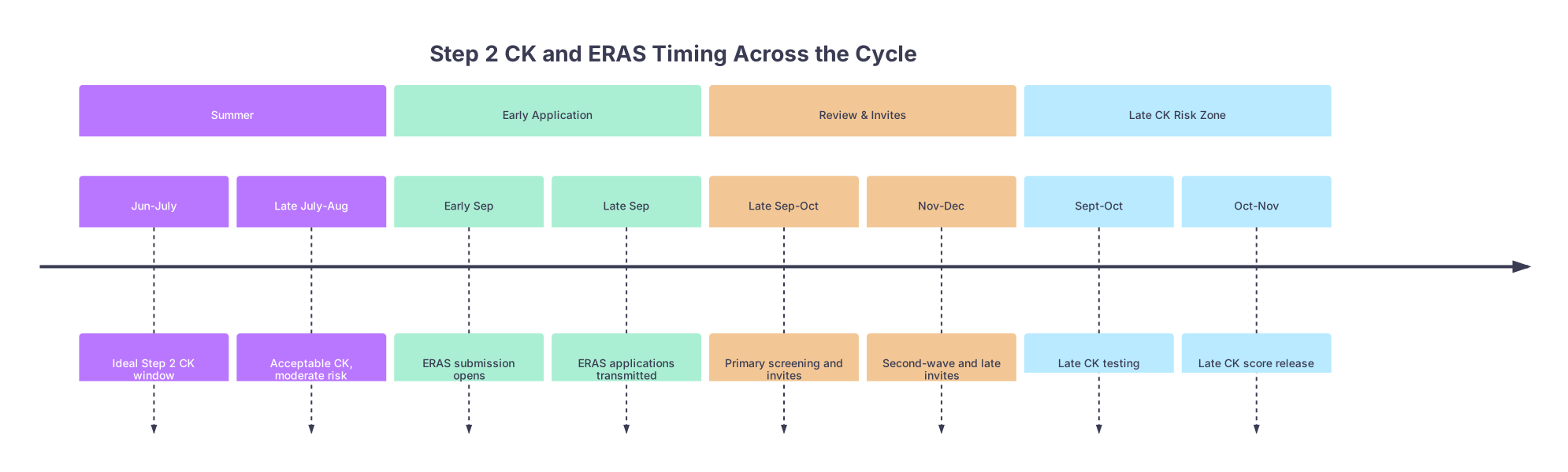
| Period | Event |
|---|---|
| Summer - Jun-July | Ideal Step 2 CK window |
| Summer - Late July-Aug | Acceptable CK, moderate risk |
| Early Application - Early Sep | ERAS submission opens |
| Early Application - Late Sep | ERAS applications transmitted |
| Review & Invites - Late Sep-Oct | Primary screening and invites |
| Review & Invites - Nov-Dec | Second-wave and late invites |
| Late CK Risk Zone - Sept-Oct | Late CK testing |
| Late CK Risk Zone - Oct-Nov | Late CK score release |
11. A Few Niche Situations People Quietly Stress About
Dual-Apply (e.g., Ortho + PM&R / Derm + IM prelim)
If you are dual-applying with one highly competitive and one more forgiving specialty:
- Time CK for the competitive side. Those programs care more.
- The “backup” specialty will still be happy to see a solid CK score whenever it arrives, and many of those programs review into October and November anyway.
IMG / DO applicants
For IMGs and DOs aiming at competitive or academic programs:
- Step 2 CK timing is even more critical. Many PDs use CK as the main objective metric.
- You want CK in the file on or very near the ERAS transmission date if you are trying to break into academic IM, anesthesia, EM, or surgery from a less traditional background.
If Step 1 result was borderline concerning (for the pre-Pass/Fail crowd)
- A strong Step 2 CK can rescue you. But only if programs see it in time to matter.
- In that situation, you behave like CK is your lifeline: take it earlier (June/July), and do not sit on the score once it posts.
12. Quick Comparison Table: When to Take CK vs Effect on ERAS
| CK Test Window | Typical Score Release | ERAS Impact Level |
|---|---|---|
| Late June – Early July | Late July – Early Aug | Ideal, full score visible day 1 |
| Late July – Mid Aug | Late Aug – Mid Sep | Good, minor timing risk |
| Late Aug – Early Sep | Late Sep – Early Oct | Moderate risk for competitive |
| Late Sep – Oct | Late Oct – Nov | High risk, especially competitive |
| Nov or later | Dec or later | Very high risk, often too late |
13. One More Visual: Where Your Stress Actually Should Be
Most students obsess over the ERAS submission date. They do not spend enough time planning the CK date.
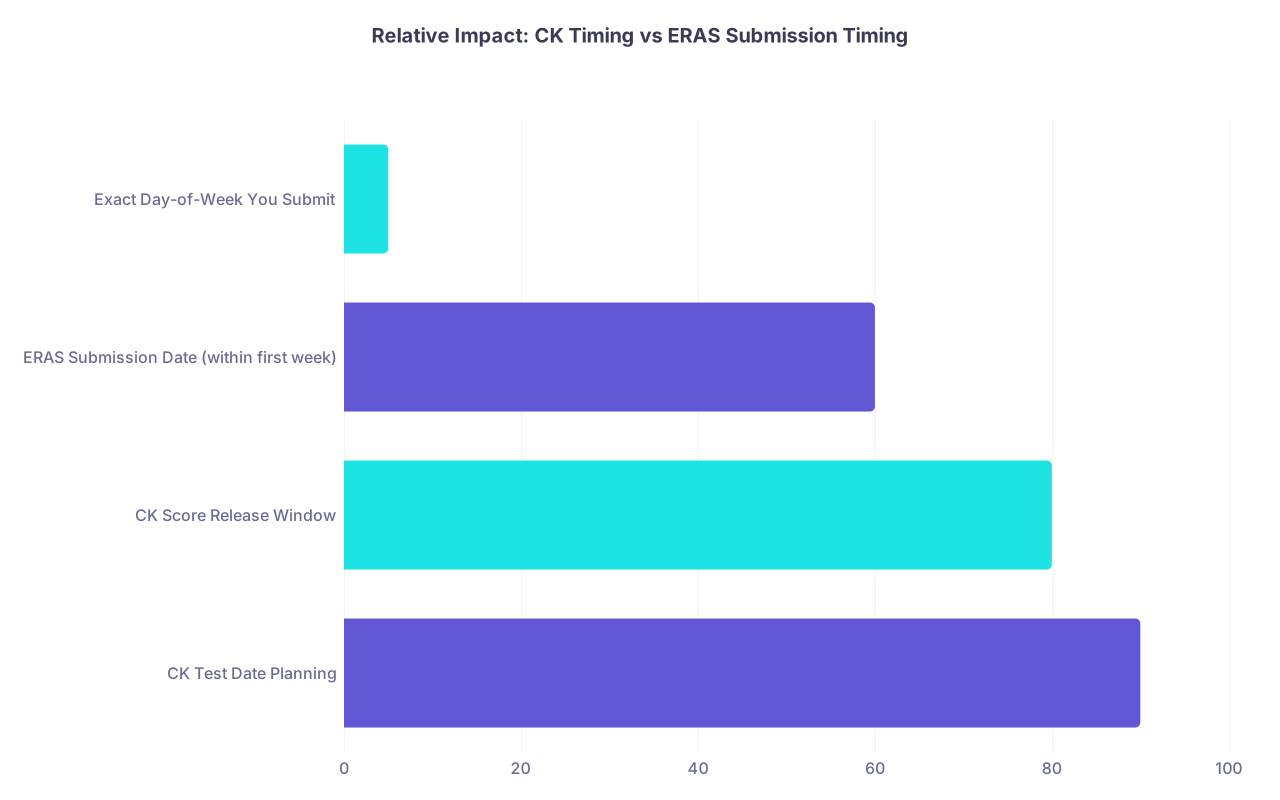
| Category | Value |
|---|---|
| CK Test Date Planning | 90 |
| CK Score Release Window | 80 |
| ERAS Submission Date (within first week) | 60 |
| Exact Day-of-Week You Submit | 5 |
You can see the pattern:
- Getting CK scheduled at the right month matters a lot.
- Submitting ERAS on the very first minute vs three days later? Essentially noise, as long as you are in that first-week block.
Key Takeaways
- Plan your Step 2 CK test date backwards from ERAS: for most people, late June to late July is ideal; late August or later starts to introduce real risk for competitive fields.
- Submit ERAS on time (early September) regardless of CK status; do not hold your entire application hostage to a pending score unless your advisors tell you your current file is essentially unmatchable without it.
- Once CK posts, release the transcript promptly and let programs see it during their main review window; trying to “hide” an unflattering score with timing tricks almost always hurts more than it helps.