
The ERAS timestamp is not “just a formality.” Programs absolutely look at it. The real question is how and when it matters—and when it quietly stops mattering at all.
I’ve sat in those committee rooms. I’ve watched PDs filter hundreds of applications with two clicks: Step score and “date submitted.” I’ve heard the exact phrases:
“Who are the early keeners?”
“Sort by earliest. Let’s start there.”
“Anyone who applied last week is probably using us as backup.”
If you think programs don’t care when you hit submit, you’re wrong. They do. But not in the simplistic way students talk about on Reddit.
Let me walk you through how ERAS timestamps actually get used when faculty are choosing who to interview—and what that means for the best time to submit ERAS if you care about your chances.
The First Week: Where Timestamp Is a Sledgehammer
During the first 7–10 days after programs get access to ERAS, the timestamp can make or break whether you’re even seen.
Here’s what happens behind the curtain.
Programs receive a flood of applications on day one. At many places, by the end of the first week they’ve already received 60–80% of all applications they will get for the season.
Most programs are not thoughtfully reviewing 1,000–5,000 applications one by one. They’re triaging. Hard. And the timestamp is one of the triage tools.
You’ll see this a lot on day 1–3:
“Okay, filter to complete applications submitted in the first 48 hours, US grads, Step 1 pass, Step 2 ≥ 230, no red flags. That’s our first batch.”
They do this for two reasons:
- They’re trying to identify the most engaged applicants early.
- They physically need to cut the list down to something readable.
Programs differ, but many have some version of “early batch” review. At one mid-tier IM program I know, they’ll literally block off a Saturday morning two weeks after ERAS opens, sort by earliest submission date, and say: “Let’s pull our first 80–100 interviews from this group.”
If you’re complete and in that early group, you’re in the first bucket. If you submit 3 weeks later, you’re often in the “maybe later, if we still have spots” pile. Which rarely gets the same attention.
So yes, in that first window, timestamp isn’t a tie-breaker. It’s a gate.
And that leads us to your real concern: how early is “early enough”?
What “Early” Actually Means (Not the Myth You’ve Heard)
Students love extremes: “Submit the minute ERAS opens or you’re dead.” That’s not how it actually works.
Programs don’t care if you submitted at 9:01 AM on opening day or 4:37 PM that afternoon. They see both as “very early.” What they do care about is whether you’re in the first wave when they start their serious review.
There are three windows that matter:
| Window | Typical Perception by Programs | Risk/Benefit |
|---|---|---|
| Week 0–1 | Highly engaged, serious interest | Strong early review priority |
| Week 2–3 | Normal, still in main pool | Mixed; depends on program volume |
| Week 4+ | Late, lower priority unless stellar | Often only seen if you’re exceptional |
If your question is “What’s the best time to submit ERAS?” the honest answer for most specialties is:
Submit a complete, polished application in the first 3–5 days that programs can see it.
Not rushed. Not sloppy. But not “I’ll wait three weeks to perfect this one sentence in my personal statement” either.
Once you drift beyond that first week, your timestamp starts working against you at a lot of places—especially mid- to high-volume programs.
And for very competitive specialties (derm, ortho, plastics, ENT, rad onc, integrated plastics, neurosurgery)? They’re often building their interview list heavily off the first wave.
How Programs Actually Use Timestamp in Filters and Sorting
People imagine faculty scrolling chronologically, timestamp by timestamp. No. They’re smarter and lazier than that.
The timestamp gets used in four main ways.
1. First-Pass Filters: “Only Early Completes”
At the beginning, many programs will apply filters like:
- US MD/DO
- Step 1 = Pass (or sometimes “has score report available”)
- Step 2 ≥ X
- No prior residency
- Application submitted by [date] (sometimes implicitly, just by sorting)
Then they sort that filtered group by date submitted (ascending) and start reviewing from the top.
Translation: if you’re early and you meet the numeric screens, you get eyes on you sooner. And being “seen early” in this context means you’re competing against fewer people for the same number of interview slots because nothing has been filled yet.
I’ve watched a PD at a medium competitive IM program say: “Let’s commit 60% of our interview slots from the first pass, then hold 40% for later standouts or connections.” That first 60%? Almost all from people who submitted in the first 7–10 days.
2. Prioritization When They’re Overwhelmed
By week 2 or 3, programs are drowning in applications. This is when the timestamp turns into a blunt prioritization tool.
One faculty member I know in EM puts it plainly:
“If someone couldn’t be bothered to apply in the first couple of weeks, they’re not my priority. We’ll look if we have open dates later, but early people get the first look.”
Are late applicants automatically rejected? No. But they often become “we’ll get to them if we still need more interviews” cases.
And yes, that’s as brutal as it sounds.
3. Tie-Breaker for Perceived Interest
Programs are paranoid about wasting interview slots on people who won’t rank them.
Timestamp gets interpreted—sometimes unfairly—as a signal of interest.
The logic goes like this:
- Applied very early: “They probably care about us, or at least care about this specialty and were on top of things.”
- Applied late: “Are we their safety? Backup? Did they get a late home letter and panic-apply?”
One PD in psych:
“If I’m comparing two similar applicants and one applied on day 1 and the other on day 24, I assume the first one is more serious about us. That’s not always true, but we don’t have time to psychoanalyze everyone.”
Is this sophisticated? No. Is it happening? Yes.
4. Red Flag When Paired With Other Data
Timestamp alone doesn’t usually hurt you. But when paired with other concerns, it can push you into the rejection pile.
Example patterns faculty notice:
- Late ERAS + very late Step 2: “Were they delaying because they were worried about the score?”
- Late ERAS + no away rotations in that specialty: “Backup applicant?”
- Late ERAS + minimal specialty-specific activities: “Last-minute specialty switch?”
Faculty are very good at spotting “panic” application patterns. Timestamp is part of that picture.
When Timestamp Stops Mattering (And When It Still Does)
Here’s the part nobody tells you: the timestamp’s power is front-loaded. But it’s not irrelevant after that.
After the First Wave of Invites
Once the first major batch of interview invitations goes out (often 1–3 weeks after ERAS opens), the timestamp’s influence drops for most programs.
At that point, they’ve:
- Filled a good chunk of interview spots
- Identified a core pile of strong applicants
- Flagged some “revisit later” files
From here forward, invited applicants are coming from:
- Connections (home students, strong letters from known faculty)
- Truly outstanding profiles (research monsters, insane scores, unique backgrounds)
- Specialty “needs” (rural background, language skills, diversity priorities)
In those cases, timestamp isn’t your savior or executioner. Your file is.
But there’s a catch.
For Backfill Interviews and Cancellations
Throughout the season, as applicants cancel or no-show, programs backfill spots. This is where timestamp quietly resurfaces.
When an interview coordinator is told: “We just had three cancellations for next Thursday; fill those spots,” they do not re-run an elaborate holistic review. They do something like this:
- Filter by: “Not yet invited,” “meets score minimums,” maybe “geographically not too far,” etc.
- Sort by: sometimes timestamp, sometimes score, sometimes “manual notes”
If they sort by timestamp ascending, your early submission still helps you months later. If they sort by descending, late submits with strong metrics might actually get a look.
Different programs do it differently—but I’ve watched multiple coordinators default to early timestamp as “likely more interested / more organized” when scrambling to fill last-minute spots.
So no, timestamp is not just a “day 1 issue.” It stays in the background as a quiet ranking factor all season.
Specialty Differences: Where Timestamp Is Ruthless vs. Flexible
Not all programs weaponize timestamp the same way. Some barely care. Others use it as an extended phenotype of your professionalism.
Let’s be honest about the patterns.
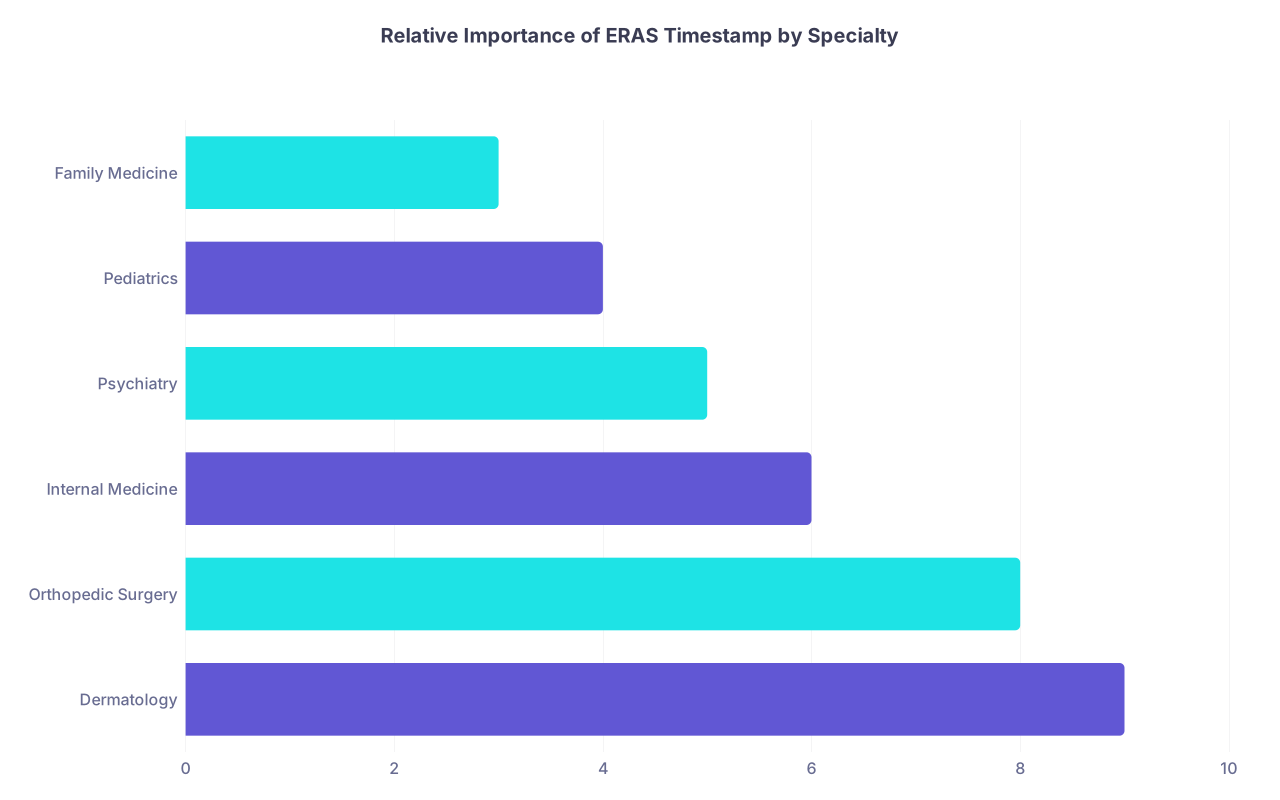
| Category | Value |
|---|---|
| Dermatology | 9 |
| Orthopedic Surgery | 8 |
| Internal Medicine | 6 |
| Psychiatry | 5 |
| Pediatrics | 4 |
| Family Medicine | 3 |
Use that as a relative sense, not a scientific scale.
High-Competitiveness Fields (Derm, Ortho, ENT, Plastics, Neurosurg, Rad Onc)
These specialties are flooded with highly screened applicants. Many have more than enough well-qualified people in the first week alone to fill every interview slot twice.
Some of them act like this:
- “We’ll fill 80–90% of our initial interview offers from week 1 applicants.”
- “After that, we only look if:
- It’s a home student
- There’s a personal contact
- The file is absurdly good”
If you’re aiming at these fields and you submit in week 3? You might still match somewhere. But you’ve definitely taken yourself out of serious contention at several programs that leaned hard on early timestamp.
Middle-Competitiveness (IM at good academic centers, EM, Anesthesia, OB/GYN, Neuro)
Timestamp still matters, but there’s more nuance.
Plenty of applicants apply in week 1–2, but these programs also:
- Hold back some invites intentionally
- Take time to see full Step 2 reporting for many students
- Consider applicants submitting in week 2–3 as “normal”
Here, the difference isn’t “early vs doomed,” it’s “early vs slightly behind the curve.” But if you drift into week 4+, your timestamp starts raising eyebrows unless the rest of your file is compelling.
Lower-Competitiveness / High-Need Fields (FM, some Peds, some Psych, community IM)
These programs are more flexible on timing. They’re often still reviewing new applicants weeks into the season and may struggle to fill interview spots.
But even here, there’s a subtle bias:
An FM PD once told me:
“We read everyone, but we tend to schedule early submitters first. They get the best dates. If you apply in November, it’s hard for me not to assume we were your backup.”
You’ll still get interviews if you’re solid. You just lose the first-choice dates, the early spots, and sometimes the perception of genuine interest.
The Timestamp vs. Quality Tradeoff: Should You Rush?
This is where people get burned.
Some of you will rush to submit on day 1 with:
- A sloppy personal statement
- half-finished experiences
- No Step 2 (when your Step 1 is pass and your Step 2 could actually help you)
And then blow your advantage.
An early complete, coherent, and strong application beats a rushed mess every time. Faculty can smell rushed content—awkward generic statements, half-baked descriptions, fragmented CVs.
So here’s the tradeoff, plainly:
- It is far better to submit on day 3 with a polished application than on day 1 with obvious errors.
- It is usually better to submit in week 1 with strong, if not perfect, essays than in week 3 with “perfect” prose but a late timestamp.
- It is sometimes better to wait 1–2 weeks to get a solid Step 2 score reported if:
- You had a weak Step 1 (even if it’s pass/fail, your Step 2 might be your main academic currency)
- Or you’re moving into a more competitive tier of programs with that Step 2
What you do not want is: “I delayed for a month to keep editing my personal statement” when no one cares that much about your final round of adjective polishing.
How Timestamp Plays with Other “Signals”
Programs don’t look at timestamp in a vacuum. It interacts with:
- Geographic fit
- Home vs. away rotations
- Letters from known people
- Research fit
- Diversity / background priorities
Here’s the unvarnished truth: connections and fit beat timestamp. Every time.
If you’re a home student with solid letters from department faculty, you’re getting looked at—even if you submitted on day 12 instead of day 2. Faculty openly say things like:
“She’s our rotator, she’ll get a look regardless of when she clicked submit.”
But among the anonymous pile—the people with no built-in link to the program—that timestamp suddenly starts doing more work.
One program coordinator in anesthesia put it like this:
“For our home and away rotators, we don’t care about timestamp. For everyone else, we sort early first because we assume they’re more likely to rank us if we interview them.”
So if you have zero connection to a place? Being early is essentially your “I’m serious about you” signal.
Concrete Recommendations: Best Time to Submit ERAS (If You Actually Want Interviews)
You wanted specifics. Here they are.
For Most Applicants in Most Specialties
Aim to:
- Have your application fully ready to submit on or within the first 3–5 days of ERAS opening to programs.
- That means:
- Finalized personal statement (not perfect, but not sloppy)
- Experiences entered and proofread
- Letters requested early enough that most will be in by opening week (or shortly after)
- Step 2 taken early enough that you’re not waiting until late October for a score
Submitting in that first week puts you into the “early serious applicants” pool almost everywhere. Your timestamp works for you—not as a miracle, but as a quiet ally.
If You’re Aiming for Very Competitive Specialties
You should be acting like this is an arms race—because it is.
You want:
- ERAS ready to go on day 1 or within the first 2–3 days, max
- Step 2 score reported (unless your advising situation truly justifies waiting)
- Rotations, research, and letters aligned and ready
Programs that receive a tsunami of elite applicants will absolutely build a huge percentage of their interview list from the first wave. You don’t want to be the amazing late-comer they never have time to notice.
If You’re Behind and It’s Already Week 3 or Later
Don’t panic-submit garbage just to change your timestamp.
At that point:
- Yes, you’ve lost some “early” advantage.
- But a solid late application still beats a weak early one.
For you, the strategy shifts:
- Rely more heavily on:
- Home programs
- Away rotations
- Advisors making direct calls/emails
- Strong, specific letters
- Target programs that:
- Historically send out interviews later
- Are less ultra-competitive
- Are in regions with less applicant demand
Late isn’t fatal. It just means you’re not riding the timestamp wave and you’ll need your file and connections to carry more weight.
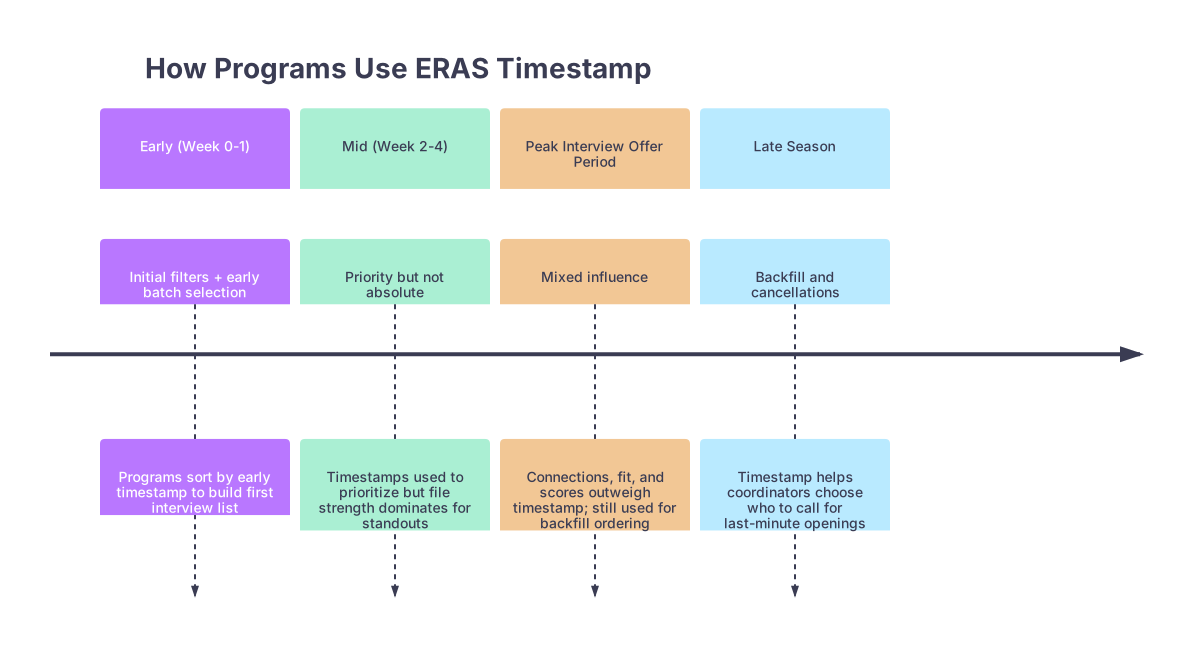
| Period | Event |
|---|---|
| Early (Week 0-1) - Initial filters + early batch selection | Programs sort by early timestamp to build first interview list |
| Mid (Week 2-4) - Priority but not absolute | Timestamps used to prioritize but file strength dominates for standouts |
| Peak Interview Offer Period - Mixed influence | Connections, fit, and scores outweigh timestamp; still used for backfill ordering |
| Late Season - Backfill and cancellations | Timestamp helps coordinators choose who to call for last-minute openings |

One More Ugly Truth: Timestamp Also Reflects Professionalism
Faculty won’t say this on panels, but they say it in closed rooms.
A chronically late timestamp pattern looks like:
- Late Step 2
- Late ERAS
- Late thank-you emails
- Late rank list registration
- Late responses to scheduling
And attendings—especially in procedural fields—hate anything that smells like disorganization.
I’ve heard it framed bluntly:
“We’re choosing people we can trust to be in the OR at 6:00 AM, not at 6:07. If you’re late on the application side of your life, I assume you’ll be late on the clinical side at some point too.”
Is that fair 100% of the time? No. But residency selection is all about patterns and impressions, not courtroom-level fairness.
When you submit early, you’re not just gaming a filter. You’re sending a signal:
“I respect deadlines. I prepared. I’m not doing this haphazardly.”
That signal quietly tilts decisions your way more than you’d think.
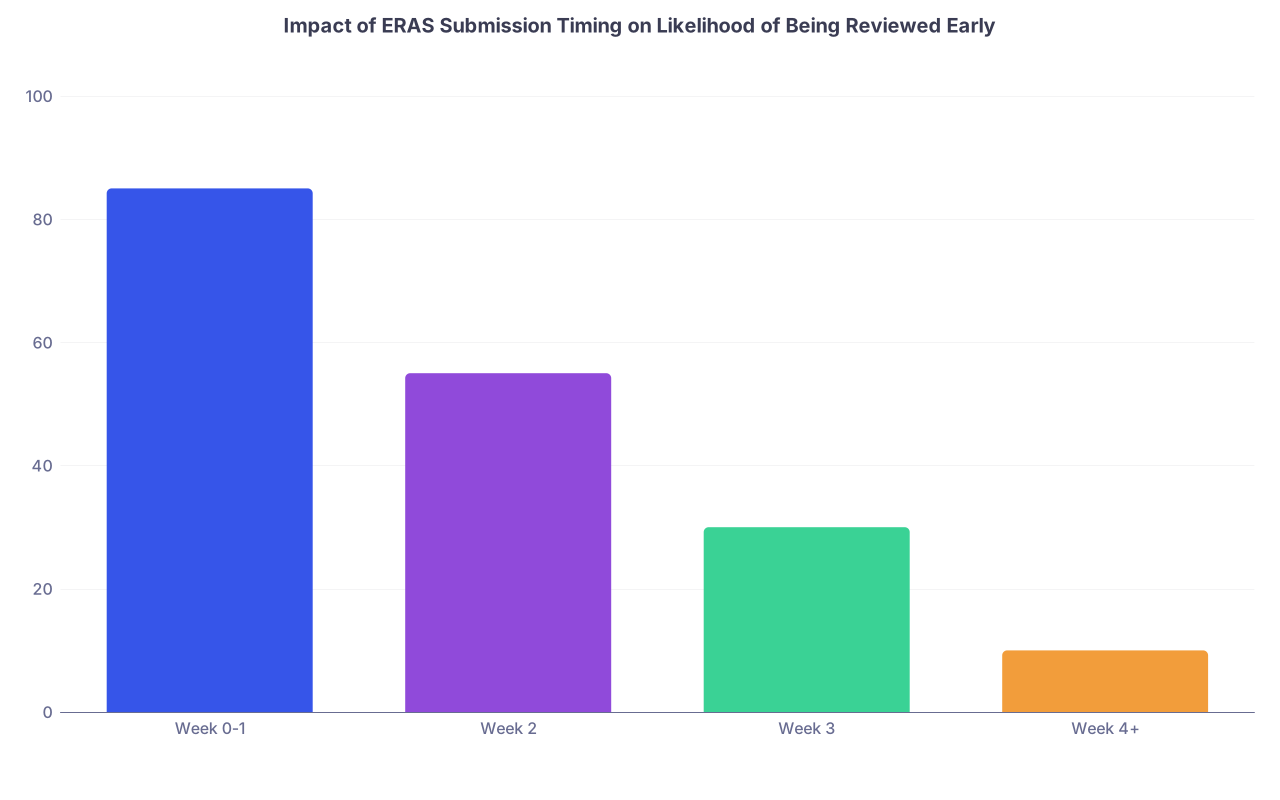
| Category | Value |
|---|---|
| Week 0-1 | 85 |
| Week 2 | 55 |
| Week 3 | 30 |
| Week 4+ | 10 |
(Those numbers aren’t from a specific paper; they’re a realistic reflection of how often I’ve seen early applicants end up in the first serious review bucket.)

The Bottom Line: How to Use This Knowledge
Here’s what really matters from everything you just read:
- Submit early, not perfect: A well-prepared application in the first 3–5 days beats a polished one in week 3 that arrives after programs have already filled half their interview slots.
- Timestamp is a quiet but real signal: It’s used for early triage, perceived interest, and, later, backfill decisions. It won’t rescue a weak file, but it will amplify a decent one.
- Don’t let late become a pattern: If you’re going to signal anything to a program, let it be that you’re the person who’s ready when it counts—not the one sprinting behind the deadline.
You can’t control your class rank once it’s set. You can’t rewrite your Step scores. But you can control when you click “submit” on ERAS.
Programs are watching that timestamp more than they’ll ever admit to you publicly. Act accordingly.