
It’s October 10th. Your classmates are posting their interview invites in the group chat. You’re staring at your ERAS “Certify and Submit” button with a sinking feeling in your stomach—because you haven’t submitted yet. Or you submitted late. Or you added a bunch of new programs yesterday.
And the question sitting in the back of your mind is brutal and simple:
“Are they even going to look at my application now?”
Let me tell you what actually happens behind those program doors once interview invites start going out—because the public-facing “we review applications holistically on a rolling basis” line is only half the story.
The Timeline You Never See
First thing you need to understand: most programs are not “constantly reviewing” once invites start. They front-load.
Here’s how it works behind the scenes in most places.
Phase 1: The Initial Harvest (late Sept – early Oct)
Program directors and coordinators don’t wait around for all the latecomers. They build their main interview list from the first wave.
At a typical academic IM program, for example, this is what I’ve seen repeatedly:
- Applications open to programs: around Sept 25
- Big review push: next 10–14 days
- First major batch of invites: early to mid October
During that stretch, faculty reviewers get a spreadsheet (or portal list) of all applications received to date. They sort by whatever matters most to that program: Step 2 score, class rank, home / region, visa status, etc. Then they start tagging:
- “Interview”
- “Maybe / Hold”
- “Reject”
Nobody is sitting there saying, “But what about the stellar applicant who might apply on October 20?” They’re thinking, “We have 600 apps right now and 150 invites to send—we need to move.”
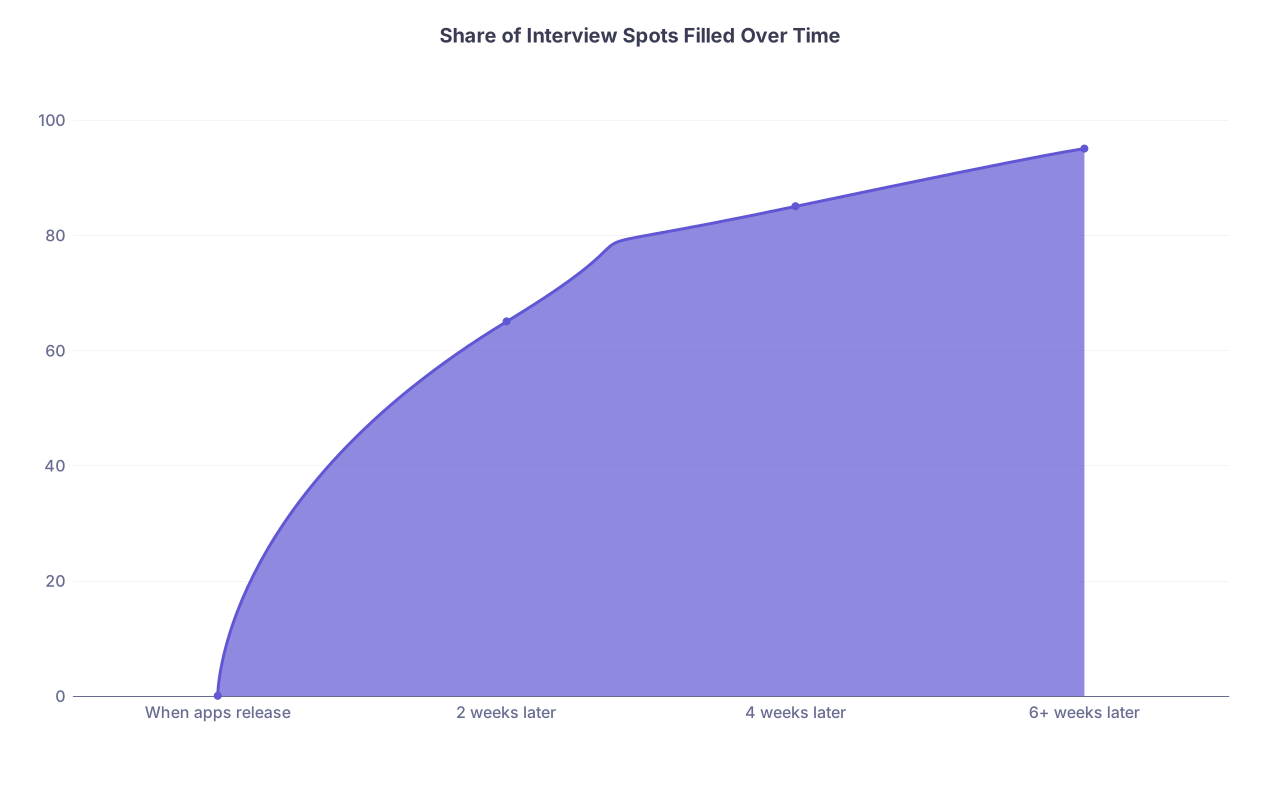
| Category | Value |
|---|---|
| When apps release | 0 |
| 2 weeks later | 65 |
| 4 weeks later | 85 |
| 6+ weeks later | 95 |
That graph is roughly what you’d see if you could pull internal data from many competitive programs. By 2 weeks after apps release, a huge chunk of interview spots are tentatively assigned.
So what happens if your ERAS file shows up after they’ve done that first pass?
That’s where things get ugly—and more complicated.
What Actually Happens to Late Files
There are three main realities you need to know.
1. The Default: You’re In a Holding Bin
Once the first big review wave is done, most programs do not go back and re-screen everybody every time a new application appears.
What actually happens:
- New apps join the list, unreviewed
- The default filter/sort (Step 2 score, etc.) might bury you somewhere in the middle or bottom
- No one is urgently assigned to “Late Apps Duty”
So your late file lives in a kind of limbo. Not rejected. Not truly considered.
Programs will dip into that late pool only when they have a reason:
- Someone cancels an interview
- They realize they need more applicants in a certain category (home state, DOs, visa candidates, underrepresented, etc.)
- A faculty member advocates for a specific late applicant (yes, this happens)
If you’re just an anonymous late application with no connection to the program?
You’re hoping someone has time. Spoiler: in October and November, most faculty do not.
2. The Second Pass: Targeted, Not Global
The “second pass” everyone talks about is real—but it’s not what you think.
They do not say: “We’ve filled most interview slots, now let us review all remaining 500 applicants thoroughly.”
What they actually do is more like this:
They filter for:
- Applicants from their own medical school or rotation sites
- Applicants from target regions
- Applicants with very high metrics they somehow missed
- Demographic categories they are underweight in this year
- Specific niche interests (research area, community health, etc.)
Then they skim that filtered subset of late or unreviewed apps.
So yes, people absolutely get interviews from late files. But it’s not purely “meritocratic random chance.” It’s strategic need-based reviewing.
Here’s how that looks in practice. I watched this happen at a mid-tier university IM program:
- By mid-October, they’d filled 85% of their interview slots
- They realized they were weak on:
- Their own med school students
- Certain regional schools
- URiM candidates
- They ran filters in their ERAS portal specifically for those groups—including late submissions
- A few late-file students got interviews because they matched the need profile
The rest? Never touched.
If you applied late and you’re not in a “priority” category for that program, the odds that someone gives your file real attention drop significantly.
3. Late Isn’t Binary—There Are Levels of “Too Late”
People talk about “late” like a switch. It’s not. It’s a sliding scale.
This is closer to reality for many programs:
| Submission Timing (relative to program access date) | Typical Internal Reality |
|---|---|
| 0–3 days after | Full consideration, highly likely review |
| 4–10 days after | Still prime, usually reviewed |
| 11–21 days after | Mixed: many reviewed, some skipped |
| 22–35 days after | Selective review only (special reasons) |
| >35 days after | Rarely reviewed unless specifically flagged |
The key inflection point at many places is that first major invite release. Once they’ve sent that, a big psychological shift happens internally:
“Main list is done. Now we’re managing cancellations and filling gaps.”
You’re no longer competing for “first-pass” attention. You’re competing for “we need a backup for December 18 because three people canceled” attention.
And that is a very different game.
What Happens When You Add Programs Late
Different but related question: what if you submitted ERAS early, but you added more programs after invites started?
Those programs see you exactly the way they see anyone who applied late.
They do not get an alert saying, “Exceptionally motivated applicant added us later—please review first.” You just drop into the queue with a timestamp much later than everyone else.
So the same rules apply:
- If you add a program a few days after they started reviewing, you’re probably still fine
- If you add a program three weeks after their first invites went out? You’re mostly hoping for leftover scraps, specific filtering needs, or random kindness
I watched an EM program explicitly say in a meeting:
“We’re done adding new schools to the interview pile unless they’re our home students or someone with a direct faculty recommendation.”
If you added them late with no connection, you simply never existed in their conversation.
The Myth of “Rolling” vs “Non-Rolling”
You’ll see programs claim things like “We review applications holistically” or “We do not strictly follow rolling admissions.”
From the inside, that usually means one of three things:
- They don’t send all invites on a single fixed date
- They don’t explicitly say “we ignore apps after X date”
- They reserve a portion of interviews for later-review groups (home students, prelims, couples match, etc.)
It does not mean that submitting in November carries the same weight as submitting in late September.
The only programs where timing truly matters less:
- Very small programs with relatively few applications
- Some community programs
- Some less competitive specialties in less popular regions
Even there, faculty are human. They do their deepest review when the list is fresh and their attention is focused. Latecomers get less mental bandwidth.
What Programs Actually Do With Late Files (Concrete Scenarios)
Let’s get specific. I’ll walk you through how I’ve seen different programs handle late applications once invites are rolling.
Scenario 1: Mid-tier University Internal Medicine
- Target: 350–450 interviews
- Applications: 3000+
Week 1–2:
Faculty assigned blocks of applicants alphabetically or by random allocation. Everyone in the queue at that time gets at least a cursory review.
Week 3–4 (invites now going):
New applications come in. Some attendings check the portal occasionally; others never look again. Program coordinator mostly uses:
- Score filters
- School filters
- “Favorites” from faculty who remember specific names
Result for a late applicant with no connection: you’re only getting seen if your Step 2 is blazing hot or you trip a filter they’re actively looking at (school, state, diversity initiatives).
Scenario 2: Competitive Academic Surgery Program
- Target: ~100–120 interviews
- Applications: 1000–1500
They build a preliminary rank of applicants before invites even go out. That list might be 250–300 long.
Once invites start, they work almost exclusively off that list.
Late applications?
They might quickly scan:
- Applicants from top-tier schools
- Applicants with very high Step 2
- Home / sub-I rotators who applied late
Everyone else is invisible. Not because they hate you. Because they already have 2–3x as many strong candidates as they can interview, locked and loaded.
Scenario 3: Community Program in a Non-Coastal City
- Target: 120–150 interviews
- Applications: 800–1000
These are the programs where late can still work.
They often don’t have a full-time residency admin devoted solely to recruitment. Reviewing may spread out more slowly; some interviews are deliberately held back until later to accommodate late-comers, couples, local applicants, and last-minute needs.
If you submit 3–4 weeks after the start date here, your chances aren’t dead. But even at these places, once they feel they have “enough” solid applicants, the urgency to keep scrubbing new files plummets.
Step Scores, Late ERAS, and Harsh Realities
Now, here’s the thing nobody likes to say out loud:
Once you’re late, you’re competing in a smaller number of spots with stricter informal cutoffs in many programs.
Why?
Because when you finally show up in the system, they already have:
- Tons of strong, early applicants they like
- A good distribution of schools and backgrounds
- A working list they feel comfortable with
So the mental bar subconsciously shifts from:
“Should we consider this applicant?”
to
“Is this person so good that they’re worth displacing someone we already liked?”
That’s brutal, but that’s how human minds protect their past decisions.
For late files, PDs and faculty tend to only pull the very top outliers or those that fill a specific gap:
- Exceptionally strong metrics or achievements
- Specific connection to the program or region
- Underrepresented groups they’d like more representation from
- Applicants with niche research aligning with a department priority
If you’re average for that program’s pool and late, you’re in trouble.
What If You’re Late Because of Step 2 Timing?
Here’s a common scenario: You delayed submitting ERAS because you were waiting for Step 2 CK, particularly now that Step 1 is pass/fail.
What happens if you submit once Step 2 posts, which might be 2–4 weeks after apps opened to programs?
Inside, reactions are mixed:
- Some PDs explicitly say they prefer a complete file with Step 2, even if it’s slightly later
- Others would rather see an early application, then update the score later
But once invites have started going out, you’re back in the same late-pool problem. A few nuances though:
If your Step 2 is very strong compared to their usual pool, your late file has a better chance of being flagged during one of those targeted “search by score” passes.
If your Step 2 is mediocre, delaying to wait for it often backfires. You gave up the “early full review” advantage for a score that doesn’t pull you into a late filtered batch.
The One Thing That Actually Changes Late Outcomes: Advocacy
There is one lever that can truly resurrect a late ERAS file.
Not a perfectly worded email from you.
Not a long “interest” statement.
Advocacy.
Specifically:
- An attending at that institution emailing the PD: “This student applied late but is excellent, please take a look.”
- A well-respected faculty member at your home institution emailing or calling their contact at that program.
- A resident at that program who knows you well asking the chief or PD to review your file.
When that happens, here’s what I’ve seen time and time again:
Program coordinator opens ERAS → searches your AAMC ID or name → pulls you up regardless of date. You get real attention. In some cases, you leapfrog hundreds of anonymous early applicants because you’re now a “known quantity.”
Without that advocacy, in a late scenario, you’re just one more PDF in a huge list.
Tactical Advice If You’re Already Late
You can’t undo the clock, but you can be strategic.
Target programs where timing matters less.
Community programs, less competitive regions, smaller cities not on every applicant’s radar. They’re more likely to still be looking carefully at new files.Leverage any real connections.
Past rotations, attendings, alumni, even credible near-peers. Ask for genuine advocacy, not spammy mass emails. One good email is worth 50 cold applications.Email the right way.
If you must reach out yourself, keep it short and specific. PDs are allergic to long, generic “I’m very interested” essays. A three-sentence, concrete, program-specific note sometimes gets your name searched in ERAS. Sometimes.Stop the bleeding. Apply now.
Do not “wait until everything is perfect” in November. Imperfect but submitted in October beats perfect and submitted in December 99 times out of 100.Remember: different programs are on different clocks.
A big-name coastal academic IM program in a major city? Your mid-October application is functionally late.
A small community program that just opened their review process or is still collecting applicants? You may still be early for them.

| Step | Description |
|---|---|
| Step 1 | New Late Application Arrives |
| Step 2 | Low chance of full review |
| Step 3 | Filtered search |
| Step 4 | File reviewed |
| Step 5 | Interview offer or waitlist |
| Step 6 | Program Needs? |
| Step 7 | Meets filter? |
| Step 8 | Exceptional or fills gap? |
| Step 9 | Advocacy email/call? |
That’s about as honest a flowchart of late ERAS reality as you’ll ever see.
So… When Is the “Best Time” to Submit ERAS, Really?
You already know the slogan version: as early as possible once ERAS is available to programs.
But let me translate that into something more useful given everything we just unpacked.
- If you want full first-pass consideration at most academic programs, your application should be in within the first week of programs gaining access.
- If you submit in the second or third week, you’re still often fine, but you’re sliding toward “partial” rather than “universal” review.
- Once major interview waves start going out—typically early to mid-October—you’re no longer in the main pile. You’re asking to be pulled from the margins.
People say “residency application season is a marathon.” It’s not. At the application submission stage, it’s a sprint. The marathon starts after you get the interviews.
You’re not fighting some abstract time demon. You’re fighting:
- Human attention limits
- Cognitive inertia once lists are made
- The comfort PDs feel once they believe they “have enough good applicants”
The earlier your ERAS file exists in their world, the more you benefit from all three.
With all this in mind, your next step is simple: decide whether your remaining energy this season should go into fixing timing (submitting now, expanding your list intelligently, getting advocacy) or into accepting that this cycle may be rough and planning a smarter, earlier second attempt.
Either way, you’re past the fairy-tale stage. You know what really happens to ERAS files once invites start flying.
What you do with that knowledge—that’s your next chapter.
But that’s a story for another day.