
Most applicants get ERAS timing wrong because they trust rumors more than the actual rules.
If you are planning your residency application around what upperclassmen in the lounge “heard from a chief” about rolling review, you are putting your Match at risk. Not exaggerating. I have watched strong candidates lose interview slots because they followed confident, wrong timing advice.
You are in the “Best Time to Submit ERAS” category. That means one thing: timing mistakes can hurt you more than a slightly weaker letter or a generic personal statement. Programs cannot interview an application they never seriously saw.
Let me walk you through the landmines.
The Myth That Will Hurt You: “ERAS Isn’t Really Rolling”
The most dangerous belief I hear:
“ERAS is not truly rolling. As long as you submit by [insert random date someone told you], you are fine.”
Wrong in two ways.
First, there are two different systems at play:
- ERAS submission and transmission rules – when you can submit and when programs receive files
- Program behavior – how early programs actually start reviewing and sending invites
Rumors usually blur these into one fuzzy, false narrative. For example:
- “It’s not rolling anymore. They all wait until after MSPE release.”
- “You can submit anytime in October; they do batch review now.”
- “Taking Step 2 late is fine because programs keep reviewing all season.”
No. Programs may not officially be rolling in some aspects, but interviews are finite. Early applicants get seats. Late applicants fight for crumbs.
Here is how people get trapped:
- They hear that ERAS holds everything until a certain date.
- They assume that means application timing does not matter.
- They forget that programs start building their interview lists the moment they have enough strong applications in front of them.
You are not competing against a deadline. You are competing against how fast other applicants hit “certify and submit.”
How Rolling Actually Works (And How Rumors Twist It)
Stop trusting fuzzy phrases like “sort of rolling” or “semi-rolling.” Programs either have:
- A defined download/review start date, then rolling invitations
- A soft batch review period, then ongoing rolling decisions
- Or, rarely, mostly-batch review but still with early triage and flagging
The rumor mill hears one program director at a webinar say “we don’t penalize later applicants” and transforms it into “timing doesn’t matter anymore.” That is not what they said.
Let me be direct:
Programs almost never hold every single file untouched and then read them all fairly on the same day like some Step exam bell curve fairy tale.
They do things like:
- Flag home students and strong signals early
- Pre-screen based on filters (USMLE cutoff, visa status, attempts)
- Start building a “priority review” pile even before the official MSPE release
- Send first-wave invites as soon as the committee feels they have a solid pool
Once those first waves go out, you are no longer in a clean race. You are applying to a program where 30–70% of interviews may already be filled.
Here is the part people ignore:
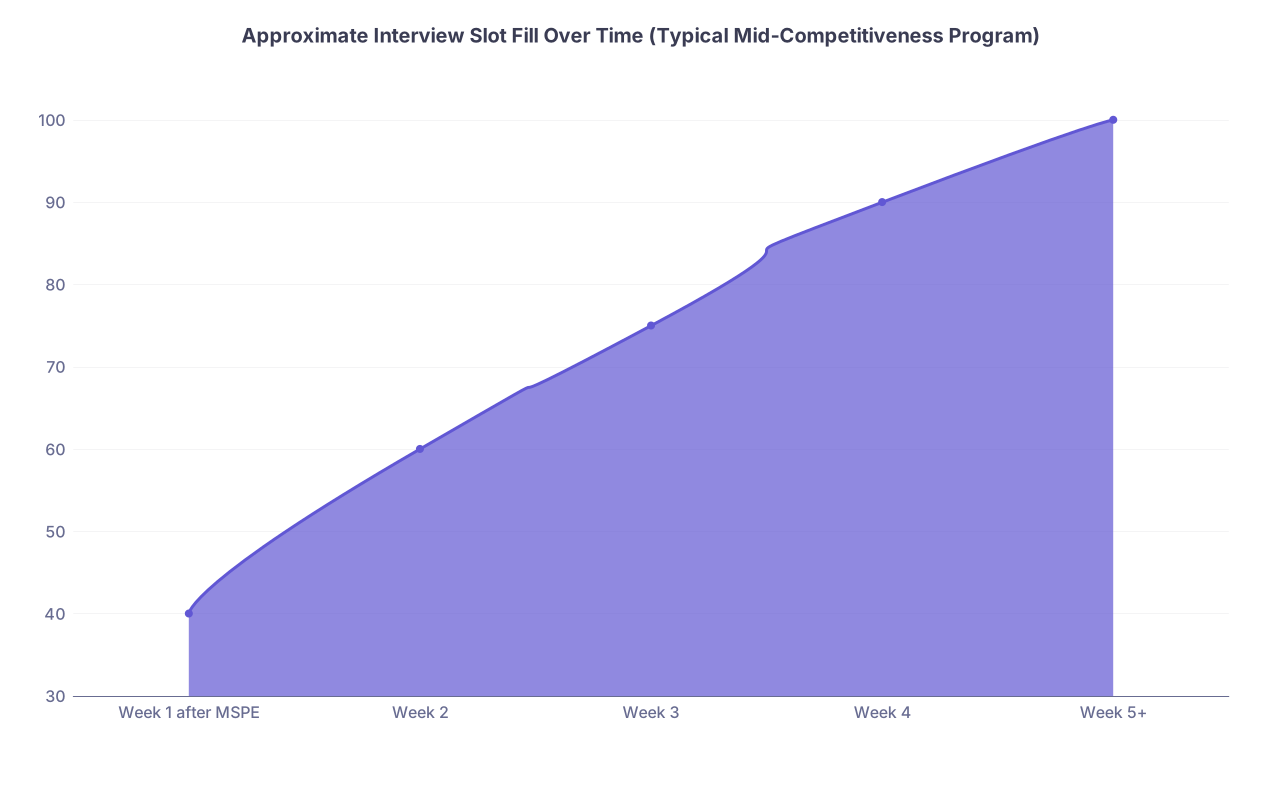
| Category | Value |
|---|---|
| Week 1 after MSPE | 40 |
| Week 2 | 60 |
| Week 3 | 75 |
| Week 4 | 90 |
| Week 5+ | 100 |
Do all programs look exactly like this? Of course not. But I have sat in meetings where by week three, the coordinator literally said, “We are basically full; now we just fill in special cases.” If you are submitting in “special case” territory without being special, you have a problem.
ERAS Timeline Mistakes That Quietly Wreck Applications
Most timing damage is silent. Nobody emails you saying, “You would have had an interview if you applied two weeks earlier.” You just stare at a quiet inbox.
The most common timing errors:
1. Confusing “Submit Date” With “Complete Application Date”
Programs do not review a ghost. If your application is missing core pieces, it is essentially invisible.
A complete application usually means:
- ERAS application submitted and certified
- USMLE/COMLEX scores released
- Letters of recommendation uploaded and assigned
- Personal statement selected
- Photo uploaded (yes, they care more than they admit)
- MSPE available (after October 1) – depending on program
The classic mistake:
Submitting ERAS on the first possible day but having only one letter in, no Step 2 score for a competitive specialty, and no final personal statement chosen. You think you are “early.” On the program’s end, you look unfinished and are pushed into the “review later” pile. Which often means “never seriously reviewed.”
2. Believing “October Is Early Enough for Everyone”
This one hits IMGs and competitive specialty hopefuls especially hard.
Someone says:
“As long as you are in by October 15, you are fine. Everyone knows this isn’t rolling now.”
No. For:
- Competitive specialties (Derm, Ortho, ENT, Urology, Plastics, some EM): late September vs mid-October can be the difference between 10 interviews and 3.
- IMGs: many IMG-heavy programs start screening very early. If they fill a big portion of their interview list from early completed applications, late arrivals get a few pity invites.
If your profile is not obviously stellar, you cannot afford to be in the second or third wave. You want to be in the thick of the first serious review pass.
The Specific “Rolling Review” Rumors You Must Ignore
Let’s call out the greatest hits I keep hearing in advising sessions. These are the ones that sabotage otherwise careful applicants.
Rumor #1: “Programs Wait for MSPE; Before That, Timing Doesn’t Matter”
Reality:
Some do. Many do not. And even those that “wait” are not blind. They can see:
- Scores
- Transcripts
- Letters already uploaded
- Your experiences and personal statement
- Your school name
I have watched programs pre-flag strong applicants before MSPE release so they can move faster after October 1. Translation: If you are late even getting into their system, you miss early flagging entirely.
Rumor #2: “They Review in Batches, So Early vs Late in That Window Is the Same”
This one has just enough truth to be dangerous.
Some programs have a stated review window, like:
“We will review all applications submitted by October 15 as a group.”
But actual behavior usually looks like:
- Start prelim review as applications appear
- Build informal “strong candidate” and “probably no” lists
- Officially “meet” and confirm invites during the batch meeting
If your application lands on October 14 with missing letters or late Step 2 while others were complete on September 28, who do you think they already discussed, recognized, and favored informally?
Rumor #3: “Taking Step 2 Late Is Fine; Programs Keep Reviewing All Season”
This one is half-true and people treat it as gospel.
Yes, programs can and do offer some interviews later in the season when new information comes in. But Step 2 taken late (September or later) can create this perfect storm:
- You delay submitting until the score posts
- While you wait, peer applicants with complete files slide into the first review rounds
- Programs fill most of their interview lists
- You arrive with a “now-complete” application in mid- or late-October trying to compete for leftover slots
Does this always kill your chances? No. But if you are not a top-tier applicant, it absolutely shrinks them.
Rumor #4: “Away Rotations Guarantee You an Interview, So Timing Isn’t Critical Elsewhere”
I have seen students put most of their effort into timing away rotations, then casually submit ERAS closer to the stated program deadlines. They assume, “My aways will carry me.”
Reality:
- Away rotations can help for a few targeted programs
- They do almost nothing to compensate for being late everywhere else
- And some home/away programs will still pass on you if your file was incomplete when they really looked
Timing across your entire list matters. Not just at the 2–3 places you rotated.
How Programs Actually Use Time (The Uncomfortable Truth)
Let me expose the part that rarely appears in official webinars.
Here is typically what happens in a mid-competitive internal medicine or general surgery program:

| Step | Description |
|---|---|
| Step 1 | Applications Appear in ERAS |
| Step 2 | Coordinator Applies Filters |
| Step 3 | Early Strong Files Flagged |
| Step 4 | Committee Preview of Top Group |
| Step 5 | First Wave Interview Invites Sent |
| Step 6 | Borderline/Incomplete Pile |
| Step 7 | Reviewed Only If Spots Remain |
You do not want to live in the “Borderline/Incomplete Pile.” Late completion shoves you there by default.
Filters coordinators often apply early:
- Step 1 / Step 2 CK minimum thresholds
- Attempts (fails filtered out automatically)
- Visa requirement flags
- Home institution or region preference
- IMGs vs US grads vs DO
If your application is incomplete when that filter pass happens, you may never enter the serious review flow. By the time you are complete, they are already deep in love with their early flagged pool.
Dangerous “Timing Strategies” You Should Abandon
Smart applicants sabotage themselves with strategies that sound responsible but disregard how programs actually operate.
Strategy Mistake #1: “I Will Wait to Submit Until Everything Is Perfect”
Perfection is a timing trap.
I have watched students:
- Delay submitting to tweak experiences wording for the tenth time
- Wait weeks for one more letter from a slow attending
- Hold back their application until a hoped-for publication is accepted
By the time they hit “certify and submit,” they are two weeks behind their peers. And programs are not giving style points for an extra-polished volunteering description.
What you should avoid:
Holding your entire application hostage over optional refinements. A very late “perfect” application is less competitive than a solid, complete early one.
Strategy Mistake #2: “I Will Submit Now, Then Add Letters and PS Later”
Yes, technically you can submit ERAS, then assign letters when they come in. Technically.
But the danger: Programs sometimes download applications in large batches early. If yours comes through missing key letters or with no specialty-specific personal statement assigned, reviewers see an incomplete or generic version first. That first impression sticks.
Better approach:
Have at least:
- 2–3 letters (including one from the specialty)
- Correct personal statement for that specialty
- Scores released
…before most programs start their serious review window. Then submit as close to “day one” as your components allow.
When Timing Actually Can Be Flexible (And When It Really Cannot)
Not everything is life-or-death timing wise. The problem is applicants are usually relaxed about the wrong things and stressed about the trivial.
Here is a quick reality check:
| Item | Delay Impact |
|---|---|
| ERAS certification & submit | High – core timing factor |
| Step 2 CK for competitive fields | High – can block invites |
| Specialty-specific PS uploaded | High – affects early review |
| One additional non-core LOR | Low – can add later |
| Minor experience wording | Very low – do not delay |
You cannot casually push back:
- Initial ERAS submission
- Core letters (like your main specialty letter)
- Step 2 CK if your Step 1 is weak or pass/fail-only and your specialty expects strong CK
You can adjust after submission:
- Adding an extra fourth letter to certain programs
- Minor edits to your program list
- Applying to a few additional backup specialties if needed (earlier is better, but not fatal if slightly later)
The mistake is treating everything like it must be flawless before you dare to click submit, then waking up in mid-October shocked that interviews are already going out.
How To Protect Yourself From “Rolling Review” Myths
You cannot control what your classmates say in the group chat. You can control how you verify things.
Simple protective steps:
- Read the actual ERAS timeline for your year from AAMC or for your specialty match (San Francisco Match, NRMP, etc.).
- Check program websites for any stated deadlines or review policies. Many openly say “We begin review as soon as applications are available.” Believe them.
- Ask your dean’s office / advisors specific questions, not vague ones:
- “By what date should my application be complete to be considered early for internal medicine?”
- “How did last year’s students who submitted after October 10 fare compared to those before?”
- Watch when your peers start getting invites. If your inbox is quiet and others with similar stats have multiple interviews, ask if your application was truly complete early.
And most importantly:
Stop treating anonymous Reddit comments and hallway wisdom as policy. A PGY-2 who matched in 2021 at a single program is not the gold standard for understanding multi-program, multi-year timing patterns.
A Safer Timing Game Plan (That Actually Respects Reality)
You do not need a paranoid Gantt chart, but you do need a backbone strategy.
This is the rough shape that avoids most self-inflicted timing wounds:
By late spring / early summer:
- Decide primary specialty and realistic backups
- Identify likely letter writers; ask early
By mid-late summer:
- Personal statement essentially done
- ERAS experiences written in solid form
- Step 2 CK scheduled early enough that score returns before the crucial review period (for most, this means no later than early August)
Around ERAS opening:
- Fill out and proofread ERAS
- Confirm letter writers are uploading on time
- Aim to be ready to submit very close to the first day you are allowed to certify, or shortly after, with core components ready.
Before heavy review starts (around MSPE release or slightly before):
- Application complete at most target programs: scores + letters + PS assigned
- Program list built and double-checked
Think of it this way:
You want programs to see your full, representative application during their first serious pass. Anything that pushes you into their “second look if we still have room” bin is hurting you.
The Quiet Cost of Believing Timing Myths
Nobody will tell you directly, “You missed our early review wave and that is why you are on our waitlist.” Instead, you will hear:
- “We had an unusually competitive applicant pool this year.”
- “There were many strong candidates and limited interview slots.”
- Or nothing at all—just radio silence.
I have seen students with strong Step 2 scores, good letters, and solid research end up with scattered interview offers simply because they:
- Took Step 2 in September
- Waited for one last “dream letter”
- Or believed “October 15 is totally fine; everything is batched now”
Those same candidates, shifted two weeks earlier, would likely have doubled their interview count.
You do not need to be perfect. You do need to stop playing timing roulette based on rumors from people who do not sit in selection meetings.
FAQ (Read These Before You Decide to “Wait Just a Bit”)
1. If my application is not perfect by the first submission day, should I still submit early or wait?
Submit as early as you can while meeting a minimum bar of completeness: at least two, ideally three letters (including one in your specialty), your personal statement ready, and Step scores available if at all possible. Do not delay weeks for cosmetic improvements or an optional fourth letter. Those refinements rarely outweigh the cost of missing the first review pass.
2. Is it really that bad if my application is complete a week or two after MSPE release?
It depends on your specialty and competitiveness. For less competitive specialties and strong applicants, a small delay may be survivable. For competitive fields or borderline profiles, being behind the main wave can cost you interview volume. The problem is you often will not know which category you truly fall into until it is too late, so leaning early is much safer.
3. My Step 2 score will not be back until mid-October. Should I still apply this cycle?
If Step 2 is critical for your specialty (which it is for many now), applying with a significantly delayed score puts you at a disadvantage. Some applicants still match in that situation, but their margins are thinner and they usually compensate with other strengths or less competitive specialties. You need honest input from an advisor who knows your full profile before gambling on a late-complete file.
4. How do I handle letters that might be delayed without sabotaging my timing?
Plan for delay before it happens: request letters early, send polite reminders, and have backup letter writers in mind. Submit your ERAS when you have enough core letters to be taken seriously; you can add an extra letter later. Do not hold the entire application just because one attending is slow, unless that specific letter is absolutely central and you are still ahead of the main review window.
Open your calendar and ERAS timeline today and put a star on the earliest realistic date your application can be truly complete—then work backward aggressively from that, instead of forward from vague rumors about “rolling review.”