Last September, a program coordinator at a solid mid-tier IM program opened ERAS at 8:01 a.m. Their filter spit out 600 applications that met minimum criteria. By 8:20 a.m., the program director had already tagged the first 40 as “high interest.” Every single one of those had been submitted in the first 48 hours.
A week later, a nearly identical applicant—same Step 2, same school tier, same class rank—showed up in the queue. The PD’s exact words: “If we had seen this one on day one, they’d have been in our first wave of invites.” They never got one. Not because they weren’t good enough. Because of timing.
Let me tell you what really happens in those screening rooms—and exactly how submitting ERAS early actually gets you more humans looking at your file, not just earlier bots.
The Myth vs. The Reality of “Early” ERAS
You’ve probably heard a dozen contradictory takes:
“Submit at 9:00 a.m. on opening day or you’re dead.”
“Doesn’t matter, programs don’t download for weeks.”
“Just submit before the MSPE release; everything is the same.”
Most of that is half-truths repeated by people who have never seen the back end of ERAS or sat in a screening meeting.
Here’s what’s actually going on.
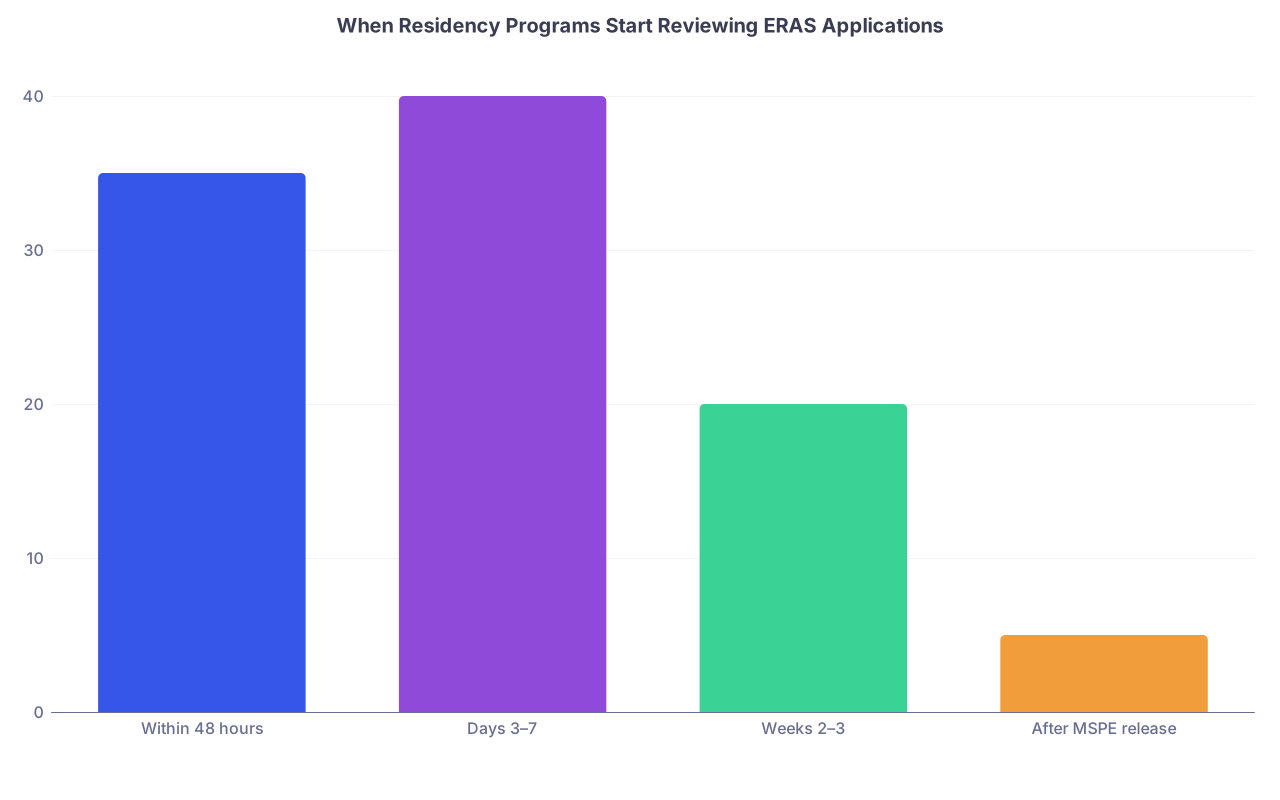
Programs fall into rough categories for when they start reviewing:
| Category | Value |
|---|---|
| Within 48 hours | 35 |
| Days 3–7 | 40 |
| Weeks 2–3 | 20 |
| After MSPE release | 5 |
Those numbers line up eerily well with what I’ve seen across medicine, surgery, and a few competitive specialties. Most programs don’t wait. They start early, they triage quickly, and they lock in a huge chunk of their interview list before latecomers even hit their queue.
The biggest misunderstanding: early submission doesn’t just move you earlier in a single line. It often moves you into a higher-quality review environment.
Early = fewer apps in the pile, more bandwidth per file, more discussion, more benefit of the doubt.
Late = tired screeners, rigid filters, and “we already have enough of this profile.”
What Actually Happens When ERAS “Opens”
Forget the public-facing dates. Inside the program office, this is closer to reality.
Step 1: The First Download
When ERAS releases applications to programs, someone—usually the coordinator—does the first bulk download. At a mid-sized IM program this might be 1,500–2,500 applications by the end of week one. In ortho or derm, the total may be lower, but the pressure is much higher.
Some programs do a midnight or early-morning pull on the first possible day. Others wait a day or two. But here’s the key: that first batch becomes the “primary” pool for early screening.
Step 2: The First Screening Session
Within 24–72 hours of that first download, one of two models usually happens:
PD-dominant model
PD sits in their office scrolling through applications, maybe with one enthusiastic associate PD. They start flagging “interview,” “maybe,” “no,” using their own heuristics.Committee model
PD + APDs + maybe a chief or two in a conference room, going through a filtered subset: “US grads only,” “Step 2 ≥ 220,” etc. They’ll screen 100–300 files in a session. Sometimes more. Often way too many.
This is where your timing matters.
If your ERAS is in that first wave, you’re in the fresh eyes group. People are relatively focused. The list of “strong candidates” is basically empty. There’s no internal bias of, “We already have eight people from X med school” or “We’re full of 250+ already.”
By week two, those biases exist. Informally, but very real.
Why Early ERAS Gets You Extra Eyes
Here’s the part most students never hear directly: your application doesn’t get the same number of eyeballs in October as it does in September—even at the same program.
1. PD Attention Is Front-Loaded
Most program directors are deeply involved in screening early. Not out of pure love for the process. Out of fear.
They know if they don’t lock in strong candidates early, other programs will.
So in those first few days:
- PDs personally review a big chunk of applications.
- They’re more likely to take time with borderline but interesting files.
- They’re more willing to overrule rigid filters: “Yeah, they’re at 217, but look at this LOR and research.”
By week three?
They’re tired, they trust their filters more, and a lot of interview slots are informally “reserved.”
I’ve watched PDs sigh scrolling through the later downloads: “We already have enough people like this.” Same board scores. Same school tier. Different timing. Different outcome.
2. More Generous “Maybe” Bins Early On
At the beginning, the mindset is: “We need to find our 150 interviewees out of this insanity.” Cautious. Curious. Slightly anxious.
That anxiety actually helps you.
Early on, a file might land in:
- Definite invite
- Strong maybe (revisit once we see more)
- Weak maybe
- No
But those “strong maybes” and “weak maybes” get a second look later. Sometimes a third, especially if the PD is nervous they’ve been too rigid or they’re short on applicants from certain schools, regions, or backgrounds.
If you’re late? There’s no generous maybe bucket left. The psychological frame has flipped to: “We already have enough; now we’re only pulling absolute standouts or very specific profiles.”
Extra eyes almost never means an extra chance for late applicants. It means PD + APD + chief are discussing the early interesting ones in detail. Three people scrutinizing you when the board is still blank is much better than one person glancing at you after 80 invites are already sent.
3. Faculty and Chiefs Are Only Involved Early at Many Programs
Many places pull in chiefs or key faculty for the early wave, then taper them off when their clinical duties crush them.
So week one:
- PD
- 1–2 APDs
- 1–2 chiefs
- Sometimes a faculty member who cares about education
That’s multiple viewpoints. More argument. More chances for someone to say, “Hey, don’t toss this one, look at this rotation or this non-traditional background.”
Week three?
Coordinator plus PD, both behind on everything else in life. The review is necessarily more mechanical.
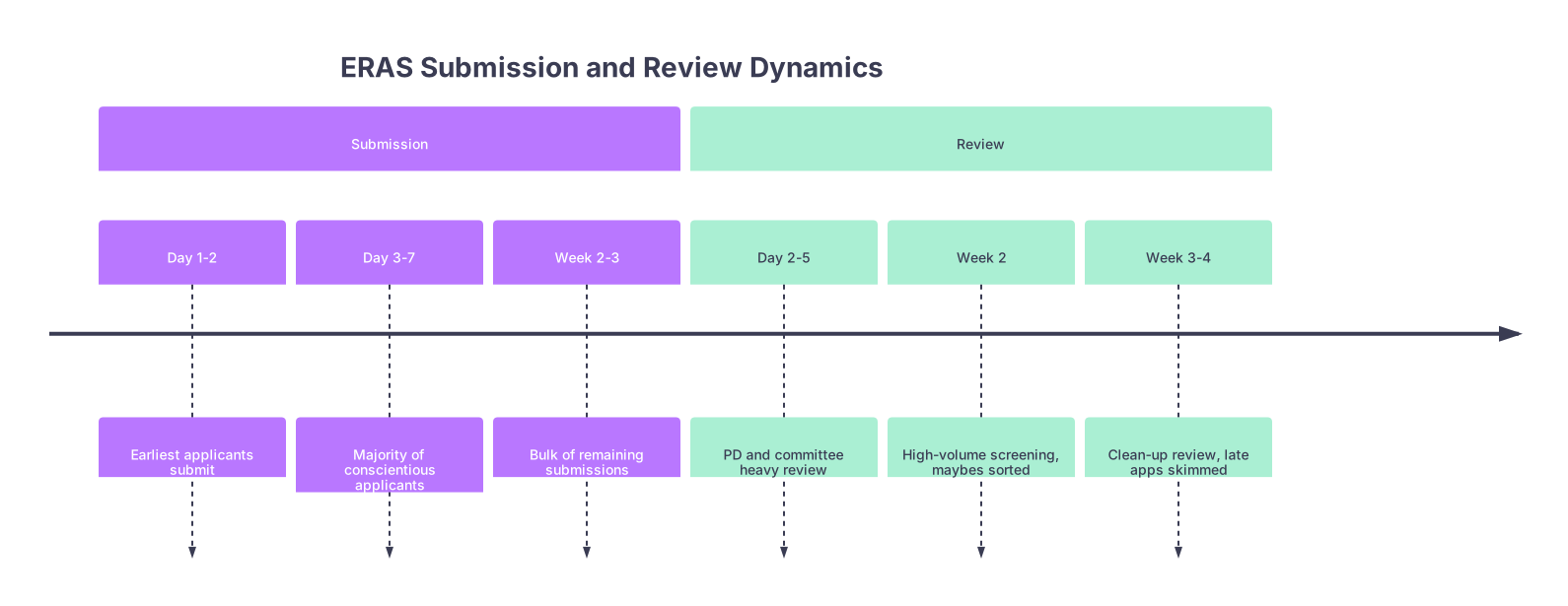
The Calendar Reality: When “Early” Actually Is
Let’s cut through the vague advice. “Early” is not a feeling; it’s a window.
| Period | Event |
|---|---|
| Submission - Day 1-2 | Earliest applicants submit |
| Submission - Day 3-7 | Majority of conscientious applicants |
| Submission - Week 2-3 | Bulk of remaining submissions |
| Review - Day 2-5 | PD and committee heavy review |
| Review - Week 2 | High-volume screening, maybes sorted |
| Review - Week 3-4 | Clean-up review, late apps skimmed |
Here’s how that plays out inside:
Day 1–3 submission: You’re almost guaranteed to be in the first major review sweep at most programs that care about being competitive. PD-heavy eyeballs. Higher “consideration per file.”
Day 4–7 submission: Still solid. You’ll either land in the tail end of the first sweep or the top of the second. Still relatively high-quality screening, but the “freshness” advantage is fading.
Week 2 submission: Now you’re background noise at a lot of places. You may still be fine at lower-volume or less competitive programs, but at many institutions, half the interview list is already mentally penciled in.
After that: You’re relying on cancellations, errors in the early process, or programs that fell behind. It can still work out, especially in less competitive fields, but you’ve voluntarily given up your best edge—time.
How Filters and Timing Interact (This Part Hurts People Quietly)
Let me walk you through what actually happens on the screen when your file appears.
Most programs use filters in ERAS:
- US MD vs DO vs IMG
- Step 2 cutoffs
- YOG windows
- Visa status
- Sometimes med school list by name
Here’s the catch: those filters aren’t always set the same way all season.
A PD early in the season might say, “Let’s keep it broad for the first pass, see what the pool looks like.” So they set Step 2 ≥ 220 instead of 230. Or they don’t turn on the “US MD only” filter for early review of a few hundred files.
Two weeks later, after seeing how many strong candidates they already have? They tighten. Hard.
I’ve seen:
- Step 2 filter quietly raised mid-season.
- Non-traditional YOG cutoffs added in week three: “We’re already full on recent grads; let’s cap at 3 years since graduation.”
- DO and IMG folders moved from PD review to one rushed associate or even essentially sidelined unless they’re extreme standouts.
So that exact same application—same numbers, same LORs—that would have been fully read and discussed if it appeared in the system on day 2, might never even hit a human screen if it drops in after the filter change.
No one emails you to tell you this. To you, it just looks like silence.
The Psychological Bias of “Already Have Enough”
This is the ugliest, most human factor no one likes to admit.
By the time a program has:
- Enough applicants with 245+
- Enough from “strong” schools
- Enough with a particular profile (research heavy, local, osteopathic, IMG, etc.)
…their willingness to be intrigued by another one drops.
I once watched an APD skim an app and say, “We already have six from that school and three with almost this exact Step score and profile.” That applicant had no idea timing killed them, not merit.
Early applicants set the baseline. Late applicants get compared to that baseline with a strong “do we really need more of the same?” energy.
If your application profile is common for that specialty—mid to high 230s–240s in IM, average-but-solid for FM or peds, etc.—you don’t want to be the tenth one in that bucket. You want to be one of the first three.
Timing does that.
Specialty Differences: Who Cares the Most About Early?
Not all specialties treat timing with the same level of ruthlessness, but don’t be fooled—almost all screen on a rolling internal basis, even if interviews aren’t released immediately.
| Specialty Type | Timing Sensitivity | Notes |
|---|---|---|
| Competitive (Derm, Ortho, ENT) | Very High | Early apps get deep review |
| Mid-Competitive (IM, EM, Anes) | High | First 1–2 weeks critical |
| Less Competitive (FM, Psych) | Moderate | Early still clearly helps |
| SOAP-Focused Programs | Lower | Timing matters less overall |
In competitive specialties, committees often schedule entire half-days just to comb through early apps. They want to claim “their” people before others do.
In mid-competitive specialties, they fear missing strong candidates and being stuck with a weaker pool. So the initial reviews are anxious, thorough, and PD-involved.
Lower-volume or less competitive programs sometimes move slower—but even there, the more conscientious places start building their A-list quickly, especially for geographic or mission-fit candidates.
The “Extra Eyes” Advantage for Imperfect Applications
If your scores are stellar, your school is top-tier, and your LORs are glowing from famous names, timing helps but doesn’t make or break you. You’ll float either way at many places.
But if you’re in any of these groups, early submission is your cheapest, highest-yield boost:
- Below-average Step 2 for your specialty
- DO or IMG in a competitive region or field
- Non-traditional grad year
- Red flag that needs context (leave of absence, remediation, big career change)
- Strong story but not immediately obvious on skim
Those last two categories are where extra eyes literally change outcomes.
I’ve watched this play out:
- Chief resident pushes: “Yes, they’re a 218, but read their personal statement. They worked full-time, family responsibilities, upward trajectory.” Early in the season, that argument wins spots.
- Later in the season, same file type? Response is: “We already took a chance on a few; we’re full on risk.”
Your file getting read by three people instead of one is worth more than any late-night line tweak in your personal statement.
Early submission is how you buy that multi-reader review.
So When Should You Actually Hit Submit?
Here’s the honest balance:
You do not need to destroy yourself trying to submit at 9:00:00 a.m. on opening minute. But you do need to be ready in the first 1–3 days of submissions being released to programs, if you care about maximizing interview odds.
That means:
- All core sections complete at least a week before.
- Personal statement(s) done and proofed.
- Program list mostly built. Minor last-minute tweaks are fine; wholesale changes at 2 a.m. are not.
- Letters uploaded and assigned (or at least your main ones).
If waiting 24–48 hours means going from a sloppy application to a polished one, wait the 24–48 hours. But if you’re debating between “perfectly formatted” and “on day 2 instead of day 7,” choose earlier.
The ugly truth: a B+ application on day 2 will outcompete an A- application on day 10 at a lot of programs.
Common Self-Sabotage Mistakes with Timing
I’ve seen smart students tank their early advantage with avoidable choices:
They delay submission because they’re obsessing over:
- Rewriting the personal statement for the 14th time.
- Adding two more optional programs that they might not even rank.
- Waiting on that “maybe” LOR from a big-name attending who’s already 3 weeks late.
You’re trading real, structural advantages (earlier screening, more eyes, gentler filters) for fantasy gains.
If your main letters are in and solid, submit. That delayed “prestige” letter? It might not change anything, and by the time it arrives, half the damage from late submission is already baked in.
And no, programs are not sitting there thinking, “This personal statement could have used one more sentence about leadership.”
They’re thinking, “Does this person clear our basic thresholds, seem sane, and fit something we want?” And they’re thinking that faster and more generously when they’re not already drowning.
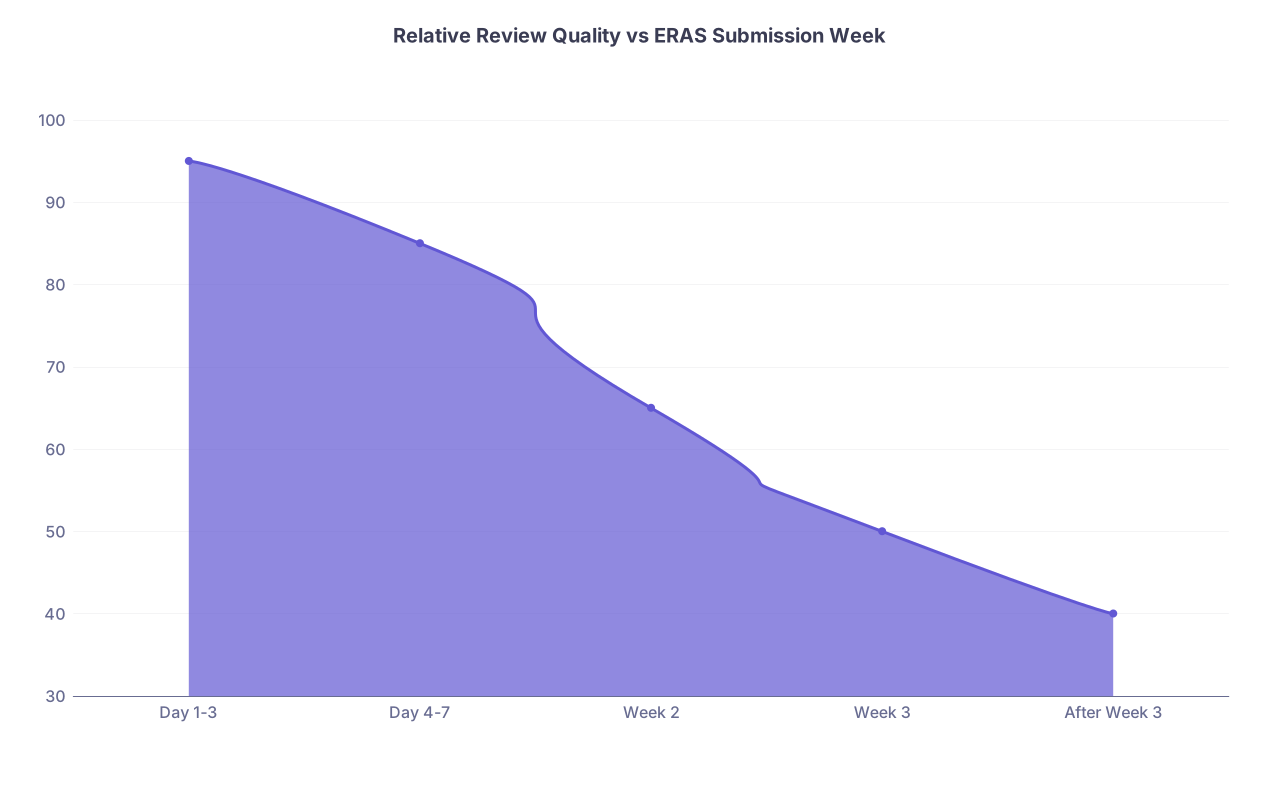
Quick Visual: Early vs Late Review Quality
| Category | Value |
|---|---|
| Day 1-3 | 95 |
| Day 4-7 | 85 |
| Week 2 | 65 |
| Week 3 | 50 |
| After Week 3 | 40 |
Those aren’t precise numbers, obviously. But that curve is real. The proportion of your application that actually gets seen and discussed drops as time goes on.
Your job is to stay in the steep, generous part of that curve.
FAQs
1. If I submit early but one letter is late, do programs still see my application?
Yes. Once you hit submit and ERAS releases to programs, they can see your application with whatever letters are assigned at that time. New letters added later appear automatically. PDs are used to letters trickling in. I’d rather you submit on day 2 with three solid letters than wait two weeks for a fourth that adds little.
2. Do programs literally offer interviews on a rolling basis as they review?
Many do, even if they say they don’t. Or they at least build a “priority invite list” in real time. There are programs that batch-release invites on a set date, but the ranking of who’s invited in that batch is often determined by those early review sessions. If you’re not in that early stack, you’re fighting for fewer leftover spots.
3. Does early submission matter as much for less competitive specialties like FM or psych?
It still matters, just in a quieter way. The pressure is lower, but human behavior is the same. Early applications get more bandwidth, more discussion, and often more willingness to consider slightly nontraditional profiles. In highly desirable urban or academic FM/psych programs, timing can matter as much as in some “mid-competitive” fields.
4. What if my Step 2 score is pending near the opening date—wait or submit?
If you’re within a week of score release and Step 2 is a major part of your competitiveness (e.g., weaker Step 1, IMG, or competitive specialty), it can be reasonable to wait those few days. But do not slide into week 2 or 3 because of this unless there’s a clear strategic reason. I’ve seen more applicants hurt by late submission than helped by squeezing in a slightly higher score.
If you remember nothing else: early ERAS doesn’t just put you in the queue sooner. It puts you in front of more people, with more patience, before the bar quietly shifts upward. You cannot control the competition’s scores, or where you went to school, or who writes your letters. But you can control whether you’re on that screen in the first wave—when programs are still looking for reasons to say yes.