It is 11:42 PM the night before ERAS opens for programs.
Your personal statement file is still called “PS_final_FINAL_revised.docx.”
You are toggling between MyERAS and a Word doc, copy‑pasting experiences, fixing typos on the fly, refreshing your email to see if your last letter uploaded.
You tell yourself: “Everyone submits at midnight. I have to get it in the second it opens or I will be behind.”
You are about 20 minutes away from making one of the most expensive mistakes of your career.
Let me be blunt: the “midnight submission” mentality is how strong applicants quietly sabotage themselves. Not because timing does not matter. It does. But because panicked timing + sloppy content = fewer interviews, every year, without fail.
You want to avoid that group.
The Myth: “If I Do not Submit Day 1, I Am Screwed”
The core error is binary thinking:
- “Submit at 9:00 AM on opening day = competitive”
- “Submit a few days later = doomed”
Reality is more nuanced and much less dramatic.
Programs do not download all applications at 9:01 AM and finish screening them by lunchtime. They:
- Batch download applications over days to weeks
- Use filters (Step scores, specialty-specific screeners, home vs non‑home)
- Often do rolling review over several weeks
- Do not even send most interview invites for days to weeks after they first view applications
The critical window is early, not instantaneous.
Where you get destroyed is not by submitting on September 19 instead of September 18.
You get destroyed by:
- Submitting early but with:
- Wrong personal statement attached to the wrong specialty
- Broken or misordered experiences
- Major red flags you did not bother to explain
- Typos, inconsistencies, and sloppy structure
- Or waiting too long—late September, October—because you were “perfecting” under time pressure you created yourself
So yes, there is such a thing as too late. But there is also such a thing as stupid early.
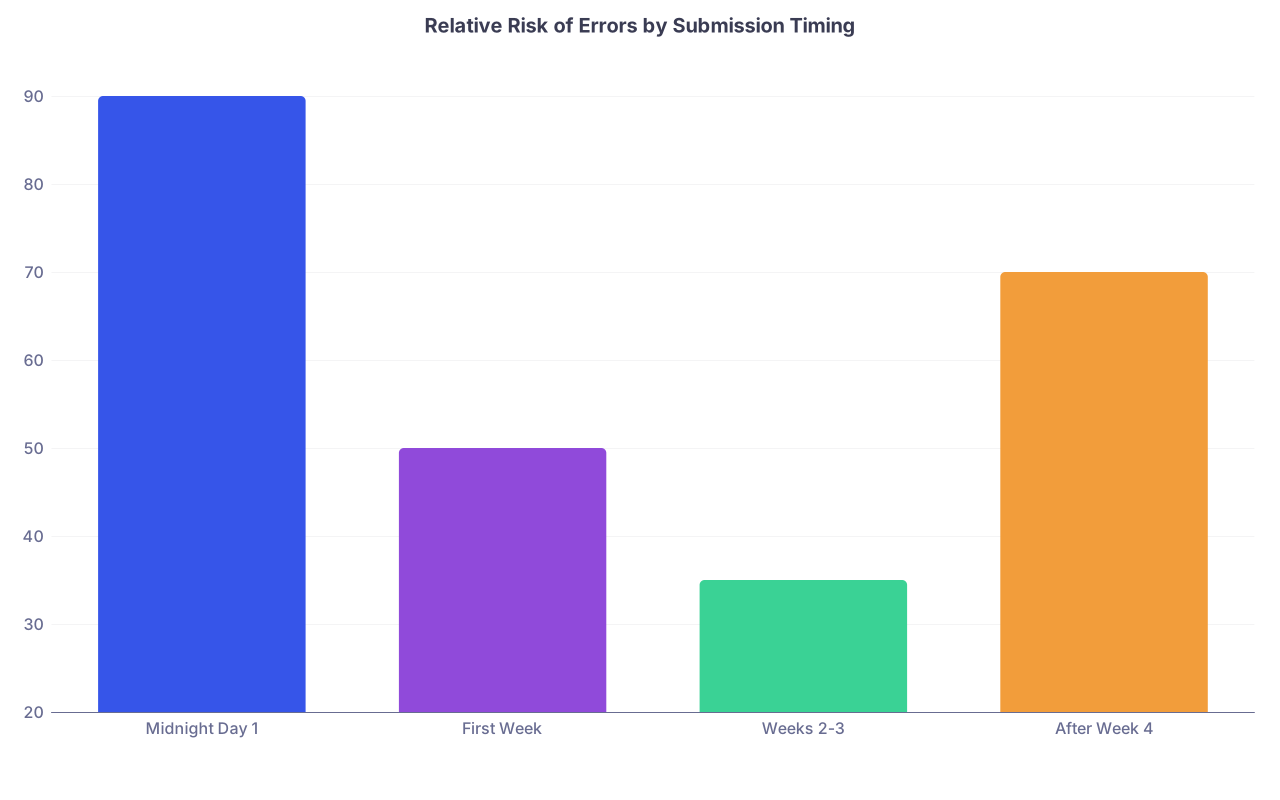
| Category | Value |
|---|---|
| Midnight Day 1 | 90 |
| First Week | 50 |
| Weeks 2-3 | 35 |
| After Week 4 | 70 |
(Think of the values as a rough “error risk index” I have seen play out: frantic first‑night and truly late applications are where the worst mistakes cluster.)
The Real Cost of the Midnight Push
You are not just risking minor typos. You are risking interviews. Let me walk through the patterns I have seen repeatedly.
1. Attaching the Wrong Personal Statement
This one is brutal.
You are dual applying IM + Neuro. It is 11:58 PM. You are convinced you need to submit now or die. You:
- Upload “Internal Medicine PS”
- Upload “Neurology PS”
- Click through program assignments in a rush
At 12:03 AM, your dream neurology program receives:
“I have always been drawn to the breadth of INTERNAL MEDICINE…”
Or your internal medicine prelim program gets a lengthy ode to cortical circuitry and movement disorders.
You just burned that program. They may be polite about it, but you are done.
Common variants:
- Peds PS sent to Med-Peds programs with zero mention of Med-Peds
- Generic “surgery” PS to neurosurgery / ortho without specialty‑specific content
- “Dear Program Director at [Program]” left in and sent to 80 different programs
This happens constantly when people are racing the clock.
2. Mismatched Experiences and Broken Narrative
The midnight ERAS applicant often:
- Shoves in extra experiences without rewiring the story
- Leaves research projects unlabeled or inconsistently titled
- Has dates that do not match CV/Dean’s letter or look suspicious:
- “Research assistant 2018–2024” when you were in full‑time classes and 3 other jobs
- Overlapping roles that scream either superhuman or dishonest
Screening faculty may not articulate it, but they feel it: something is off. And “off” is enough to move you from “interview” to “no.”
3. Typos and Sloppy Writing That Signal Disinterest
I have seen:
- “I am excited to apply to your neuroloy program.”
- “I look forward to training in interbal medicine.”
- Program name spelled wrong. City spelled wrong. PD name wrong.
You think, “They will understand, I was rushed, everyone is rushed.”
They will not. They will assume:
- Careless
- Generic mass-application
- Not truly interested in their specific program
You might be a fantastic applicant. They will not take that risk.
Timing Reality: When Does Submitting Actually Matter?
Let us ground this in something more concrete.
| Submission Window | Competitiveness Impact | Typical Risk Pattern |
|---|---|---|
| Opening Day (AM–Day 2) | Optimal | High rush / error risk |
| Rest of Week 1 | Still excellent | Moderate, fixable errors |
| Weeks 2–3 | Acceptable but worse | Fewer interview spots left |
| After Week 4 | Clearly disadvantaged | Many invites already released |
The real “best time” is:
- Within the first 3–7 days after ERAS opens to programs
- With a polished, proofread, internally consistent application
- With correct, carefully assigned personal statements and program lists
Submitting at 9:00 AM on the first available minute gives you almost no advantage over submitting on Day 3.
Submitting at 11:59 PM Day 0 with major errors gives you severe disadvantage over submitting Day 4, correct and clean.
If you remember nothing else: content quality within the early window beats timestamp by a mile.
The Hidden Psychological Trap: Fear‑Driven Timing
The midnight submission trap is not about logistics. It is about fear.
Here is the psychology:
- You hear: “Submit early or you are dead.”
- You procrastinate because the stakes feel huge.
- Anxiety spikes as the date approaches.
- Instead of doing calm, methodical work 2–4 weeks before, you:
- Keep tweaking your personal statement
- Avoid asking people to proofread because it might bring criticism
- Put off finalizing your program list
- Then you “solve” all that anxiety with a sudden burst of activity the night before:
- Rush writing your experiences
- Randomly rank experiences as “most meaningful”
- Half‑proofread on your phone while toggling between tabs
This feels like productivity. It is not. It is panic disguised as effort.
You are essentially trading:
- Weeks of thoughtful edits and review
for - Hours of frantic, last‑minute clicking
And then calling the outcome “good enough because at least it is early.”
It is not good enough.
Concrete Ways Rushing ERAS Costs You Interviews
Let us spell it out, specialty by specialty.
Internal Medicine / Family Med / Peds
“Less competitive” does not mean sloppy is forgiven.
What rushing costs you here:
- Program fit: You do not tailor anything. You end up with:
- Generic, copy‑pasted interests
- No mention of community vs academic preferences
- No explanation for low Step or a leave of absence
- Geographic story: You forget to articulate why you are applying widely in the Midwest when all your life is East Coast. PDs assume you will not rank them highly.
Competitive Specialties (Derm, Ortho, ENT, Urology, Neurosurg)
These are unforgiving.
What rushing costs you here:
- Fine‑tuned research framing: You underplay strong projects by:
- Poorly worded responsibilities
- Leaving out mentor names that carry weight
- Not specifying your actual contributions
- Small‑error disqualification: In hyper-competitive pools, typos and mismatches are easy reasons to thin the pile.
You may think, “If I am not day‑1 early, I lose these anyway.”
Wrong. Many of these programs review over weeks. A Day 3 or Day 5 error‑free application wins over a Day 1 mess.
Transitional Year / Prelim Positions
These get flooded. The midnight trap hits hard here.
Programs skim quickly. Sloppy apps get tossed first because they have hundreds of nearly identical files.
What You Should Do Instead: A Safer ERAS Timeline
Here is the part nobody likes because it requires discipline before things feel urgent.
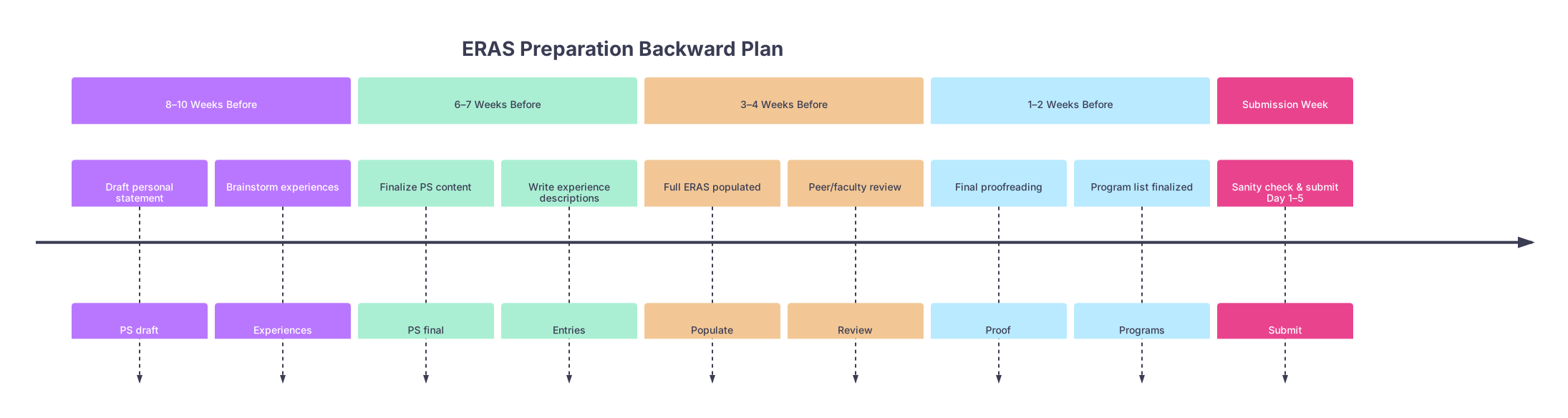
| Period | Event |
|---|---|
| 8–10 Weeks Before - Draft personal statement | PS draft |
| 8–10 Weeks Before - Brainstorm experiences | Experiences |
| 6–7 Weeks Before - Finalize PS content | PS final |
| 6–7 Weeks Before - Write experience descriptions | Entries |
| 3–4 Weeks Before - Full ERAS populated | Populate |
| 3–4 Weeks Before - Peer/faculty review | Review |
| 1–2 Weeks Before - Final proofreading | Proof |
| 1–2 Weeks Before - Program list finalized | Programs |
| Submission Week - Sanity check & submit Day 1–5 | Submit |
Key principle: ERAS is done before opening day. Submission day should be boring.
Break it down.
1. Finish 90–95% of ERAS at Least 1–2 Weeks Before
By that point:
- Personal statement(s) fully written and edited
- Experiences entered, trimmed, and prioritized
- Red flags addressed in a coherent, non‑defensive way
- Program list drafted and roughly tiered
When ERAS opens for programs, your job is:
- Check everything
- Do a last pass or two
- Submit sometime between Day 1 and Day 5
Not: “Write half your personal statement between 10 PM and 1 AM.”
2. Use a Rigid Pre‑Submission Checklist
Do not trust your brain at midnight; use a checklist and go line by line.
Mandatory checks before you hit submit:
- Correct specialty‑specific personal statement assigned to each program
- Name, AAMC number, and med school perfectly consistent with official records
- All dates make sense and do not show impossible overlap
- No “TBD” or placeholder text anywhere
- All research entries:
- Correct authorship status
- Same titles as on your CV and any submitted publications
- LOR assignments correct:
- No letter intended for Program A assigned to Program B only
- SLOEs (if EM) directed where they should be
This is the stuff that gets messed up when you are racing the clock.
3. Schedule a “Mock Submission” Day
One underrated trick:
Pick a day 1 week before ERAS opens and pretend that is the real deadline.
On that mock day:
- Assume you must be ready to click submit by 5 PM
- Address everything that stands in the way
- Whatever is not ready becomes your honest risk list
Then you have a week. To fix actual problems. Calmly.
Tech + Logistics Pitfalls of Midnight Submissions
Rushing also increases the odds that random technical nonsense will ruin your night.
1. Server Lag, Timeouts, and Glitches
When everyone jumps on the system at once:
- Pages load slowly
- You misclick
- You think you saved something and you did not
- The system logs you out while you are editing, and you lose work
If this happens at 8 PM, you can calmly re‑enter and recheck.
If it happens at 11:55 PM and you are panicking about “day 1,” you are more likely to submit without verifying.
2. Recommendation Letters Not Uploaded Yet
Classic scenario:
- You planned on a fourth letter
- Attending promised “I will upload it this weekend”
- It is not there at 11 PM the night before
Instead of making a rational decision (submit with 3; add 4th later if needed), you:
- Start frantically emailing
- Delay everything
- Or worse, you wait days, then wind up submitting late and stressed
Better approach: assume some letters will be late. Build your core application to be submission‑ready with 3 strong letters.
Smart “Early” vs Stupid “Early”
Let me draw a hard line.

Smart Early
You:
- Finish the bulk of content weeks ahead
- Have at least one person (ideally faculty or advisor) read your PS and scan ERAS
- Do a slow, detailed proofread over 2–3 different days
- Submit:
- Morning or afternoon,
- Within the first several days app is available to programs
- In a mental state where you are not tremoring from caffeine and anxiety
Stupid Early
You:
- Spend weeks avoiding real work by “thinking about your story” but not writing
- Underestimate how long ERAS data entry actually takes
- Start filling major sections the day before
- Submit at 11:59 PM “because earlier is always better”
Stupid early feels bold and committed. It is actually lazy planning plus fear.
Red Flags You Are Walking into the Midnight Trap
Watch for these:
- You are still editing the core content of your personal statement within 72 hours of submission day
- You cannot show anyone your full ERAS because “it is not quite ready yet” a week before
- You tell yourself, “I do my best work under pressure”
- You are still adding or removing entire programs at the last minute without clear reasoning
- You do not have a written checklist; your plan is “I will just go through the tabs”
If two or more of these are true, you are on track to be the person emailing me in October asking why you have 2 interviews with decent stats.
Frequently Asked Questions
1. Is submitting a few days after ERAS opens really okay, or will I lose interviews?
Submitting within the first week that ERAS is available to programs is effectively equivalent to day‑1 for the vast majority of specialties and programs. Screening is staggered. Committee meetings occur over days to weeks. A clean, polished application on Day 3 easily beats a sloppy one on Day 0. Where you truly start to see decreased interview odds is typically after Week 3–4, when many programs have already sent a large chunk of their invites.
2. If I notice a mistake after submitting (wrong PS, typo, etc.), should I email programs?
For minor typos, do not email. You will just draw attention to it. Programs expect small imperfections. For a major error—like the wrong personal statement specialty assigned—you can send a short, direct email to the program coordinator explaining that there was a technical error in document assignment and attaching the correct PS. Do not send long emotional apologies. Keep it professional and concise, and accept that some programs will ignore it.
3. How many proofreaders should look at my ERAS before I submit?
At minimum: one person who knows you and one person who understands residency applications (advisor, recent resident, faculty). Too many opinions can paralyze you, but zero outside review is a common and costly mistake. Ask them specifically to look for:
- Inconsistencies and confusing timelines
- Red flag explanations that feel defensive or unclear
- Obvious typos, repetition, or clunky phrasing in your PS and experiences
You are not seeking perfection. You are eliminating avoidable, distracting errors.
4. What if my letters are not all in yet—should I wait to submit?
No. If your core application (PS, experiences, scores, at least 3 solid letters) is ready, submit within the early window and let additional letters arrive later. Programs can see new letters as they come in. Waiting weeks just to add an extra letter usually harms you more than it helps. The real mistake is using a missing letter as an excuse to delay fixing and submitting the parts you control.
Key points to walk away with:
- Being in the early window matters; being the first timestamp does not.
- Rushed, midnight ERAS submissions bleed interviews through preventable errors—wrong PS, sloppy entries, typos that signal you do not care.
- The safest strategy is boring: finish early, proof carefully, submit calmly in the first few days instead of worshiping the 11:59 PM deadline.