
ERAS Almost Ready but Not Perfect: A 48-Hour Timing Game Plan
It is September 3rd, 9:40 p.m. Your ERAS application unlocks for programs in less than 48 hours.
Your personal statement is at “7/10 but understandable.” Your experiences section has three entries that feel generic. A mentor still has not answered your “Can you take a quick look?” email. And now you are hearing the classic anxiety refrain:
“Do I hit submit exactly at 9:00 a.m. on opening day… or wait a day to polish?”
Here is the truth: at this point, you are not deciding between “perfect” and “late.” You are deciding between “good enough, on time” and “slightly better, possibly strategically delayed.”
Let me give you a concrete, hour-by-hour game plan for the next 48 hours. No fluff. No vague “do your best.” A specific timing strategy so you know exactly what to fix, what to ignore, and when to submit.
Step 1: Understand How ERAS Timing Really Works (So You Stop Guessing)
Before you decide whether to submit at 9:00 a.m. on the dot or 24 hours later, you need to know how timing actually hits your application.
The three timing facts that actually matter
Programs do not see apps the second you submit.
They see them when ERAS releases the transmission batch to programs (on the “applications available to programs” date) and then as you’re added to their download queue.Being in the first big “opening batch” helps.
Programs often:- run filters (Step scores, geographic ties, etc.),
- quickly glance at PS/experiences,
- start tagging “interview potential” piles.
If you are in that first wave, you are in the earliest consideration set. That is good.
But being in that wave does not require submitting at 9:00 a.m. versus 11:00 a.m.A 24–48 hour delay can matter for you but rarely kills you.
For competitive programs in Derm, Ortho, Plastics, ENT – earlier is better, but:- 2–3 days late is not an instant death sentence.
- 1–2 weeks late? That is where serious damage begins, especially for competitive specialties.
Here is a simple way to think about it:
| Submission Timing vs Opening | Impact on Most Specialties | Impact on Hyper-Competitive Specialties |
|---|---|---|
| Same day (0–12 hours) | Ideal but flexible | Strongly preferred |
| +1 day | Usually fine | Mild risk, still acceptable |
| +3–5 days | Some risk | Noticeable disadvantage |
| +2+ weeks | Significant disadvantage | Often fatal unless exceptional app |
So the real decision is not “9:00 a.m. vs 9:01 a.m.”
It is: Do I submit on opening day at 90–95% quality, or delay 24–48 hours for real, high-yield improvements?
The rest of this plan assumes:
- You are within 48 hours of the applications being available to programs.
- You want to stay in that “early group” but avoid sending something sloppy.
Step 2: Run a Ruthless 30‑Minute Triage of Your Application
You cannot fix everything. You should not try. You need a triage list.
Set a 30‑minute timer. No editing yet. Just assessment.
A. Check the true “fatal error” zones
These are problems that must be fixed before you submit. If one of these is broken, do not hit submit until it is resolved:
- Wrong NRMP/ERAS ID consistently in documents
- Major factual errors:
- Wrong graduation year
- Missing completed degree
- Incorrect visa/citizenship status
- Personal statement with:
- Another specialty name (“I am excited to apply to Internal Medicine…” in your EM PS)
- The wrong program name or obviously recycled content with another hospital’s name
- Critical red flags in experiences:
- Describing something unprofessional or illegal (it happens more than you think)
- Calling something “research” that was not research at all
- Letters of recommendation:
- Assigning a letter clearly written for another specialty without editing your assign list
- Missing any letters for your main specialty if the program requires at least one in-specialty letter
If any one of these is wrong, you delay submission until fixed. No debate.
B. Identify the “high-yield but fixable in hours” areas
These are where a few focused hours will significantly boost your application:
Personal statement is:
- Rambling (over 1 page single spaced)
- Generic: no concrete patient/story, no sense of you
- Tells, not shows (“I am hardworking, compassionate, and a team player…”)
Experiences section:
- Multiple entries with identical, vague language (“Improved communication skills” everywhere)
- No quantified impact (no numbers, no scope, everything sounds tiny)
- Leadership roles under-described
Program list:
- Too top-heavy (all academic powerhouses with your 220 Step 2)
- Too geographic narrow if you do not have ties
- Missing backup specialties if your primary one is highly competitive and your metrics are average
C. Identify “low-yield perfectionism traps”
These are what you let go of. Today.
- Micro-optimizing which order 2 non-core experiences appear in
- Tweaking one adjective in the PS for the 11th time
- Rewriting every bullet to sound “more elegant”
- Worrying about a 3.0 vs 3.1 word spacing in your PDF preview
Anything that has minimal effect on interview decisions is dead weight right now.
At the end of this 30‑minute triage, write down:
- Fatal fixes (must be done before submitting)
- High-yield edits (worth doing if time allows)
- Trash list (things you will explicitly ignore)
Then you build the 48-hour plan around that.
Step 3: A 48‑Hour Game Plan – Hour by Hour
Let us assume this:
- You are 48 hours from “applications released to programs.”
- You want to submit by that release, but your app is at 80–90%.
Here is the playbook.
Hour 0–2: Lock your strategy, not your wording
Goal: Decide when you will submit and what you will accept as “finished.”
Decide your hard deadline:
- If you are applying to:
- EM/IM/FM/Peds/Neuro/Path/PM&R:
You can afford to aim for “submit by the end of opening day” not necessarily the exact first hour. - Derm, Ortho, Urology, Plastics, ENT, Ophtho, NSGY:
Aim to submit no later than mid‑day opening day unless your application has a true fatal issue.
- EM/IM/FM/Peds/Neuro/Path/PM&R:
- If you are applying to:
Commit on paper:
- “I will submit by: [DATE, TIME] unless I uncover a fatal error.”
- This is your anchor. Keeps you from endless tinkering.
Decide your non-negotiables:
- One solid personal statement (even if not genius).
- Experiences free of obvious typos and with at least 5–6 strong, specific descriptions.
- Reasonable program list: broad enough for your stats, with some reach, some target, some safety.
That is your frame. Now tactics.
Hour 2–10: Fix the highest-impact written content
Two main documents decide first impressions: your PS and your Experiences descriptions.
A. Tighten your personal statement in 3 focused passes
Set 90–120 minutes. No more. You are not writing a novel.
Pass 1 – Structure (20–30 min)
Check if you have at least this:
- 1 clear opening story or moment. Not “I like internal medicine,” but an actual scene.
- 1–2 paragraphs explaining:
- Why this specialty (concrete reasons).
- How your past fits (experiences, traits, skills).
- 1 paragraph on what you want in training (teaching, patient population, setting).
- 1 closing paragraph that:
- Sounds human.
- Comes back to a theme from your opening if possible.
If your PS is missing any of these, fix the structure first before polishing sentences.
Pass 2 – Cut fluff and clichés (30–40 min)
Delete or rewrite things like:
- “I have always wanted to be a doctor.”
- “Medicine is the perfect blend of science and art.”
- “I am hardworking, compassionate, and a team player.”
Instead, show what you mean:
- A specific story about running a chaotic night shift.
- A moment you made a tough call on a patient.
- A time you took responsibility when something went wrong.
Use concrete details surgeons would respect, not buzzwords a committee has seen 5,000 times.
Pass 3 – Quick polish (20–30 min)
- Correct obvious grammar.
- Remove overly complex sentences that even you would not want to read.
- Make sure your name, specialty, and any program references are correct.
Stop. Walk away. If you keep editing past 2 hours, your marginal gain is basically zero.
B. Upgrade 6–10 key experiences instead of touching all of them
Not every experience needs a masterpiece description. But a handful should stand out.
Target:
- 3–5 most important clinical experiences
- 2–3 leadership/research/teaching roles
For each one, rewrite with this formula:
1–2 sentences: Scope
- What you did.
- Where.
- Who you served.
- How often.
1–2 sentences: Action and impact
- What changed because you were there?
- Numbers: how many patients, how many students, how many projects.
1 sentence: Skill or trait tied to residency
- Communication with difficult patients.
- Managing uncertainty.
- Running a team.
- Handling high volume.
Example before (what I actually see often):
“Worked in the ICU where I cared for critically ill patients. Learned the importance of teamwork and communication. Improved my ability to manage complex patients.”
After (what you should write):
“Completed a 4‑week MICU sub‑internship at a tertiary center, managing 4–6 patients daily with sepsis, respiratory failure, and multi‑organ dysfunction. Wrote daily notes, presented on rounds, and independently followed up on overnight changes. Learned to prioritize tasks in a high-acuity setting and communicate succinctly with nurses, respiratory therapists, and consultants during codes and rapid responses.”
You do not need to fix every one of your 10+ entries. Focus on the ones a PD will actually read: most recent, most substantial, most relevant.
Hour 10–16: Clean your program strategy and letters
At this point, your written content is “good enough and specific.” Next: make sure you are not torpedoing yourself with a broken program strategy.
A. Reality-check your program list
Your goal is not “perfect list.” Your goal is “non-delusional list.”
Use a quick sanity pass:
- Compare your Step 2 (and 1 if still numeric) and class rank to typical ranges by specialty.
- Look at where your school historically matches with your profile (ask your Dean’s office or advisor).
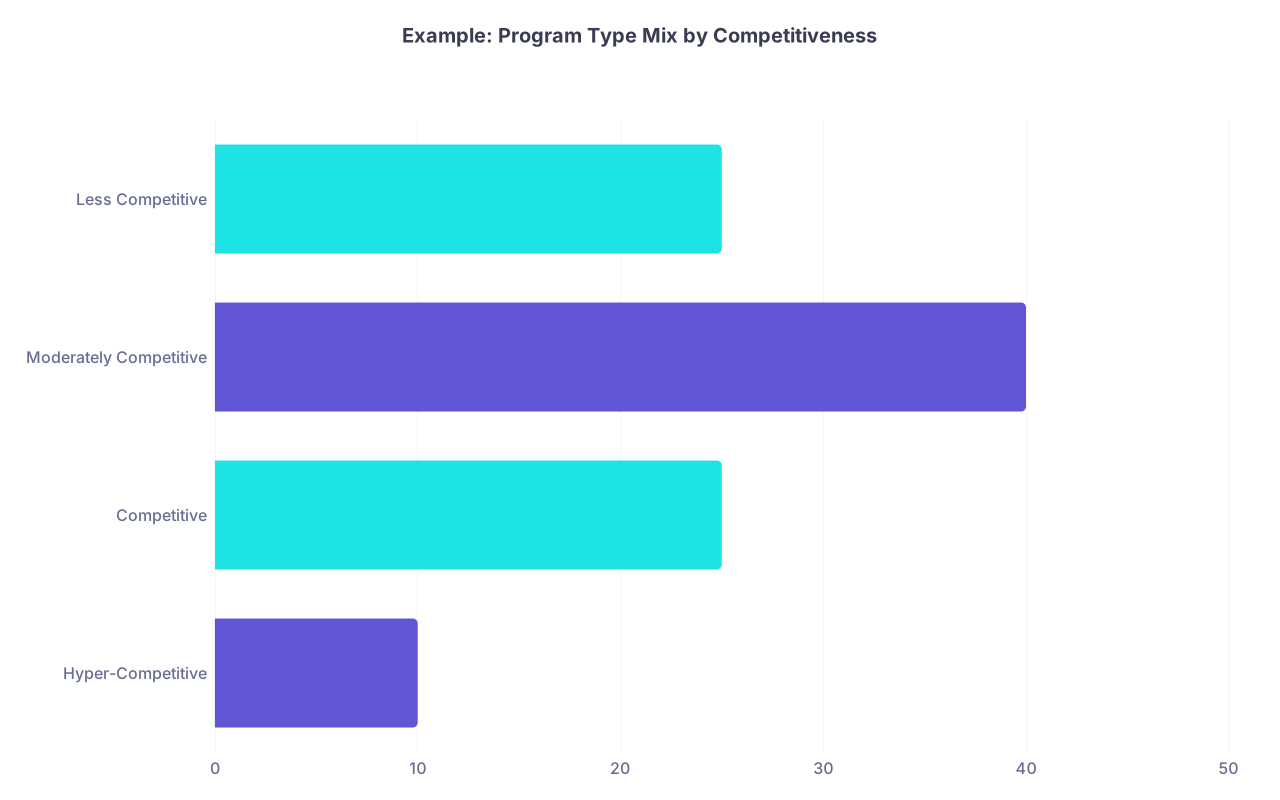
| Category | Value |
|---|---|
| Hyper-Competitive | 10 |
| Competitive | 25 |
| Moderately Competitive | 40 |
| Less Competitive | 25 |
As a rough target mix for most applicants:
- 10–20% reach programs
- 50–60% realistic target programs
- 20–30% safety programs (especially community-based, smaller or non-urban)
If you are:
- Step 2 = 220, no AOA, average MS3 evals, applying IM:
- 30 applications all to MGH, UCSF, Hopkins, Penn is fantasy.
- You need a heavy dose of mid-tier university + strong community programs.
Prune obviously unrealistic programs, add additional realistic ones. This is one of the most high-yield changes you can make in 1–2 hours.
B. Verify your letters are correctly assigned
Common disaster I see every year: mis-assigned letters.
- Double-check:
- Each letter is assigned to the correct specialty.
- You are not using a generic “To the Internal Medicine Program Director” letter for EM.
- You have at least:
- 2–3 in-specialty letters for your primary specialty.
- 1 from a sub‑I or strong core clerkship if possible.
If you are missing a letter entirely:
- Decide if waiting 24–48 hours may secure it:
- If the letter writer has already uploaded to ERAS but you have not assigned it → fix now.
- If the letter writer has not uploaded and you have no backup → do not delay indefinitely. You can still assign letters after you submit. Programs will get the new letter when it is uploaded.
So in the 48-hour window, do not postpone your entire application waiting for a “maybe” letter, unless:
- This is your single core specialty letter.
- The writer is actually reliable and responsive and says, “I will upload tonight.”
Hour 16–24: Technical quality control and error hunt
This is the boring part. It is also where a lot of people blow it.
A. Print or PDF everything and read like a PD
Do not just scroll in the ERAS interface. Download the PDF preview and read it.
You are looking for:
- Inconsistent dates (2021–2020 instead of 2020–2021)
- Gaps that are not explained (6–12+ month gaps should be addressed somewhere)
- Typos in:
- Institution names
- Degree names
- Project titles
- Weird formatting:
- ALL CAPS random sections
- Bullet lists that render as a mess
Fix only what is clearly wrong or confusing. Do not restart paragraphs because you think they might sound nicer.
B. Confirm all required sections are complete
Quick checklist:
- Personal Information
- Education/Training
- Experiences (no placeholder text like “TBD” left behind)
- Publications/Presentations (optional but accurate if present)
- Licensure/Exams/USMLE/COMLEX entries correct
- Personal Statement assigned to each program set
- Letters of Recommendation assigned where possible
- Photo uploaded (professional, neutral background, appropriate attire)

If the photo is your remaining issue and you have any reasonably professional one (decent lighting, plain background, business attire), use it. Do not delay for a marginally better picture.
Hour 24–36: Rest cycle + trusted second look
You are tired. Your judgment is slipping. This is where stupid mistakes sneak in.
A. Take a strategic break
Sleep. Or at least step away for 4–6 hours. Your brain needs distance to see obvious problems.
B. Get 1–2 fast, competent reviewers
Not 5. Not a group chat committee. One or two people who can quickly skim:
- Your personal statement.
- 4–6 key experiences.
- The top of your program list.
Ask them very specific questions:
- “Is there anything confusing or cringe?”
- “Do I sound like the person you actually know?”
- “Any glaring typos or red flags?”
Give them a hard deadline: “I need your thoughts back within 4 hours.”
If they send changes, only accept the ones that clearly improve clarity or remove real problems. Reject pure stylistic preference. This is not time for “Maybe change ‘compelling’ to ‘captivating’.”
Hour 36–44: Make your final edits and lock it down
You now have:
- A structurally sound personal statement.
- 6–10 strong experiences.
- A non-delusional program list.
- Reasonable letter assignments.
- No obvious technical errors.
Now you move from editing to execution.
A. Final 2–3 hour focused editing block
- Implement any high-yield feedback from your reviewers.
- Fix remaining typos they caught.
- Tighten any obviously bloated sentences that stood out to them.
Resist:
- Adding entirely new experiences.
- Rewriting full paragraphs from scratch.
- Rethinking your entire program list.
That is panic, not strategy.
B. System check: ERAS platform itself
Do this before crunch hour when the servers are slammed.
- Make sure:
- You can log into MyERAS without issues.
- Payment method is valid.
- All documents appear under the correct tabs.
- PDF preview generates without errors.
If there is any tech issue, contact ERAS support now, not 5 minutes before your deadline.
Hour 44–48: Submit strategically — not emotionally
You are in the home stretch. This is where people freeze or overthink.
A. When exactly should you submit?
If you are:
Applying to moderately competitive or less competitive specialties (IM, FM, Peds, Psych, Neuro, Path, etc.)
- Submitting anytime on the day applications are first released to programs is fine.
- Even up to 24 hours after that first morning is usually safe.
Applying to competitive specialties (EM, Anes, Gen Surg, etc.)
- Aim for within the first half of that first release day.
Applying to hyper-competitive specialties (Derm, Ortho, Plastics, ENT, NSGY, Uro, etc.)
- Strong preference: in the first wave (within the first few hours of that release).
- But: I would still choose a 6–12 hour delay if you discovered a truly fatal issue.
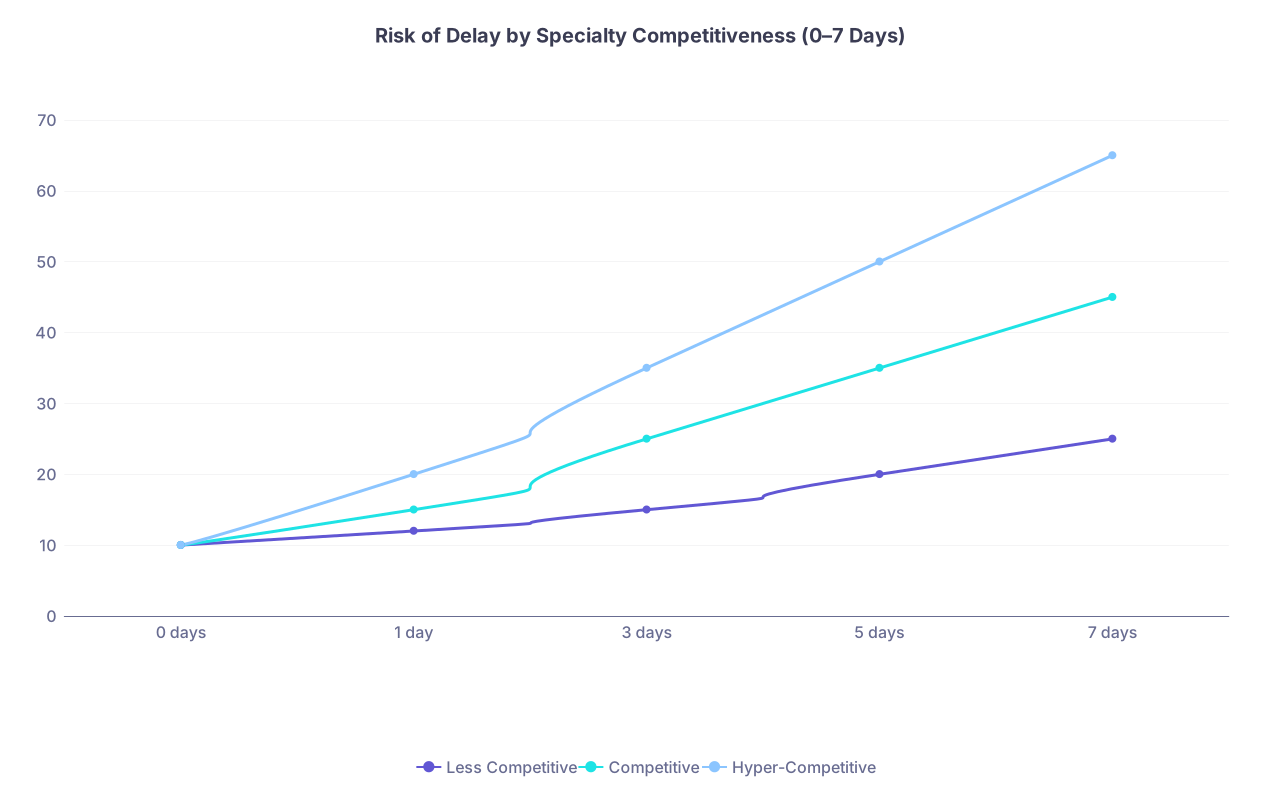
| Category | Less Competitive | Competitive | Hyper-Competitive |
|---|---|---|---|
| 0 days | 10 | 10 | 10 |
| 1 day | 12 | 15 | 20 |
| 3 days | 15 | 25 | 35 |
| 5 days | 20 | 35 | 50 |
| 7 days | 25 | 45 | 65 |
(The values here are “relative risk” of disadvantage, not exact percentages, but the pattern is real: the more competitive the specialty, the less delay you can afford.)
B. Pre-submit checklist (the 5‑minute sanity pass)
Right before you click submit, confirm:
- Correct specialty named in PS (if specialty-specific).
- No other program names accidentally left in PS.
- Program list looks roughly like your final target (no obvious missing region/program type).
- Payment total makes sense (you are not accidentally applying to 200 programs).
- You accept that this is “good enough to send,” not “perfect.”
Then submit. Stop re-opening the PDF. You are done.
What If You Are Already Past the Ideal Window?
Some of you are not in the 48-hour window. You are 3–10 days late already. Anxiety is now mixed with guilt.
Here is how to think about it.
If you are within 3–7 days of opening
- Still absolutely worth submitting.
- You are slightly disadvantaged at highly selective programs that fill interview slots early, but:
- Many community and mid-tier programs review applications over weeks, not hours.
- A strong application can still earn plenty of interviews.
Your priority now:
- Quality > shaving off 12 more hours.
- But speed still matters — do not “perfect” this for another week.
If you are 2+ weeks late
You are playing from behind, but the answer is not “give up.”
Your focus:
- Lean harder on:
- Geographic ties.
- Programs with historically broader interview windows.
- Apply to a wider program list to compensate.
- Make sure your application is especially strong where you can control it:
- PS
- Experiences
- Letters
And accept reality: You may need a parallel plan (prelim year, SOAP, reapplication strategy). That is not failure. That is you being strategic.
A Quick Visual: 48‑Hour ERAS Rescue Timeline
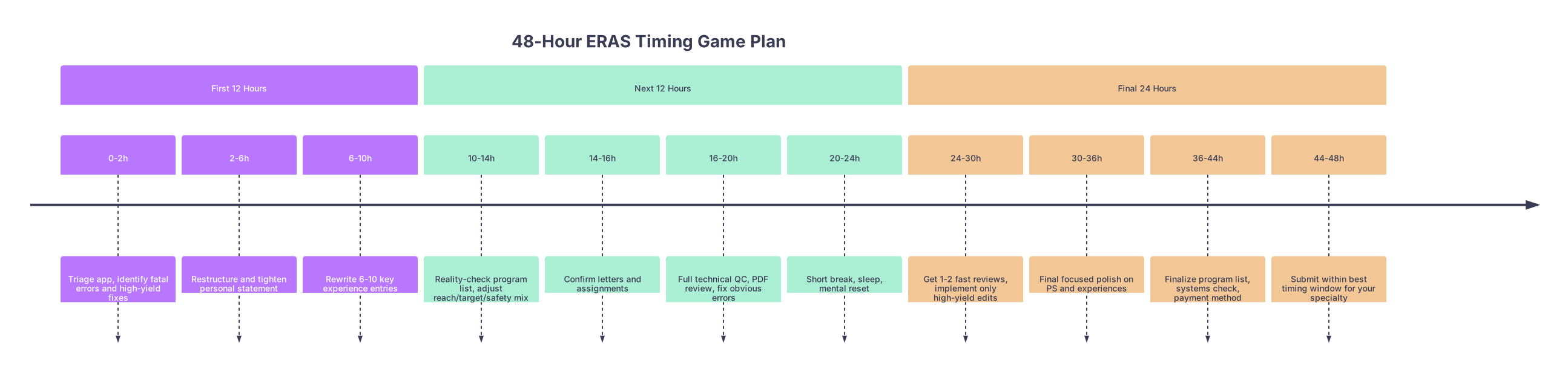
| Period | Event |
|---|---|
| First 12 Hours - 0-2h | Triage app, identify fatal errors and high-yield fixes |
| First 12 Hours - 2-6h | Restructure and tighten personal statement |
| First 12 Hours - 6-10h | Rewrite 6-10 key experience entries |
| Next 12 Hours - 10-14h | Reality-check program list, adjust reach/target/safety mix |
| Next 12 Hours - 14-16h | Confirm letters and assignments |
| Next 12 Hours - 16-20h | Full technical QC, PDF review, fix obvious errors |
| Next 12 Hours - 20-24h | Short break, sleep, mental reset |
| Final 24 Hours - 24-30h | Get 1-2 fast reviews, implement only high-yield edits |
| Final 24 Hours - 30-36h | Final focused polish on PS and experiences |
| Final 24 Hours - 36-44h | Finalize program list, systems check, payment method |
| Final 24 Hours - 44-48h | Submit within best timing window for your specialty |
The Bottom Line: Your 48‑Hour Rules
You are not aiming for perfect. You are aiming for sharp, error-free, and early enough.
Keep these three rules in your head:
Fix fatal errors first, then high-yield content, and ignore everything else.
Structural PS issues, terrible experience descriptions, and broken program lists matter. Micro-wordsmithing does not.Being in the early group is better than being perfect and late.
For most specialties, submitting same day or within 24 hours of opening is functionally “on time.” Hyper-competitive fields need you closer to that first-wave batch, but another 6–12 hours for real fixes can still be worth it.Decide your deadline, then commit to “good enough and sent.”
Write down your submission time, fix only what moves the needle, and then press submit. Obsessing in the last hour is how people introduce new errors, not genius.
You have 48 hours. That is enough to turn “almost ready but not perfect” into “strong, clean, and on time.” Use it with a plan, not panic.