
It is early September. ERAS just opened for submission in a week or two, your classmates are bragging that “all my letters are in,” and you are staring at your application seeing this:
- 2 letters uploaded
- 2 “Requested”
- 0 idea when those last two will show up
And these are not random letters. They are the big ones. The department chair. The away rotation attending. The people you actually need.
You want to submit ERAS early (because you have read everywhere that early is better), but you also do not want to annoy or alienate the people who control your letters and, frankly, your reputation.
Here is the good news: you can still submit a strong, on-time ERAS application while some letters are late, and you can do it without burning bridges. You just need a clean protocol and a spine.
Let us walk through exactly how.
1. Understand What “On Time” Actually Means for ERAS
First fix: stop thinking of “on time” as one calendar day.
Programs see thousands of applications. They do not sit there on the morning of the first download date and permanently judge anyone whose LOR is not attached at 8:00 a.m.
There are two separate timelines you care about:
- The ERAS submission date – when you click “submit” and pay
- When programs start looking at complete files – when your app + scores + MSPE + LORs are reasonably assembled
These are not the same thing.
The realistic “on time” window
For most specialties:
- Submitting between opening day and ~7–10 days after keeps you in the “early enough” group
- Programs may not seriously sort through applications for another 1–3 weeks after the first download
- Many LORs trickle in during that window and still get read
Is there a benefit to submitting on day one? Slight. But the difference between day one and day five or day seven is marginal compared with the difference between September and October.
So your goal is not “all LORs in by 8 a.m. opening day.”
Your goal is:
- ERAS submitted during that roughly first week window, with
- Enough LORs to not look incomplete or weak
Then let late letters attach as they come.
2. How Many Letters Do You Need To Submit?
You do not need the final, perfect letter set to hit submit.
Most programs:
- Require 3 letters minimum
- Allow 4, sometimes 5 (but 4 is standard to send)
Here is how I advise students:
- Have at least 2 solid, uploaded specialty-specific letters by the time you submit ERAS
- Have 1 more uploaded from any strong clinical supervisor
- Treat the remaining letter(s) as upgrades you plug in later
If you have:
- 3 letters in ERAS (2 in your chosen specialty, 1 solid clinical):
You can safely submit. - 2 letters in ERAS and 2 promised but not yet uploaded:
You are on the bubble. You can still submit, but you need to be strategic by program.
Let’s put this into a simple comparison.
| Situation | Recommendation |
|---|---|
| 2 specialty + 1 strong clinical uploaded | Submit ERAS, assign all 3, add 4th when it arrives |
| 1 specialty + 2 strong clinical uploaded | Submit ERAS, prioritize programs that are more holistic; push late writer more firmly |
| 2 total letters uploaded, 2 promised | Wait a few days if possible; if not, submit and send 2, then add rest ASAP |
| 3+ specialty letters in | Submit yesterday; you are fine |
Key point: programs can receive new letters after you submit. They do not lock your letter list the moment you hit send.
3. The Hard Truth: Different Writers Need Different Pressure
Not all late letter writers are the same.
You treat a department chair differently from a fellow you worked with for 2 weeks. And you should.
Categorize your letter writers
Put each writer in one of these buckets:
- High-power, high-importance
- Chair, program director, big-name attending in your field
- Moderate importance, good clinical supervisor
- Core rotation attendings, away rotation preceptors, subspecialty people
- Low-power, supplemental
- Fellow, research mentor with minimal clinical pull, non-core clinical
You push harder and earlier on bucket 2 and 3. You are more careful with bucket 1.
4. Timeline: What To Do Week by Week When Letters Are Late
Let us say ERAS submissions open on September X.
You are here: 1–3 weeks before ERAS submission opens
You requested letters months ago. Some people have not submitted.
Step 1: One month out – formal, polite reminder
Send this 4 weeks before you plan to submit.
Subject line example:ERAS LOR – Thank you again & timelines
Body:
Dear Dr. [Name],
Thank you again for agreeing to write a letter of recommendation for my residency application in [Specialty]. ERAS is now open for letter submission, and I plan to submit my application around [date – usually within the first week after opening].
I have assigned your letter in ERAS, so you should have received an email with upload instructions. Please let me know if you did not receive it, and I’ll re-send the request immediately.
I am very grateful for your support.
Best regards,
[Your Name]
[AAMC ID]
That is respectful, clear, and it gives them a target date.
Step 2: Two weeks out – status check with a slightly firmer tone
If no upload after 2 weeks, follow up.
Subject:Quick check-in: ERAS letter of recommendation
Body:
Dear Dr. [Name],
I hope you are doing well. I wanted to briefly follow up regarding my ERAS letter of recommendation for [Specialty]. I am planning to submit my application on [date], and I am finalizing my documents now.
If there is any additional information that would be helpful (updated CV, personal statement, etc.), I would be happy to send that along.
Thank you again for supporting my application.
Best,
[Your Name]
Still polite, but you have introduced a real date and a mild sense of urgency.
Step 3: One week out – direct, time-bound nudge
Now you are about a week from your planned submission date. No letter yet.
You send this.
Subject:Time-sensitive: ERAS letter for [Your Name]
Dear Dr. [Name],
I hope your week is going well. I wanted to touch base once more regarding my ERAS letter of recommendation for [Specialty].
I am planning to submit my ERAS application on [exact date], and it would be extremely helpful to have your letter uploaded by then or as close to that date as possible.
Please let me know if there are any concerns or if I can provide anything to make this easier (bullet points, updated CV, or draft personal statement).
I truly appreciate your time and support.
Sincerely,
[Your Name]
You are very direct now: date, ask, and offer help.
Step 4: 2–3 days before submission – decision point
Still nothing.
Now you decide, writer by writer:
- Is this letter critical and replaceable?
- Example: core IM attending who is responsive but slow → you push
- Is this letter critical and not replaceable (like a chair letter)?
- You stay polite and patient, but you still follow up
- Is this letter nice-to-have but not essential?
- You mentally move on. Submit without it; if it shows up later, great.
At this point, you send a very short reminder:
Dear Dr. [Name],
I am submitting my ERAS application on [date] and wanted to check in one last time about my letter of recommendation.
If you are able to upload the letter this week or soon after, I would be very grateful, as it will be a key part of my application to [Specialty].
Thank you again,
[Your Name]
Then you move to actual strategy: how to submit without blowing up relationships.
5. How To Submit ERAS While Letters Are Still Missing
Here is the tactical part.
A. Submit ERAS with the letters you have
If you have 3 letters (2 in specialty, 1 strong clinical) by your target submission date:
- Submit ERAS
- Assign those 3 letters to your programs
- Add and assign additional letters as they arrive
Programs do not get notified with push alerts for every new letter. They just see that another LOR is available the next time they open your file.
B. Mix “early apps” and “full apps”
If you have only 2 letters but cannot wait much longer, here is a workaround.
You split programs into:
- Group 1: Safeties / less competitive programs / places less likely to be hyper-obsessed with early perfection
- Group 2: Dream / highly competitive programs / reaches
Plan:
- Submit ERAS now
- Assign 2 letters to Group 1 programs so your application is live
- Wait a few more days for missing letter(s)
- When they arrive, assign 3–4 letters to Group 2 programs
You will survive having a couple of programs see 2 letters at first. They may not even look at your file for another week. By then, you can have updated it to 3+.
Better to be early with slightly incomplete letters at some mid-tier places than late everywhere.
C. Remember you can customize letters per program
You do not need to send the same 4 letters to every single program.
Example:
- Your chair letter is late
- You have 3 strong clinical letters already in ERAS
You can:
- Submit ERAS
- Assign 3 strong letters initially
- When the chair letter arrives, replace a weaker letter for high-priority programs only
Programs will see the final assigned set when they seriously review your file.
6. How To Push Without Burning Bridges
This is what you are actually worried about: annoying the person who will later show up at an interview dinner and casually mention, “Oh yes, I wrote their letter.”
Here is what ruins bridges:
- Panicked, guilt-tripping messages (“I really need this or I will not match”)
- Multiple emails within a few days
- CC’ing other people (like the coordinator or PD) in a passive-aggressive way
- Calling their office repeatedly or dropping by unannounced when they are clearly busy
Here is what does not ruin bridges:
- 3–4 spaced, respectful reminders over a month
- Offering helpful materials: CV, bullets, sample summary of your work together
- Being honest about your timeline and stress without dumping it all on them
- Taking responsibility if you requested late in the season
If someone is offended by 3 politely spaced reminders over several weeks, that is a them problem, not a you problem.
What to say if you are actually worried they will not deliver
If you have a gut feeling they may bail or never write it, you need a backup without insulting them.
Email example:
Dear Dr. [Name],
I know this is a very busy time of year, and I appreciate your willingness to support my residency application. Because ERAS timelines are tight, I am also confirming another letter as a backup in case timing becomes difficult.
If you are still able to submit a letter in the coming weeks, I would be truly grateful and will gladly include it in my application set.
Thank you again for your time and mentorship,
[Your Name]
You have:
- Given yourself permission to move on
- Not accused them of anything
- Left the door open if they eventually come through
That is how you protect your match and your relationship simultaneously.
7. Contingency Planning: When a Key Letter Will Clearly Be Late
Sometimes you just know: the letter will not be there by your ideal date. The attending is on vacation, or the chair is at a national conference, or they literally tell you, “I will get to it in a few weeks.”
Now what?
A. Rank your letters by impact
Think like a PD for 30 seconds.
If you had:
- A strong subspecialty attending letter on time
- A generic but timely letter from an internist
- A potentially excellent but late chair letter
Which hurts more to be missing at the moment of first review?
Short answer: missing strong, detailed clinical letters hurts more than missing a chair letter that can be added later. I have seen chair letters attached weeks after submission and still carry weight.
So prioritize:
- Detailed letters from people who actually saw you work
- Then title / prestige letters
B. Use temporary letter sets
For high-priority programs:
- Initially assign: 3 clinical letters (or 2 clinical + 1 research / mentor who knows you very well)
- Add chair letter later and swap out your weakest one for those programs
Remember: they will not punish you for “changing your mind” on which letters to show.
C. Communicate reality if you must
If your school or a department requires a chair letter and it is institutionally delayed (classic in some specialties), you can sometimes:
- Ask your dean’s office or advisor whether programs in your specialty expect late chair letters
- They often do. Some chairs are habitually late and programs know this.
If you are ever directly asked in an interview why a letter arrived late, the explanation is simple and non-dramatic:
“Our department chair standardly writes letters later in the season. I had several strong clinical letters already in ERAS when I submitted, and the chair letter was added when it became available.”
No story. No excuses. Just matter-of-fact.
8. Visualizing the Process: LOR + ERAS Timeline
Here is how the movement usually happens in practice.
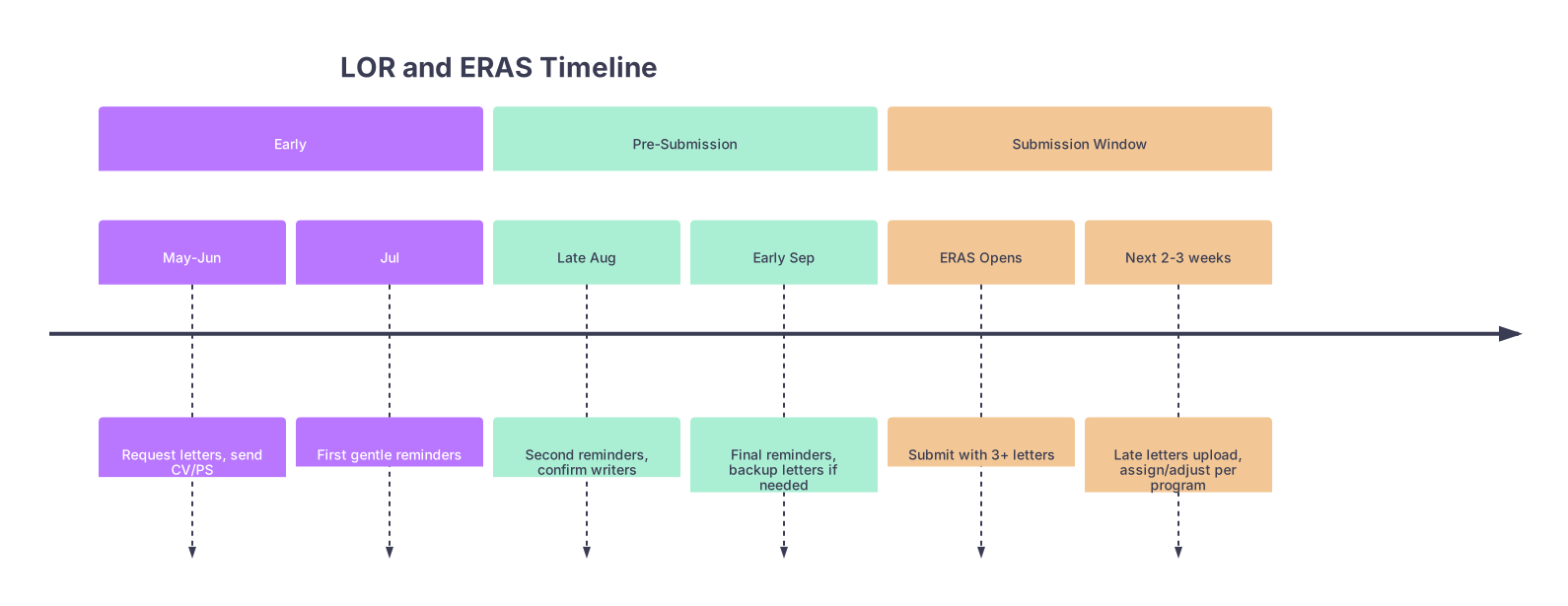
| Period | Event |
|---|---|
| Early - May-Jun | Request letters, send CV/PS |
| Early - Jul | First gentle reminders |
| Pre-Submission - Late Aug | Second reminders, confirm writers |
| Pre-Submission - Early Sep | Final reminders, backup letters if needed |
| Submission Window - ERAS Opens | Submit with 3+ letters |
| Submission Window - Next 2-3 weeks | Late letters upload, assign/adjust per program |
You are not behind just because one letter is lagging into that “next 2–3 weeks” block.
9. When To Escalate: Using Coordinators and Advisors
Most of you under-use the tools you have.
You do not have to suffer in silence waiting for a chronically late attending.
Who can help?
- Clerkship or department coordinators – They often know the attending’s patterns and can gently nudge from the inside.
- Student affairs / dean’s office – They have seen this hundreds of times and sometimes will intervene if it is a systemic issue.
- Your specialty advisor – They can help you decide if a missing letter is actually worth the stress.
How to ask for help without drama:
Hi [Coordinator/Advisor],
Dr. [Name] kindly agreed to write a residency letter for me, but it has not appeared in ERAS yet. I have sent a few reminders over the past month.
Since we are close to my planned submission date, I wanted to ask if you had any advice on how to proceed, or if a brief reminder from the department might be appropriate.
Thank you,
[Your Name]
You are not bad-mouthing anyone. You are asking for guidance and maybe a quiet nudge.
10. Data Reality Check: Programs See Late Letters All The Time
You are not the first person with a late LOR.
Look at how application completeness affects review timing conceptually:
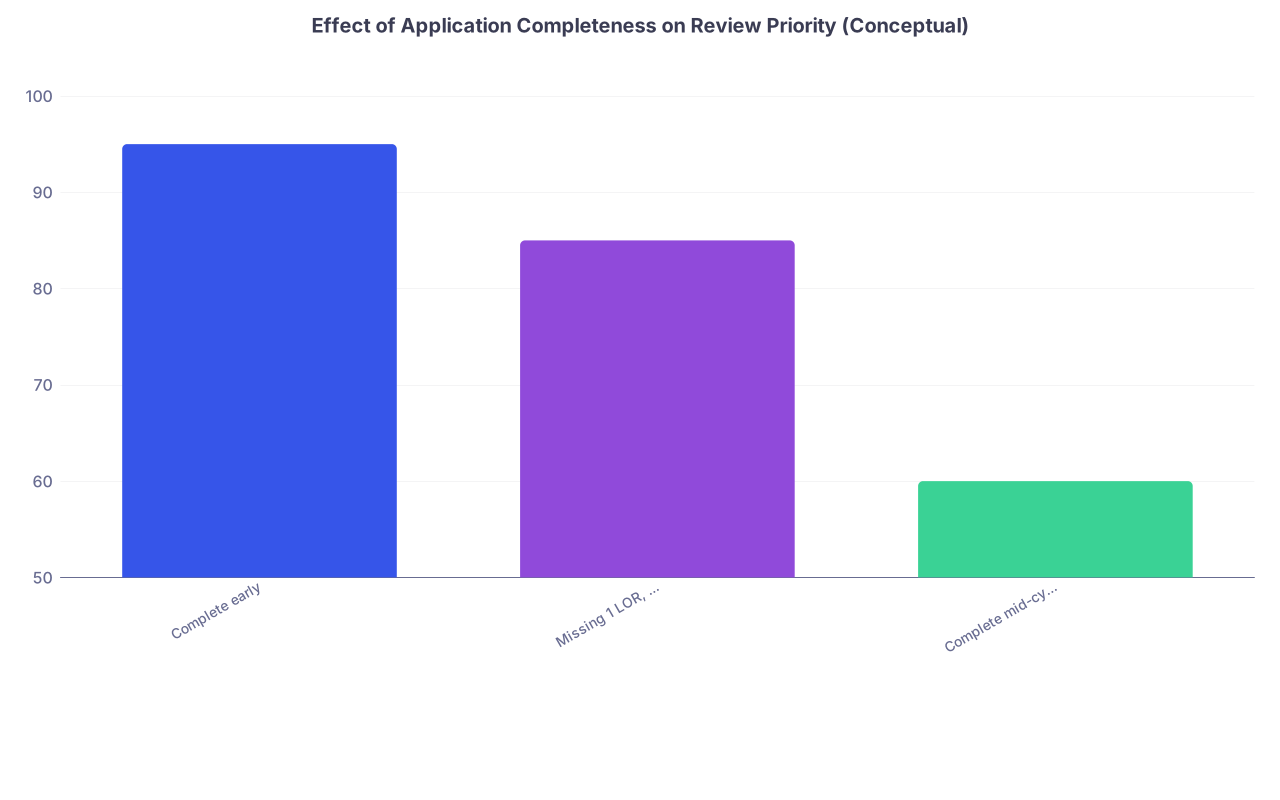
| Category | Value |
|---|---|
| Complete early | 95 |
| Missing 1 LOR, added later | 85 |
| Complete mid-cycle | 60 |
This is conceptual, not a precise percentage. But the pattern holds:
- Fully complete applications early get top priority
- Applications that are “almost complete” but fix themselves within a couple of weeks still do reasonably well
- Truly late or incomplete applications (October, missing core pieces) drop off fast
Your goal is to live in that first or second group. You can absolutely be there even if one LOR arrives fashionably late.
11. Script Bank: What To Say in Tricky Situations
1. Writer verbally agreed, then goes silent for weeks
Dear Dr. [Name],
I hope you are doing well. I wanted to follow up regarding the ERAS letter of recommendation you had kindly agreed to write on my behalf. I know your schedule is extremely busy, and I want to be respectful of your time.
If timing has become difficult this season, please let me know. I completely understand and can arrange an alternative letter, though I would of course be very grateful if you are still able to submit one.
Thank you again for your support,
[Your Name]
This gives them an easy out. Some people are too polite to say “no” up front and then just disappear.
2. Writer asks you to draft the letter
Common and not a problem.
Your move:
- Say yes
- Write a factual, humble, specific draft that makes you look competent but not superhuman
- Emphasize direct observations they actually made (“on inpatient cardiology I worked with Dr. X for 4 weeks…”)
- Let them edit as they wish
It is not unethical. It is normal.
3. You already submitted ERAS and THEN realize a letter is missing from assignments
You forgot to assign a letter to a few programs. Or mis-clicked.
Fix:
- Log in to ERAS
- Go to “Documents” → “Letters of Recommendation”
- Assign the correct letters to those programs
Programs will see the final configuration when they look. No need to email them apologizing.
FAQ (Exactly 3 Questions)
1. Is it better to wait to submit ERAS until all my letters are in, or submit with 2–3 and add the rest later?
Submit during the early window with 2–3 strong letters rather than delaying weeks to be “perfect.” A complete, early-enough application with slightly delayed additional letters is much better than a fully complete but late application. Aim for at least 2 specialty-specific and 1 good clinical letter by submission, then treat later letters as upgrades.
2. Will programs hold my application until every single assigned letter is uploaded?
Many programs start scanning applications when they have the main components: ERAS, personal statement, transcript, Step scores, and several letters. A single missing letter does not always stop initial review, especially if other strong letters are present. When the missing letter arrives, it attaches automatically and can still be read before interviews are offered.
3. How many reminder emails to a late LOR writer is “too many”?
Three to four total over a month is reasonable: one about 4 weeks before you submit, one 2 weeks out, one 1 week out, and a final brief check 2–3 days before your target date if needed. Space them out, stay respectful, and offer help (CV, bullets, personal statement). That level of follow-up is standard and does not burn bridges.
Key Takeaways
- You can and should submit ERAS in the early window even if 1 letter is late, as long as you have 2–3 strong ones in.
- Use structured, spaced reminders and backup letters so your application is safe without alienating important writers.
- Programs see late LORs constantly; what hurts you is being truly late overall, not having one letter show up a week or two after submission.